


The Market Research Paradox: Are We Hearing Consumers or Ourselves?
Market Research sits at the center of modern business strategy. Product launches, pricing models, and positioning decisions often begin with Market Research insights. Companies rely on Market Research to guide data collection, measure customer satisfaction, and understand consumer behavior. Yet an important question is emerging in boardrooms: does Market Research fully capture consumer needs, or can it sometimes reinforce existing assumptions?
This debate does not undermine the value of Market Research. It highlights structural limits in survey design, data collection, and interpretation frameworks that may occasionally amplify current perspectives.
The solution is evolution. When Market Research integrates AI-driven data collection and behavioral analysis, businesses gain a deeper, more dynamic understanding of customer satisfaction and shifting consumer expectations.
Market Research and the Question of Consumer Truth
How Market Research Became the Foundation of Strategic Decisions
Market Research became central to strategy because it brings structure to decision-making. Through systematic data collection and segmentation analysis, Market Research allows companies to replace guesswork with evidence. Strategic teams rely on Market Research insights to evaluate consumer demand, test product concepts, and forecast customer satisfaction outcomes.
Research highlighted in Harvard Business Review’s analysis on customer insight strategies shows that organizations systematically investing in consumer insight outperform competitors in innovation and growth. Market Research therefore stabilizes decision-making in complex markets, though its impact ultimately depends on the quality of the research framework.

Why Market Research Still Shapes Customer Satisfaction Strategies
Customer satisfaction strategies rarely emerge without Market Research. Businesses collect structured feedback to understand expectations, frustrations, and unmet needs. Surveys, interviews, and behavioral analysis all contribute to this insight pipeline.
Market Research enables organizations to detect patterns across large populations and prioritize improvements. Companies redesign products, services, and experiences based on these insights.
However, interpretation remains critical. As discussed in World Economic Forum research on the future of consumer data, organizations increasingly recognize that consumer insight systems must integrate multiple analytical signals. Market Research continues to guide customer satisfaction strategies but becomes significantly stronger when combined with broader data intelligence.
Market Research Data Collection: Strength or Structural Limitation
The Central Role of Data Collection in Market Research
Every Market Research insight originates from data collection. Surveys, interviews, and focus groups have long formed the backbone of Market Research programs. These methods capture expressed preferences and structured feedback, giving companies a clear snapshot of consumer attitudes.
Yet expressed opinions do not always match actual behavior. Consumers frequently struggle to articulate emerging needs or future expectations. According to MIT Technology Review’s discussion on AI-driven consumer analytics, behavioral data analysis often reveals patterns that traditional surveys fail to capture.
Market Research remains powerful, but its data collection methods must evolve to reflect how consumers actually interact with products and digital environments.
Traditional vs AI-Enhanced Market Research Data Collection
| Research Dimension | Traditional Market Research | AI-Enhanced Market Research |
| Data Collection | Surveys and focus groups | Behavioral analytics and real-time data |
| Consumer Signals | Expressed opinions | Observed actions |
| Insight Generation | Periodic analysis | Continuous analysis |
| Customer Satisfaction Tracking | Post-interaction surveys | Behavioral sentiment detection |
How Survey Design in Market Research Can Shape Outcomes
Survey design plays a powerful role in Market Research outcomes. Question wording, response options, and participant selection all shape how respondents interpret questions and deliver answers.
Three mechanisms commonly influence Market Research results:
- Framing influence – wording guides interpretation
- Selection bias – samples may not represent the full market
- Response limitation – fixed options restrict nuanced opinions
These dynamics do not invalidate Market Research. They highlight the importance of thoughtful research design. Increasingly, organizations complement surveys with behavioral analytics and AI-assisted data collection to strengthen Market Research reliability.
Market Research and Customer Satisfaction: Interpreting the Signals
Why Market Research Focuses on Customer Satisfaction Metrics
Customer satisfaction remains a central metric in Market Research because it correlates directly with loyalty and retention. Businesses monitor satisfaction through surveys, feedback loops, and customer service interactions.
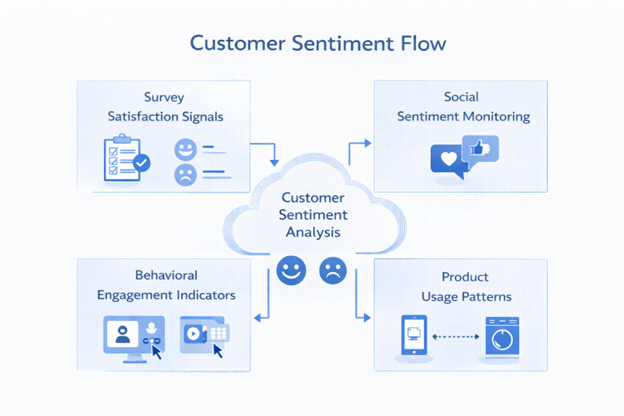
Market Research allows companies to track how consumers perceive product quality and brand reliability. A study discussed in McKinsey’s research on customer experience leaders highlights that companies consistently measuring customer satisfaction outperform competitors in long-term revenue growth.
Customer satisfaction metrics provide essential insight, yet they represent only one layer of consumer understanding. Market Research becomes more powerful when combined with behavioral data and continuous analysis.
The Risk of Over-Interpreting Market Research Feedback Loops
Market Research metrics can sometimes generate strategic feedback loops. When organizations rely heavily on a single satisfaction indicator, innovation may narrow. Surveys capture how customers evaluate existing experiences rather than future possibilities.
Companies may therefore optimize around current expectations rather than explore emerging opportunities. This dynamic does not undermine Market Research but illustrates the limits of isolated data collection systems.
Expanding Market Research with behavioral analytics and AI-driven pattern detection allows companies to identify emerging needs before customers explicitly articulate them.
Market Research Bias: When Data Collection Reflects Assumptions
Sampling Choices in Market Research and Their Strategic Consequences
Sampling choices strongly influence Market Research insights. The participants selected for data collection determine which perspectives shape the conclusions.
Common sampling risks include:
- Overrepresentation of loyal customers
- Limited geographic diversity
- Digital participation bias
- Underrepresentation of emerging segments
Recognizing these structural risks strengthens Market Research design. When organizations diversify sampling methods and integrate multiple data sources, research results better represent the full complexity of consumer behavior.
Market Research Bias as a Structural Risk, Not a Failure
Bias in Market Research should be understood as a structural risk rather than a failure of the discipline. Every research framework includes assumptions about audience selection, survey design, and interpretation models.
Organizations that recognize these dynamics often improve their research systems. According to Deloitte’s research on AI-driven decision intelligence, combining human analysis with machine learning reduces blind spots in market insights.
Market Research evolves when companies diversify analytical inputs and integrate emerging technologies into the research process.
AI Expanding the Scope of Market Research Data Collection
How AI Enhances Market Research Beyond Traditional Surveys
Artificial intelligence expands Market Research capabilities by analyzing behavioral data at scale. Instead of relying solely on expressed opinions, AI-enabled Market Research observes real consumer interactions across digital environments.
AI systems capture signals such as:
- purchase activity
- product usage patterns
- search behavior
- customer journey interactions
- social conversation trends
These insights complement traditional Market Research. Surveys reveal attitudes, while behavioral analytics reveal actions. Together they provide a richer understanding of customer satisfaction and evolving consumer expectations.
Market Research Signals vs AI Behavioral Signals
| Insight Type | Traditional Market Research | AI Behavioral Analysis |
| Consumer Opinion | Surveys and interviews | Sentiment detection |
| Customer Satisfaction | Survey scores | Behavioral engagement |
| Product Interest | Self-reported feedback | Search and browsing behavior |
| Market Trends | Periodic studies | Continuous pattern recognition |
AI-Driven Market Research and Behavioral Data Signals
AI does not replace Market Research. Instead, it expands its observational power. AI-supported Market Research platforms analyze patterns across massive datasets that traditional analysis cannot process efficiently.
These systems integrate structured surveys, behavioral data streams, and predictive analytics simultaneously. According to IBM’s research on AI-powered analytics platforms, organizations combining AI with traditional research methods gain deeper consumer insights and more accurate forecasting capabilities.
The result is a stronger Market Research ecosystem capable of detecting subtle shifts in customer satisfaction and demand.
Market Research and AI: Toward a Hybrid Intelligence Model
Combining Human Insight and AI in Market Research
The most effective Market Research strategies now operate through hybrid intelligence systems. Human researchers and AI algorithms contribute complementary strengths.
Human analysts bring cultural interpretation, contextual understanding, and qualitative insight. AI contributes large-scale data collection, pattern recognition, and continuous behavioral monitoring.
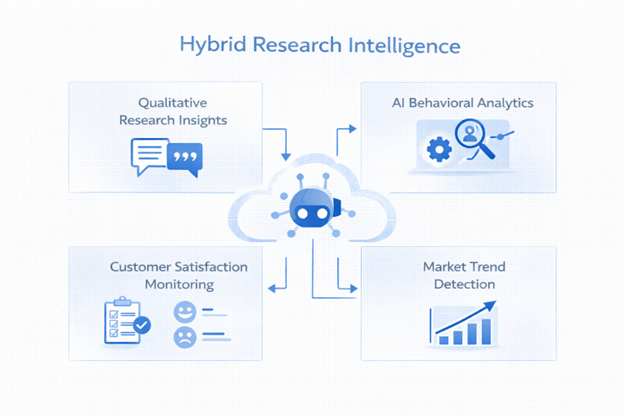
Together they transform Market Research from periodic reporting into a continuous strategic intelligence engine.
Market Research Evolution Through Continuous Data Collection
Continuous data collection changes the rhythm of Market Research. Traditional research programs operate periodically, producing snapshots of consumer sentiment. AI-driven systems generate insights continuously.
This capability enables companies to detect emerging market trends faster and respond more effectively. Product teams receive immediate feedback on new features, while marketing teams identify changes in customer expectations.
Market Research therefore evolves into a dynamic intelligence system that supports real-time strategic adaptation.
Market Research Governance: Protecting Customer Understanding
Ethical Data Collection in Market Research
As Market Research expands through AI-powered analytics, ethical governance becomes increasingly important. Responsible data collection protects consumer trust and strengthens the credibility of research insights.
Effective Market Research governance frameworks include:
- transparent data usage policies
- consent-based data collection
- responsible AI oversight
- cross-functional research review processes
Maintaining these safeguards ensures that Market Research continues to represent consumer perspectives responsibly while supporting reliable customer satisfaction insights.

Designing Market Research Systems That Improve Customer Satisfaction
Future-ready Market Research systems rely on integrated research ecosystems rather than isolated methods. Combining multiple data sources improves the accuracy and reliability of insights while reducing the risk of incomplete interpretations. When Market Research connects surveys, behavioral analytics, and continuous data collection, organizations gain a more comprehensive view of consumer expectations and evolving market dynamics.
Effective Market Research ecosystems integrate:
- qualitative interviews
- structured surveys
- behavioral analytics
- AI predictive models
- continuous satisfaction monitoring
This layered approach reduces the risk that Market Research reflects narrow assumptions and allows organizations to capture a broader view of consumer expectations.
Market Research in the Age of Intelligent Data
Why Market Research Must Evolve With AI Capabilities
Market Research now operates in a digital ecosystem where consumers leave behavioral signals across platforms, devices, and interactions. Traditional research methods alone cannot capture this complexity.
Artificial intelligence expands Market Research capabilities by processing large volumes of behavioral data while preserving structured research frameworks. This combination allows companies to identify patterns that would otherwise remain invisible.
Organizations integrating AI into Market Research programs gain stronger strategic foresight and a deeper understanding of customer satisfaction dynamics.
The Future of Market Research and Consumer Understanding
Market Research remains one of the most powerful strategic tools available to modern organizations. The challenge is not questioning its relevance but ensuring that it evolves alongside consumer behavior and technological capability.
When Market Research relies only on traditional surveys, insights may remain incomplete. When Market Research integrates AI-driven data collection and behavioral analysis, the perspective becomes significantly richer.
The future belongs to hybrid intelligence systems where human researchers interpret context while AI expands analytical scale. Together they transform Market Research into a more accurate reflection of consumer needs and a stronger foundation for customer satisfaction strategy.
Market Research at a Strategic Turning Point
Market Research remains one of the most powerful tools for understanding consumers and guiding strategic decisions. However, the complexity of modern markets requires Market Research to evolve beyond traditional data collection alone. When research frameworks combine structured surveys, behavioral analytics, and AI-driven analysis, insights become more accurate and dynamic. Rather than replacing traditional methods, artificial intelligence strengthens them by revealing patterns that surveys alone may miss. The most effective approach is not choosing between traditional Market Research and technology but integrating both. This hybrid model allows organizations to better understand consumer expectations and build stronger customer satisfaction strategies in an increasingly data-driven economy.
What is H-in-Q?
H-in-Q is an AI solutions agency founded in Tangier in 2018, specializing in data mining, artificial intelligence models, and digitalization solutions across industries.
How did H-in-Q evolve from market research to AI solutions?
We started with AI-powered market research tools like Converse-in-Q and BuzzPulse-in-Q, and today we apply the same intelligence to HR, customer service, e-commerce, Industry 4.0, and more.
What makes H-in-Q unique?
Unlike generic SaaS providers, our DNA is research. We combine methodological rigor with cutting-edge AI to deliver solutions that are both scientifically sound and business-ready.
Do you serve clients outside Morocco?
Yes. While headquartered in Tangier, we work with organizations across Europe, North America, and MENA, bringing global agility with local expertise.
Are your solutions customizable?
Absolutely. Every model—whether a chatbot, analytics dashboard, or BI assistant—is trained and tuned on your specific data and workflows.
What industries does H-in-Q serve?
We cover market research, HR and talent management, customer service, social listening & reputation, e-commerce, and Industry 4.0 digitalization.
References
- Harvard Business Review – Know Your Customers’ “Jobs to Be Done”
- McKinsey – The Three Cs of Customer Satisfaction
- World Economic Forum – How Data Is Transforming Consumer Insight
- MIT Technology Review – AI and the Future of Consumer Analytics
- Deloitte – AI-Driven Decision Intelligence
- IBM – AI and Data Platforms for Business Insights
- Read also : Market Research: Strategy Asset or Costly Waste?