


Your last market research project probably took six to ten weeks, and by the time the report landed on your desk, the consumer behavior it described had already shifted. That is not a process problem. That is a technology problem. AI market research solves it by compressing insight timelines from weeks into hours, and it is doing so at a scale that Harvard Business Review describes as a fundamental disruption of the $140 billion global market research industry.
This guide explains exactly how AI market research works, the technologies behind it, the step-by-step process, and what US businesses need to do to start using it. No jargon, no research-industry insider language. Just a clear breakdown of a capability that is rapidly becoming the standard for competitive intelligence.
What Is AI Market Research? The Definition That Actually Matters
AI market research is the use of machine learning, natural language processing, and predictive analytics to collect, analyze, and interpret consumer and market data at scale; automatically. Instead of waiting weeks for surveys to be coded and reported, AI processes thousands of data points simultaneously and surfaces actionable insights in hours, not months.
Traditional market research follows a slow, linear path: design a survey, recruit respondents, collect responses, clean the data, analyze it manually, then write a report. Each step adds days or weeks to the timeline. AI breaks that sequence entirely. It monitors conversations happening right now on social media, in customer reviews, in support tickets, and in behavioral data, and it identifies the patterns, sentiment shifts, and emerging trends hidden inside all of it.
Three core technologies make this work. Natural language processing (NLP) reads and interprets unstructured text; the kind of language found in a product review or a customer service call. Machine learning finds patterns across large datasets without needing a human analyst to define the categories in advance. Predictive analytics turns those patterns into forecasts about what consumers are likely to do next. Together, they transform raw, messy data into structured business intelligence.
Why AI Market Research Matters for US Businesses in 2026
According to McKinsey’s 2025 State of AI survey, 78% of organizations now use AI in at least one business function, up from 55% just two years earlier. The companies moving fastest are not doing so because AI is trendy. They are doing so because the gap between their insight speed and their competitors’ is becoming a structural business advantage.
The cost of slow research is real and quantifiable. A product team that launches based on six-week-old consumer data is betting on a market snapshot that is already out of date. A marketing team that waits for quarterly brand tracking results cannot respond to a sentiment shift that happened three weeks ago. A competitive intelligence team running manual analyst reports misses the competitor pricing change that happened while the report was being written.
AI market research eliminates that lag. Companies using AI tools for marketing report an average 39% increase in revenue and 37% reduction in costs, according to aggregated industry data. Those numbers are not driven by AI doing something magical, they are driven by faster decisions made with fresher, more complete data. The businesses that have not yet built an AI research capability are not just moving slower. They are making decisions with information their competitors have already moved past.
How AI Market Research Works: A 6-Step Process for Business Leaders
Most explanations of AI market research describe the technology. This one describes what actually happens to your data from the moment it enters the system to the moment it becomes a business decision.
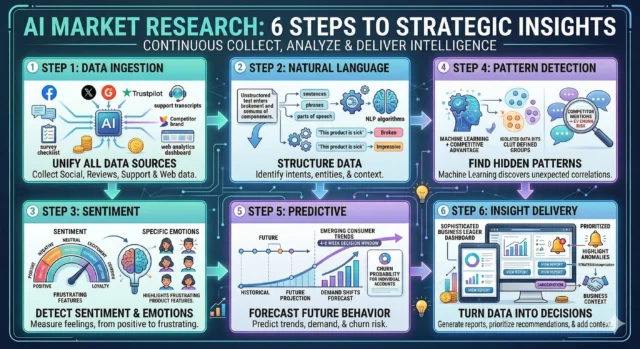
Step 1: Data ingestion – connecting every source at once
AI research systems pull data from multiple channels simultaneously: social media posts, customer reviews on platforms like G2 and Trustpilot, customer support transcripts, open-ended survey responses, competitor content, and behavioral signals from web analytics. A traditional research team would require days just to collect and consolidate these sources. An AI system does it continuously, in the background.
Step 2: Natural language processing – reading the data
Once data is ingested, NLP algorithms read it the way a human analyst would, but orders of magnitude faster. NLP breaks sentences into components, identifies the intent behind phrases, recognizes named entities like brands and products, and understands the difference between “this product is sick” meaning broken and “this product is sick” meaning impressive. This step converts unstructured language into structured, analyzable signals.
Step 3: Sentiment and emotion detection – finding how people feel
Beyond reading what customers say, AI detects the emotional tone behind it. Sentiment analysis classifies text as positive, negative, or neutral, but advanced models go further, identifying specific emotions like frustration, excitement, confusion, or loyalty. A brand can analyze every support interaction from the past year and identify the exact product feature that generates the most customer frustration, without a single human reading each ticket.
Step 4: Pattern detection and clustering – finding what you did not know to look for
This is where machine learning creates genuine competitive advantage. Unlike a human analyst who searches for patterns within predefined categories, machine learning identifies clusters and correlations that no one anticipated. It might surface the fact that customers who mention a specific competitor are 3x more likely to churn within 60 days; a pattern invisible to traditional analysis but immediately actionable for a retention team.
Step 5: Predictive modeling – forecasting what happens next.
AI does not just analyze what has happened. It uses historical patterns to forecast future behavior. AI-powered predictive analytics can identify emerging consumer trends 4 to 6 weeks before they appear in traditional survey data; giving businesses a decision window that did not previously exist. A consumer goods brand can forecast demand shifts before they hit retail sales. A B2B software company can predict churn probability for individual accounts before the renewal conversation.
Step 6: Insight delivery – turning data into decisions.
The final step is the one most often overlooked in technical explanations: turning the AI output into something a business leader can act on. Modern AI research platforms generate automated reports, highlight anomalies that require attention, and surface recommendations ranked by business impact. The researcher’s job shifts from data processing to strategic interpretation, validating AI-generated findings and connecting them to business context that algorithms cannot supply on their own.
AI Market Research Best Practices: What Works, What Wastes Time
Start with one workflow, not the whole stack. The businesses that fail with AI market research are the ones that attempt to automate everything simultaneously. Start with the highest-value, clearest-ROI use case, typically sentiment analysis of existing customer feedback or automated competitive monitoring and validate results before expanding.
Treat data quality as non-negotiable. AI produces insights only as reliable as the data it processes. Fraudulent survey responses, biased sampling, or incomplete data sources produce misleading outputs with high confidence scores. Build data quality controls before scaling any AI research workflow.
Keep humans responsible for strategy, not just validation. AI identifies patterns. Humans interpret what those patterns mean for a specific business in a specific competitive context. The companies extracting the most value from AI market research are the ones where experienced researchers use AI to eliminate analytical grunt work, not the ones where AI has replaced researchers entirely.
Combine real-time monitoring with periodic deep research. AI social listening excels at continuous trend detection. It is less suited for the depth of understanding that structured interviews and qualitative sessions provide. The strongest research programs combine AI-powered real-time monitoring with scheduled human-led qualitative work to understand the “why” behind the patterns AI surfaces.
Measure what changed, not just what you learned. Track the business decisions that AI research directly informed and the outcomes that followed. Organizations with high AI maturity consistently measure ROI on research investments, and that accountability loop is exactly what separates programs that scale from pilots that stall.
Do not confuse speed for accuracy. AI produces insights fast. Fast is only valuable if the insights are correct. Build review checkpoints where experienced analysts validate AI outputs before those outputs influence significant business decisions.
How AI Is Transforming Market Research for US Businesses in 2026
The shift is not incremental. Generative AI is enabling a capability that did not exist two years ago: synthetic personas and digital twins; AI-generated consumer proxies that simulate how real market segments would respond to products, campaigns, or pricing changes. Andreessen Horowitz and Foundation Capital have both published investment theses describing this as a fundamental transformation of how consumer insights will be generated at scale.

For US businesses, the practical implications are immediate. AI-powered conversational research platforms can conduct thousands of adaptive interviews simultaneously; surveys that adjust their questions based on each respondent’s previous answers, producing qualitative depth at quantitative scale. Social listening tools powered by NLP monitor brand mentions, competitor activity, and category conversations in real time, surfacing signals that quarterly brand trackers would catch three months too late.
The businesses that treat AI market research as a capability (not a project) will compound their insight advantage faster than any competitor with superior research budgets but slower research infrastructure. H-in-Q.com’s BuzzPulse-in-Q platform is built on exactly this principle: AI that turns real-time brand and consumer signals into strategic intelligence, continuously, without the manual overhead that traditional research requires.
The technology is mature. The data infrastructure exists. The only variable is whether your organization chooses to build this capability now or watches competitors build their advantage while you wait.
Tools That Power AI Market Research in 2026
The AI market research stack covers five core capability areas that any US business needs to know.
Social listening and sentiment platforms like Buzzpulse, Brandwatch and Sprinklr monitor millions of online conversations, automatically categorizing sentiment and surfacing emerging topics relevant to your brand and category. These tools are the entry point for most organizations because the data they analyze already exists and the ROI on real-time brand monitoring is immediate.
Conversational AI research platforms like Converse-in-Q and Remesh conduct AI-led interviews and focus groups at scale, adapting questions dynamically based on participant responses. These replace or augment traditional focus groups for product testing, concept validation, and customer journey mapping.
Predictive analytics platforms like Pecan apply machine learning to historical business data; churn rates, purchase patterns, and campaign performance to forecast future outcomes. These are most valuable for businesses with substantial historical data and clear predictive questions to answer.
Competitive intelligence tools like Crayon and Kompyte automate the monitoring of competitor websites, pricing pages, product announcements, and advertising activity, alerting teams to relevant changes as they happen.
AI survey platforms like Quantilope and Attest automate survey design, quality control, and response analysis; flagging fraudulent or low-quality responses automatically and generating insight summaries from open-ended responses without manual coding.
👉 View our AI Market Research Solutions
People Also Ask
What is AI market research?
AI market research uses machine learning, natural language processing, and predictive analytics to automatically collect, analyze, and interpret consumer and competitive data at scale. It replaces slow, manual survey analysis with real-time pattern detection across social media, reviews, behavioral data, and customer feedback; delivering insights in hours rather than weeks.
How does AI collect data for market research?
AI systems ingest data from multiple sources simultaneously; social media posts, customer reviews, support transcripts, survey responses, and web behavioral data. NLP algorithms then interpret the language, machine learning identifies patterns across the dataset, and predictive models forecast future behavior based on historical trends.
Can AI replace traditional market research?
AI does not replace traditional market research; it augments it. AI excels at processing large datasets, detecting patterns, and continuous monitoring. Human researchers remain essential for study design, qualitative depth, emotional nuance, and strategic interpretation. The most effective programs combine both: AI handles the scale and speed; humans handle the judgment and strategy.
How accurate is AI market research?
Accuracy depends on data quality, model calibration, and appropriate use case selection. AI sentiment analysis typically achieves 85–90% accuracy on clear, unambiguous text. Accuracy drops on irony, cultural subtext, and niche industry language. Results should always be validated by experienced researchers before driving significant business decisions.
What technologies power AI market research?
Three core technologies drive AI market research. Natural language processing reads and interprets unstructured text; reviews, comments, survey responses. Machine learning detects patterns across large datasets without predefined categories. Predictive analytics uses historical patterns to forecast future consumer behavior. These three work in combination on every modern AI research platform.
How much does AI market research cost?
AI market research tools range from free tiers for basic social monitoring to enterprise platforms priced at $10,000 or more per month for full-scale competitive intelligence and predictive analytics. For most US businesses, the more relevant question is cost relative to traditional research spend: AI platforms typically deliver comparable or deeper insights at 40–70% lower cost than commissioning equivalent studies from traditional research agencies.
Conclusion
AI market research works by replacing the slow, linear process of traditional consumer research with a continuous, automated system that processes thousands of data points simultaneously; using NLP to read the data, machine learning to find the patterns, and predictive analytics to forecast what happens next. For US business leaders, the practical impact is a dramatic compression of insight timelines and a consistent improvement in decision quality.
The six-step process; data ingestion, NLP reading, sentiment detection, pattern clustering, predictive modeling, and insight delivery; is not a future capability. It is available today, at price points accessible to organizations of every size. The businesses building this infrastructure now are not just moving faster. They are building an insight compounding effect that grows more valuable with every data point they collect.
Ready to see how AI market research can replace your manual research workflows? H-in-Q.com’s team builds custom AI research solutions for businesses that need real-time consumer intelligence. book your free strategy call →
Sources :
How to Use AI for Market Research and Analysis in 2026: A Complete Guide
AI For Market Research in 2026: Evolution, Process, and Tools | Similarweb
Market Research in 2030: Automated Intelligence or Mistakes?
How to Use AI in Market Research to Stay Competitive in 2026 | Sprinklr