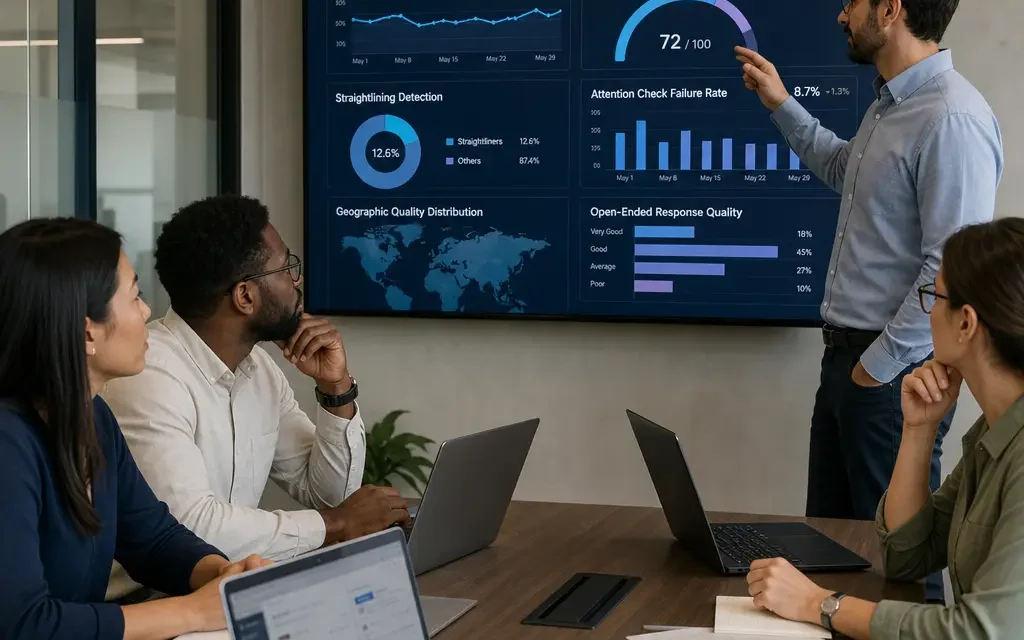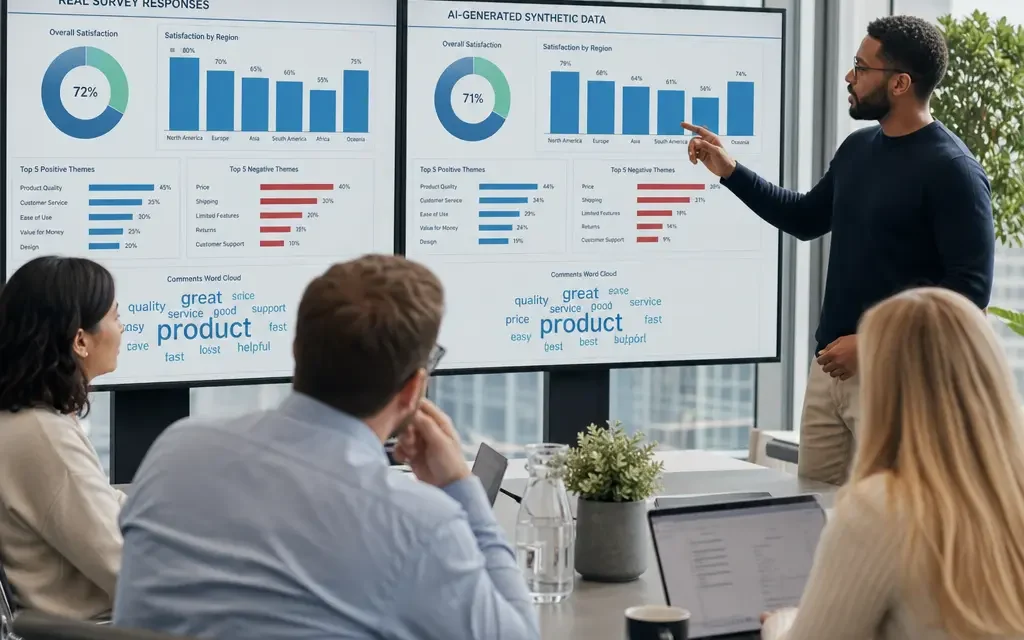


Synthetic respondents use AI to simulate survey participants. Learn when to use them, validation benchmarks, and how to combine synthetic and real data.
Introduction 91% of companies say market research data directly increased their sales, yet most early-stage founders skip it entirely, assuming real research requires a budget they don’t have. It doesn’t. Government databases, customer interviews, free survey tools, and social listening cover almost everything a paid research agency would provide, at the cost of your own...
DIRECT ANSWERΒ "H-in-Q offers 7 free market research tools covering every stage of a research program: the Sample Size Calculator, Market Research Ratio Calculator, NPS Calculator, Quota Simulator, Focus Group Discussion Guide, Cross-Tab Generator, and Competitive Matrix Builder. All 7 tools are 100% free with no account required, covering market sizing, study planning, qualitative research...
Direct Answer A competitive analysis template is a structured framework for systematically documenting and comparing competitors across defined categories β pricing, features, positioning, marketing, and customer sentiment β to identify strategic gaps and opportunities. A free competitive analysis uses public sources like company websites, Google search results, SimilarWeb, review sites, and social media in place...
Direct AnswerΒ When should a business upgrade from free to paid market research tools? Upgrade when response volume consistently exceeds free-tier caps, when you need historical or longitudinal trend data, or when researcher hours spent working around a limit exceed what a subscription costs. Before that point, free tools like Google Trends and Census Business...
Introduction A skincare brand once reported 80% overall satisfaction with a new product; a genuinely good topline number, until a crosstab revealed that 76% of customers aged 55+ were actually unsatisfied, a signal completely invisible in the blended average. This is the entire reason cross-tabulation exists: a single overall percentage can hide the exact groups...
Introduction A focus group with the right participants and the wrong discussion guide produces two hours of pleasant conversation and almost no usable insight. A well-structured guide turns that same two hours into the clearest qualitative signal a research budget can buy. A typical professionally moderated focus group costs $5,000β$15,000 per session in 2026, including...
IntroductionΒ Most market research projects that fail do not fail in the field. They fail in the planning meeting where someone looked at the budget, named a sample size that felt right, and nobody calculated what that numberΒ actually meantΒ for precision, feasibility, or the cost ofΒ recruiting toΒ each quota cell. The result is fieldwork that runs over...
Companies with the highest Net Promoter Score in their industry grow at more than twice the rate of their competitors, yet most businesses calculate NPS once, glance at the number, and never act on what the underlying segments are actually telling them. NPS is a single-question metric, but the score itself is only half the...
Seventy percent of VC rejections cite “market size unclear” on the first pass, not because the market is actually too small, but because the founder threw out a single, unsupported billion-dollar number with no math behind it. TAM, SAM, and SOM are the three metrics that fix this: they turn a vague claim about market...