


The Battle for Control in the Age of Customer Experience
Artificial intelligence has rewritten the rules of customer experience. What was once a reactive support function has become a predictive engine powered by data, automation, and machine learning. In the predictive analytics world, brands now anticipate intent before customers articulate it. The result is frictionless journeys, hyper-relevant recommendations, and real-time service recovery. Yet critics argue that this same infrastructure resembles a surveillance machine dressed as convenience.
The debate is no longer academic. Organizations that fail to modernize their CX strategies risk irrelevance, while those that accelerate face accusations of overreach. The core question is clear: does AI elevate personalization in marketing to a new strategic level, or does it erode trust through constant monitoring? The answer determines the future architecture of business itself.
The Rise of AI-Driven Customer Experience in the Predictive Analytics World
How the Predictive Analytics World Is Reshaping Customer Experience
The predictive analytics world has transformed CX from observation to anticipation. Algorithms analyze behavioral signals across touchpoints, detecting patterns invisible to human teams. According to McKinsey’s research on AI-driven personalization, organizations leveraging predictive systems see stronger engagement and retention momentum.
Instead of waiting for complaints, AI models forecast dissatisfaction. Instead of generic offers, dynamic recommendations respond to micro-signals. The strategic shift is profound:
- From historical reporting to real-time prediction
- From static segmentation to adaptive profiling
- From campaign cycles to continuous optimization
Customer experience becomes a living system, not a departmental function.

Why Businesses Are Betting Their Future on AI Customer Experience
In boardrooms, customer experience is no longer discussed as a soft metric tied to satisfaction surveys. It is engineered as revenue architecture embedded in growth strategy. Automation eliminates operational drag, predictive analytics identifies churn risk before defection occurs, and personalization in marketing systematically expands lifetime value across every touchpoint.
Critics argue that over-automation strips away human authenticity. Executives counter with evidence from Harvard Business Review’s analysis of data-driven advantage, showing companies that treat data as a strategic asset outperform slower competitors.
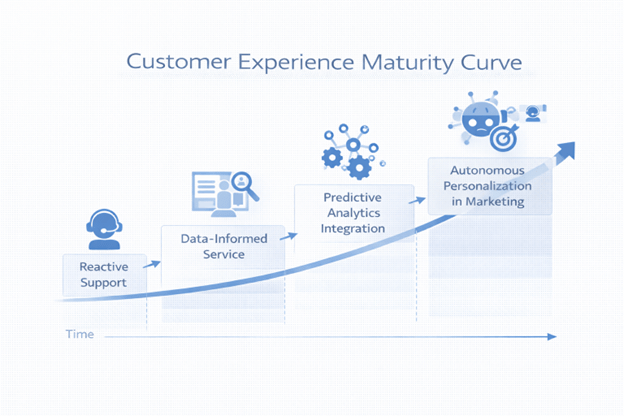
The visual illustrates structural progression rather than metrics, reinforcing that AI maturity is a strategic journey.
The message is unmistakable. Customer experience powered by AI is competitive survival.
Personalization in Marketing Through Customer Experience Intelligence
Data as the Engine of Customer Experience Personalization in Marketing
Personalization in marketing once meant inserting a first name into an email or grouping customers into rigid demographic segments. That era now looks primitive. Today, AI-driven CX integrates behavioral history, contextual triggers, device usage patterns, transaction data, and predictive scoring into a single orchestration layer that evolves in real time. Every interaction feeds the system, sharpening relevance with each touchpoint.
As highlighted in Deloitte’s perspective on AI-powered marketing transformation, intelligent systems empower brands to move beyond audience-level messaging and engineer fully individualized journey design, aligning content, timing, and channel with precision that manual strategies cannot replicate.
Traditional vs AI-Powered Customer Experience
| Traditional Customer Experience | AI-Powered Customer Experience |
| Static segmentation | Real-time adaptive segmentation |
| Reactive support | Predictive intervention |
| Generic campaigns | Dynamic personalization in marketing |
| Periodic surveys | Continuous sentiment analysis |
CX becomes fluid, contextual, and adaptive. Marketing stops broadcasting and starts responding.
When Customer Experience Becomes Hyper-Personalized
Hyper-personalization triggers discomfort for some observers who see it as algorithmic overreach. The same predictive analytics world that delivers seamless convenience and anticipates needs with precision also depends on deep behavioral insight, continuous data capture, and pattern recognition that can feel intrusive without clear transparency and governance safeguards.
However, relevance is not intrusion when governance is strong. AI-driven journey orchestration creates:
- Context-aware product recommendations
- Proactive issue resolution
- Intelligent cross-channel continuity
Organizations that hesitate risk falling behind competitors who embrace structured AI frameworks. Hyper-personalized CX is not excess. It is evolution.
The Surveillance Argument: Is Customer Experience Crossing the Line?
The Data Collection Infrastructure Behind Customer Experience
Critics describe modern customer experience systems as surveillance pipelines disguised as convenience engines. Behavioral tracking spans devices, channels, connected products, and third-party ecosystems, capturing granular interaction data at every touchpoint. Data brokers, cloud infrastructures, and APIs integrate these signals at scale, creating unified customer profiles that evolve continuously. The concern is structural: unprecedented visibility without proportional transparency.
When consumers cannot clearly see how their data is collected, processed, and monetized, trust erodes. The World Economic Forum has emphasized in its digital transformation frameworks that responsible data governance is foundational, arguing that sustainable digital economies depend on accountability, transparency, and enforceable trust mechanisms.
Transparency, Consent, and the Future of Customer Experience Governance
Personalization Value vs Surveillance Risk in Customer Experience
| Value Creation | Surveillance Concern |
| Faster service | Continuous tracking |
| Better recommendations | Behavioral profiling |
| Predictive analytics world insights | Data exploitation risk |
| Seamless omnichannel | Loss of anonymity |
The table frames the tension clearly. CX delivers measurable value, yet governance must evolve.
Regulation should not suffocate innovation or delay technological progress. It must codify responsible use, establish enforceable guardrails, and clarify accountability. When AI systems operate with transparency, explicit consent mechanisms, and continuous bias audits, the surveillance argument loses credibility. Intelligent infrastructure grounded in governance, not fear, defines the competitive future.
AI Autonomy vs Human Control in Customer Experience Strategy
Can AI Replace Human Judgment in Customer Experience?
Automation accelerates response times, standardizes workflows, and scales support capacity without proportionally increasing operational overhead. Intelligent systems triage requests, resolve routine inquiries, and maintain continuous service availability across global markets. Yet human empathy remains indispensable in complex, high-stakes scenarios where judgment, contextual awareness, and ethical sensitivity shape outcomes.
The efficiency versus accountability debate now dominates executive discussions. Full automation promises cost compression and speed, while hybrid models defend nuance, trust, and long-term brand credibility.
Hybrid Customer Experience Models in the Predictive Analytics World
The predictive analytics world favors augmentation over replacement.
The dashboard clarifies role allocation without presenting numerical claims. It communicates structural alignment.
AI should dominate pattern recognition, anomaly detection, predictive modeling, and routine workflows that require speed, scale, and consistency. Humans must retain control over ethical judgment, strategic decision-making, and emotionally sensitive interactions where nuance matters. This hybrid structure prevents blind automation while amplifying operational intelligence. By aligning machine precision with human accountability, organizations strengthen CX, protect trust, and create a governance framework capable of sustaining innovation without sacrificing responsibility.

The Business Case for AI-Enhanced Customer Experience
ROI of Customer Experience in the Predictive Analytics World
Customer experience is a growth lever. AI reduces operational inefficiencies, automates routine inquiries, and identifies churn risk before revenue erosion occurs.
IBM’s enterprise AI research highlights how intelligent automation enhances operational agility while reducing service friction. In competitive markets, agility determines survival.
Competitive Advantage Through Personalization in Marketing and Customer Experience
Strategic advantages include:
- Faster resolution cycles
- Intelligent segmentation
- Continuous feedback loops
- Proactive issue detection
- Scalable personalization in marketing
Data network effects compound as systems ingest more interactions, refine models, and sharpen predictive accuracy. Organizations that invest early in AI-powered CX build proprietary insight layers that competitors struggle to replicate, even with similar technology. Every interaction strengthens the intelligence loop.
The business case is structural, not tactical. Companies that hesitate for the sake of caution forfeit learning velocity. In the predictive analytics world, delay is strategic surrender disguised as prudence.
Redefining Trust in the Era of AI Customer Experience
Trust as the New Currency of Customer Experience
Trust is no longer built through slogans, advertising claims, or carefully crafted brand narratives. It is engineered through governance architecture embedded into technology, workflows, and executive oversight. Transparent data policies must clearly explain what is collected, why it is collected, and how it is used. Clear opt-in structures give customers genuine agency rather than passive acceptance. Continuous bias auditing and algorithmic explainability ensure fairness and accountability at scale. When these mechanisms are institutionalized, CX shifts from an opaque, data-hungry system to accountable infrastructure that strengthens loyalty, reduces regulatory risk, and supports sustainable AI-driven growth.
The Future of Customer Experience: Surveillance Capitalism or Intelligent Service?
Five principles define ethical AI customer experience:
- Data minimization
- Algorithmic transparency
- Explicit consent frameworks
- Continuous bias auditing
- Executive-level governance oversight
Organizations that implement these principles proactively shape the market narrative and define the standards others are forced to follow. By embedding transparency, governance, and ethical AI frameworks into their CX strategy, they position themselves as industry leaders rather than reactive participants. Those that resist or delay adaptation will not preserve flexibility; they will invite regulatory intervention. Compliance will eventually be imposed, often under stricter conditions and with higher operational costs.
The Final Verdict on AI-Powered Customer Experience
AI-powered customer experience is not a threat to autonomy. It is the operating system of modern business. The surveillance critique collapses when transparency, governance, and ethical architecture are embedded by design.
In the predictive analytics world, inertia is more dangerous than innovation. Companies that hesitate will lose relevance to competitors who master personalization in marketing at scale. Intelligent automation strengthens relationships when implemented responsibly. It anticipates needs, reduces friction, and builds durable loyalty.
The future belongs to organizations that treat CX as strategic infrastructure rather than a compliance risk. AI is not optional. It is the foundation of competitive advantage. Businesses must lead, refine governance, and accelerate adoption. Intelligent service will outcompete analog hesitation every time.
References
McKinsey – The Value of Getting Personalization Right or Wrong Is Multiplying
Harvard Business Review – What’s Your Data Strategy?
Deloitte – AI-Powered Marketing Transformation
World Economic Forum – Digital Trust Initiative
AI Customer Experience: Revolution or Dehumanization?