

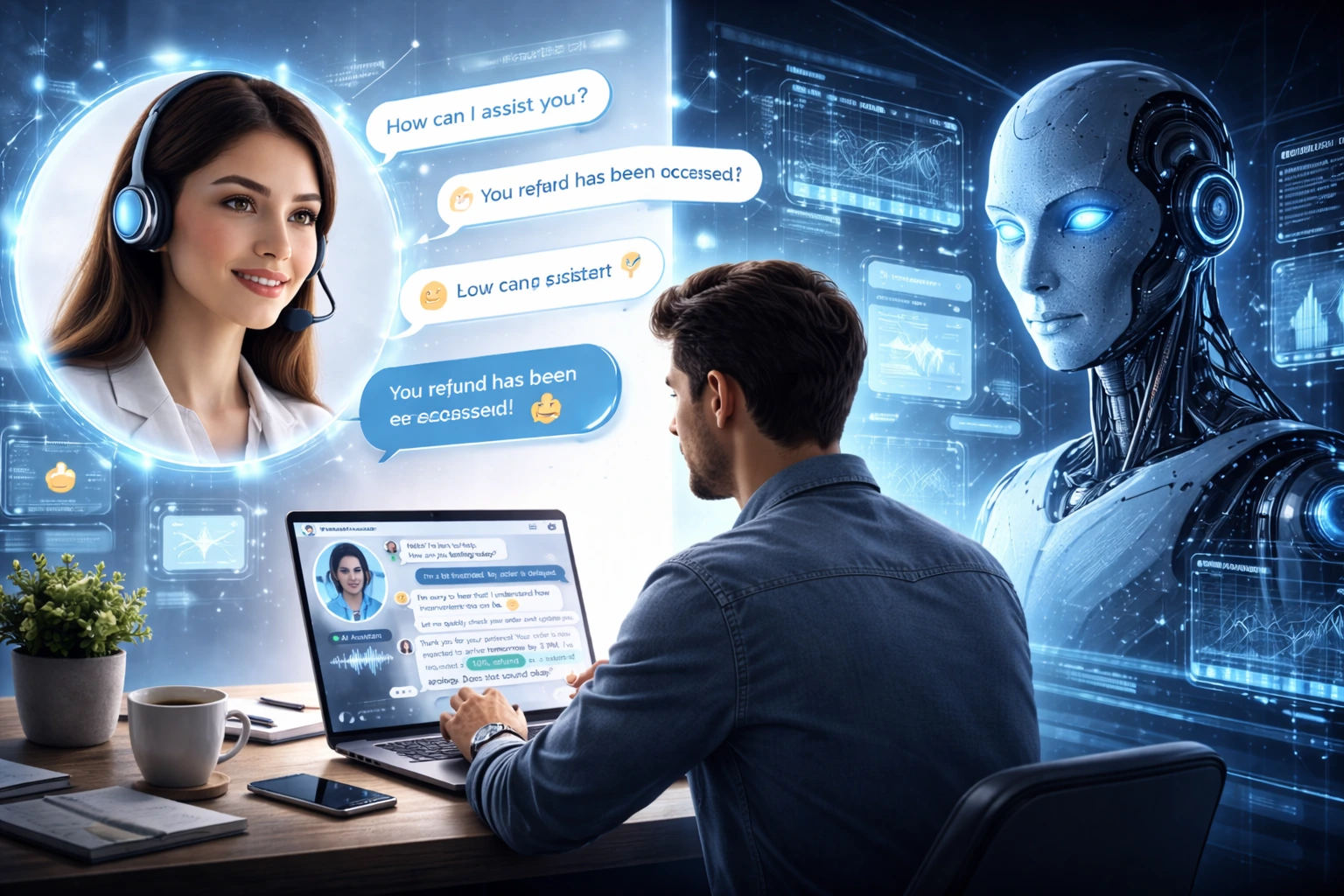
The AI Dilemma in Customer Experience
The future of customer interaction is no longer human-first. It’s algorithm-first. From automated chats to predictive personalization, AI is now the architect of the customer experience. Businesses champion this shift as a revolution in speed, scale, and service — but at what cost? As technology becomes the first and sometimes only touchpoint, the risk isn’t inefficiency. It’s dehumanization.
Customers no longer speak with people; they speak with personas built by predictive models. While AI unlocks precision and consistency, it often strips away the most crucial layer of interaction: emotional nuance. This isn’t just a change in tools, it’s a transformation in philosophy. Is automation the evolution of service, or a betrayal of its very foundation? As companies race to integrate AI, they face a clear crossroads: augment the human experience or replace it. The customer experience, once deeply personal, now hangs in a digital balance.
Automation vs Empathy in the Customer Experience
Where AI Thrives in the Customer Experience
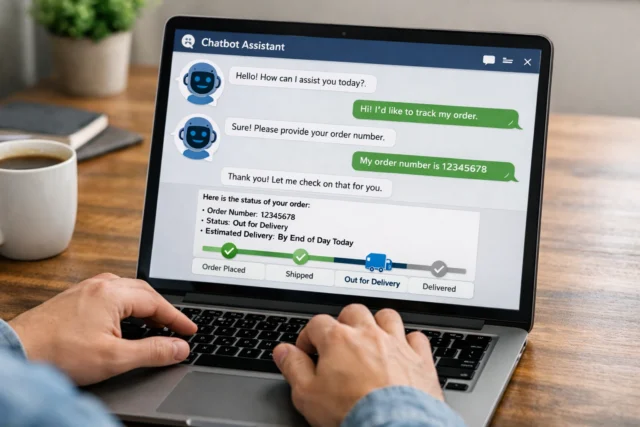
AI thrives in environments where humans fail: late-night queries, high-volume demand, multi-language support. It never tires, never forgets, never gets flustered. AI-powered chatbots handle millions of conversations daily, optimizing resolution rates and cutting wait times drastically. Service delivery at this scale is impossible with human agents alone.
E-commerce giants and financial institutions are increasingly replacing Tier 1 support with AI interfaces. According to McKinsey, automation can reduce service costs by up to 40%, while boosting satisfaction when implemented well. But “well” is the catch, because when it goes wrong, it alienates.
The Cost of Losing Human Touch
Empathy is not a function of data processing speed. It’s a function of trust. Customers navigating grief, frustration, or fear don’t want an efficient reply. They want a human one. Over-reliance on AI strips interactions of emotional context and context is everything.
Brands like TSB and United Airlines have made headlines for botched chatbot responses during sensitive moments, reinforcing the perception that AI lacks empathy. The backlash isn’t just emotional; it’s financial. Poor AI handling of emotional interactions leads to lost customers, public outcry, and damaged reputations.
Key Trade-Offs Between Automation and Empathy:
- Speed vs Sensitivity
- Scale vs Personalization
- Consistency vs Flexibility
- Cost-Efficiency vs Human Value
- Availability vs Relational Depth
Predictive Analytics and the Future of Customer Experience
The Rise of Predictive Analytics in Service Models
Welcome to the predictive analytics world, where AI doesn’t just react, it anticipates. Predictive models analyze behavioral data to foresee what customers will want before they ask. This allows businesses to offer proactive service, timely promotions, and frictionless support.
Retailers like Amazon and Netflix thrive in this realm, forecasting next buys and binge-worthy content based on subtle behavior signals. Predictive analytics is the secret weapon for reducing churn and increasing customer lifetime value; making it the beating heart of AI-powered service strategy.
Accuracy vs Assumption: Are We Guessing Wrong?
But predictions are not guarantees. When data skews, assumptions misfire. AI may infer that a returning customer wants a product they’ve already complained about. Worse, it may fail to identify dissatisfaction cloaked in polite feedback.
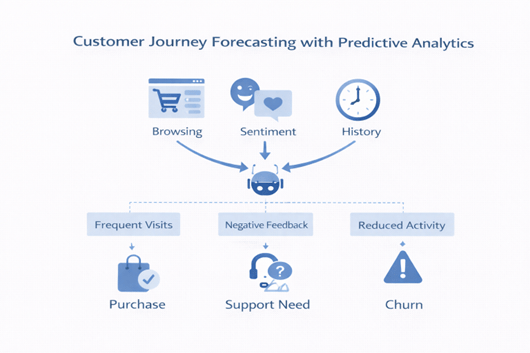
The predictive analytics world is not immune to bias. When training data reflects skewed demographics or outdated assumptions, AI reinforces stereotypes rather than dismantling them. The cost? Misdirected offers, tone-deaf messages, and alienated customers. As MIT Technology Review notes, cleaning AI of bias is no longer optional, it’s foundational to trust.
Personalization in Marketing or Surveillance in Disguise?
How AI Enables Hyper-Personalization in Marketing
Hyper-personalization has become the holy grail of customer experience. AI can dynamically customize emails, product suggestions, and landing pages based on granular insights. This is personalization in marketing taken to the next level, where every click shapes the next message.
According to Deloitte, personalized content increases engagement, reduces acquisition costs, and boosts conversion. Companies leveraging AI personalization are seeing higher ROI and better retention.
When Personalization Becomes Creepy
But when personalization feels intrusive, it backfires. Customers recoil when brands “know too much”, especially when data collection is opaque. Suggesting products based on overheard voice commands or location tracking may increase conversions, but also increases distrust.
There’s a fine line between relevance and surveillance. With growing regulations like GDPR and CCPA, ethical personalization is now a competitive advantage. Brands that cross the line face not just reputational damage, they face legal consequences.
Personalization vs Privacy
| Type of Personalization | Value to Customer | Potential Privacy Concern |
| Email targeting | Relevant offers | Email scanning |
| Dynamic web content | Convenience | Behavioral tracking |
| AI chat recommendations | Fast solutions | Data profiling |
AI’s Impact on Loyalty and Lifetime Value
From Touchpoints to Loyalty Loops
Loyalty used to be earned through consistent human interaction. Now, it’s engineered. AI maps customer behaviors to craft retention strategies that hit before churn ever begins. Dynamic pricing, instant issue resolution, and surprise rewards? All AI-generated, all frictionless.
AI doesn’t just remember a customer’s last action, it remembers why they acted. It’s the difference between being reactive and becoming indispensable. Companies using AI-powered loyalty systems see deeper engagement and increased lifetime value, according to Harvard Business Review.
The Risk of Over-Optimizing the Relationship
But over-optimization risks turning humans into data points. When every action is A/B tested, every emotion gamified, the relationship loses authenticity. Loyalty built on algorithms alone lacks soul and customers feel it.
There’s also a saturation point. If customers feel manipulated rather than appreciated, even the smartest AI fails. The key is not more automation, it’s smarter orchestration.
Training AI on Emotion: Can Machines Really Care?
Sentiment Analysis and Emotional AI in CX
Emotional AI is the frontier of modern customer experience. It analyzes tone, phrasing, and behavior to adapt responses in real time. When a customer is frustrated, AI softens language. When they’re satisfied, it prompts upsells.
Financial institutions and telecoms use sentiment analysis to defuse churn risks. But emotion detection is only as good as its input and sarcasm, cultural nuance, or masked emotion often elude the algorithm.
Simulated Empathy vs Genuine Connection
Here lies the dilemma: Can simulated empathy be enough? Or does it insult the customer’s intelligence? AI may know when you’re upset, but it doesn’t care, it responds. There’s a difference.
And yet, simulated empathy works. Studies show that customers often prefer timely AI responses over waiting for humans. The paradox is this: empathy can be faked and customers might prefer the performance.
Emotion + Response Mapping
| Emotional Cue | AI Interpretation | Response Strategy |
| Frustration | Negative sentiment | Escalate, apologize |
| Confusion | Uncertainty detected | Provide clearer options |
| Satisfaction | Positive sentiment | Trigger reward/upsell |

Humans + AI: The Hybrid Frontier of Customer Experience
When Humans and AI Collaborate Effectively
The strongest customer experience models don’t choose between humans and machines. They integrate both. AI handles the bulk like routing, searching, recommending, while humans step in for nuance, emotion, and conflict.
Hybrid models dominate industries like healthcare and finance, where stakes are high and empathy matters. AI supports, humans decide. This co-pilot model elevates both the agent and the customer.
The Future Workforce: CX as a Co-Pilot Model
To thrive in this model, companies must reskill human teams. The future of CX isn’t about doing what AI can’t, it’s about doing what AI shouldn’t. Creativity, judgment, and intuition will define tomorrow’s agents.
IBM advocates a “human-in-the-loop” approach where AI amplifies but never replaces. CX doesn’t die in automation, it’s reborn in orchestration.
5 Best Practices for a Hybrid CX Model:
- Train agents in AI tools, not just soft skills
- Define clear handoff protocols
- Use AI for prediction, not decision
- Monitor emotional quality, not just KPIs
- Reward human + AI collaboration outcomes
Reclaiming Humanity Through Smarter AI
The debate is over: AI will continue to dominate the future of customer experience. The question is whether we let it replace human connection or empower it. When used carelessly, AI dehumanizes. But when designed with empathy, AI can elevate every touchpoint.
This isn’t about choosing between humans and machines. It’s about using machines to make humans more human. From predictive analytics world precision to personalization in marketing mastery, AI is our most powerful tool. But it’s only a tool.
The future belongs to brands that wield AI not as a shield, but as a lens, one that magnifies customer needs, not replaces them. The companies that win will be those that understand this: AI should never replace empathy. It should operationalize it.
Meta Description
Explore how AI transforms customer experience through automation, predictive analytics, and personalization, without losing the human touch.
Suggested URL
/
References
- Customer Experience in the Age of AI – Harvard Business
- Next Best Experience: How AI Can Power Every Customer Interaction – McKinsey
- AI in Customer Experience (CX) – IBM
- AI Use Cases in Customer Experience – SmartDev
- The Future of CX Is Predictive: Advanced Analytics Is Driving Proactive Customer Engagement – TDWI