


The Industry 4.0 Inflection Point: Progress at a Cost
Industry 4.0 has become the defining industrial narrative of the decade. Executives frame it as the gateway to intelligent automation, hyper-connectivity, and data-driven production. Critics warn that Industry 4.0 risks entrenching capital dominance and deepening workforce displacement. Both claims hold weight. The integration of AI, robotics, IoT, cloud platforms, and augmented reality is reshaping value creation at systemic scale. What was once incremental operational improvement now looks like structural reinvention. The real tension lies between productivity acceleration and social imbalance. Can Industry 4.0 unlock distributed innovation across ecosystems, or does it consolidate power among those who already control data, infrastructure, and algorithms? The answer is not neutral. The trajectory of Industry 4.0 clearly favors those who master technology. The only question is who will adapt fast enough to benefit.
Industry 4.0 and the Promise of Exponential Innovation
Industry 4.0 Redefines Operational Intelligence
Industry 4.0 transforms factories into adaptive intelligence systems. AI-driven predictive maintenance, digital twins, and real-time analytics replace static planning. As highlighted in Harvard Business Review’s research on digital transformation in manufacturing, digitally connected production environments increase resilience and responsiveness. Industry 4.0 does not simply automate; it creates feedback loops that continuously refine operations.
Augmented reality elements are becoming embedded into maintenance, training, and assembly workflows. Engineers operating within an augmented reality zone access layered instructions, diagnostics, and simulation overlays directly in their field of view. This is operational cognition scaled through technology.
Industry 4.0 as a Competitive Weapon
Conversion of data into strategic capital that compounds over time. Companies that own connected infrastructure do not merely collect information; they operationalize it into predictive insight, adaptive supply chains, and accelerated product development cycles. According to McKinsey insights on digital manufacturing and operations transformation, leading adopters of Industry 4.0 outperform laggards in agility and innovation velocity, strengthening competitive barriers and reinforcing long-term market dominance.
| Traditional Industry Model | Industry 4.0 Model |
| Linear production chains | Connected value ecosystems |
| Reactive maintenance | Predictive intelligence systems |
| Labor-intensive processes | AI-augmented workflows |
| Limited data visibility | Real-time operational transparency |

The augmented reality meta layer amplifies coordination between human expertise and machine precision. The divide is no longer between large and small firms. It is between those integrated into Industry 4.0 networks and those operating outside them.
Industry 4.0 and the Inequality Acceleration Argument
Talent Polarization Under Industry 4.0
Industry demands hybrid expertise that blends AI literacy, data fluency, cybersecurity awareness, and systems thinking. Routine, repetitive roles steadily decline while high-skill engineering, analytics, and automation architecture positions surge in strategic importance. The World Economic Forum Future of Jobs Report 2023 highlights persistent shifts toward technology-centric capabilities across advanced manufacturing ecosystems. It does not eliminate work; it restructures it around cognitive and digital leverage. Workers operating within augmented reality training environments experience accelerated learning curves and real-time performance augmentation. Those excluded from structured digital upskilling initiatives risk structural marginalization in increasingly automated production landscapes.
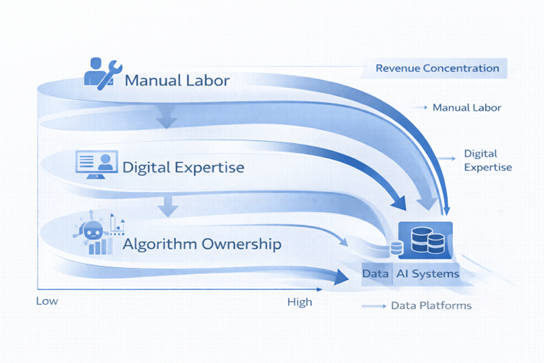
Capital Concentration in the Industry 4.0 Era
The infrastructure behind Industry 4.0 is capital-intensive. Cloud computing, AI integration, cybersecurity, and robotics require sustained investment. Deloitte’s Industry 4.0 insights and smart factory research emphasize that transformation often favors firms with scalable digital infrastructure.
Small manufacturers struggle to enter the augmented reality zone of advanced production due to integration costs. Ecosystems consolidate around tech-enabled leaders.
The debate frames this as systemic inequality. The counterargument is sharper: technology always rewards early adopters. Industry 4.0 simply accelerates competitive Darwinism.
Industry 4.0, Augmented Reality, and the New Productivity Divide
Augmented Reality as a Force Multiplier
Augmented reality is not experimental novelty. It is a structural productivity amplifier within Industry 4.0. According to MIT Technology Review’s coverage of AI and industrial innovation, augmented and AI-driven systems reduce error rates and shorten training cycles by embedding contextual data directly into workflows.
Augmented reality elements create a persistent augmented reality meta layer across the factory floor. Workers interact with digital overlays that guide assembly, inspection, and repair.
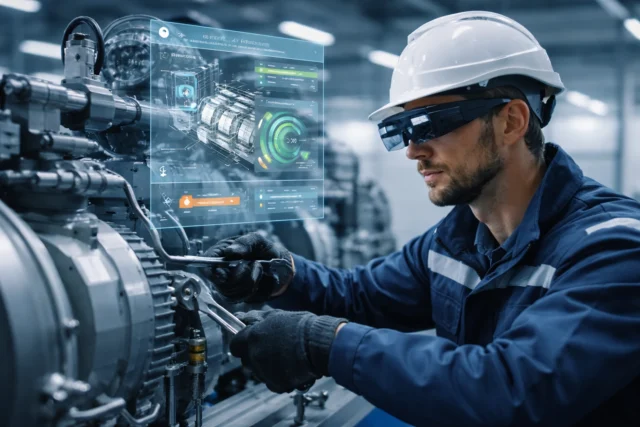
This technology narrows human error while increasing speed. Industry 4.0 systems become adaptive environments where digital and physical processes converge.
The Augmented Reality Zone and Workforce Transformation
Factories operating inside an augmented reality zone gain structural efficiency, faster training cycles, reduced errors, and stronger competitive resilience.
| Without Augmented Reality | With Augmented Reality in Industry 4.0 |
| Static manuals | Interactive real-time guidance |
| Longer onboarding cycles | Accelerated immersive training |
| Reactive troubleshooting | Predictive visual diagnostics |
| Isolated expertise | Distributed knowledge access |
The augmented reality meta ecosystem turns expertise into a scalable, transferable asset embedded directly into operational workflows. Institutional knowledge no longer sits in manuals or in the minds of senior technicians; it becomes digitally codified and instantly accessible. Critics argue this shift dilutes craftsmanship and over-standardizes skill. In practice, Industry 4.0 expands human capacity by embedding contextual intelligence into every task, elevating workers into orchestrators of interconnected, intelligent systems.
Industry 4.0, Governance, and Power Structures
Can Governance Democratize Industry 4.0?
Industry 4.0 without governance risks deep structural asymmetry, where algorithmic power concentrates in the hands of dominant platform owners and data controllers. Unchecked deployment of AI systems can erode trust, amplify bias, and obscure accountability across complex industrial ecosystems.
IBM’s responsible AI and governance framework underscores the necessity of transparency, explainability, and auditable decision pathways in AI-driven environments to ensure that innovation scales without compromising institutional integrity or stakeholder confidence.
Policy frameworks can:
- Incentivize SME adoption
- Promote ethical AI standards
- Support digital workforce reskilling
- Encourage open interoperability
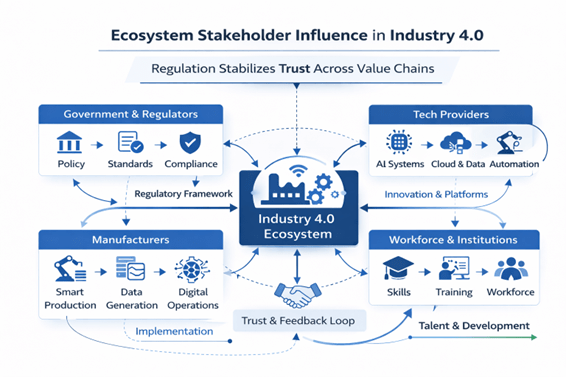
Regulation does not suppress Industry 4.0. It stabilizes trust across interconnected value chains.
Industry 4.0 Without Governance: A Corporate Arms Race
Without guardrails, Industry 4.0 evolves into concentrated platform power where industrial ecosystems orbit around a handful of dominant technology providers. Data becomes proprietary territory, tightly controlled and monetized. AI becomes strategic leverage capable of shaping pricing, supply chains, and market access. According to the World Economic Forum’s platform and digital transformation insights, collaborative governance frameworks determine whether innovation diffuses across industries or concentrates within digital monopolies.
It can easily become an arms race for algorithmic dominance and infrastructure control. Yet historical precedent confirms that suppressing technological progress undermines competitiveness. The strategic imperative is disciplined adoption reinforced by intelligent oversight.
Industry 4.0 as a Strategic Imperative for Innovation Leadership
Why Companies Cannot Opt Out of Industry 4.0
Opting out of Industry 4.0 equates to strategic stagnation in markets defined by accelerating technological velocity. Companies that delay digital integration gradually lose operational visibility, cost efficiency, and innovation momentum. McKinsey’s manufacturing and supply chain transformation research consistently highlights the widening performance gap between digital leaders and laggards, showing that early adopters compound advantages through smarter operations, faster decision cycles, and more resilient value chains.
It enables:
- Real-time decision intelligence
- Integrated supply chain visibility
- Scalable automation
- Augmented reality-enabled workforce optimization
Competitive markets reward technological velocity. Industry 4.0 accelerates innovation cycles beyond what analog systems can sustain.
Reframing Industry 4.0 as Human Amplification
The most advanced systems integrate AI-driven analytics with human insight to create adaptive, high-precision decision architectures. Deloitte’s AI-augmented enterprise analysis underscores that organizational performance peaks when technology amplifies, rather than replaces, human expertise.
Augmented reality elements reinforce this amplification model by embedding contextual intelligence directly into operational workflows, enabling real-time guidance and informed intervention. Within the augmented reality zone, cognitive systems and human judgment converge in a dynamic collaboration interface.
Industry 4.0 does not represent mechanistic substitution; it delivers strategic augmentation. Organizations that position AI as a growth catalyst consistently outperform those that deploy it purely for cost reduction.
Innovation Engine or Inequality Multiplier?
Industry 4.0 undeniably accelerates inequality when access to technology is restricted. Talent polarization intensifies. Capital concentrates. Competitive advantages compound. Yet rejecting It does not reverse inequality. It magnifies vulnerability. Economies that hesitate fall behind technologically dominant ecosystems.
Innovation historically reshapes labor markets before stabilizing them. Industry 4.0 follows this pattern at amplified speed. Augmented reality, AI, predictive systems, and intelligent automation expand productive capacity beyond traditional limits. The decisive factor is not whether Industry 4.0 drives inequality. It is whether institutions, companies, and workers adapt aggressively enough to capture its benefits.
It is the engine of modern industrial strategy. The future belongs to those who design, govern, and deploy it with ambition. Technology does not wait for consensus. It rewards execution.
References
Harvard Business Review – Digital Transformation
McKinsey – Manufacturing and Operations Transformation
World Economic Forum – The Future of Jobs Report 2023
Deloitte – Industry 4.0 Insights
MIT Technology Review – Artificial Intelligence
IBM – Artificial Intelligence and Responsible AI
H-in-Q – Industry 4.0 Digital Twins: Optimization or Surveillance?