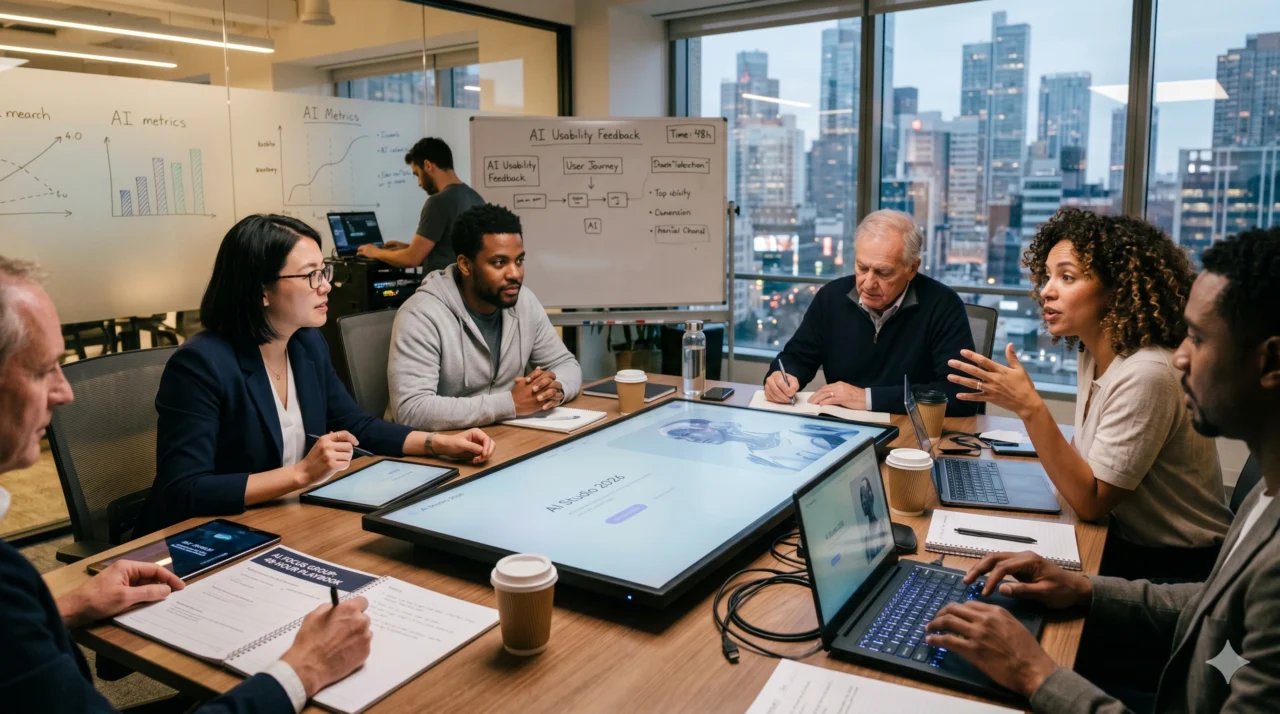
Most marketing teams that want to run an AI focus group spend more time researching how to start than it would have taken to just run the study. The guides available online are either too theoretical to act on or written for synthetic persona tools only; missing the real-participant AI model that delivers authentic qualitative insight at the same speed.
This is the playbook that fixes that. It covers the complete process for running an AI focus group with real participants from brief to actionable findings in 48 hours or less; including a ready-to-use discussion guide template, the exact recruiting parameters that work, the four mistakes that kill session quality, and how to turn AI-generated output into decisions your team can act on. H-in-Q’s market research team has run this process across US and MENA markets using HiVox-in-Q’s community-based AI platform. Every step below is field-tested, not theoretical. By the end, you will have everything you need to run your first session this week.
What You Need Before You Start: The 3 Non-Negotiables
Most AI focus groups that produce poor results fail before the session begins. Three setup decisions determine 80% of your output quality, and all three happen in the planning phase.
Non-negotiable 1: One specific research objective linked to one real decision. The most common mistake in focus group research, AI or traditional is beginning with a vague objective. “Understand our brand” is not a research objective. “Determine which of three product names generates the highest purchase intent among US millennial women earning $75K+” is a research objective. Write one primary question and no more than three supporting questions. Every element of your discussion guide must ladder back to a decision your organization will make based on the findings. If you cannot name that decision before you start, you are not ready to field the study.
Non-negotiable 2: A participant profile specific enough to produce representative data. Recruiting “adults aged 25–45” for a study about enterprise software purchasing will produce useless data. Your participant profile must include demographic anchors (age range, geography, income), behavioral qualifiers (category users, competitor customers, recent purchasers), and psychographic signals where relevant (values, attitudes, lifestyle). The tighter your participant specification, the more actionable your findings.
Non-negotiable 3: A stimulus that is presentation-ready. If you are testing a concept, creative, or messaging, it must be in a format the platform can present clearly. A polished concept is not required, participants can evaluate rough ideas, but the stimulus must be unambiguous. Vague stimuli produce vague reactions. If two different participants could interpret your stimulus in two completely different ways, refine it before you launch.
The 48-Hour AI Focus Group Timeline
Here is exactly how 48 hours breaks down from the moment you have a clear research objective to the moment you have actionable findings in hand.
| Hour | Activity |
| 0–2 | Write research objective, define participant profile, select platform |
| 2–4 | Build discussion guide (use template below) |
| 4–6 | Configure platform, set up session, launch recruitment |
| 6–24 | Recruitment and participant confirmation |
| 24–30 | Session runs (AI-moderated, asynchronous or live) |
| 30–36 | AI analysis runs: thematic coding, sentiment tagging, report generation |
| 36–44 | Human review of AI output, insight synthesis |
| 44–48 | Findings brief prepared and delivered to decision-maker |
This timeline applies to AI-assisted sessions with real participants on platforms like HiVox-in-Q. Synthetic persona studies compress to 3–6 hours total. Traditional focus groups running the same research take 4–8 weeks.
Step 1: Write Your Research Brief (Hour 0–1)
Your research brief is a single document that answers five questions before you touch any platform or write any questions. Write it in under 30 minutes. Skipping this step is the single most reliable predictor of a focus group that produces no actionable findings.
The 5-question research brief:
- What decision will this research directly inform? Be specific. “Product launch go/no-go decision for CS-in-Q’s new pricing tier” is a decision. “Better understanding of our customers” is not.
- What do we already know, and what do we need to learn? List what your team already believes to be true. The gap between what you know and what you need to know is your research scope. Do not use a $5,000 study to confirm what you already know, use it to fill the specific gaps that are blocking the decision.
- Who specifically needs to hear and believe the findings? The audience for your research determines the format of your output. If findings go to a CMO, you need an executive summary with clear recommendations. If they go to a product team, you need granular theme breakdowns with supporting quotes.
- What would a finding that changes our decision look like? This is the most important question most researchers never ask. If you can articulate what a “red light” finding would look like, what participants could say that would change your decision, you have defined a meaningful research objective. If you cannot articulate this, your research objective is not specific enough.
- What is the timeline for the decision this research informs? This determines whether 48-hour AI research is the right format or whether a slower, deeper research program is warranted. If the decision needs to be made in a week, AI focus groups are the right tool. If the decision is six months away, the research program can afford more depth.
Step 2: Build Your Discussion Guide (Hour 2–4)
The discussion guide is the most leverage-rich document in your entire research process. A well-built guide produces insights a poorly-built guide will never surface, regardless of how good your platform or how engaged your participants.
The 6-section discussion guide structure that works for AI-moderated sessions:
Section 1: Warm-up (10 minutes) Get participants comfortable and establish context without telegraphing your hypotheses. Open questions about category usage, general attitudes, and recent experiences. The goal is not to collect data; it is to build comfort and set an honest, open tone for the session.
Example warm-up questions:
- “Tell us briefly about the last time you evaluated a new [product/service/tool] for your business.”
- “What is the most frustrating thing about how you currently handle [category]?”
Section 2: Unprompted category exploration (15 minutes) Before showing any stimulus, explore how participants think about the category in their own words. The language they use, the analogies they reach for, and the problems they name unprompted are often the most commercially valuable output of the entire session.
Example exploration questions:
- “When you think about [category], what comes to mind first?”
- “How do you decide between options in this category?”
- “What would have to be true for you to switch from your current solution?”
Section 3: Stimulus presentation (20 minutes) Present your concept, messaging, or creative. Allow participants to react individually before opening group discussion. In AI-moderated sessions, the platform manages the sequencing; your job is to write clear stimulus presentation prompts.
Example stimulus prompts:
- “We are going to show you [concept description]. Take a moment to read/view it, then share your first reaction; what stands out, what questions it raises, and what, if anything, concerns you.”
- “On a scale of 1–10, how likely would you be to [take action] based on what you just saw? Walk us through your reasoning.”
Section 4: Comparative evaluation (10 minutes) If testing multiple variants, have participants compare directly. Direct comparison produces clearer preference data than evaluating each option in isolation.
Example comparative questions:
- “Comparing Option A and Option B, which better addresses the challenge you described earlier? Why?”
- “If you had to choose one to act on today, which would it be? What would make you more confident in that choice?”
Section 5: Direct recommendation question (5 minutes) Ask participants directly what they would do. Most discussion guides avoid this because it feels presumptuous, but it is often the most actionable data point in the session.
Example recommendation questions:
- “Based on everything we have discussed, what is the one change that would make you most likely to [take desired action]?”
- “What would you tell a colleague who asked you whether to [engage with this product/brand/offer]?”
Section 6: Closing open invitation (5 minutes) Give participants the space to say anything the discussion guide did not cover. Some of the most commercially valuable insights in qualitative research come from the final two minutes when participants say what they actually wanted to say throughout the session.
Example closing prompt:
- “Before we close, is there anything important about this topic that our questions did not give you space to share?”
Ready-to-use discussion guide template (adapt for your research objective):
RESEARCH OBJECTIVE: [One specific decision this research will inform]
PARTICIPANT PROFILE: [Demographics + behavioral qualifiers]
SESSION LENGTH: 60–75 minutes
WARM-UP (10 min)
1. Tell us about the last time you [relevant category behavior].
2. What is the biggest challenge you face with [category]?
EXPLORATION (15 min)
3. How do you currently [handle the problem your product solves]?
4. What would make you switch from your current approach?
5. What does [ideal outcome] look like to you?
STIMULUS (20 min)
6. [Present stimulus]: What is your first reaction?
7. What, specifically, stands out? What concerns you?
8. On a scale of 1–10, how likely would you be to [take action]? Walk us through your reasoning.
COMPARATIVE (10 min)
9. Comparing [Option A] and [Option B]: which better addresses what you described? Why?
RECOMMENDATION (5 min)
10. What one change would make you most likely to [desired action]?
CLOSE (5 min)
11. Anything important this discussion did not give you space to share?
Step 3: Configure Your Platform and Launch Recruitment (Hour 4–6)
Platform configuration is where most first-time AI focus group users spend too much time. Three decisions matter; everything else is interface navigation.
Decision 1: Synchronous vs. asynchronous session format. Synchronous sessions run live, in real time, with all participants present simultaneously. They produce richer group dynamics but require scheduling coordination. Asynchronous sessions let participants respond on their own timeline within a defined window (typically 24–48 hours). For community-based AI platforms like HiVox-in-Q, asynchronous formats consistently produce higher participation rates and more candid responses, participants are not performing for a group in real time.
Decision 2: Session length and incentive. 60–75 minutes is the optimal session length for AI-moderated focus groups. Quality degrades after 75 minutes regardless of how engaged participants are. For incentive sizing, US participants in 2026 expect $50–$150 for a 60-minute focus group depending on professional seniority; B2C consumers at $50–$75, B2B professionals at $100–$150. Underpaying produces either no-shows or disengaged participants who rush through questions.
Decision 3: Recruitment source. For AI-assisted platforms, participant recruitment comes from three sources: the platform’s built-in panel, your own customer or prospect database, or third-party recruitment panels. Your own database produces the highest engagement and most contextually relevant responses; participants already have a relationship with your brand. Platform panels produce the fastest recruitment timelines. For multilingual or multi-market research, HiVox-in-Q’s community infrastructure handles recruitment across English, French, Spanish, and Arabic-speaking US audiences in a single session configuration. 👉 [Internal Link: “HiVox-in-Q platform” → /ai-market-research/HiVox-in-q-focus-group-online/]
Step 4: Run the AI-Moderated Session (Hour 24–30)
In a well-configured AI focus group, your role during the session is observer, not operator. The AI manages discussion flow, ensures every participant contributes, probes vague responses, and flags high-value moments in real time. Your job is to monitor the live feed for signals the AI may not have prioritized, and to prepare follow-up probes if the discussion surfaces an unexpected direction worth exploring.
What to monitor during a live AI-moderated session:
Watch for moments where participants respond with unusual brevity; these often signal either low engagement with the stimulus or a reluctance to share the honest reaction. Note which questions generate the longest, most detailed responses; these topics are worth probing further in your post-session analysis. Watch for contradictions between a participant’s stated preference and their reasoning; these mismatches often reveal the most commercially valuable insight in the session.
The 3 things that kill AI focus group session quality:
- An over-specified discussion guide. If every question is fully scripted with no room for the AI to probe dynamically, the session produces predictable data. Build your guide around objectives and stimulus, not a rigid script. The AI’s ability to follow emergent threads is one of its core advantages over human moderation, do not constrain it.
- Participants who were not properly screened. The fastest way to get useless data is to have the wrong people in the session. A 20-minute screener survey before recruitment confirmation is not overcautious; it is standard practice. Include at least one behavioral qualifier question (not just demographic) that disqualifies participants who do not actually use the category you are researching.
- Testing too many things in one session. A 60-minute AI focus group can reliably explore one research objective with 2–3 stimulus variants. Trying to test five messaging concepts, three product names, and two pricing models in a single session produces shallow data on all of them. Scope tightly, run multiple sessions if needed.
Step 5: Review AI Analysis and Synthesize Findings (Hour 30–48)
AI-generated analysis after a focus group session typically includes automated transcription, sentiment scoring per question and per participant, thematic clustering across all responses, key quote extraction, and a summary report with recommended findings. Teams using AI-assisted analysis discover critical insights up to 5x faster than those using traditional manual coding methods.
Your job in this phase is not to re-analyze the data from scratch; it is to validate, contextualize, and extend what the AI has already surfaced. Three activities deliver the most value in this phase:
Activity 1: Check the AI’s thematic coding against your research objective. AI thematic analysis clusters responses based on frequency and semantic similarity; it surfaces what participants said most often, not necessarily what is most commercially important. Read through the raw transcript of 3–5 high-signal responses the AI flagged, and verify that the themes it identified actually map to the decision your research was designed to inform.
Activity 2: Hunt for the outlier responses. The most valuable qualitative data is often in the minority; the participant who articulated a concern no one else named, the person who loved the concept for a completely unexpected reason, the skeptic whose objection identifies a positioning vulnerability your team had not considered. AI analysis surfaces consensus; your job is to find the valuable dissent.
Activity 3: Translate themes into recommendations, not observations. A research report that says “participants responded positively to messaging around cost savings” is an observation. A recommendation says “lead with the 30% cost reduction claim in all US paid media; it was the single most cited purchase trigger across all three audience segments.” Every finding in your output should map directly to an action. If a finding does not change anything your team would do, it does not belong in the final report.
How AI Is Changing the Focus Group Workflow for US Teams in 2026
The 48-hour AI focus group represents a structural change in how US marketing teams access qualitative insight, not just a faster version of the same process. The operational implications go beyond speed.
When research takes 6–8 weeks, it happens episodically, once per quarter or once per launch cycle. When research takes 48 hours, it becomes continuous; a weekly input into product, messaging, and creative decisions rather than a periodic sanity check. The teams building this continuous research muscle in 2026 will have a compounding insight advantage over competitors who still treat focus group research as a special-occasion methodology.
AI moderation also changes the quality of the data, not just the speed of its delivery. 72% of insights teams now use AI in qualitative research (Greenbook GRIT, 2025), and the dominant reason cited is not cost reduction, it is consistency. An AI moderator applies the same probing standard to every participant in every session. The data quality does not depend on whether your moderator had a difficult morning or whether one participant dominated the room. Consistency of moderation is the most underappreciated quality advantage of AI focus groups, and it directly compounds the value of every session you run. 👉 AI focus groups vs traditional
H-in-Q’s Hivox-in-Q platform is built around this continuous research model: community-based AI focus group sessions that deliver authentic participant responses, multilingual support for US teams researching diverse audiences, and AI analytical infrastructure that compresses time from session to insight to under 12 hours.
Tools You Need to Run an AI Focus Group in 2026
- Hivox-in-Q: Community-based AI focus group platform for real-participant sessions. Recommended for US teams running multilingual research or continuous research programs. 👉Hivox-in-Q
- Looppanel: AI analysis layer for any session. Upload recordings from any platform and get AI-generated thematic analysis, quote extraction, and repository building. Starting at $30/month.
- Dytto / Sampl: Synthetic persona platforms for pre-session hypothesis screening. Run these before committing to a real-participant study to narrow your research scope.
- io / UserInterviews: Recruitment panels for B2B and consumer participant sourcing when using your own database is not viable.
- Notion + Looppanel: Insight repository workflow: analysis in Looppanel, findings stored and shared in Notion for cross-team access. 👉best AI focus group platforms
FAQ: How to Run an AI Focus Group
FAQ: How to Run an AI Focus Group
How long does it take to run an AI focus group?
AI-assisted focus groups with real participants take 24–48 hours from brief to findings; including recruitment, session, AI analysis, and human synthesis. Synthetic persona studies run in 3–6 hours. Both compare to 4–8 weeks for traditional focus groups. The timeline assumes a clear research objective already written; add 2–4 hours if you are starting from a vague brief.
How many participants do you need for an AI focus group?
For AI-assisted community sessions, 15–30 participants per session produces reliable thematic saturation, the point at which additional responses stop surfacing new themes. For larger-scale validation studies, 50–100 participants adds quantitative confidence to qualitative findings. For synthetic AI personas, generate 5–8 distinct personas representing your key audience segments, always including at least one skeptic.
What is the best platform for running an AI focus group?
The best platform depends on your research objective. For community-based discussions with real participants across multiple languages and markets, Hivox-in-Q is the strongest option for US teams. For large-scale enterprise sessions, Remesh scales to 1,000 participants. For synthetic concept screening before real-participant validation, Dytto delivers the fastest results. For AI analysis of sessions you have already run, Looppanel starts at $30/month.
How do you write a good focus group discussion guide?
A strong discussion guide has six sections: a 10-minute warm-up, 15 minutes of unprompted category exploration, 20 minutes of stimulus presentation and reaction, 10 minutes of comparative evaluation, 5 minutes for a direct recommendation question, and 5 minutes of open invitation at the close. Every question must connect to a specific decision the research will inform. Total session time should not exceed 75 minutes.
What are the most common mistakes when running an AI focus group?
The four most common quality killers are: a vague research objective not linked to a specific decision; participants who were not properly screened against behavioral qualifiers; a discussion guide so rigidly scripted that it prevents the AI from probing emergent threads; and trying to test too many things in a single session. Each of these is entirely avoidable with 2–3 hours of thoughtful planning before you launch.
How do you analyze AI focus group results?
AI-generated output includes automated transcription, sentiment scoring, thematic clustering, and a summary report. Your role in analysis is to validate the AI's thematic coding against your research objective, hunt for valuable outlier responses the AI may have deprioritized due to low frequency, and translate every finding into a specific recommendation, not just an observation. Every theme in your final report should map directly to an action your team will or will not take based on the finding.
Conclusion
Running an AI focus group in 48 hours is not a shortcut, it is the result of a well-structured process applied to the right tool. The brief, the discussion guide, the participant profile, and the post-session synthesis framework are all places where shortcuts produce poor data. Invest 4–6 hours of careful setup, and the session and analysis largely run themselves.
The 48-hour timeline is real. The quality ceiling is high. And the teams that build this into their standard workflow, running AI focus groups as a continuous research input rather than a quarterly event, will consistently make better product, messaging, and creative decisions than competitors still waiting 8 weeks for traditional research to come back. H-in-Q’s Hivox-in-Q platform is built for exactly this workflow: community-based AI focus groups with real participants, native multilingual support, and AI analytical infrastructure that delivers actionable findings within 12 hours of session close. Run your first AI focus group this week →
The only thing standing between you and better consumer insight is a 30-minute research brief.