


Table of Contents
- What Is the Synthetic Respondents vs Real Participants Decision
- Why Synthetic Respondents vs Real Participants Matters for Businesses in 2026
- How to Choose Between Synthetic Respondents and Real Participants: Step-by-Step
- Best Practices for Choosing Between Synthetic and Real Participants
- How AI Is Changing Synthetic Respondents vs Real Participants Decisions in 2026
- Tools and Resources for Implementing This Decision Framework
- Frequently Asked Questions
In 2026, market researchers face a choice that didn’t exist five years ago: recruit human participants or generate synthetic respondents using AI. This decision carries significant implications for research validity, budget allocation, timeline feasibility, and ultimately the quality of insights that drive strategic decisions. The synthetic respondents vs real participants debate is no longer theoretical it’s a practical methodology question every research team must answer before launching a study.
Traditional participant recruitment consumes 30-50% of total research budgets and extends timelines by weeks. Synthetic respondents promise cost reductions exceeding 80% and near-instant data collection. Yet the stakes are high: choose incorrectly and you risk building strategy on flawed insights, regulatory non-compliance, or stakeholder skepticism that undermines adoption.
The research teams at H-in-Q.com have developed decision frameworks that help organizations navigate this choice systematically, matching methodology to research objectives rather than defaulting to habit or hype. The framework accounts for study purpose, required validity thresholds, regulatory context, budget constraints, and timeline pressure.
In this guide, you’ll discover a systematic approach to choosing between synthetic respondents and real participants, step-by-step implementation protocols, validation requirements for each approach, and hybrid strategies that combine both methods for optimal results.
What Is the Synthetic Respondents vs Real Participants Decision
The synthetic respondents vs real participants decision is the methodological choice between using AI-generated personas trained on behavioral data versus recruiting actual human beings to provide survey responses, interview feedback, or usability testing input. This decision determines research validity, cost structure, timeline, and the types of insights you can reliably extract. Synthetic respondents are large language models fine-tuned to simulate demographic segments, while real participants are recruited humans who provide genuine, lived-experience responses.
This choice represents a fundamental shift in market research methodology. For decades, the gold standard was always human participants the larger and more representative the sample, the better. Synthetic respondents challenge this orthodoxy by offering statistically consistent patterns at a fraction of the cost and time investment.
The decision framework emerged because neither approach is universally superior. Real participants provide authentic emotional responses, cultural nuance, and regulatory compliance for industries like pharmaceuticals and finance. Synthetic respondents excel at pattern recognition, rapid iteration, and exploring hypothetical scenarios without recruitment delays.
Understanding when each approach delivers maximum value requires examining research objectives, validity requirements, and practical constraints. A concept test for a consumer packaged good has different needs than a patient experience study for a medical device. The framework helps researchers match methodology to context rather than applying a one-size-fits-all solution.
Why Synthetic Respondents vs Real Participants Matters for Businesses in 2026
The choice between synthetic and real participants directly impacts research ROI, decision-making speed, and competitive advantage. Organizations that master this decision framework complete twice as many research cycles annually compared to peers locked into traditional-only approaches, according to a Forrester Research analysis of enterprise research operations in 2026.
Budget allocation depends entirely on this choice. Real participant studies for a 1,000-person sample typically cost $25,000-60,000 when factoring in recruitment, incentives, platform fees, and analysis time. Synthetic respondent studies for identical sample specifications cost $800-3,500. This 90% cost differential allows research teams to explore 10x more hypotheses within the same annual budget.
Timeline compression creates strategic advantages in fast-moving markets. Traditional participant recruitment requires 2-4 weeks for panel sourcing, screening, and scheduling. Synthetic respondents generate complete datasets in 24-72 hours. For product teams operating on agile sprints or marketers responding to competitor moves, this speed difference determines whether research informs decisions or arrives too late to matter.
Regulatory and ethical considerations constrain the decision space. Healthcare research involving patient data, financial services studies requiring SEC compliance, and academic research seeking IRB approval often mandate real participants. Synthetic respondents lack the legal standing of informed consent and cannot replace humans in these contexts yet.
The quality-cost tradeoff is non-linear. Synthetic respondents achieve 75-85% accuracy for demographic and behavioral patterns but drop to 40-60% for emotional depth and cultural specificity. The framework helps researchers identify which 15-25% accuracy gap matters for their specific objectives and whether that gap justifies 10x higher costs.
How to Choose Between Synthetic Respondents and Real Participants: Step-by-Step
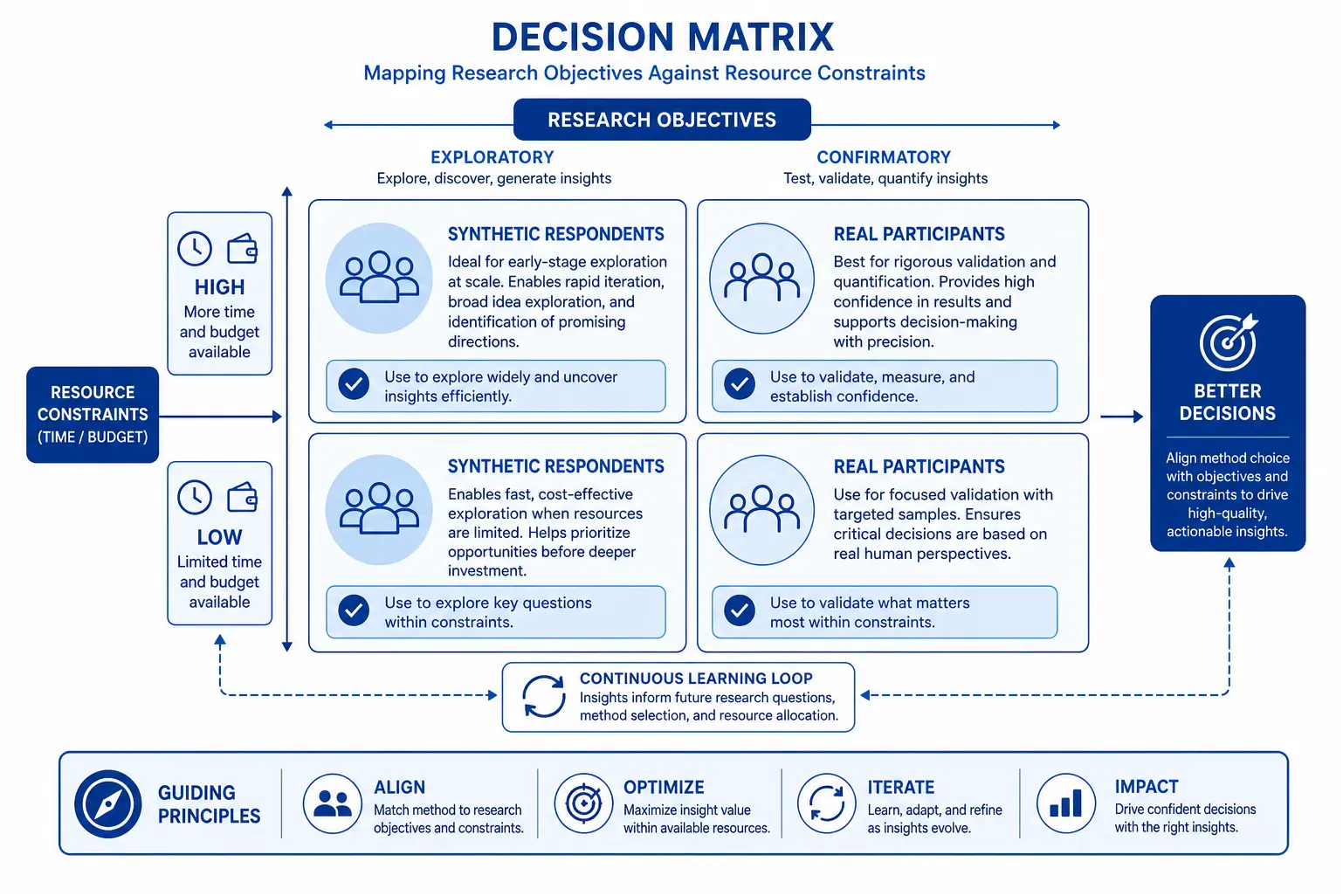
Step 1: Define your research objective with precision. Classify your study as exploratory (generating hypotheses), evaluative (testing concepts), or confirmatory (validating decisions). Exploratory research tolerates higher uncertainty and benefits from synthetic respondents’ speed and cost. Confirmatory research demands higher validity thresholds that often require real participants. Write a one-sentence objective statement that includes the decision this research will inform.
Step 2: Assess regulatory and compliance requirements. Review whether your industry, geography, or stakeholder expectations mandate human participants. Healthcare, financial services, and academic research typically require IRB approval or equivalent oversight that excludes purely synthetic data. If regulatory constraints exist, real participants are non-negotiable for primary data collection, though synthetic respondents may supplement analysis.
Step 3: Determine required emotional depth and cultural specificity. Rate your study on two dimensions: emotional authenticity (low/medium/high) and cultural nuance (low/medium/high). High ratings on either dimension favor real participants. A pricing sensitivity study for commodity products rates low on both; a brand positioning study exploring identity and values rates high. Synthetic respondents struggle with genuine emotional reactions and culturally embedded meanings.
Step 4: Calculate your validity threshold and acceptable error margin. Define the minimum accuracy level your stakeholders will accept and the consequences of being wrong. If a 15% error rate in understanding customer preferences leads to a failed product launch costing millions, real participants justify their premium. If you’re exploring 20 concept variations knowing only 3-5 will advance, synthetic respondents’ 80% accuracy suffices for initial filtering.
Step 5: Map your budget and timeline constraints realistically. Document actual available budget (not ideal budget) and hard deadline dates. If your budget is under $5,000 or your timeline is under two weeks, synthetic respondents may be your only viable option. If budget exceeds $30,000 and timeline allows 6+ weeks, real participants become feasible. The 5,000-30,000 range is where hybrid approaches deliver optimal value.
Step 6: Evaluate sample size and segmentation complexity. Count the number of demographic segments, behavioral cohorts, or psychographic groups you need to analyze separately. Real participant recruitment costs scale linearly with segment count each additional niche audience adds recruitment difficulty and cost. Synthetic respondents handle complex segmentation at minimal incremental cost, making them ideal for studies requiring 10+ distinct subgroups.
Step 7: Consider downstream validation and iteration needs. Determine whether this study is standalone or part of a multi-phase research program. If you plan to iterate concepts based on findings, synthetic respondents enable rapid testing cycles. If this study produces final recommendations requiring board-level confidence, real participants provide the credibility and validity stakeholders demand. Hybrid approaches work well when synthetic respondents inform iteration and real participants validate winners.
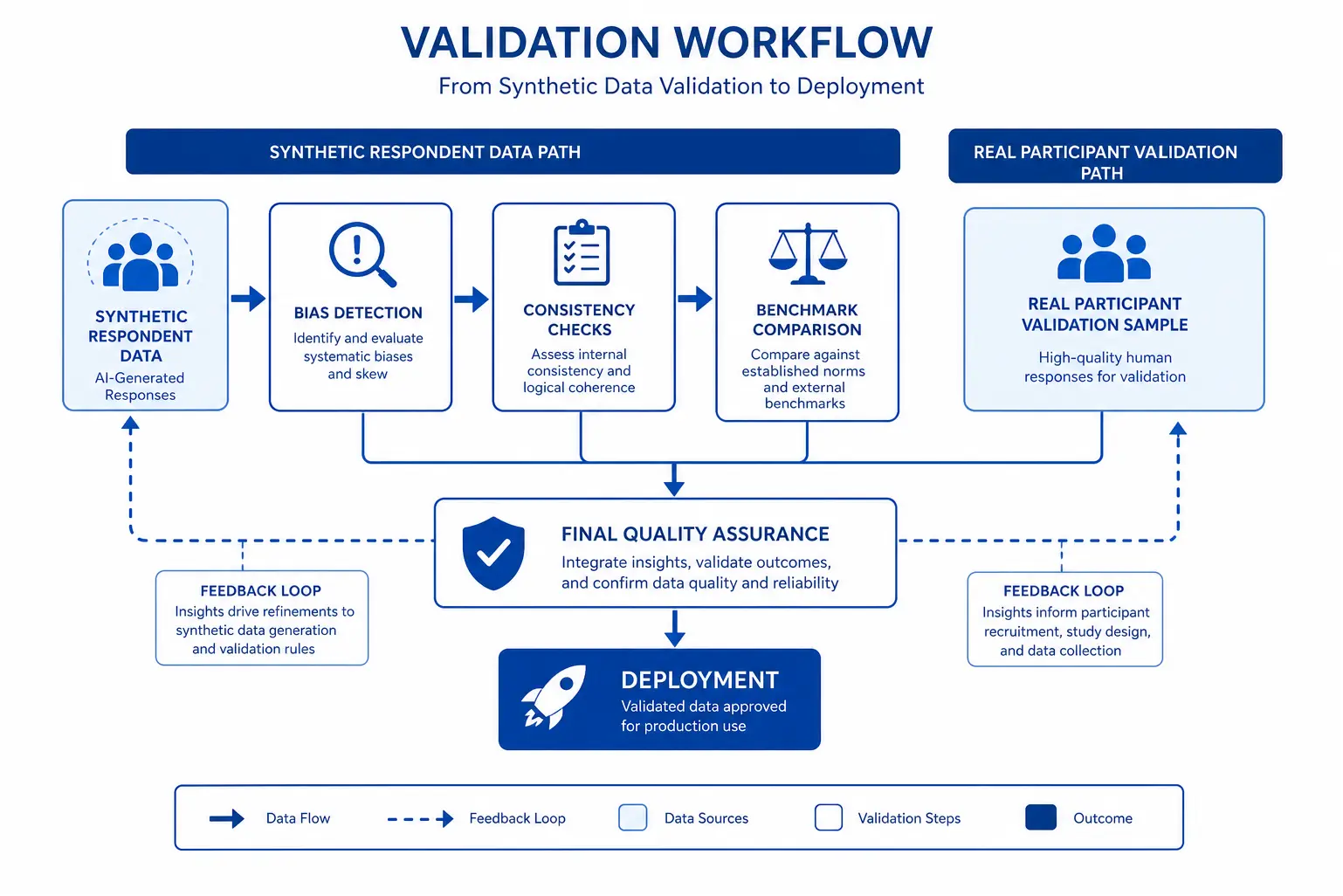
Step 8: Document your decision and validation plan. Create a written record explaining your methodology choice, the framework criteria that drove it, and the validation steps you’ll implement. For synthetic respondent studies, specify how you’ll benchmark against known data or validate with a real participant subset. For real participant studies, document how you’ll ensure sample representativeness. This documentation builds stakeholder confidence and creates institutional knowledge.
Best Practices for Choosing Between Synthetic and Real Participants
1. Start with synthetic, validate with real when budget allows. Use synthetic respondents to explore 15-20 concepts rapidly, identify the top 3-5 performers, then validate those finalists with a smaller real participant sample. This hybrid approach reduces total costs by 50-70% compared to testing all concepts with real participants while maintaining validity for final decisions. The synthetic phase filters noise; the real participant phase confirms signal.
2. Never use synthetic respondents alone for high-stakes, irreversible decisions. Product launches, brand repositioning, major capital investments, and strategic pivots require the highest validity levels. Real participants provide the confidence interval and stakeholder credibility these decisions demand. Synthetic respondents can inform the research design and supplement sample sizes, but should not constitute the sole evidence base.
3. Calibrate synthetic models against your specific market before deployment. Generic synthetic respondent models trained on broad population data may not reflect your niche audience’s characteristics. Validate synthetic outputs against historical research data, customer analytics, or a small real participant benchmark study before scaling. A 50-person real participant calibration study can dramatically improve synthetic respondent accuracy for subsequent larger studies.
4. Disclose methodology transparently to stakeholders and in publications. Specify whether data came from synthetic respondents, real participants, or a hybrid approach. Describe the AI models used, training data sources, and validation steps taken. Transparency builds trust and allows stakeholders to appropriately weight findings. Methodological disclosure is becoming an ethical standard as synthetic research scales.
5. Use real participants for discovering unknown unknowns; use synthetic for exploring known variables. Real participants surface unexpected insights, spontaneous reactions, and perspectives you didn’t think to ask about. Synthetic respondents excel at systematically exploring variables you’ve already identified. If your research goal includes discovering what you don’t know you don’t know, real participants are essential. If you’re optimizing known parameters, synthetic respondents suffice.
6. Monitor for model drift and bias amplification in synthetic respondents. AI models can perpetuate or amplify biases present in training data. Regularly audit synthetic respondent outputs for demographic stereotyping, unrealistic consistency, or patterns that diverge from real-world benchmarks. Implement bias detection protocols and update models quarterly as new behavioral data becomes available.
7. Reserve real participants for emotionally charged or ethically sensitive topics. Mental health research, trauma experiences, social justice issues, and deeply personal decisions require genuine human input. Synthetic respondents lack the ethical standing and emotional authenticity these topics demand. Using synthetic respondents for sensitive research risks both methodological invalidity and reputational damage.
How AI Is Changing Synthetic Respondents vs Real Participants Decisions in 2026
Generative AI has fundamentally altered the decision calculus by improving synthetic respondent accuracy while simultaneously making real participant analysis more efficient. Large language models fine-tuned on behavioral datasets now achieve 85% accuracy on demographic and attitudinal patterns, up from 60-70% in 2024. This accuracy improvement expands the range of research questions where synthetic respondents deliver acceptable validity.
AI-powered participant recruitment platforms have reduced real participant costs and timelines. Automated screening, dynamic quota management, and predictive quality scoring compress recruitment from 3-4 weeks to 5-7 days while reducing per-participant costs by 30-40%. This efficiency gain narrows the cost differential between synthetic and real participants, making hybrid approaches more economically viable.
Natural language processing enables deeper analysis of both synthetic and real participant responses. Sentiment analysis, theme extraction, and semantic clustering apply equally to AI-generated and human-generated text, allowing researchers to combine datasets and compare patterns systematically. This analytical parity makes hybrid methodologies more practical.
The research methodology teams at H-in-Q.com have developed AI-driven decision trees that recommend optimal methodology mixes based on study parameters. By analyzing 2,000+ completed research projects, these systems predict which approach will deliver the best validity-to-cost ratio for specific research objectives, automatically flagging cases where synthetic respondents pose unacceptable risks or where real participants represent unnecessary expense.
Continuous learning systems now update synthetic respondent models in near-real-time as new behavioral data becomes available. This reduces model drift and improves accuracy for rapidly evolving markets. Real participant studies feed data back into synthetic models, creating a virtuous cycle where each methodology improves the other’s performance.
Explainable AI tools provide transparency into synthetic respondent reasoning, showing which training data patterns influenced specific responses. This interpretability helps researchers identify when synthetic outputs reflect genuine behavioral patterns versus model artifacts, improving confidence in distinguishing valid insights from hallucinations.
Tools and Resources for Implementing This Decision Framework
Synthetic Minds offers enterprise-grade synthetic respondent platforms with industry-specific model fine-tuning. Their validation dashboards compare synthetic outputs against real participant benchmarks automatically, flagging discrepancies that exceed acceptable thresholds. Pricing starts at $2,000/month for unlimited synthetic respondents with built-in bias detection.
Conjointly provides hybrid research capabilities combining synthetic respondents for initial concept screening with real participant validation. Their platform automatically routes high-performing concepts from synthetic testing to human panels, streamlining the hybrid workflow. Free tier available for studies under 200 synthetic respondents.
Qualtrics Research Core integrates traditional panel recruitment with synthetic respondent options in a single platform. Their decision wizard asks researchers about study objectives, timelines, and budgets, then recommends optimal methodology mixes. Enterprise pricing varies based on annual research volume.
Prolific specializes in high-quality real participant recruitment with advanced screening and attention check automation. Their platform serves as the validation layer for researchers using synthetic respondents in exploratory phases. Per-participant pricing averages $6-12 depending on targeting complexity and study length.
SimSurvey focuses specifically on the synthetic respondent use case, offering pre-trained models for consumer goods, B2B technology, and healthcare markets. Their calibration service runs parallel synthetic and real participant studies to establish accuracy baselines for your specific audience. Starting at $500 per study.
Research Defender provides quality assurance and fraud detection for real participant studies, ensuring that when you invest in human input, you’re getting genuine responses rather than bots or inattentive participants. This validation layer justifies the premium paid for real participants. Pricing at $0.50-1.50 per participant screened.
The choice between synthetic respondents and real participants is not binary but contextual. The framework presented here provides a systematic approach to matching methodology with research objectives, validity requirements, and practical constraints. Organizations that master this decision process gain speed, cost efficiency, and research quality simultaneously.
Three principles guide optimal decisions: use synthetic respondents for exploration and iteration where speed and scale matter most, reserve real participants for validation and emotionally nuanced topics where authenticity is non-negotiable, and implement hybrid approaches that leverage each method’s strengths while mitigating weaknesses. The synthetic respondents vs real participants question becomes less about choosing one over the other and more about orchestrating both strategically.
As AI capabilities advance and regulatory frameworks evolve, the decision criteria will shift. Regular reassessment of your methodology choices ensures your research operations remain optimized for current technological capabilities and market conditions. The competitive advantage belongs to organizations that treat methodology selection as a strategic capability rather than a default habit. Explore how H-in-Q.com can help your research team implement decision frameworks that optimize for validity, speed, and cost simultaneously. The future of market research is neither purely synthetic nor exclusively human it’s intelligently hybrid.
Frequently Asked Questions
When should I use synthetic respondents instead of real participants?
Use synthetic respondents for exploratory research, concept testing, rapid iteration, or when budget and time constraints prevent traditional recruitment. Reserve real participants for final validation, sensitive topics requiring genuine human emotion, and regulatory-compliant studies where synthetic data is not yet accepted.
Are synthetic respondents as accurate as real survey participants?
Synthetic respondents achieve 75-85% accuracy compared to real participants in controlled studies, particularly for demographic and behavioral patterns. However, they underperform on emotional nuance, spontaneous reactions, and culturally specific contexts where lived experience is irreplaceable.
Can I combine synthetic respondents with real participants in one study?
Yes, hybrid approaches are increasingly common in 2026. Use synthetic respondents to generate initial hypotheses and scale sample sizes, then validate findings with a smaller real participant cohort. This reduces costs by 40-60% while maintaining methodological rigor.
What are the main risks of using synthetic respondents?
The primary risks include model bias amplification, lack of genuine emotional depth, regulatory non-compliance in certain industries, and potential hallucination of non-existent patterns. Always validate synthetic outputs against real-world benchmarks and disclose methodology transparently.
How much cheaper are synthetic respondents compared to real participants?
Synthetic respondents typically cost 70-90% less than recruiting and compensating real participants. A 1,000-respondent synthetic study might cost $500-2,000 versus $15,000-50,000 for equivalent traditional panel recruitment, depending on targeting complexity and geographic scope.
Do synthetic respondents work for B2B market research?
Synthetic respondents perform well for B2B research when trained on industry-specific data and validated against known benchmarks. They excel at simulating role-based decision-making patterns but require real participant validation for niche industries, emerging markets, and executive-level insights.