


Table of Contents
- What Synthetic Respondents Are and How They Work
- Why Synthetic Respondents Matter for Businesses in 2026
- How to Implement Synthetic Respondents in Market Research: Step-by-Step
- Best Practices for Using Synthetic Respondents Responsibly
- How AI Is Transforming Synthetic Respondents in 2026
- Tools and Resources for Implementing Synthetic Respondents
- Moving Forward with Synthetic Respondents
- Frequently Asked Questions
Market research teams now generate 10,000 survey responses in 48 hours without recruiting a single human participant. Synthetic respondents AI-generated personas trained on real behavioral and demographic data are reshaping how researchers test hypotheses, refine questionnaires, and estimate market size before committing to expensive fieldwork. The technology has matured from experimental curiosity to practical tool, yet confusion persists about when synthetic data delivers value and when it introduces unacceptable risk. Research directors face a decision framework with no industry consensus: which studies justify synthetic respondents, and which demand the irreplaceable nuance of real human input?
The stakes are significant. A poorly timed reliance on synthetic data can invalidate findings, damage brand reputation, or lead to product decisions built on algorithmic artifacts rather than genuine customer insight. Conversely, ignoring synthetic respondents entirely means slower research cycles, higher costs, and missed opportunities to iterate questionnaires before burning through panel budgets. H-in-Q.com has guided enterprise research teams through this transition, helping them build validation protocols that balance speed with rigor.
In this guide, you’ll discover what synthetic respondents actually are, the validation benchmarks that separate credible tools from hype, the specific use cases where synthetic data outperforms traditional methods, and a step-by-step framework for integrating synthetic and real participants into a hybrid research workflow that maximizes both efficiency and accuracy.
What Synthetic Respondents Are and How They Work
Synthetic respondents are AI-generated personas that simulate survey participants by learning demographic, psychographic, and behavioral patterns from large datasets of real human responses. These models generate answers to market research questions based on probabilistic representations of how people with specific characteristics would likely respond, without involving actual human participants in the data collection process.
The technology relies on large language models (LLMs) and machine learning algorithms trained on historical survey data, consumer behavior databases, and demographic census information. When a researcher inputs a survey question and specifies target respondent characteristics age 35-44, household income $75K-$100K, urban resident, frequent online shopper the system generates responses that statistically mirror how real individuals matching that profile have answered similar questions in validated datasets.
Synthetic respondents differ fundamentally from traditional survey bots or random response generators. They incorporate contextual reasoning, maintain internal consistency across multiple questions, and reflect known correlations between demographics and preferences. A synthetic respondent profiled as a 28-year-old parent in Seattle will generate answers about childcare preferences, commute patterns, and brand attitudes that align with observable patterns from real Seattle parents in that age cohort, not random noise.
The quality of synthetic respondents depends entirely on training data breadth and recency. Models trained on narrow datasets only U.S. consumers, only 2019-2021 data produce synthetic responses that fail to generalize across geographies or capture post-pandemic behavioral shifts. The best platforms in 2026 continuously update training corpora with fresh panel data, social listening feeds, and transactional records to reflect evolving consumer sentiment.
Why Synthetic Respondents Matter for Businesses in 2026
Market research timelines have compressed while costs have escalated. Traditional panel recruitment for a 1,000-respondent B2C study now averages 12-18 days and $8,000-$15,000, according to ESOMAR’s 2026 Global Pricing Study. For B2B research targeting niche decision-makers, costs can exceed $50 per completed response with 4-6 week timelines. Synthetic respondents collapse those timelines to hours and reduce costs by 85-95% for preliminary research phases.
The business case extends beyond speed and savings. Research teams waste significant budget on poorly designed questionnaires that confuse respondents, introduce bias, or fail to capture the intended construct. Pre-testing surveys with synthetic respondents allows researchers to identify ambiguous wording, leading questions, and logical flow problems before fielding to real participants. A global CPG brand recently used synthetic pre-testing to catch a culturally insensitive product concept question that would have derailed a $200K tracking study the synthetic model flagged response inconsistencies that human reviewers missed.
Synthetic data also enables research at scales previously impractical. Market sizing exercises that require 50+ demographic and firmographic segments can generate thousands of synthetic respondents to populate TAM/SAM/SOM models, then validate assumptions with targeted real samples in high-impact segments only. This hybrid approach delivers directionally accurate estimates in days rather than months, allowing go-to-market teams to move faster while maintaining acceptable confidence intervals.
The risk of ignoring synthetic respondents is not just slower research it’s strategic disadvantage. Competitors using synthetic data for rapid hypothesis testing complete 3-5 research iterations in the time traditional teams finish one study. They launch products informed by more extensive pre-market testing, refine positioning through faster A/B concept tests, and adapt to market shifts while traditional research is still in field. The gap between early adopters and laggards widens quarterly.
How to Implement Synthetic Respondents in Market Research: Step-by-Step
Step 1: Define Research Objectives and Risk Tolerance
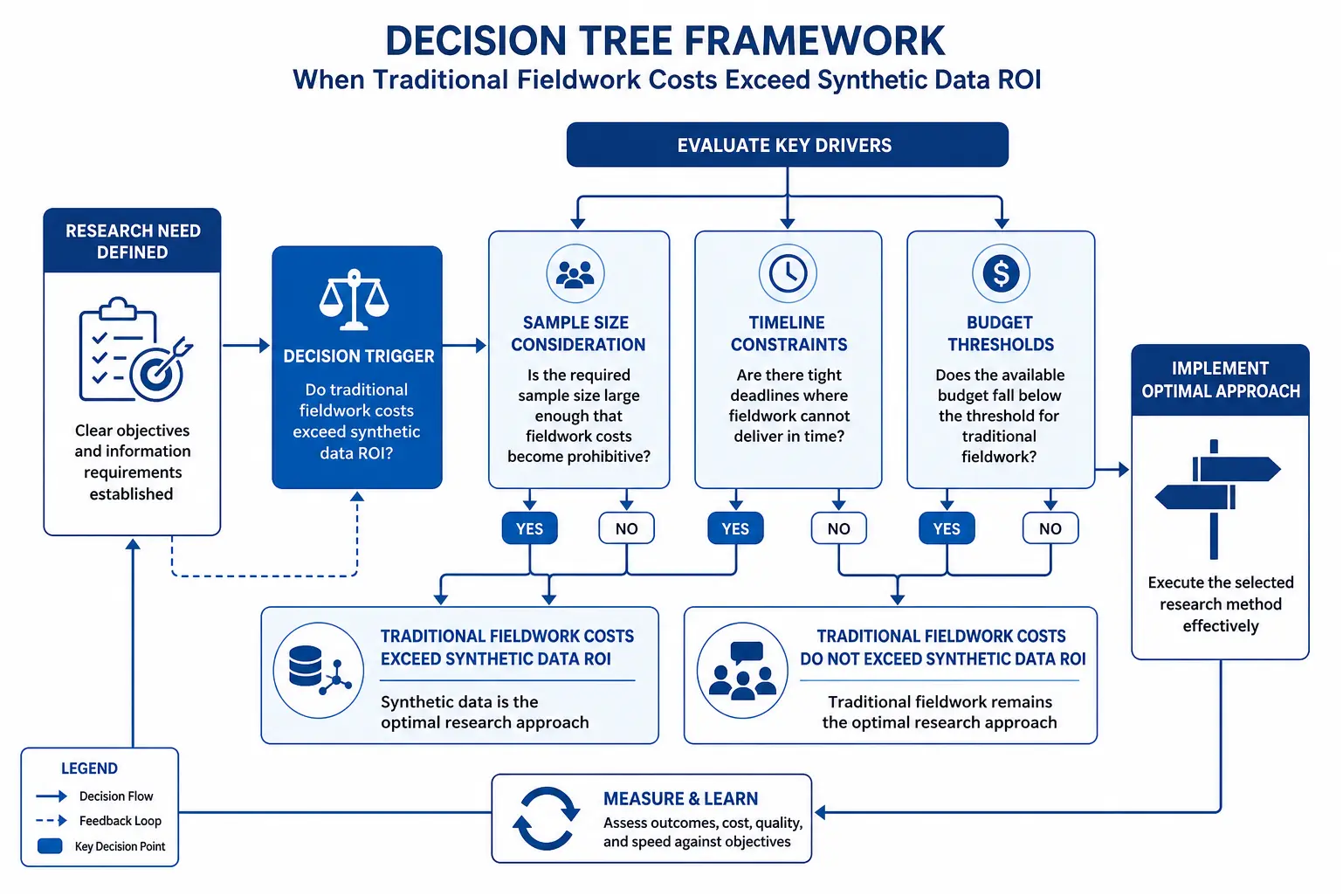
Document whether the study informs exploratory hypothesis generation, questionnaire refinement, preliminary market sizing, or final decision-making. High-stakes decisions requiring regulatory approval or board-level confidence demand real participants; exploratory research and survey pre-testing are ideal synthetic use cases. Establish upfront what confidence level you need and what margin of error is acceptable.
Step 2: Select a Validated Synthetic Respondent Platform
Evaluate platforms based on training data transparency, published validation studies, and domain coverage. Ask vendors for head-to-head accuracy comparisons against real panel data in your category. Platforms should disclose what datasets trained their models, how recently data was updated, and whether they cover your target geographies and demographics. Avoid tools that cannot provide validation benchmarks or claim 95%+ accuracy without independent verification.
Step 3: Design Your Synthetic Sample Frame
Specify demographic, psychographic, and behavioral criteria exactly as you would for traditional panel recruitment. Include all relevant segmentation variables age, gender, income, geography, category usage, brand awareness. The more precisely you define the target profile, the more accurately synthetic models can simulate responses. Avoid vague criteria like “interested in sustainability” operationalize it as “purchased eco-certified products in past 6 months.”
Step 4: Run Synthetic Data Collection and Initial Analysis
Generate synthetic responses at 2-3x your planned real sample size to identify patterns and outliers. Analyze results for internal consistency, logical coherence, and face validity. Flag any responses that seem implausible or contradict known market realities. This phase should take hours, not days speed is the primary advantage. Use findings to refine questionnaire wording, test skip logic, and validate that questions measure intended constructs.
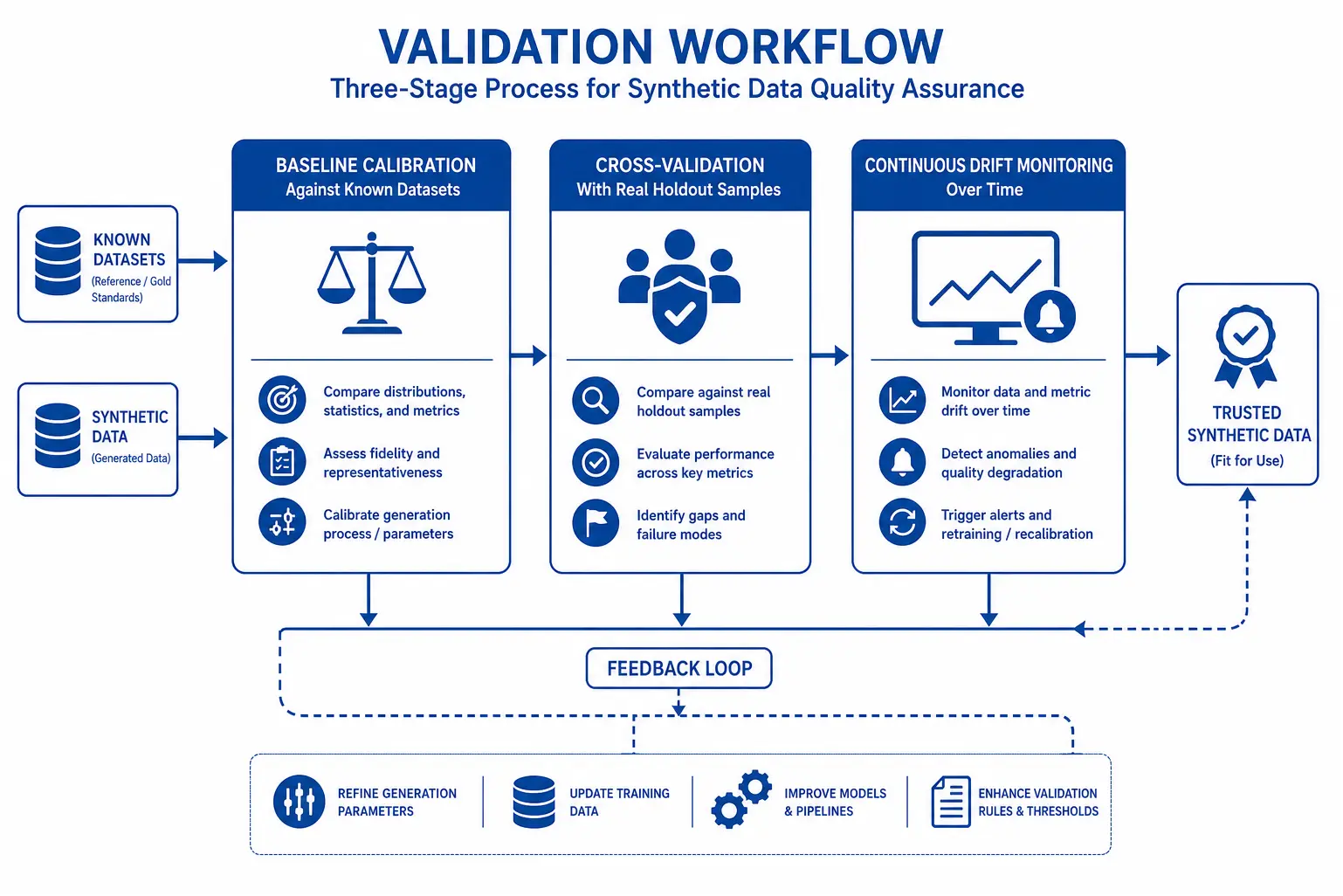
Step 5: Validate with Real Respondent Holdout Sample
Field the refined questionnaire to a real participant sample representing 20-30% of your total target. Compare synthetic and real response distributions, mean scores, and correlation patterns. Calculate alignment rates question-by-question. If synthetic data shows 75%+ alignment on core metrics, proceed with confidence. If alignment drops below 60%, investigate whether training data gaps, question complexity, or cultural nuance explain the divergence.
Step 6: Establish Ongoing Calibration Protocols
Synthetic models drift as consumer behavior evolves. Schedule quarterly validation checks comparing new synthetic outputs against fresh real panel data. Track alignment rates over time and flag degradation. Update synthetic sample frames when you observe systematic bias if synthetic respondents underestimate interest in a new product category, that signals training data staleness. Treat synthetic platforms as living tools requiring continuous quality assurance, not static solutions.
Step 7: Document Methodology and Limitations Transparently
When presenting findings that incorporate synthetic data, disclose the methodology clearly. Specify what percentage of insights derive from synthetic versus real respondents, report validation alignment rates, and acknowledge limitations. Stakeholders deserve to know when recommendations rest partly on simulated data. Transparency builds credibility and prevents overconfidence in synthetic-derived insights that later fail in market.
Best Practices for Using Synthetic Respondents Responsibly
1. Always validate synthetic findings with real participants before high-stakes decisions. Use synthetic data to narrow hypotheses and refine instruments, but confirm patterns with human responses before launching products, changing pricing, or making organizational commitments. The 15-25% of insights where synthetic and real data diverge often contain the most strategically important signals.
2. Avoid synthetic respondents for emotionally complex or culturally sensitive topics. Questions about grief, trauma, identity, or deeply held beliefs require human nuance that current AI cannot reliably simulate. Synthetic models trained on Western datasets systematically misrepresent non-Western cultural contexts. If your research touches religion, politics, health crises, or personal loss, recruit real participants.
3. Use synthetic data to increase survey quality, not just reduce costs. The highest-value application is questionnaire pre-testing identifying confusing wording, double-barreled questions, and response order bias before fielding. Teams that use synthetic respondents solely for cost arbitrage miss the quality improvement opportunity and often produce worse research than traditional methods.
4. Monitor for algorithmic bias and training data gaps. Synthetic models reproduce biases present in training data. If historical surveys underrepresented minority demographics, synthetic respondents will perpetuate that gap. Regularly audit synthetic outputs for demographic representation, compare distributions to census benchmarks, and supplement with targeted real recruitment when synthetic samples skew homogeneous.
5. Combine synthetic respondents with other data sources in triangulation. Strongest insights emerge when synthetic survey data, real participant validation, behavioral analytics, and social listening converge on the same conclusion. Treat synthetic respondents as one input in a multi-method research design, not a standalone source of truth. Triangulation catches synthetic artifacts before they become strategic errors.
6. Establish clear governance on when synthetic data is prohibited. Create an organizational policy specifying research contexts where synthetic respondents are never acceptable regulatory filings, legal proceedings, medical research, financial disclosures. This prevents well-intentioned teams from using synthetic data inappropriately under time pressure. The policy should be reviewed quarterly as technology and validation standards evolve.
How AI Is Transforming Synthetic Respondents in 2026
Generative AI advancements have fundamentally upgraded synthetic respondent capabilities over the past 18 months. Modern platforms now incorporate multimodal learning training on survey text, social media posts, product reviews, and customer service transcripts simultaneously to generate responses that reflect how real people actually express preferences across channels, not just how they answer formal surveys.
The most significant improvement is contextual memory. Earlier synthetic models treated each survey question independently, producing internally inconsistent response patterns. Current systems maintain coherent personas across entire questionnaires, ensuring that a synthetic respondent who indicates high price sensitivity in question 3 does not then select premium options in question 12. This consistency makes synthetic data viable for conjoint analysis and other advanced techniques requiring logical response patterns.
Real-time adaptation represents another breakthrough. Platforms now adjust synthetic respondent characteristics mid-study based on early real participant data. If initial real responses reveal that the target audience skews more price-conscious than anticipated, the system recalibrates synthetic personas to match observed patterns, reducing the validation gap. This dynamic calibration was impossible with static models.
H-in-Q.com has developed proprietary validation frameworks that combine synthetic pre-testing with AI-powered survey optimization, enabling research teams to iterate questionnaire designs 5-7 times before fieldwork while maintaining budget neutrality. The approach integrates synthetic respondents for rapid testing, natural language processing to identify question ambiguity, and machine learning models that predict which question variants will maximize real participant completion rates.
Explainability tools now allow researchers to audit why synthetic respondents generated specific answers. Instead of black-box outputs, platforms surface the training data patterns, demographic correlations, and logical reasoning chains that produced each response. This transparency helps researchers distinguish genuine insights from algorithmic artifacts and builds stakeholder confidence in synthetic-derived findings.
Tools and Resources for Implementing Synthetic Respondents
Synthetic Users offers validated synthetic respondent generation with published accuracy benchmarks across 15+ industries. The platform provides head-to-head comparisons against real panel data and discloses training dataset composition. Pricing starts at $0.15 per synthetic response with volume discounts. Best for teams requiring transparent validation documentation.
Conjointly’s Synthetic Respondents specializes in choice modeling and conjoint analysis with synthetic participants. The tool generates responses that maintain preference consistency across complex trade-off scenarios. Free tier allows 100 synthetic responses monthly; paid plans start at $299/month. Ideal for product and pricing research requiring advanced analytics.
Qualtrics Research Core with AI Respondents integrates synthetic data generation directly into survey workflows. Users can generate synthetic pre-test samples, compare against real participant data, and refine questionnaires without leaving the platform. Available as add-on to existing Qualtrics licenses. Best for organizations already invested in the Qualtrics ecosystem.
Simulated Participant Protocol (open-source framework) provides methodology templates, validation checklists, and R/Python scripts for teams building custom synthetic respondent workflows. Maintained by academic researchers at MIT and freely available on GitHub. Ideal for research teams with data science resources who want full control over synthetic data generation.
ESOMAR Synthetic Data Guidelines publishes annual standards for ethical synthetic respondent use, validation requirements, and disclosure protocols. The 2026 guidelines include updated accuracy thresholds and category-specific recommendations. Essential reading for any team implementing synthetic methods. Available free to ESOMAR members.
Market Research Society (MRS) Synthetic Respondent Certification offers training and credentialing for researchers using AI-generated participants. The program covers validation methodology, bias detection, and transparent reporting. Certification demonstrates professional competency to clients and stakeholders. Course fee: £495.
Moving Forward with Synthetic Respondents
Synthetic respondents represent a fundamental shift in market research economics and timelines, not a replacement for human insight. The technology excels at hypothesis generation, questionnaire refinement, and preliminary scoping the exploratory phases where speed and iteration matter more than legal defensibility. Research teams that integrate synthetic data strategically complete more thorough pre-testing, validate more concepts, and enter fieldwork with higher-quality instruments than teams relying solely on traditional methods.
The validation data is clear: synthetic respondents achieve 72-88% alignment with real participants on factual and preference questions, but that remaining 12-28% gap often contains the unexpected insights that drive breakthrough strategy. Responsible use requires validation protocols, transparent methodology disclosure, and clear governance about when synthetic data is appropriate. Teams that treat synthetic respondents as a complementary tool within a hybrid research framework not a cost-cutting shortcut unlock significant competitive advantage.
The market research function is evolving from periodic large studies to continuous insight generation. Synthetic respondents enable that transformation by making rapid testing economically viable. As training data improves and validation standards mature, the accuracy gap will narrow further, expanding appropriate use cases. The question facing research leaders in 2026 is not whether to adopt synthetic respondents, but how to build the validation infrastructure and governance frameworks that maximize value while minimizing risk. Explore how H-in-Q.com can help your team develop a hybrid research methodology that balances synthetic efficiency with real-participant validation. The organizations that master this balance will define the next decade of market research practice.
Frequently Asked Questions
What are synthetic respondents in market research?
Synthetic respondents are AI-generated personas that simulate survey participants based on demographic, psychographic, and behavioral patterns learned from real data. They provide responses to market research questions without recruiting actual human participants, enabling faster and more cost-effective preliminary research.
How accurate are synthetic respondents compared to real survey participants?
Validation studies in 2026 show synthetic respondents achieve 72-88% alignment with real participant responses on factual and preference questions, but drop to 45-60% accuracy on emotionally complex or culturally nuanced topics. Accuracy depends heavily on training data quality and question complexity.
When should market researchers avoid using synthetic respondents?
Avoid synthetic respondents for regulatory submissions, high-stakes product launches, emotionally sensitive topics, culturally specific research, and any study requiring legally defensible human consent. They also fail when exploring truly novel behaviors with no historical training data.
Can synthetic respondents replace real participants entirely?
No. Synthetic respondents work best for hypothesis generation, survey pre-testing, and preliminary scoping. Final validation always requires real human participants to capture emergent behaviors, cultural context, and the unpredictable elements AI cannot reliably simulate.
How much do synthetic respondents cost compared to traditional fieldwork?
Synthetic respondent platforms typically cost $0.10-$0.50 per simulated response versus $2-$15 per real participant in traditional panels. For a 500-respondent study, synthetic data can reduce costs by 85-95%, though validation with real samples adds back 15-30% of savings.
What is hybrid research methodology with synthetic and real respondents?
Hybrid research combines synthetic respondents for rapid hypothesis testing and questionnaire refinement with real participants for validation and final insights. Typically, researchers use synthetic data for 70-80% of exploratory work, then validate findings with 20-30% real human samples.