


Table of Contents
- What Are the Risks of Synthetic Data in Market Research
- Why the Risks of Synthetic Data in Market Research Matter for Businesses in 2026
- How to Identify and Mitigate Synthetic Data Risks: Step-by-Step
- Best Practices for Mitigating Synthetic Data Risks
- How AI Is Changing Risk Management for Synthetic Data in 2026
- Tools and Resources for Managing Synthetic Data Risks
- Conclusion
- Frequently Asked Questions
Synthetic data promises faster, cheaper market research, yet 73% of researchers report discovering significant quality issues only after deploying synthetic respondents in production studies. The vendor pitch sounds compelling: instant access to any demographic, perfect sample sizes, no recruitment headaches. What they rarely emphasize upfront are the fundamental limitations that can invalidate your entire research investment if you deploy synthetic data without understanding where it breaks down.
Market research teams face mounting pressure to deliver insights faster while budgets shrink. Synthetic respondents generated by large language models offer an attractive solution, but the technology carries risks that extend far beyond simple accuracy metrics. These risks affect strategic decision-making, brand positioning, and product development in ways that become apparent only after costly mistakes have been made.
The risks of synthetic data in market research span technical, methodological, and ethical dimensions that vendors have little incentive to highlight. At H-in-Q.com, we work with research teams implementing AI solutions responsibly, and we consistently see the same preventable errors when organizations treat synthetic data as a direct replacement for human insight rather than a specialized tool with specific constraints.
In this guide, you’ll discover the documented limitations of synthetic respondents, the specific research scenarios where they fail, how to validate synthetic data quality, and the governance frameworks necessary to use this technology without compromising research integrity.
What Are the Risks of Synthetic Data in Market Research
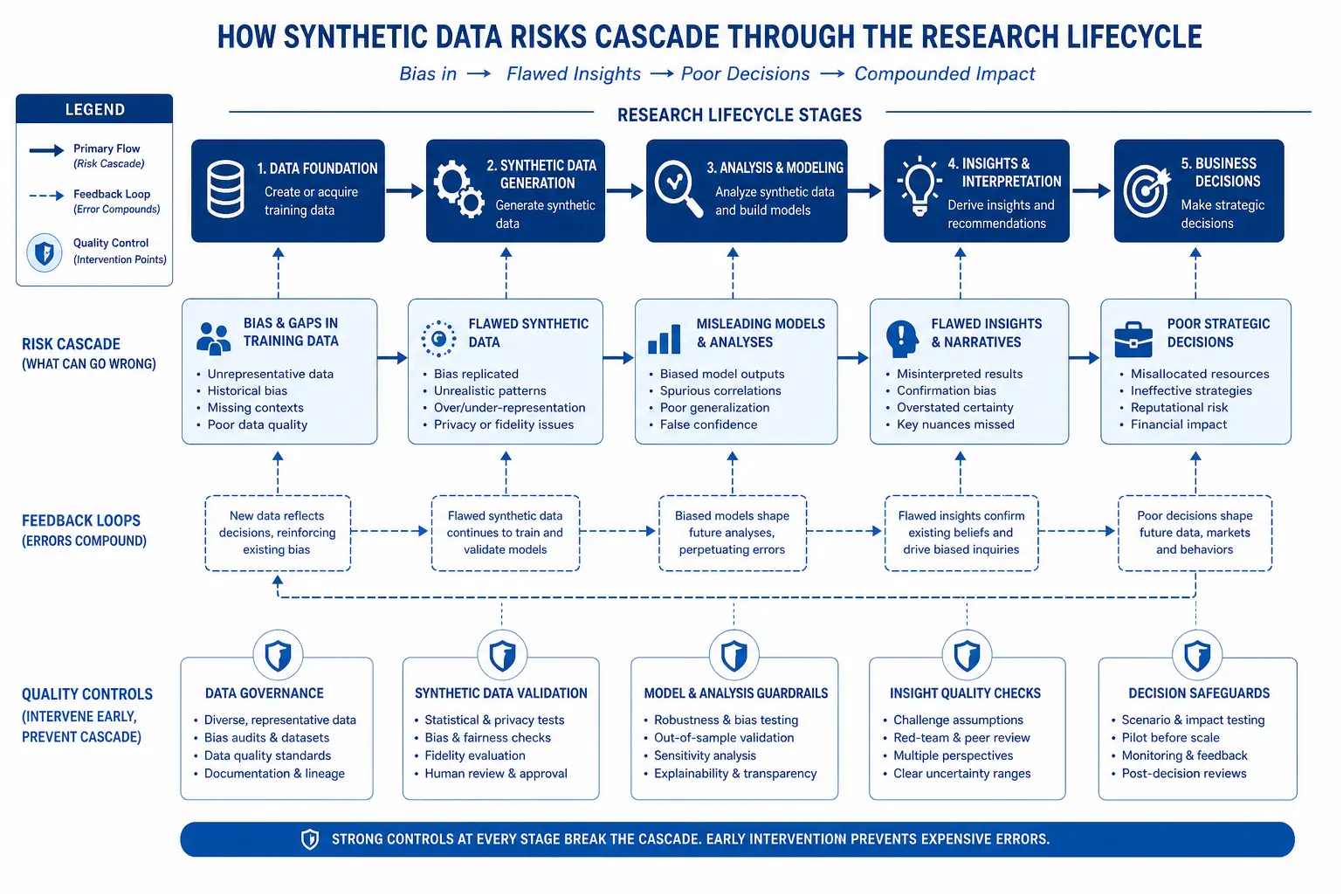
The risks of synthetic data in market research include systematic bias replication from training data, inability to capture authentic human emotion and cultural context, generation of plausible but factually incorrect responses, lack of genuine demographic diversity, and the fundamental limitation that synthetic respondents cannot provide experiences or perspectives outside their training parameters. These limitations create a dangerous illusion of validity because synthetic responses often appear statistically coherent while being substantively wrong.
The core technical risk stems from how large language models learn patterns. These systems identify statistical correlations in training data and reproduce them, which means any bias, gap, or error in the original dataset gets systematically encoded and amplified. A model trained predominantly on English-language internet content from Western sources cannot authentically represent the lived experience of a rural farmer in Southeast Asia, regardless of how the prompt is engineered.
Methodological risks emerge when researchers apply traditional research quality frameworks to synthetic data. Standard measures like internal consistency and response variance can appear normal even when the underlying data is fundamentally flawed. A synthetic respondent can provide perfectly consistent answers across a 30-minute survey because it has no fatigue, no distraction, and no genuine cognitive processing but this consistency is artificial, not a sign of quality.
The business risk manifests when strategic decisions get made on synthetic insights that seem rigorous but miss critical market realities. Product features designed around synthetic feedback, brand positioning based on synthetic sentiment, or market entry strategies informed by synthetic cultural understanding can fail spectacularly because the data looked good on every traditional metric while being disconnected from actual human behavior and preference.
Why the Risks of Synthetic Data in Market Research Matter for Businesses in 2026
The financial stakes of synthetic data risks have escalated dramatically. According to a Forrester Research report from early 2026, companies that deployed synthetic research without proper validation protocols experienced an average of $2.3 million in costs from failed product launches or repositioning efforts based on flawed insights. This figure represents only the direct measurable costs, not opportunity costs or brand damage.
The competitive landscape in 2026 makes these risks more consequential. Markets move faster, product cycles compress, and the margin for error in strategic decisions shrinks. When a competitor launches a product based on genuine human insight while you optimize for synthetic preferences, the market punishes the mistake quickly and publicly. The speed advantage that synthetic data promises becomes a liability when it accelerates you toward the wrong conclusion.
Regulatory scrutiny has intensified around AI-generated insights used in decision-making. The European Union’s AI Act implementation in 2026 specifically addresses the use of synthetic data in consumer research, requiring disclosure and validation protocols. Companies using synthetic respondents without proper governance face not just poor research outcomes but potential compliance violations and legal exposure in regulated industries.
The reputational risk extends beyond individual research projects. When stakeholders discover that strategic recommendations were based on AI-generated rather than human responses especially if this was not transparently disclosed trust in the entire research function erodes. Internal credibility, once lost to a synthetic data failure, takes years to rebuild regardless of how many subsequent studies use traditional methods.
The opportunity cost matters most for innovation-focused organizations. Synthetic data excels at reproducing patterns from the past but fundamentally cannot identify genuinely novel consumer needs or emerging cultural shifts. Companies that over-rely on synthetic research risk optimizing for yesterday’s patterns while missing the weak signals that define tomorrow’s opportunities.
How to Identify and Mitigate Synthetic Data Risks: Step-by-Step
Step 1: Conduct a Use Case Appropriateness Assessment Before deploying synthetic data, evaluate whether your research question falls within appropriate use cases. Synthetic data works for testing survey instruments, exploring broad concept reactions, and filling demographic gaps in preliminary research. It fails for emotionally nuanced topics, culturally specific insights, emerging trend identification, and any research requiring verifiable personal experience. Document this assessment with specific justification for why synthetic data is appropriate for your particular question.
Step 2: Audit Training Data Provenance and Recency Demand transparency from vendors about what data trained their models and when. A model trained on internet content through 2023 cannot provide valid insights about 2026 cultural attitudes or market conditions. Request documentation of training data sources, demographic representation, geographic coverage, and temporal boundaries. Reject vendors who cannot or will not provide this fundamental information about their methodology.
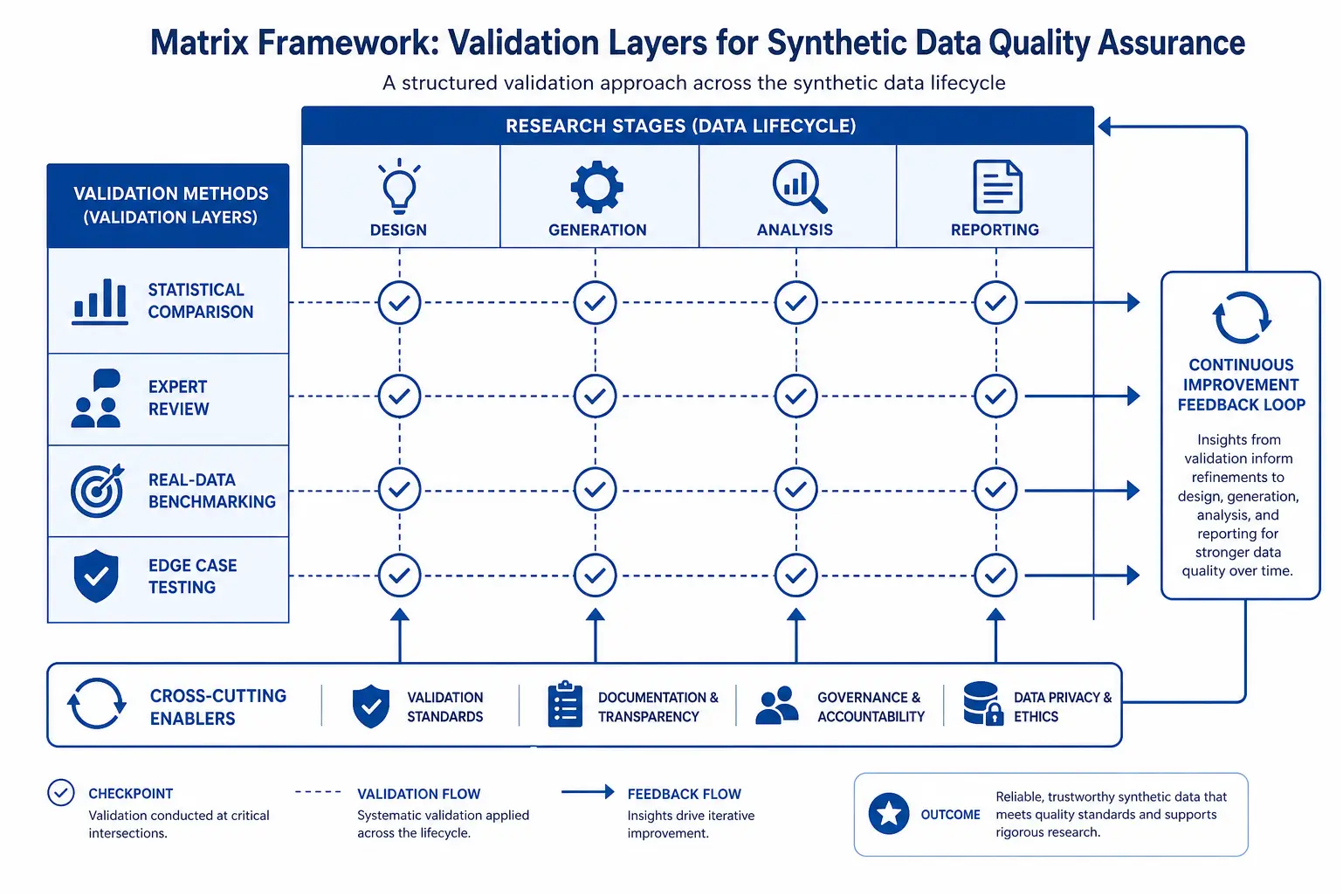
Step 3: Establish Parallel Validation Protocols Design every synthetic data study with a parallel validation component using real human respondents on a representative subset of questions. This validation sample need not be large 50 to 100 real respondents can reveal systematic divergence between synthetic and human responses. Compare not just aggregate statistics but response patterns, qualitative depth, and logical consistency across question types.
Step 4: Test for Known Failure Modes Deliberately include questions designed to expose common synthetic data failures: requests for specific personal experiences, culturally specific references, temporal knowledge (recent events), emotional depth probes, and logical consistency traps. Synthetic respondents often fail these tests in predictable ways providing generic experiences, missing cultural nuance, citing outdated information, offering shallow emotional responses, and contradicting themselves when questions are rephrased.
Step 5: Implement Expert Review Checkpoints Require domain experts and cultural specialists to review synthetic outputs before analysis. Statistical validity checks catch some errors, but subject matter experts identify substantive problems that appear statistically normal. An expert in luxury consumer behavior will immediately recognize when synthetic responses about high-end purchase motivations sound plausible but miss the actual psychology of luxury buyers.
Step 6: Document Limitations Transparently Create a standardized limitations disclosure for every research deliverable using synthetic data. This documentation should specify what percentage of data is synthetic, what validation was performed, what known limitations apply to the specific research question, and what decisions should not be made based solely on these findings. Transparency protects both the research function and decision-makers who rely on the insights.
Step 7: Establish Governance and Approval Workflows Implement formal approval processes for synthetic data use that require sign-off from research leadership, data science teams, and relevant business stakeholders. This governance prevents individual researchers from deploying synthetic methods in inappropriate contexts and ensures organizational awareness of where synthetic data is being used and what risks are being accepted.
Step 8: Create Feedback Loops for Continuous Validation When business decisions are made based on synthetic research, track outcomes systematically and compare them to predictions. Did the product feature that tested well with synthetic respondents actually resonate with real customers? Did the brand messaging that synthetic data validated perform as expected in market? These feedback loops reveal where synthetic data is reliable for your specific use cases and where it consistently fails.
Best Practices for Mitigating Synthetic Data Risks
1. Never use synthetic data as the sole basis for high-stakes decisions. Strategic product launches, brand repositioning, market entry, or significant budget allocation should always include validation with real human respondents. Synthetic data can inform preliminary exploration or hypothesis generation, but final go/no-go decisions require human validation. The cost of real research is trivial compared to the cost of a failed launch based on synthetic insights.
2. Prioritize depth over breadth in validation samples. Rather than surveying 1,000 synthetic respondents and 50 real ones, consider 300 synthetic and 200 real respondents with deeper questioning. The goal is not statistical power but pattern comparison. Smaller real samples with richer data reveal synthetic limitations more effectively than large synthetic samples with minimal validation.
3. Segment validation by demographic and psychographic characteristics. Synthetic data quality varies dramatically across different populations. Models may perform adequately for mainstream demographics well-represented in training data while failing completely for minority populations, non-Western cultures, or specialized psychographic segments. Validate separately for each key segment rather than relying on aggregate comparisons.
4. Counterintuitively, use synthetic data to stress-test research instruments, not to replace human responses. One of the most valuable applications of synthetic respondents is identifying ambiguous questions, confusing skip logic, or survey fatigue issues before fielding to real humans. Synthetic respondents provide instant feedback on instrument quality at zero marginal cost, improving the efficiency of subsequent human research rather than replacing it.
5. Establish red-line topics where synthetic data is categorically prohibited. Create an organizational policy that explicitly bans synthetic data for specific research domains: trauma and sensitive personal experiences, discrimination and bias research, emerging cultural movements, legal or regulatory compliance studies, and any research where participants might face harm if their responses were misrepresented. These boundaries prevent well-intentioned researchers from deploying synthetic methods in fundamentally inappropriate contexts.
6. Require temporal decay documentation for all synthetic models. Synthetic data quality degrades over time as the world changes beyond the model’s training cutoff. A model trained through 2024 becomes progressively less reliable for 2026 research as cultural attitudes, market conditions, and consumer preferences evolve. Vendors should provide explicit guidance on appropriate use windows and update frequencies.
7. Invest in synthetic data literacy across the research organization. The biggest risk is not the technology itself but researchers who don’t understand its limitations. Training programs should cover not just how to use synthetic data tools but when not to use them, how to validate outputs, and how to communicate limitations to stakeholders. This literacy prevents the most common failure mode: treating synthetic data as equivalent to human research simply because the vendor made it easy to deploy.
How AI Is Changing Risk Management for Synthetic Data in 2026
Artificial intelligence is simultaneously creating and solving synthetic data risks in market research. Advanced AI systems now perform automated validation by comparing synthetic response patterns against known human behavioral signatures, flagging outputs that exhibit statistical anomalies or logical inconsistencies that human reviewers might miss. These validation AI systems essentially audit other AI systems, creating a quality control layer that was impossible with traditional methods.
Machine learning models trained specifically on research methodology can now predict which research questions are likely to produce unreliable synthetic data based on question structure, topic sensitivity, and demographic targeting. These prediction systems help research teams make better deployment decisions upfront rather than discovering limitations after the study completes. The technology analyzes thousands of past studies to identify patterns in where synthetic data succeeded or failed.
H-in-Q.com has developed AI-powered governance frameworks that automatically route research proposals through appropriate approval workflows based on synthetic data usage, topic sensitivity, and business impact. These systems ensure that high-risk applications of synthetic data receive proper scrutiny while allowing low-risk uses to proceed efficiently, balancing innovation with appropriate caution.
Natural language processing advances enable more sophisticated detection of synthetic data artifacts the subtle linguistic patterns that distinguish AI-generated text from human responses. These detection systems help identify when synthetic respondents are being used without disclosure and can flag low-quality synthetic data that exhibits obvious generation patterns. The same technology that creates synthetic respondents is being weaponized to identify and validate them.
The most significant AI advancement for risk mitigation is the emergence of hybrid research platforms that dynamically blend synthetic and human respondents based on question type and response quality. These systems start with synthetic data for broad exploration, automatically identify areas requiring human validation, recruit real respondents for those specific questions, and synthesize the results into a single coherent dataset with appropriate confidence intervals for each insight. This approach optimizes for both speed and quality rather than forcing researchers to choose between them.
Tools and Resources for Managing Synthetic Data Risks
Anthropic’s Constitutional AI Framework provides transparent documentation of model limitations and bias mitigation strategies. While designed for general AI safety, the framework offers valuable guidance for researchers evaluating synthetic data vendor claims about accuracy and reliability. The constitutional approach helps teams ask better questions about what synthetic models can and cannot do.
Qualtrics Research Suite has integrated synthetic respondent validation tools that automatically flag suspicious response patterns and recommend human validation thresholds. The platform’s 2026 updates include side-by-side comparison dashboards for synthetic and human data, making quality differences immediately visible to research teams.
The Market Research Society’s Synthetic Data Guidelines published in early 2026 provide industry-standard protocols for disclosure, validation, and appropriate use cases. These guidelines offer practical checklists and decision trees that help research teams navigate deployment decisions and communicate limitations to stakeholders effectively.
OpenAI’s Model Cards for research applications document training data characteristics, known biases, and performance benchmarks across different demographic segments. These cards provide the technical transparency necessary for informed risk assessment, though researchers must actively request and review them rather than assuming vendor marketing materials tell the complete story.
Synthetic Data Validation Toolkit (open source) includes statistical tests specifically designed to detect common synthetic data failures: temporal inconsistency checks, cultural plausibility scoring, emotional depth analysis, and cross-question logical consistency validation. The toolkit integrates with major research platforms and provides automated reporting on data quality dimensions.
Research Defender (commercial platform) offers real-time monitoring of synthetic data quality during study fielding, automatically pausing data collection when quality thresholds are breached and recommending corrective actions. The system learns from each study to improve its ability to predict and prevent synthetic data failures before they compromise research integrity.
Conclusion
The risks of synthetic data in market research are neither hypothetical nor insurmountable, but they demand systematic management that most organizations have not yet implemented. Synthetic respondents offer genuine value for specific use cases when deployed with appropriate validation, governance, and transparency. The technology fails catastrophically when treated as a direct replacement for human insight rather than a specialized tool with defined limitations.
The most successful research organizations in 2026 approach synthetic data with clear-eyed pragmatism: they understand what it can and cannot do, they validate rigorously, they maintain transparency with stakeholders, and they never allow the convenience of synthetic methods to override the fundamental requirement for human truth in strategic decisions. The vendors who profit from synthetic data have little incentive to emphasize these limitations, making independent evaluation and governance essential.
The future of market research will certainly include synthetic data, but the winners will be organizations that master the discipline of knowing when to use it and when to insist on human respondents. This discipline requires investment in validation infrastructure, researcher training, and governance systems that most teams have not yet built. The cost of building these capabilities is modest compared to the cost of strategic failures based on plausible but fundamentally flawed synthetic insights.
Explore how H-in-Q.com can help your research team implement AI-powered insights with appropriate validation and governance frameworks. The organizations that thrive in the synthetic data era will be those that combine technological capability with methodological rigor, never sacrificing research integrity for operational convenience.
Frequently Asked Questions
What are the main risks of using synthetic data in market research?
The main risks include algorithmic bias replication, inability to capture genuine human emotion and cultural nuance, overfitting to training data patterns, lack of true demographic diversity, and potential for generating plausible but factually incorrect responses. These limitations can lead to strategic decisions based on fundamentally flawed insights that appear statistically valid on the surface.
Can synthetic respondents replace real human participants completely?
No, synthetic respondents cannot fully replace real human participants in 2026. They lack genuine lived experience, emotional depth, cultural context, and the ability to express truly novel perspectives. Synthetic data works best as a complement to human research for specific use cases like initial concept testing or filling demographic gaps, not as a complete replacement.
How do I validate synthetic data quality in my research?
Validate synthetic data by comparing distributions against known real-world benchmarks, conducting parallel studies with real respondents on a subset of questions, testing for logical consistency across responses, examining edge cases for plausibility, and having domain experts review outputs for face validity. Always document validation methods and limitations transparently.
What types of research questions are inappropriate for synthetic data?
Avoid using synthetic data for emotionally sensitive topics, culturally specific insights, emerging trends not in training data, creative ideation requiring genuine novelty, legal or regulatory compliance research, and studies requiring verifiable personal experiences. Synthetic data cannot authentically represent trauma, joy, cultural identity, or experiences outside its training parameters.
How does bias in synthetic data differ from bias in traditional research?
Bias in synthetic data is systematically encoded and replicated at scale from training data, making it harder to detect and impossible to correct through traditional sampling techniques. Unlike human bias which varies across individuals, synthetic bias is consistent and reproducible, creating the illusion of reliability while potentially amplifying historical inequities embedded in source datasets.
What should I ask vendors about their synthetic data methodology?
Ask vendors about training data sources and recency, validation methods against real populations, known failure modes and edge cases, demographic representation testing, bias mitigation strategies, update frequency for models, transparency in limitations documentation, and whether they conduct parallel real-human validation studies. Reputable vendors openly discuss these factors rather than making universal accuracy claims.