


Table of Contents
- What Is Synthetic Data for Survey Pre-Testing
- Why Synthetic Data for Survey Pre-Testing Matters for Businesses in 2026
- How to Implement Synthetic Data for Survey Pre-Testing: Step-by-Step
- Best Practices for Synthetic Survey Pre-Testing
- How AI Is Changing Survey Pre-Testing in 2026
- Tools and Resources for Synthetic Survey Pre-Testing
- Conclusion
- Frequently Asked Questions
A Fortune 500 brand launched a customer satisfaction survey in 2026 that asked respondents to rate “product quality” on a 1-10 scale only to discover during analysis that 40% of participants interpreted the scale backwards, assuming 1 meant “best.” The error cost six weeks of fieldwork and $180,000 in wasted panel fees. One round of synthetic data for survey pre-testing would have caught the ambiguity before a single real respondent saw the question. Survey design flaws remain the silent budget killer in market research, and traditional pilot testing catches them too late or not at all. Teams now routinely use AI-generated response simulation to stress-test questionnaires in hours instead of weeks, identifying leading questions, confusing scales, and broken logic paths before fieldwork begins. In this guide, you’ll discover exactly how synthetic pre-testing works, when it outperforms traditional pilots, and the step-by-step process for integrating it into your research workflow in 2026.
What Is Synthetic Data for Survey Pre-Testing
Synthetic data for survey pre-testing is the use of AI language models to generate simulated respondent answers to draft survey questions before recruiting real participants. The system analyzes question wording, scale design, skip logic, and response option clarity by producing hundreds or thousands of synthetic completions that mirror how diverse human audiences would interpret and answer each item.
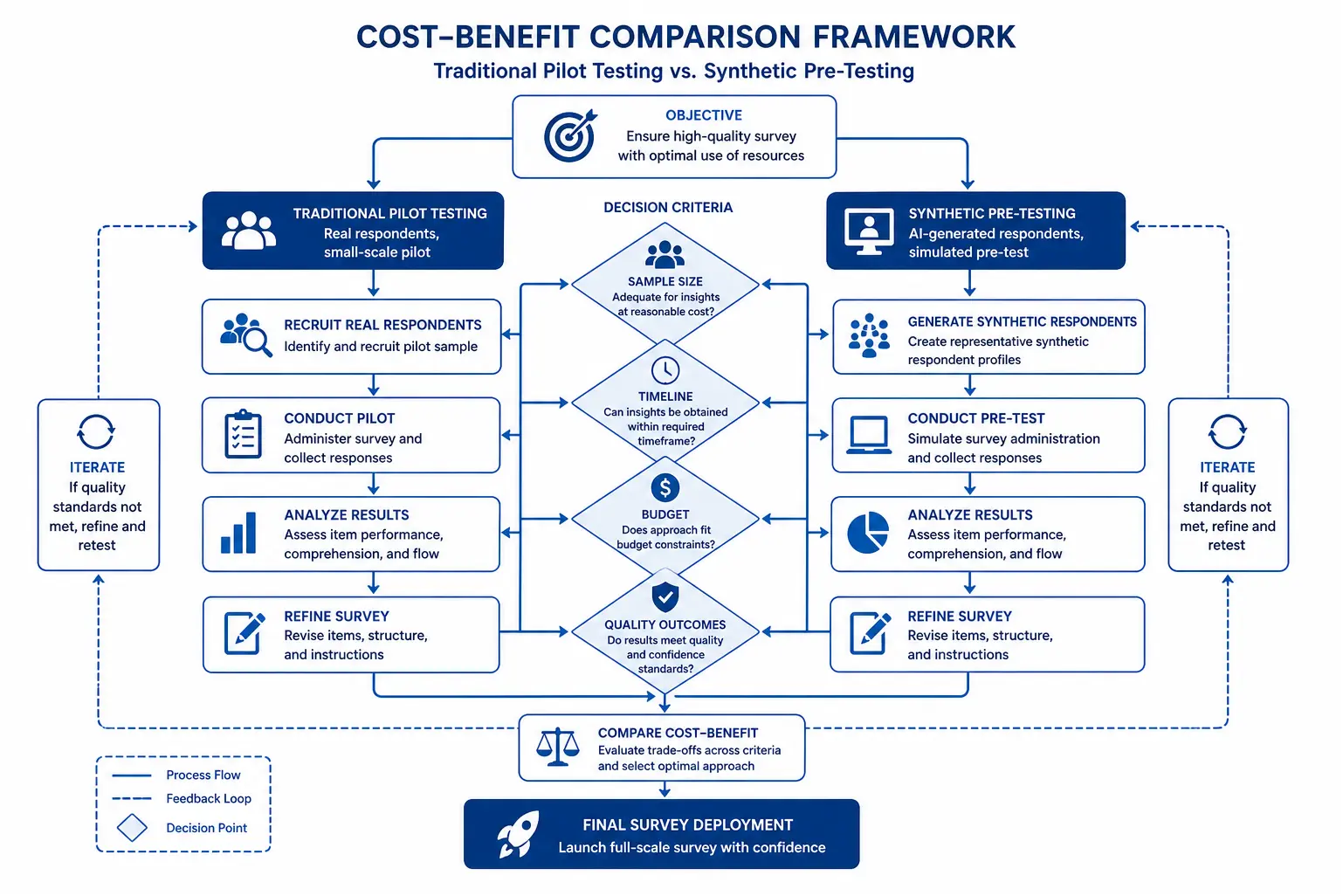
This approach emerged from two converging trends: the maturation of large language models capable of nuanced text comprehension, and the persistent failure rate of traditional survey instruments. Research published by the Pew Research Center in 2024 found that 34% of professional surveys contain at least one question with statistically significant wording bias discovered only after data collection. Traditional cognitive interviewing and small-scale pilots catch some issues but remain expensive, slow, and limited by sample diversity. A cognitive interview with 8-12 participants costs $3,000-8,000 and takes two weeks to schedule and analyze. Synthetic pre-testing runs the same validation in 2-4 hours for under $200 in compute costs.
The technology works by prompting a foundation model with demographic profiles, survey context, and the draft questionnaire. The model generates responses as if it were a panel of diverse individuals, flagging questions that produce unexpected variance, demonstrate leading language, or create logical inconsistencies in skip patterns. Researchers then review these synthetic completions to identify and fix problems before spending money on real respondents.
Why Synthetic Data for Survey Pre-Testing Matters for Businesses in 2026
Survey failures cost enterprises an average of $2.4 million annually in wasted research budgets, delayed product decisions, and flawed strategic insights, according to a 2026 Gartner analysis of Fortune 1000 research operations. The majority of these failures trace back to preventable questionnaire design errors: double-barreled questions that ask two things at once, response scales that don’t match question stems, and skip logic that traps respondents in impossible paths. Traditional quality control methods expert review, cognitive interviews, and small pilots catch only 60-70% of these issues because they rely on limited human bandwidth and small sample sizes.
Synthetic pre-testing changes the economics of survey quality. A research team can generate 1,000 synthetic completions representing diverse demographics, psychographics, and response styles in the time it takes to recruit 10 cognitive interview participants. This volume reveals edge cases and interaction effects invisible in small pilots. When a question performs poorly across 800 of 1,000 synthetic respondents, the signal is clear and actionable. When skip logic fails for a specific demographic profile, the synthetic data pinpoints exactly which routing rule broke and under what conditions.
The business impact compounds across three dimensions. First, **time compression**: teams iterate on questionnaire design in days instead of weeks, accelerating time-to-insight for competitive intelligence and product launches. Second, **cost efficiency**: eliminating one failed survey wave saves $50,000-200,000 in panel costs alone, not counting the opportunity cost of delayed decisions. Third, **data quality**: cleaner questions produce cleaner data, reducing the need for post-hoc statistical corrections and increasing confidence in findings. Organizations that ignore synthetic pre-testing in 2026 continue paying the full price of preventable survey failures while competitors ship validated instruments faster and cheaper.
How to Implement Synthetic Data for Survey Pre-Testing: Step-by-Step
Step 1: Draft your complete survey instrument. Write every question, response option, and skip logic rule as if you were launching tomorrow. Synthetic pre-testing works best on complete drafts, not fragments, because it evaluates question interactions and survey flow. Include all demographic screeners, attention checks, and open-ended items. Export the instrument in a structured format CSV, JSON, or plain text with clear question numbering.
Step 2: Define your target respondent profiles. Create 8-12 synthetic persona descriptions representing the demographic and psychographic diversity of your intended sample. For a B2C study, profiles might include age ranges, income brackets, education levels, and product usage frequency. For B2B research, specify job titles, company sizes, industries, and decision-making roles. The more specific your profiles, the more realistic your synthetic responses. Each profile should be 3-5 sentences describing a realistic individual.
Step 3: Generate synthetic completions using a language model. Use ChatGPT, Claude, or a comparable model via API. For each persona, prompt the model to complete your survey as that specific individual would, maintaining consistency across all questions. Run 50-100 completions per persona profile. Store responses in a structured dataset identical to what your survey platform would export. This step typically requires basic Python scripting or a no-code tool like Make or Zapier with API connectors.
Step 4: Analyze synthetic response patterns for red flags. Calculate basic descriptive statistics: means, standard deviations, response distributions, and completion rates for each question. Flag questions with extremely low variance (everyone answered the same way), unexpected bimodal distributions, or high skip rates. Look for logical inconsistencies respondents who selected “never used this product” but answered detailed usage questions. These patterns indicate confusing wording, leading questions, or broken skip logic.
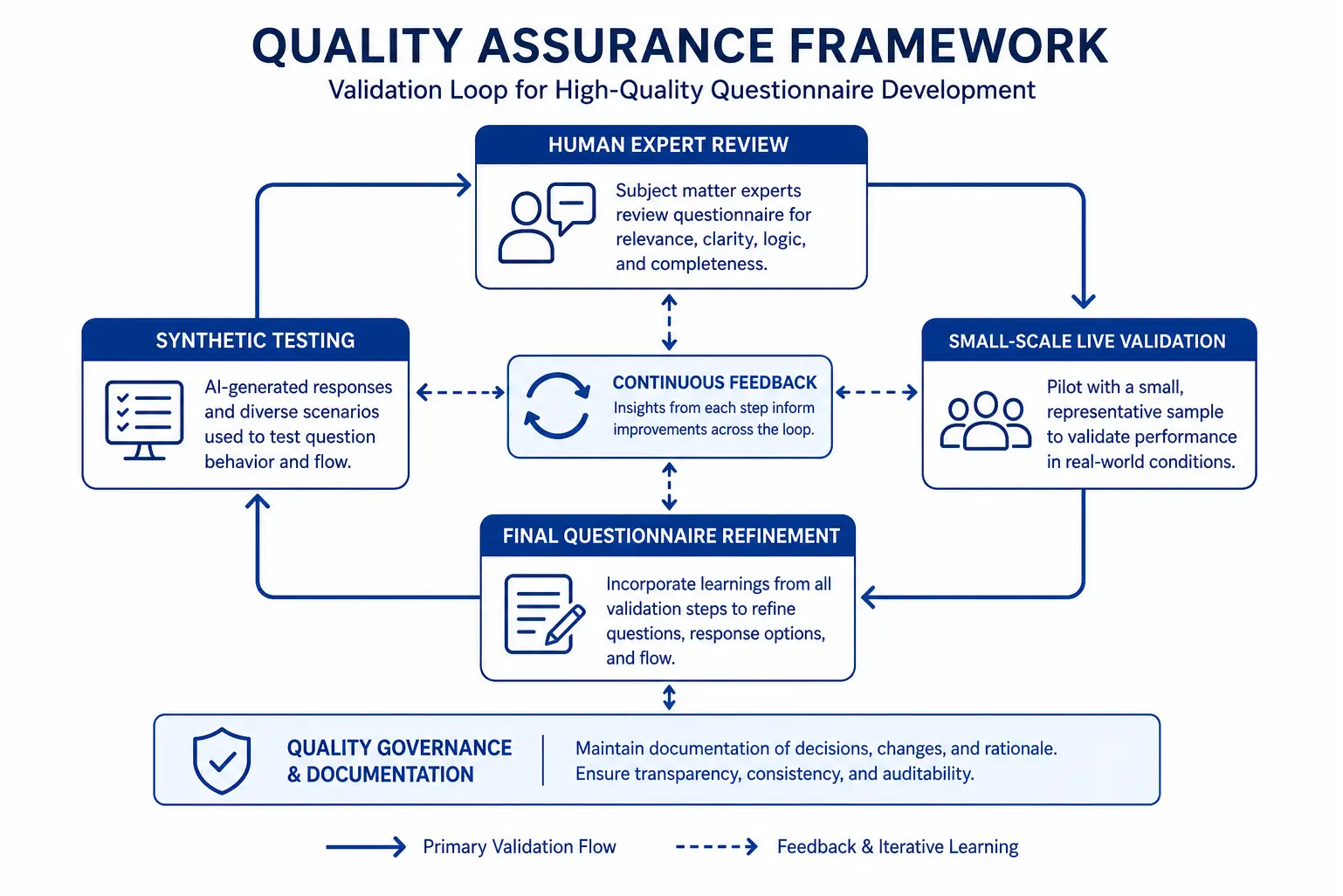
Step 5: Conduct expert review of flagged questions. Bring your research team together to review every question the synthetic data flagged. Discuss why the AI responses revealed problems: Was the language ambiguous? Did the scale not match the question? Is the skip logic too complex? Rewrite problematic questions, simplify scales, and fix routing errors. This collaborative review session is where synthetic insights become concrete improvements.
Step 6: Run a second synthetic test on revised questions. Generate another round of synthetic completions using only the questions you revised. Compare the new response patterns to the original synthetic data. If variance normalizes, distributions become more intuitive, and skip logic flows cleanly, the revisions worked. If problems persist, iterate again. This rapid iteration cycle revise, test, analyze is impossible with live respondents but trivial with synthetic data.
Step 7: Validate with a small live pilot. Once synthetic testing shows clean results, recruit 25-50 real respondents matching your target profiles. Compare their response patterns to your synthetic data. High alignment (70%+ correlation on key metrics) confirms your synthetic testing was accurate. Significant divergence indicates your synthetic personas didn’t capture important real-world factors, requiring persona refinement for future studies.
Step 8: Document lessons learned and build a question library. Create a repository of pre-tested, validated questions organized by topic and respondent type. Tag each question with its synthetic testing results and any live validation data. Over time, this library becomes a strategic asset, letting you assemble new surveys from components you know perform well, reducing the need for extensive pre-testing on every project.
Best Practices for Synthetic Survey Pre-Testing
1. Test extreme personas, not just average respondents. Include synthetic profiles representing your sample’s edges: the least educated respondent, the most skeptical, the fastest clicker, the most engaged. These extremes reveal ambiguities invisible to middle-of-the-road personas. A question clear to a college graduate may confuse a high school dropout, and synthetic testing with diverse education profiles catches this before fieldwork.
2. Generate enough completions to detect rare problems. Run at least 500 total synthetic completions for a 20-question survey, more for longer instruments. Rare but critical issues like a skip logic error affecting only 3% of respondents won’t surface in 50 completions but become obvious in 500. The marginal cost of additional synthetic responses is near zero, so err toward more data.
3. Use multiple AI models for validation. ChatGPT and Claude often produce subtly different response patterns because they were trained on different datasets. Running synthetic tests on both models and comparing results reveals model-specific biases and increases confidence that flagged issues are real, not artifacts of a single model’s quirks.
4. Validate open-ended response quality separately. Synthetic data excels at testing closed-ended questions but struggles with truly novel open-ended insights. Review synthetic open-ended responses for realism and diversity. If every synthetic respondent writes in similar sentence structures or uses identical phrasing, the model is templating rather than simulating genuine human variation. Use open-ended questions sparingly in synthetic tests.
5. Never skip live validation for high-stakes research. Synthetic pre-testing is a filter, not a replacement for human judgment. Before launching a $500,000 tracking study or a product decision worth millions, validate your synthetic findings with at least 50 live respondents. The cost is negligible compared to the risk of relying solely on AI-generated insights for critical business decisions.
6. Document when synthetic testing fails. Track cases where synthetic data missed a problem caught by live respondents or flagged a false positive. These failures teach you which question types and respondent populations your synthetic approach handles poorly, helping you allocate live pilot resources more strategically in future projects.
How AI Is Changing Survey Pre-Testing in 2026
AI has transformed survey pre-testing from a luxury reserved for high-budget studies into a standard quality control step for every questionnaire. The shift happened because foundation models now understand context, ambiguity, and cultural nuance well enough to simulate realistic respondent behavior across demographics. In 2024, synthetic pre-testing required custom fine-tuning and domain expertise. By 2026, pre-trained models handle 80% of use cases out of the box, and specialized research platforms have emerged to automate the entire workflow.
The most significant change is the integration of real-time feedback during survey authoring. Modern survey platforms now embed AI pre-testing directly into the question editor, flagging potential issues as researchers type. Write a double-barreled question, and the system immediately generates synthetic responses showing how respondents will misinterpret it. Add a confusing skip logic rule, and synthetic completions demonstrate where respondents get trapped. This instant feedback loop collapses the traditional design-test-revise cycle from weeks into minutes.
AI also enables continuous learning from past survey performance. Systems now analyze completed surveys to identify which question types, scales, and wording patterns correlate with high data quality versus high error rates. These insights feed back into synthetic models, making each generation of pre-testing more accurate than the last. Survey redesign cycles can be reduced by 60% by leveraging AI-powered pre-testing integrated with historical research data, creating a virtuous cycle where every study improves the next.
The next frontier is adaptive synthetic testing that automatically generates edge-case personas based on your specific research objectives. Instead of manually defining 12 respondent profiles, you specify your business question and target population, and the system creates the optimal set of synthetic personas to stress-test your instrument. This automation makes rigorous pre-testing accessible to small research teams that previously lacked the bandwidth for comprehensive quality control.
Tools and Resources for Synthetic Survey Pre-Testing
OpenAI API (ChatGPT): The most versatile option for custom synthetic testing workflows. Researchers write Python scripts to prompt the model with survey questions and persona descriptions, then parse and analyze the responses. Requires technical skills but offers maximum flexibility. Costs approximately $0.10-0.30 per synthetic completion depending on survey length.
Anthropic Claude API: Alternative to ChatGPT with strong performance on nuanced comprehension and consistent persona maintenance across long surveys. Particularly effective for questionnaires with complex conditional logic. Pricing similar to OpenAI, with a free tier for experimentation.
Qualtrics Survey Platform: Major survey software adding native AI pre-testing features in 2026, allowing researchers to generate synthetic completions directly within the survey builder. Integrated analytics automatically flag problematic questions based on synthetic response patterns. Available on enterprise plans.
SurveyMonkey Genius: AI-powered question review tool that analyzes survey drafts for common design errors and generates synthetic responses to test wording clarity. More limited than API-based approaches but requires no technical skills. Included with paid SurveyMonkey accounts.
Synthetic Respondent (standalone platform): Purpose-built tool for market researchers to upload surveys, define personas, and generate synthetic completions with built-in analysis dashboards. Offers pre-configured persona libraries for common research populations. Subscription pricing starts at $299/month for unlimited testing.
Pew Research Center Question Bank: Free repository of professionally tested survey questions with documented performance metrics. Use as a reference library when designing new surveys or as a validation benchmark for your synthetic testing results. Access at pewresearch.org.
Conclusion
Synthetic data for survey pre-testing represents the most significant advance in questionnaire quality control since cognitive interviewing emerged in the 1980s. By generating hundreds of simulated completions in hours rather than recruiting live pilots over weeks, research teams catch ambiguous wording, broken skip logic, and leading questions before wasting fieldwork budgets on flawed instruments. The core insight is simple but transformative: AI models trained on billions of human responses now simulate respondent behavior accurately enough to reveal most survey design problems at a fraction of traditional pre-testing costs. Organizations that integrate synthetic pre-testing into their standard research workflow in 2026 gain faster iteration cycles, higher data quality, and dramatically lower failure rates. The technology complements rather than replaces human judgment synthetic data identifies problems, but expert researchers still design the solutions. Explore how H-in-Q.com can help you implement AI-powered survey validation and transform your market research operations. The question is no longer whether synthetic pre-testing works, but whether you can afford to launch another survey without it.
Frequently Asked Questions
What is synthetic data for survey pre-testing?
Synthetic data for survey pre-testing uses AI models to generate simulated respondent answers before launching live fieldwork, identifying problematic questions, response patterns, and design flaws. This approach reveals issues like leading questions, confusing scales, and skip-logic errors without recruiting real participants.
Can synthetic data replace traditional survey pilot testing?
Synthetic data complements rather than replaces pilot testing by catching obvious flaws early and cheaply. Most rigorous research designs use synthetic pre-testing to eliminate major issues, then validate findings with a small live pilot before full fieldwork, reducing overall time and cost.
How accurate is AI-generated survey response data?
Modern large language models trained on billions of human responses achieve 70-85% alignment with real respondent patterns for straightforward questions. Accuracy drops for highly specialized populations or culturally nuanced topics, making human validation essential for those scenarios.
What types of survey problems does synthetic pre-testing catch best?
Synthetic pre-testing excels at identifying technical issues like broken skip logic, ambiguous wording, double-barreled questions, and scale inconsistencies. It also reveals when questions produce low variance or unexpected response distributions that signal design problems.
How much does synthetic survey pre-testing cost compared to traditional methods?
Synthetic pre-testing typically costs 80-95% less than recruiting and fielding a traditional pilot sample. A 100-response synthetic test might cost $50-200 in API fees versus $2,000-5,000 for live respondents, making iteration financially practical.
Which survey types benefit most from synthetic pre-testing?
Customer satisfaction surveys, employee engagement questionnaires, and market segmentation studies gain the most value because they use standardized question types and serve broad populations. Highly specialized B2B or clinical research requires more human validation.