


Table of Contents
- What Is Sampling in Market Research?
- Why Sampling in Market Research Matters for Businesses in 2026
- How to Plan Sampling in Market Research: Step-by-Step
- Best Practices for Choosing Market Research Sampling Methods
- How AI Is Changing Sampling in Market Research in 2026
- Tools & Resources for Sampling in Market Research
- Conclusion: Build Reliable Research Before Scaling Decisions
- Frequently Asked Questions
Sampling in Market Research: The Complete Guide to Reliable Studies and High-Quality Insights
A larger sample can make a biased answer look more convincing not more accurate.
Sampling in market research determines whose experiences shape your evidence and whose experiences remain invisible. Recruiting thousands of convenient respondents does not establish that your findings represent the customers you need to understand.
The practical challenge is matching recruitment, precision, and budget to the decision. A pricing study needs different evidence from exploratory interviews or international brand tracking.
For businesses exploring H-in-Q.com’s AI-powered marketing and automation expertise, reliable research inputs remain essential: automation accelerates analysis, not the correction of missing audiences.
In this guide, you’ll discover how to select methods, size samples, prevent bias, and supervise AI-assisted research.
What Is Sampling in Market Research?
Sampling in market research is the process of selecting a subset of a defined population to collect evidence about that population. Researchers specify eligibility, selection procedures, and sample size, then evaluate whether the resulting data supports their intended conclusions about customer needs, behaviors, preferences, or market conditions.
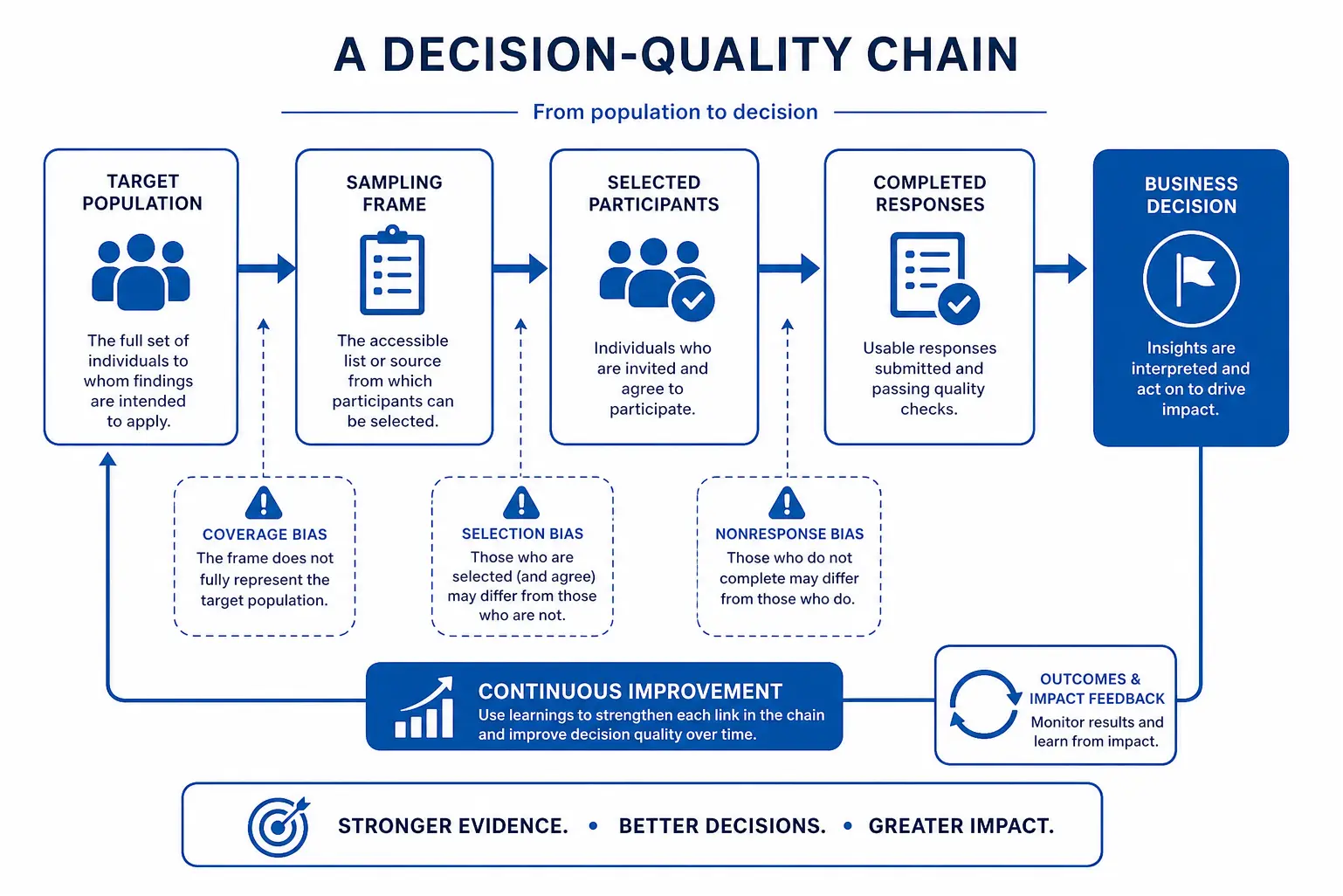
Start by separating the target population from the sampling frame. The population is everyone your question concerns; the frame is the list or source used to reach them.
A customer database excludes prospects. An online panel excludes people outside its recruitment coverage. Neither automatically represents your entire market.
Beginners should distinguish the sampling unit, such as a household, from the person answering. Record both before recruitment begins.
Why Sampling in Market Research Matters for Businesses in 2026
Sampling quality affects pricing, product investment, and market-entry decisions. Missing low-frequency buyers, for example, distorts estimates of mainstream demand.
Under simple random sampling, approximately 385 completed responses provide 95% confidence with a five-percentage-point margin of sampling error for a large population, assuming maximum variability. This addresses random sampling error, not coverage or response bias.
The American Association for Public Opinion Research’s best practices emphasize sound survey design and transparent methods.
Precision describes uncertainty within a design; it does not prove that the design represents your market. Track population coverage, selection, and nonresponse before trusting narrow error estimates.
How to Plan Sampling in Market Research: Step-by-Step
-
Define the decision. Specify the action your findings will inform, such as selecting a price. Identify the smallest difference that changes that action.
-
Define eligibility. Document geography, purchasing behavior, role, and exclusions. Avoid vague audiences such as “business leaders.”
-
Audit the sampling frame. Compare recruitment sources against the population. Identify missing groups, duplicates, and outdated contact records.
-
Choose the selection method. Use probability sampling when known selection probabilities and population inference are required. Use non-probability designs for exploratory or hard-to-reach research, disclosing their limitations.
-
Calculate completed-response targets. Set confidence and precision assumptions, then account for clustering and planned weighting. Size critical subgroups separately rather than dividing an overall target arbitrarily.
-
Budget recruitment realistically. If 20% of invitations produce eligible completions, 400 completions require approximately 2,000 invitations. Pilot the process before relying on that planning assumption.
-
Monitor fieldwork. Track quotas, response patterns, duplicate attempts, and completion quality. Investigate suspicious patterns before removing participants.
-
Document and report. Disclose sources, exclusions, weighting, and inference limits. Sampling service contracts should specify recruitment provenance, consent, replacement rules, and quality checks.
For a hypothetical global launch, stratify probability samples by country where suitable frames exist. Allocate enough responses for each market’s decision, localize questionnaires, and apply documented weights for combined estimates. Equal country sample sizes do not imply equal population shares.
Best Practices for Choosing Market Research Sampling Methods
These ten techniques serve different purposes; they are not interchangeable quality levels.
| Technique | Practical application |
|---|---|
| Simple random | Select randomly from a complete frame. |
| Systematic | Use a random start; check periodic patterns. |
| Stratified | Sample within important population groups. |
| Cluster | Select groups to reduce collection costs. |
| Multistage | Select regions, organizations, then individuals. |
| Convenience | Explore accessible audiences; restrict inference. |
| Quota | Fill predefined categories without assuming randomness. |
| Purposive | Recruit participants with relevant experience. |
| Snowball | Use referrals for difficult-to-reach populations. |
| Consecutive | Recruit every eligible arrival during a defined period. |
Apply five safeguards: pilot recruitment, randomize genuinely, inspect missing groups, protect subgroup precision, and publish limitations. Counterintuitively, stop buying additional responses when the underlying problem is coverage. Fix recruitment first.
How AI Is Changing Sampling in Market Research in 2026
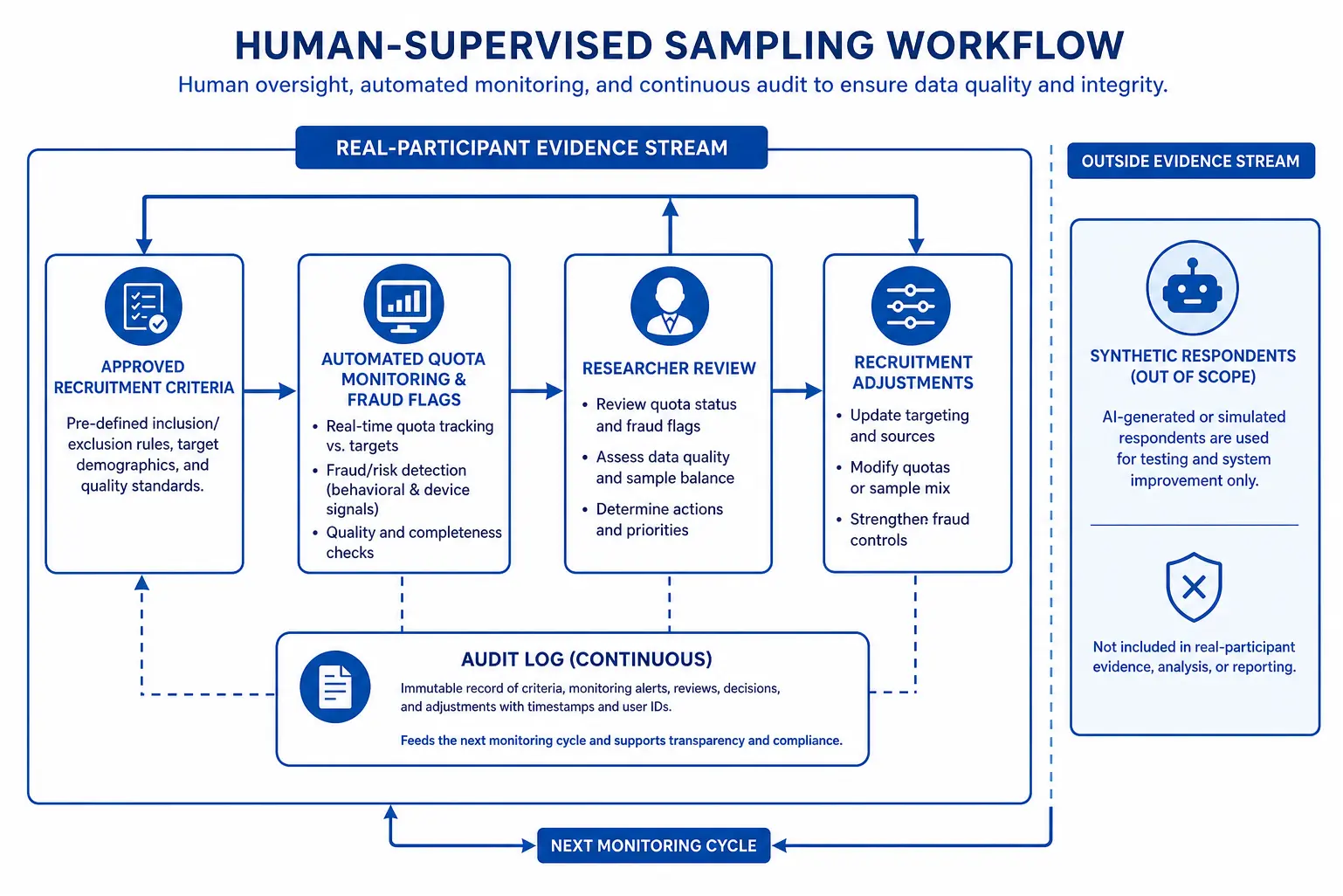
AI-assisted workflows classify open-ended screening answers, monitor quota imbalances, and flag suspicious response patterns. Automation also triggers recruitment adjustments when approved thresholds are crossed.
Keep eligibility rules explicit. Language models can misclassify unusual job titles or multilingual answers, so review ambiguous cases and record overrides.
Fraud scores require similar supervision. Fast completion alone does not establish fraud; combine signals and investigate false positives.
Synthetic respondents are simulated evidence, not observed customer behavior. Use them to test questionnaire logic, not to estimate market demand.
Maintain a human-supervised loop: approve criteria, monitor recruitment, review exceptions, adjust channels, and preserve an audit trail. Avoid uploading identifiable respondent data into unapproved systems.
Tools & Resources for Sampling in Market Research
Choose tools by function rather than treating every calculator as a complete sampling plan.
-
SurveyMonkey’s free sample size calculator estimates basic response targets. Check its assumptions before applying results.
-
OpenEpi provides free statistical utilities, including sample size calculations. Select the module matching your outcome and design.
-
R supports reproducible random selection and analysis. Specialized packages support complex survey designs.
-
Qualtrics offers paid survey and research workflows. Confirm recruitment services and quality controls in your contract.
When comparing free calculators in 2026, check finite-population corrections, proportion assumptions, and design-effect support not just the displayed total.
Conclusion: Build Reliable Research Before Scaling Decisions
Reliable sampling in market research starts with a defined population, a defensible recruitment process, and conclusions matched to the design. Sample size matters, but coverage and selection determine what those responses actually describe.
Choose methods around the business decision, calculate targets for essential subgroups, and document exclusions before fieldwork. Then use automation to monitor quality without surrendering judgment to opaque scores or synthetic participants.
Your next step is practical: audit one upcoming study’s audience definition, recruitment source, and reporting assumptions before approving its budget. Explore H-in-Q.com’s AI and automation services to connect disciplined research inputs with better business workflows.
As research automation expands, transparent sampling will remain the foundation of evidence that deserves action.
Frequently Asked Questions
What is sampling in market research?
Sampling in market research means selecting a subset of a defined population to study its characteristics, experiences, or opinions. Researchers specify who qualifies, how participants are selected, and which conclusions the design supports. A reliable sample balances population coverage, selection quality, response patterns, and the precision required for the decision.
Which sampling method is best for market research?
The best sampling method depends on your research objective, available population frame, budget, and required inference. Probability sampling supports design-based population estimates when implemented correctly. Non-probability methods suit exploratory interviews, specialized audiences, and rapid concept testing, provided researchers disclose selection limitations and avoid unsupported claims of representativeness.
How many survey responses do I need?
For a large population, approximately 385 completed responses support a 95% confidence level and a five-percentage-point margin of sampling error under simple random sampling, using maximum variability. Subgroup analysis, clustering, weighting, and expected nonresponse change requirements. This calculation does not establish representativeness or correct recruitment bias.
What is the difference between random sampling and quota sampling?
Random sampling selects participants through a probability mechanism, while quota sampling fills predefined participant categories without necessarily using random selection. Matching demographic proportions does not make a quota sample random. Quotas control selected characteristics, but unmeasured differences between participants and nonparticipants remain a source of potential bias.
How do you reduce sampling bias?
Reduce sampling bias by improving population coverage, choosing defensible recruitment methods, and monitoring who participates versus who remains missing. Use accessible survey formats, varied contact channels, appropriate incentives, and documented follow-up procedures. Apply weighting against credible benchmarks when justified, but do not treat weighting as a substitute for sound recruitment.
Can AI replace real survey respondents?
AI-generated respondents are not substitutes for observed human responses when estimating real customer attitudes or behavior. Synthetic responses support questionnaire testing, scenario exploration, and workflow development. Treat their outputs as simulations, validate useful hypotheses with actual participants, and disclose synthetic inputs separately from human research evidence.

 English
 Français
 Español