


Table of Contents
- What Is an LLM Survey Taker?
- Why the LLM Survey Taker Matters for Businesses in 2026
- Which Survey Checks Do Autonomous Agents Expose?
- Best Practices for Detecting an LLM Survey Taker
- How AI Is Changing Survey Fraud Detection in 2026
- Tools & Resources for Survey Fraud Review
- Conclusion: Protect Survey Evidence, Not Just Completion Rates
- Frequently Asked Questions
The LLM Survey Taker Niche: How Autonomous AI Agents Bypass Traditional Attention Checks
A respondent can pass every attention check without possessing any experience your survey measures.
An LLM survey taker creates that problem by combining language understanding with automated questionnaire interaction. For researchers, the danger is not nonsense: it is plausible, internally consistent data submitted under false pretenses.
Traditional checks often ask whether someone read an instruction or noticed an unusual question. Language models perform those tasks directly. Consequently, a clean attention-check score no longer establishes that a submission represents an eligible person.
H-in-Q.com’s focus on business AI and automation provides a practical lens: evaluate the workflow, not just the words. Recruitment, session behavior, response evidence, and review decisions all deserve scrutiny.
The distinction also protects legitimate respondents who use translation or accessibility assistance. Automated interaction, assisted writing, and fabricated participation require different policies rather than one blanket exclusion rule.
In this guide, you’ll discover how these agents pass conventional checks, which signals deserve attention, and how to strengthen survey acceptance decisions.
What Is an LLM Survey Taker?
An LLM survey taker is an automated system that uses a large language model to interpret survey questions and generate responses. When connected to browser or form automation, it can submit answers while maintaining a supplied persona. Fraud occurs when those submissions falsely represent eligible human participation.
The model supplies language reasoning; an automation layer handles interaction. Together, they can follow branching questions, retain earlier answers, and produce relevant open-ended explanations.
That differs from simple scripts repeatedly selecting identical options. Consistency checks still catch mistakes, but consistency itself is no longer convincing evidence of authenticity.
Keep disclosed synthetic research separate from this category. Simulated respondents have an explicit nonhuman origin; deceptive submissions conceal it. Neither should be mislabeled as observed customer experience.
Why the LLM Survey Taker Matters for Businesses in 2026
Survey contamination predates autonomous agents. In its historical 2020 analysis of bogus online respondents, Pew Research Center estimated that approximately 4% to 7% of respondents in studied opt-in polls were bogus.
That finding is not a measurement of current AI-agent prevalence. It demonstrates an established vulnerability that fluent automation makes harder to assess through answer inspection alone.
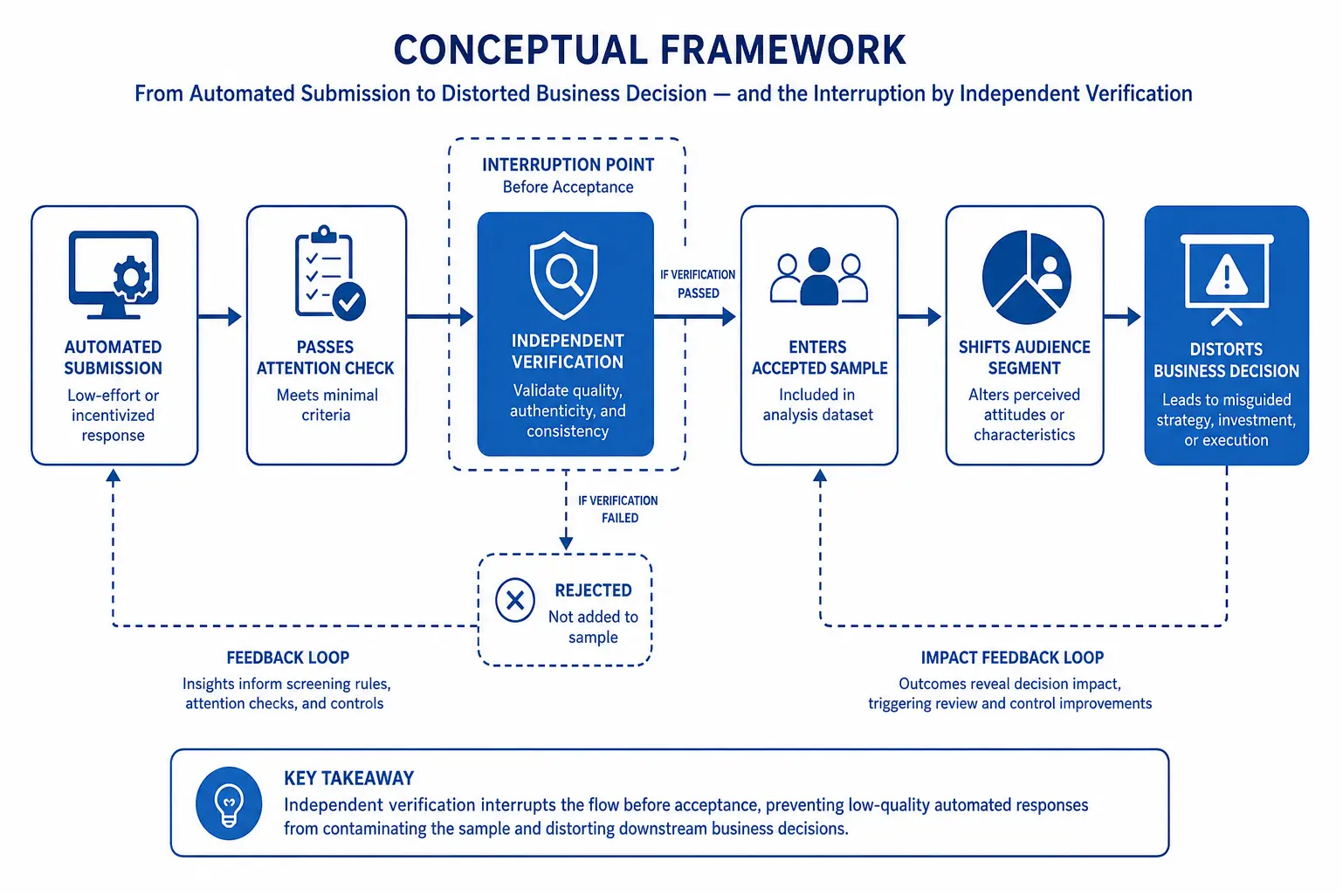
Business damage follows a specific chain: contaminated responses enter an accepted sample, shift segment estimates, and influence spending or product decisions. Larger sample sizes do not remove systematic contamination.
Passing an attention check proves instruction compliance, not respondent authenticity. Treat acceptance as an evidence-based decision, especially when incentives or sensitive commercial decisions raise the stakes.
Which Survey Checks Do Autonomous Agents Expose?
First, distinguish comprehension tests from identity and experience checks. An instruction such as selecting a named option primarily measures comprehension. A language model needs no personal experience to comply.
Next, consider persona consistency. An agent supplied with a profile can preserve age, household details, and stated preferences across questions. Consistent answers therefore provide limited independent assurance.
Open-ended responses present another challenge. Detailed explanations can be generated from questionnaire context rather than actual ownership or purchasing experience. Polished writing is neither proof of fraud nor proof of authenticity.
Finally, avoid assuming uniform capabilities. Some automated submissions expose obvious errors; others require combined recruitment and session evidence. Design controls around observable behavior, not assumptions about what every agent can accomplish.
Best Practices for Detecting an LLM Survey Taker
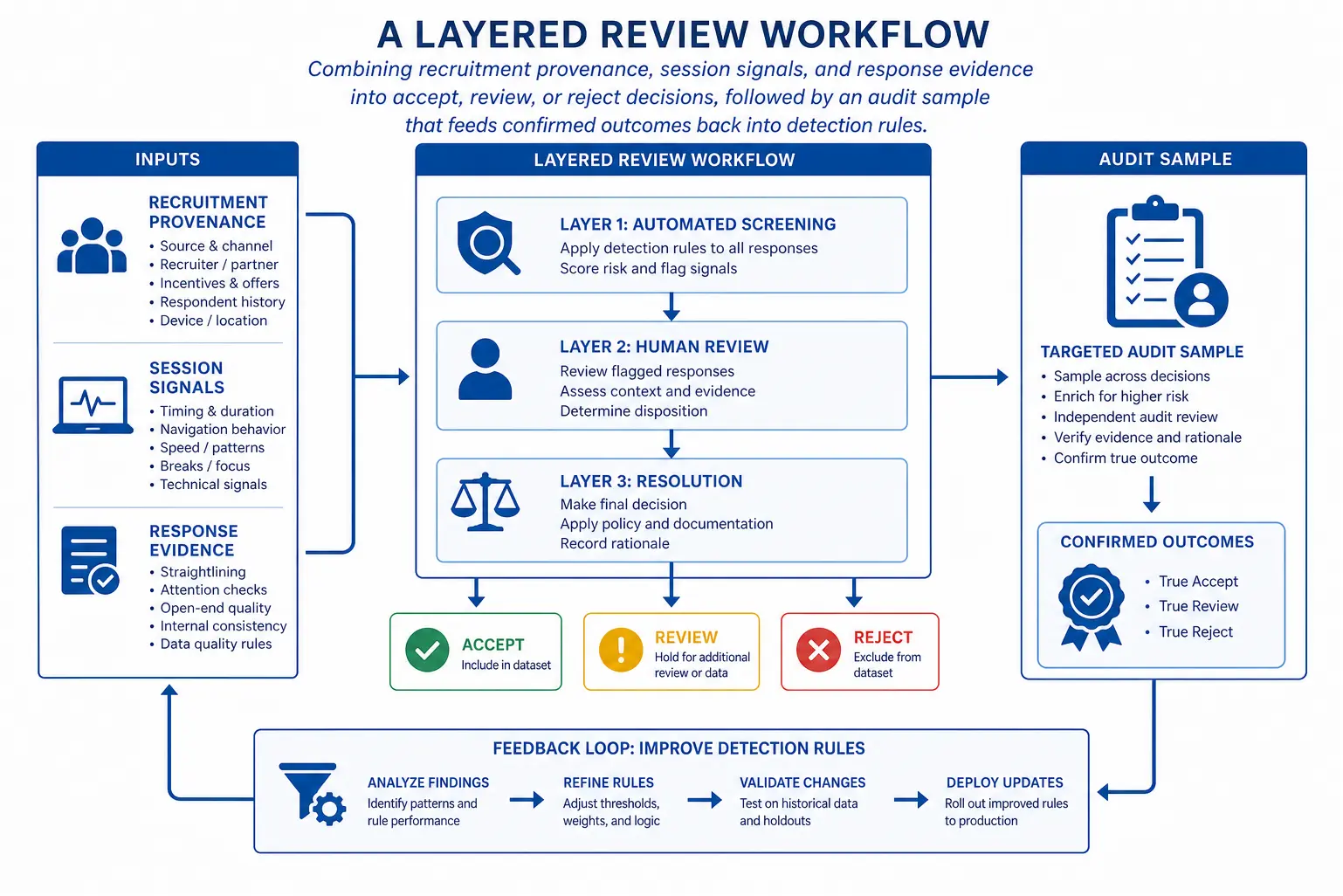
- Verify recruitment provenance. Preserve source identifiers and reconcile invitations with completions. Investigate unexplained duplication before analyzing answer quality.
- Separate evidence categories. Record eligibility, session behavior, and response quality independently so one weak signal never masquerades as confirmation.
- Use path-aware timing. Compare respondents who encountered equivalent questions rather than applying one minimum duration across different routes.
- Make checks less theatrical. Counterintuitively, adding obvious trick questions strengthens a comprehension test without establishing genuine experience. Prefer proportionate, study-relevant validation.
- Calibrate review thresholds. Measure false positives using reviewed cases, including legitimate translation and accessibility use. Avoid blanket exclusions based on writing style.
- Audit accepted responses too. Review a sample of accepted submissions alongside rejected ones, then update rules from confirmed outcomes.
Define accept, review, and reject outcomes before launch. Preserve the evidence behind each decision and maintain an escalation route for ambiguous cases.
How AI Is Changing Survey Fraud Detection in 2026
AI changes both submission generation and defensive analysis. An LLM survey taker produces contextual answers, while defensive models help investigators identify patterns across submissions.
For example, semantic clustering can surface unusually similar narratives despite different wording. Automated comparison can also flag contradictions between screening answers and later claims. Neither result establishes fraud without corroboration.
Detect suspicious patterns with AI; justify exclusions with evidence. Send flagged cases to reviewers alongside source details, routing context, and relevant session signals.
Keep evaluation separate from production decisions. Test proposed rules against reviewed cases before deployment, then monitor wrongful exclusions and missed contamination. Recalculate business findings with and without disputed responses to expose decision sensitivity.
Apply privacy controls throughout. Collect only necessary signals, restrict access, and define retention periods before introducing additional monitoring.
Tools & Resources for Survey Fraud Review
- Cloudflare Turnstile offers a free challenge layer for web forms. It adds friction but does not verify research eligibility.
- Qualtrics provides commercial survey infrastructure and response-quality features. Confirm available controls and licensing before procurement.
- Prolific provides paid participant recruitment infrastructure. Assess its screening, verification, and dispute processes against your study requirements.
- NIST’s AI Risk Management Framework is a free governance resource. Use it to organize evaluation responsibilities and document risks in AI-assisted review.
No product replaces a documented acceptance policy. Match each tool to a defined failure mode and verify its contribution through reviewed outcomes.
Conclusion: Protect Survey Evidence, Not Just Completion Rates
The LLM survey taker exposes a basic measurement error: treating successful instruction-following as evidence of authentic participation. Better wording alone does not resolve that mismatch.
Start with recruitment provenance, combine independent signals, and route uncertain cases into documented review. Then examine whether exclusions change the findings that drive business decisions. This protects research usefulness while reducing arbitrary rejection of legitimate participants.
The immediate priority is practical: audit one recent study, identify which controls establish eligibility, and separate those controls from checks that merely test comprehension. Use those findings to revise your next fieldwork plan.
Explore H-in-Q.com’s business AI and automation expertise to inform your next workflow review. Future survey quality will depend on defensible evidence, not increasingly elaborate attention checks.
Frequently Asked Questions
What is an LLM survey taker?
An LLM survey taker is a language-model-driven system that answers survey questions through software or browser automation. It generates responses from instructions, supplied personas, and questionnaire context rather than personal experience. Its output becomes research fraud when submitted deceptively as an eligible human participant.
How do AI agents pass survey attention checks?
AI agents pass many attention checks by understanding and following their written instructions. Questions asking respondents to select a particular option test instruction comprehension, which language models handle well. Passing therefore demonstrates task completion, not human identity, genuine product experience, or eligibility for a research sample.
Can CAPTCHA stop automated survey respondents?
CAPTCHA adds friction but does not establish that a respondent is an eligible research participant. Challenge systems evaluate particular interaction or risk signals, while survey validity requires additional evidence. Combine them with recruitment verification, duplicate controls, session analysis, and documented review procedures rather than treating passage as clearance.
Are AI-written open-ended answers proof of survey fraud?
AI-written answers alone do not prove survey fraud because legitimate participants also use writing assistance. The relevant questions are whether assistance violates study rules and whether the participant supplied authentic experience. Review consent requirements, eligibility evidence, and independent session signals before excluding a response.
What signals help identify automated survey responses?
Useful signals include duplicate recruitment identifiers, implausible concurrency, inconsistent eligibility claims, repeated answer structures, and unusual navigation patterns. None establishes fraud independently. Evaluate combinations against your survey design and participant population, then validate flagged cases through review before changing acceptance rules or reporting prevalence.
Should researchers reject surveys completed very quickly?
Researchers should not reject responses solely because completion was fast. Familiarity, short routing paths, accessibility tools, and reading speed affect duration. Compare timing within equivalent survey paths and combine it with other evidence, such as impossible overlap between sessions or contradictory responses to relevant questions.
Do AI text detectors work for survey fraud detection?
AI text detectors do not provide sufficient evidence for automatic survey exclusions. Their scores concern text characteristics, not participant identity or firsthand experience. Short answers and edited writing further complicate interpretation. Use any detector output as a review signal, then assess independent evidence before deciding.
How can businesses estimate the impact of suspicious responses?
Businesses can estimate impact by recalculating key findings with and without the flagged response group. Compare segment sizes, purchase intent, concept rankings, and confidence intervals where appropriate. Report the exclusion criteria and sensitivity results together so decision-makers understand uncertainty without assuming every flagged case is fraudulent.
Are disclosed synthetic respondents the same as fraudulent survey bots?
Disclosed synthetic respondents are not fraudulent survey bots because their nonhuman origin is explicit. They still require validation for the intended research task and must remain separate from observed human evidence. Fraud occurs when automated responses are misrepresented as authentic participation or qualifying lived experience.
What should a survey fraud policy include?
A survey fraud policy should define permitted assistance, eligibility requirements, collected signals, review thresholds, and appeal procedures. It should also specify retention limits, vendor responsibilities, and how exclusions affect reporting. Apply the policy consistently across sources, then audit both accepted and rejected responses for errors.

 English
 Français
 Español