

⚡ What Is an AI Focus Group for Beginners?
An AI focus group is a market research method where artificial intelligence handles moderation, analysis, and synthesis — either with real participants or AI-generated personas. In 2026, a first-time researcher with no prior experience can run a complete AI focus group in 3 days for under $4,000. Synthetic studies start at $100–$500 and deliver results in hours. Real-participant studies cost $2,000–$4,000 for 15–20 participants. The AI handles everything that previously required expertise: moderation, transcription, thematic coding, and findings synthesis. Your job is to ask the right question, find the right people, and act on what comes back.
5 steps to your first AI focus group:
- Write one specific research question
- Define your participant profile
- Choose your platform (synthetic or real-participant)
- Build a 6-question discussion guide
- Review AI findings against raw transcripts before acting
👉 Start with HiVox-in-Q for your first real-participant community AI focus group.
Introduction
Three years ago, running a focus group required a professional moderator, a research facility, a recruitment firm, a transcription service, and a budget most marketing teams did not have. The entry cost was $7,000–$30,000 per session. The timeline was 6–8 weeks. The expertise required took years to develop. For small business owners, startup founders, and marketing managers at mid-size companies, professional consumer research was simply out of reach.
That changed. In 2026, a first-time researcher with no prior experience can run a complete AI focus group — real participants, professional-grade analysis, actionable findings — in three days for under $4,000. The AI handles everything that used to require expertise: moderation, transcription, analysis, and synthesis. Your job is to ask the right question, find the right people, and review what comes back.
This guide is written for that person. No research jargon. No assumed knowledge. No step skipped. By the end, you will know exactly what an AI focus group is, which format to start with, how to run your first session this week, and what to do with the results when they come in. H-in-Q’s market research team has distilled this from direct implementation experience helping first-time researchers get from zero to actionable insights in days rather than months.
What Is an AI Focus Group? (The Honest, Simple Explanation)
A focus group is a research method where you ask a group of people — your target customers, potential buyers, or specific audience members — structured questions about a topic you need to understand better. The answers help you make better decisions: which product name to use, which message to lead with, whether your new idea actually solves a real problem.
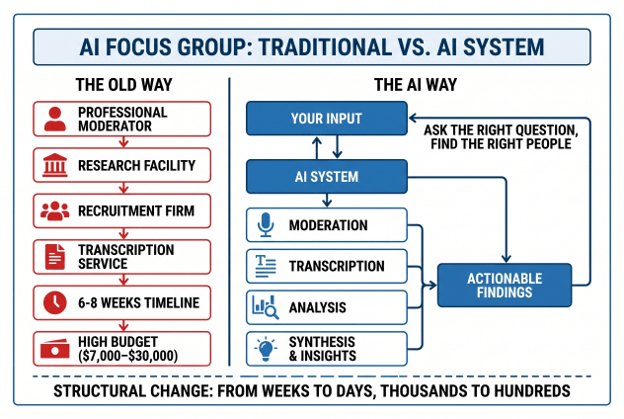
An AI focus group does the same thing, but artificial intelligence handles the facilitation and analysis work. Instead of a human moderator keeping the discussion on track and a research firm spending weeks analyzing transcripts, the AI does it automatically — asking follow-up questions, making sure everyone contributes, tagging emotional responses, identifying themes, and delivering a findings report.
The result is research that used to cost $30,000 and take 8 weeks now costing $500–$4,000 and taking 3 days. That is not a small improvement — it is a structural change that puts professional consumer research within reach of any US business for the first time.
There are two starting points for beginners, and choosing the right one matters:
Option A: Synthetic AI Focus Group (No Real Participants)
The AI generates virtual audience representatives called personas — based on your target customer description. These personas evaluate your concept, message, or idea and provide structured feedback. No recruiting. No scheduling. Results in hours. Cost: $100–$500. Best for testing an idea before you commit to talking to real people.
Option B: AI-Assisted Focus Group (Real Participants, AI Moderation)
Real people from your target audience participate in an AI-moderated discussion. The AI runs the session — asking questions, probing vague answers, managing the flow — while you observe. Results in 3–7 days. Cost: $2,000–$4,000 for a starter session of 15–20 participants. Best for validating decisions that will affect significant investment or direction.
Beginner recommendation: Start with Option A for your first study. Get familiar with how the process works, what useful findings look like, and how to write a clear research question — all at low cost and low risk. Then run Option B to validate the most important findings with real participants before acting on them.
What Can You Use an AI Focus Group For? 6 Starter Use Cases
Before running any research, you need to know what kind of question it can actually answer. AI focus groups are qualitative research — they tell you why and how people think, not how many people think it. Here are the six most common use cases for first-time researchers:
1. Testing a Product or Service Concept
“We’re developing X. Does this solve a real problem for our target customer? What concerns does it raise?”
2. Choosing Between Two Messages or Positioning Options
“We have two ways to describe our product. Which one is clearer? More compelling? Which one makes you want to learn more?”
3. Understanding Why Customers Are Not Converting
“Our website gets traffic but few sign-ups. What do visitors think when they land on our homepage? What stops them from taking the next step?”
4. Validating a Brand Name or Product Name
“We’re choosing between three names. Which one feels right for this category? What does each name make you think of?”
5. Learning How Your Target Audience Describes Their Problem
“Before we write any marketing copy, we want to understand how our audience talks about the problem we solve in their own words, not ours.”
6. Testing Pricing Perception
“We’re considering two price points. At which price does our product feel like fair value? At which does it feel too expensive? Too cheap to be credible?”
All six of these are appropriate for a first AI focus group study. They are specific enough to produce actionable findings and open-ended enough to generate qualitative insight that a survey cannot capture.
One use case to avoid as a beginner: Do not use a focus group to validate a decision you have already made. Research produces useful findings only when you are genuinely open to hearing an answer that changes your plans. If you have already decided on the product name and are just looking for reassurance, save the budget.
Before You Start: The 3 Things Every Beginner Needs
Most first focus groups that produce poor results fail before the session begins — not because of the platform, not because of the participants, but because of these three setup decisions.
Thing 1: One Specific Question Your Research Will Answer
This is the most important decision in your entire research program, and it takes 30 minutes to get right. Write a single sentence that describes the decision your research will directly inform.
Not specific enough:
- “Understand our customers better”
- “Learn what people think of our brand”
- “Get feedback on our product”
Specific enough:
- “Determine which of our two homepage headlines generates stronger interest among US freelancers aged 25–40”
- “Understand what concerns prevent small business owners from trying AI tools for the first time”
- “Identify which product name — Bloom or Clarity — feels more appropriate for a wellness app targeting women 30–50”
If you cannot write a specific research question in one sentence, your objective is not clear enough to produce actionable findings. Spend the 30 minutes. It will save you hours of analysis confusion later.
Thing 2: A Participant Profile That Describes a Real Person
Your participants must match the actual audience whose opinion matters for your decision. Being too broad here is the most common beginner mistake — it produces data from people whose opinions are irrelevant to your specific situation.
Write your participant profile by answering four questions:
- Who are they demographically? (Age range, location, income if relevant, gender if relevant)
- What have they done behaviorally? (Purchased in this category, experienced this problem, used a competitor’s product)
- What is their professional or life context? (Job title and industry if B2B, life stage if consumer)
- One qualifier that disqualifies irrelevant participants? (Has NOT already purchased, IS currently experiencing the problem, DOES use the category regularly)
Example participant profile for a B2C wellness app: Women aged 28–45 in US urban or suburban markets, currently using at least one wellness app on their phone, with household income $60K+, who have NOT previously used [Brand Name].
Example participant profile for a B2B SaaS tool: Marketing managers or directors at US companies with 20–200 employees, with budget authority or strong influence over software purchasing, currently using at least one paid marketing tool.
Thing 3: A Clear Stimulus (What You Are Testing)
Your stimulus is the material participants will react to — the concept, message, product name, creative, or idea you want them to evaluate. It does not need to be polished or final. What it must be is unambiguous — two different participants should not be able to interpret it in two completely different ways.
For a messaging test: write the two or three message options as complete sentences, not fragments. For a concept test: write a 3–5 sentence description of the product or service as if you were explaining it to a curious stranger. For a name test: present the names with a one-sentence description of what they will be attached to. For a creative test: the visual or copy must be in a format the platform can display — image, PDF, or written stimulus.
Vague stimulus produces vague reactions. If you are not sure your stimulus is clear enough, test it on one person outside your target audience before launching the full study. If they have questions about what it means, refine it first.
Step 1: Choose Your Platform (30 Minutes)
For a beginner running a first study, platform choice comes down to two decisions: real participants or synthetic, and budget. According to GreenBook’s 2025 GRIT Report, platform usability is now the #1 adoption factor for first-time AI research users — making ease of setup the most important evaluation criterion at this stage.
For Your First Synthetic Study (Recommended Starting Point)
- Dytto: Simplest interface, free tier available, results in 2–4 hours. Best for marketing teams testing messaging or concept variants quickly.
- Sampl: Accessible pricing, strong persona customization, clear outputs. Best for product teams screening new feature concepts.
For Your First Real-Participant Study
- HiVox-in-Q: Community-based AI focus groups with multilingual support. Guided setup workflow for first-time researchers. Best for US brands researching diverse audiences or needing authentic group discussion dynamics.
- Perspective AI: Free study to start, strong probing AI, individual conversation format. Best for product and UX teams running their first real-participant study.
For Adding AI Analysis to a Session You Already Ran
- Looppanel: $30/month, upload any recording, get AI analysis in hours. Best for teams that have run a session and need faster analysis.
Do not overthink platform selection for your first study. Run one synthetic study and one real-participant study on any platform that fits your budget. The methodology experience matters more than the platform choice at this stage. 👉 See the full AI focus group platform comparison
Step 2: Build Your Discussion Guide (1–2 Hours)
Your discussion guide is the list of questions the AI will work through with participants. Think of it less as a questionnaire and more as a conversation map — the AI will adapt and probe based on what participants say, but it needs a skeleton structure to follow.
For a beginner, use this six-question starter template. Adapt the content to your topic — keep the structure:
Beginner AI Focus Group Discussion Guide Template
WARM-UP (1 question — get participants comfortable)
Q1: “Tell us briefly about the last time you [relevant category experience]. What prompted it, and how did it go?”
EXPLORATION (2 questions — understand the problem before showing your solution)
Q2: “What is the biggest frustration you have with [category/current solution]? Walk us through a specific example.”
Q3: “What would a perfect solution to that frustration look like? What would it have to do?”
STIMULUS REACTION (2 questions — show your concept/message and get reactions)
Q4: “[Present stimulus here] What is your first reaction? What stands out — positively or negatively?”
Q5: “On a scale of 1–10, how likely would you be to [take relevant action] based on what you just saw? Walk us through your reasoning.”
CLOSE (1 question — capture anything the guide missed)
Q6: “Is there anything important about this topic that our questions did not give you space to share?”
Five Beginner Rules for Writing Discussion Guide Questions
Rule 1: Open-ended only. Every question must be answerable in multiple ways. “Did you like it?” is closed — it produces yes/no data. “What was your reaction to it?” is open — it produces qualitative insight.
Rule 2: One question at a time. “What did you think of the design and the price?” is two questions. The participant will answer one and ignore the other. Split every compound question.
Rule 3: Do not telegraph your hypothesis. “We believe our product is the easiest solution in this category — do you agree?” primes participants to confirm what you already believe. Ask about their experience first, before mentioning your solution’s claims.
Rule 4: Warm up before going deep. Start with easy, comfortable questions about general experience. Reserve your most important questions for the middle of the guide, after participants have settled into honest engagement.
Rule 5: Always end with an open invitation. The last question in every discussion guide should give participants space to say anything the structured questions did not cover. Some of the most valuable beginner research insights come from responses to this question.
Step 3: Set Up and Launch Your Session (1–2 Hours)
Setup varies by platform, but three decisions apply regardless of which tool you use.
Decision 1: Asynchronous or Live Session?
For beginners, asynchronous is the recommended format — participants respond on their own timeline within a 24–48 hour window rather than joining a live session. Quirks Media’s 2024 research confirms asynchronous formats consistently produce higher participation rates, more candid responses, and better scheduling compliance than live sessions. They also remove the pressure of facilitating a live event for a first-time researcher.
Decision 2: How Many Participants?
For a synthetic study: Generate 5–8 personas — enough to represent your key audience segments without overwhelming you with output volume. Always include at least one skeptic persona — someone with reasons to doubt your solution. Skeptic feedback is typically more commercially valuable than enthusiastic feedback.
For a real-participant study: 15–20 participants is the right starting point for a beginner. This sample size produces reliable thematic patterns — the point at which additional responses stop introducing new themes — without generating more data than a first-time researcher can comfortably review.
Decision 3: Who Recruits the Participants?
Three options in order of preference:
- Your own customer or prospect list (best data quality: people with real relationship to your brand or category)
- Platform built-in panel (fastest timeline: most platforms can recruit 15–20 matched participants within 24–48 hours)
- Personal network (appropriate for early-stage research: friends, colleagues, or social followers who match your participant profile)
For your own list or personal network: send a 3–5 question screener before confirming. Include at least one behavioral qualifier (e.g., “Have you purchased a wellness app in the last 12 months?”) to filter out people who do not match your participant profile.
Step 4: Run the Session (24–48 Hours)
In an asynchronous AI focus group, the session runs itself. The AI sends participants the discussion guide, manages the flow of the conversation, ensures everyone responds to every question, probes vague answers, and closes the session when the participation window closes.
Your job during the session is to monitor, not operate. Check in twice daily on the platform dashboard. Look for three signals:
Signal 1: Participation Rate
If fewer than 60% of confirmed participants have responded by the midpoint of the participation window, send a reminder. Most platforms do this automatically — confirm before launching.
Signal 2: Response Quality
If multiple participants are giving one-sentence answers to questions that should generate paragraph-length responses, the stimulus may be unclear or the questions may be too closed. Note this for your post-session review.
Signal 3: Unexpected Themes
If you see participants repeatedly returning to a topic your discussion guide did not address, note it. These unprompted themes are often the most commercially valuable findings in a beginner session.
What NOT to do during the session: Do not intervene in the AI moderation unless the platform explicitly allows and supports researcher injection. Interrupting the AI moderation flow can disrupt session consistency. Trust the process for your first study.
Step 5: Review Your AI-Generated Findings (3–4 Hours)
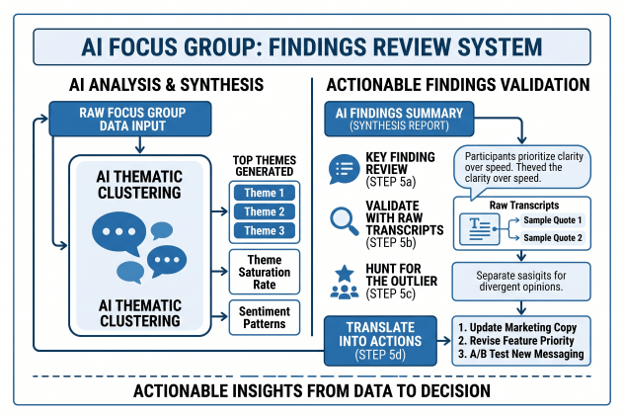
When the session closes, your platform generates an analysis report automatically. For a beginner, the report is the starting point, not the ending point. Here is how to review it in a way that produces actionable findings rather than a stack of interesting-but-unused data.
Step 5a: Read the Synthesis Summary First (20 Minutes)
Most platforms deliver a synthesized findings summary at the top of the report. Read it completely before looking at anything else. Get a first impression of the overall picture — what patterns did the AI identify, what seems to be the dominant sentiment, what themes came up most frequently?
Step 5b: Check the Top 3 Findings Against the Raw Transcripts (90 Minutes)
For the three most important findings in the synthesis summary, find 3–5 participant quotes in the raw transcript that the AI used to support each finding. This is the validation step most beginners skip — and it is the step that separates reliable findings from AI-generated plausibilities that sound convincing but are not well-grounded in the actual data.
Ask yourself: does the raw quote actually say what the synthesis claims it says? If yes, finding confirmed. If the quote is ambiguous or the AI has over-interpreted, flag the finding as directional rather than definitive.
Step 5c: Hunt for the Outlier (30 Minutes)
Scroll through the participant response list and read the 2–3 responses that seem most different from the consensus. AI thematic analysis clusters by frequency — it surfaces what most participants said. The most commercially valuable insight is often in the minority: the participant who articulated a concern no one else named, or the one who loved your concept for an unexpected reason.
Step 5d: Translate Findings Into Decisions (45 Minutes)
Write one sentence for each finding that describes what your team will do differently based on it. This is the most important step in the entire process — and the one that most beginners skip because it feels hard.
Not a decision: “Participants responded positively to the value proposition.”
A decision: “Lead with the time-saving benefit in all homepage copy — it was the single most cited reason participants said they would try the product.”
If you cannot translate a finding into a specific action your team will or will not take, it is an interesting observation, not an actionable insight. Actionable insights are the only output that justifies the research investment.
The 5 Mistakes Every Beginner Makes (and How to Avoid Them)
These are the five errors that most frequently produce poor results in a first AI focus group. All five are completely avoidable with advance preparation.
Mistake 1: Testing Too Many Things in One Session
A 60-minute AI focus group can reliably explore one research objective with two to three stimulus variants. Trying to test five messaging concepts, three product names, and two pricing models simultaneously produces surface-level data on everything and depth on nothing. Pick the one decision that most needs to be informed by research, and build the entire session around it.
Mistake 2: Participants Who Do Not Match the Participant Profile
Convenience recruiting — asking your team, your friends, or your existing email list regardless of whether they match your audience criteria — produces interesting conversations that cannot inform decisions about your actual target market. A startup founder’s opinion about enterprise software UX is not a proxy for a mid-level IT manager’s opinion. Recruit people who match your profile, not people who are easy to reach.
Mistake 3: Questions That Lead Participants Toward the Answer You Want
“Most customers tell us our product saves them 5 hours a week — do you think that would be valuable?” is not a question. It is a confirmation request. Open-ended exploration questions must not contain your hypothesis. Ask about experience first. Introduce your concept after.
Mistake 4: Treating AI-Generated Findings as Final Without Human Review
AI analysis produces reliable thematic patterns, but it can over-interpret ambiguous data or miss findings that appear in only 15–20% of responses despite being commercially significant. Always spend time reviewing the raw transcript for your most important findings before acting on the synthesized output. This step takes 60–90 minutes and catches errors before they influence decisions.
Mistake 5: Collecting Data and Not Making a Decision
The single most common waste of research budget is completing a focus group study and then not changing anything. Research has value only when it informs a decision. Before you launch, name the specific decision your research will influence. After you receive findings, make that decision. The brief, the session, and the analysis all existed to produce that one decision. Make it.
How AI Is Making Market Research Accessible to Every US Business in 2026
The most important thing AI has done for market research is not make it faster or cheaper — it is make it accessible. Traditional focus groups required a research professional’s expertise to plan, moderate, analyze, and present. That expertise was a genuine barrier for every small business, startup, and lean marketing team in the US that needed consumer insight but could not access it.
AI has removed the expertise barrier without removing the insight quality. The moderation skill that took years to develop is now automated. The manual thematic coding that required weeks of a researcher’s time is now generated in hours. The facility logistics that required a specialized vendor are now handled by a platform. What remains is the part that AI cannot do: asking the right question, building the right participant profile, and translating findings into decisions. Those three things are judgment calls — and they are accessible to any thoughtful person, with or without a research background.
According to McKinsey’s State of AI 2024 report, 72% of organizations have now adopted AI in at least one business function — and market research is among the fastest-growing adoption areas for mid-market US companies. The accessibility shift is structural and permanent.
H-in-Q’s HiVox-in-Q platform is built around this accessibility model — community AI focus groups that give first-time researchers professional-grade infrastructure without requiring professional-grade research expertise. The platform guides you through setup, manages the session, and delivers findings in a format designed for decision-makers, not just research professionals.
Tools for Your First AI Focus Group
HiVox-in-Q
Community AI focus groups. Best first real-participant platform for US teams. Guided setup, multilingual support, findings within 48 hours of session close. 👉 Start your first study on HiVox-in-Q
Dytto / Sampl
Best synthetic platforms for a first study. Free or low-cost entry, results in hours, no recruitment required.
Perspective AI
Free study to start, strong probing AI, individual conversation format. Good for first real-participant studies.
Looppanel
Best for adding AI analysis to a session you already ran. $30/month entry point.
Respondent.io
Best third-party recruitment panel for B2B participant sourcing when your own network is too small. 👉 Read the complete AI focus group playbook
FAQ: AI Focus Groups for Beginners
Can I run an AI focus group with no research experience?
Yes, AI focus group platforms are designed for non-researchers. The AI handles moderation, probing, transcription, thematic coding, and report generation automatically. A first-time researcher's job is to write a clear research objective, build a discussion guide using a template, recruit matched participants, and review the AI-generated findings. No moderator training, no manual coding, and no research facility are required.
How much does a first AI focus group cost?
A first synthetic AI study costs $100–$500 and delivers results in hours. A first real-participant AI-assisted study costs $2,000–$4,000 for 15–20 participants with a 7–10 day timeline. Most platforms offer free pilots or starter plans — Dytto, Sampl, and Perspective AI all have free entry points. A complete first program covering both synthetic screening and real-participant validation typically costs $3,000–$5,000 total.
How long does a beginner AI focus group take?
A synthetic study takes 3–6 hours from setup to findings. A real-participant asynchronous AI study takes 7–10 days total — 1–2 days for setup and guide building, 1–2 days for recruitment confirmation, 2 days for the session participation window, and 1–2 days for AI analysis and human review. The elapsed time is significantly longer than the actual working time — most of the 10 days is waiting, not working.
How many people do I need for my first AI focus group?
For a first synthetic study, generate 5–8 personas, including at least one skeptic. For a first real-participant study, 15–20 participants produces reliable thematic saturation at an accessible cost. Do not recruit fewer than 10 real participants — below this threshold, a single outlier participant can disproportionately influence findings.
What is the biggest mistake beginners make with AI focus groups?
Testing too many things in a single session. A 60-minute AI focus group produces reliable depth on one research objective with two to three stimulus variants. Beginners consistently try to answer five questions in one session and end up with surface-level data on everything. Pick the one decision your research must inform and build the entire session around it. You can run more sessions — run the first one focused.
How do I know if my AI focus group findings are reliable?
Three checks confirm reliability: verify the top 3 AI-generated findings against the raw transcript excerpts that support them; check whether the same themes appeared across participants with different demographic profiles (cross-segment consistency strengthens findings); and run a small follow-up test of the most important finding — if participants in a second study reach the same conclusion independently, it is reliable. For high-stakes decisions, always validate synthetic findings with a real-participant session before acting.
Conclusion
The barrier between a US marketing team and professional consumer research collapsed in 2026. What cost $30,000 and required specialized expertise now costs $500–$4,000 and takes three days. The technology is mature, the process is teachable, and the results are reliable for the research objectives that matter most to most businesses.
What has not changed is the part that was always the researcher’s job: asking the right question, finding the right people, and having the discipline to translate findings into decisions rather than filing them as interesting observations. Those skills do not require experience — they require attention. Give 30 minutes to writing a specific research objective. Give 60 minutes to building a discussion guide that actually maps to that objective. Give 90 minutes to reviewing findings against raw data before acting on them.
Do those three things on your first study, and you will get findings worth acting on. Everything else — the moderation, the analysis, the synthesis — the AI handles. H-in-Q’s HiVox-in-Q platform is the starting point for US teams running their first real-participant community AI focus group — guided setup, professional AI moderation, multilingual support, and findings in 48 hours of session close.
Run your first AI focus group this week →
Your first insight is three days away.