


Table of Contents
- What Is a Sampling Method in Market Research?
- Why Your Sampling Method Matters for Businesses in 2026
- How to Choose a Sampling Method: Step-by-Step
- Best Practices for Comparing Sampling Options
- How AI Is Changing Sampling Decisions in 2026
- Tools & Resources for Sampling Decisions
- Choose the Design Your Decision Requires
- Frequently Asked Questions
How to Choose the Right Sampling Method for Market Research
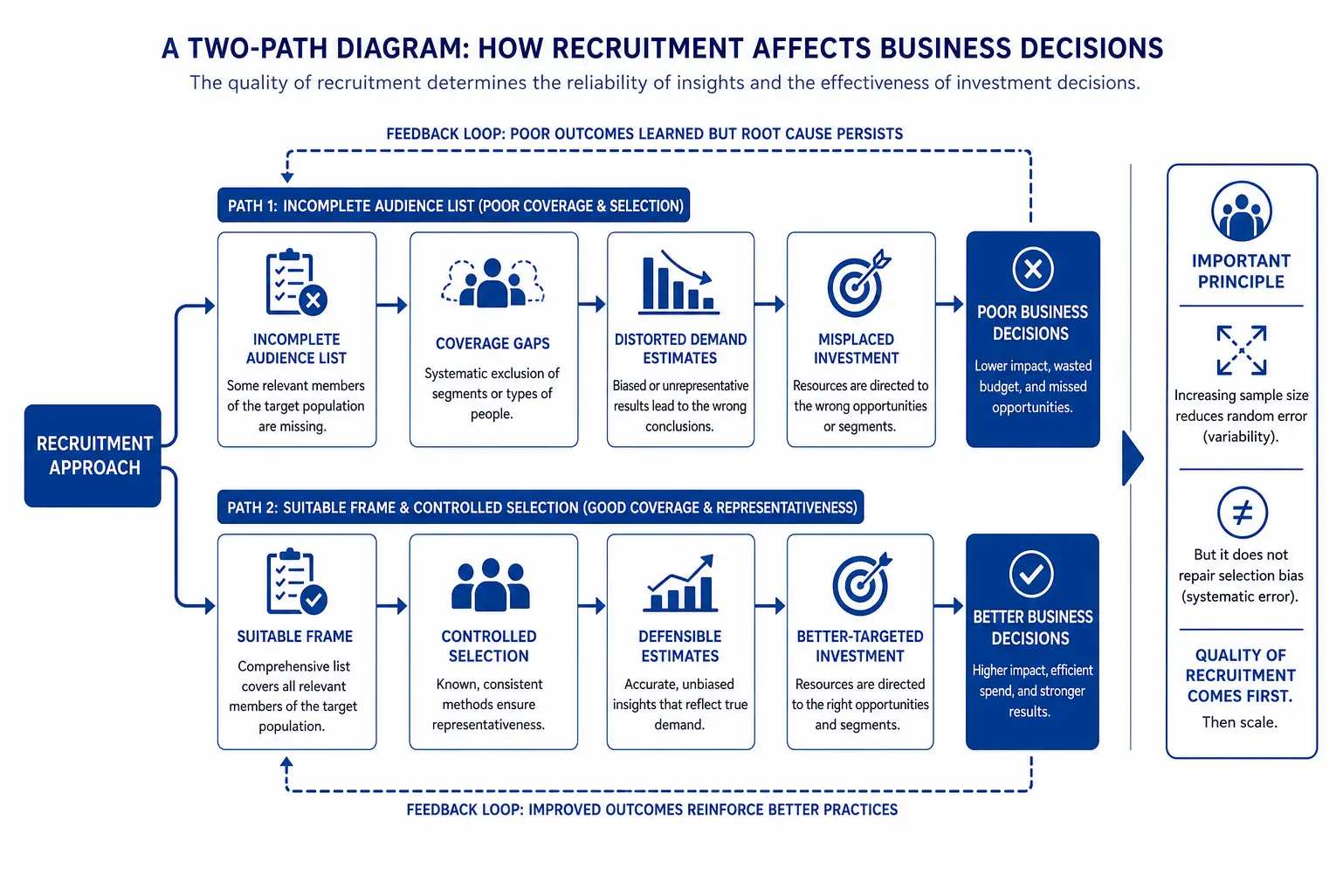
A bigger sample can make the wrong market estimate look more convincing. Choosing a sampling method starts with deciding whose behavior you need to understand, not how many survey responses you can buy.
The wrong recruitment route excludes valuable buyers or overrepresents enthusiastic customers. That distorts pricing, positioning, and demand forecasts before analysis begins.
Consistent with H-in-Q.com’s focus on AI-powered marketing and business automation, this guide treats recruitment as a decision process, not merely a data collection task.
In this guide, you’ll discover how to match selection techniques to your audience, constraints, and required evidence.
What Is a Sampling Method in Market Research?
A sampling method is the procedure used to select research participants from a defined population. It determines who can enter the study and how selection occurs. Choosing one requires matching the research objective, available population lists, recruitment constraints, and intended claims about the wider market.
Separate the target population from the sampling frame: the actual list or recruitment source you can access. An email database covers listed customers, not everyone considering your category.
Next, distinguish probability selection, with known inclusion probabilities, from nonprobability recruitment. This distinction governs which statistical claims your results support.
Why Your Sampling Method Matters for Businesses in 2026
Consider a basic planning calculation: estimating a proportion near 50% requires approximately 385 completed responses for a 95% confidence level and five-percentage-point margin of error under simple random sampling, assuming a large population.
The NIST guidance on proportion confidence intervals explains the statistical foundation. That calculation does not account for coverage gaps, nonresponse bias, or complex designs.
Sample size controls random uncertainty; it does not repair systematic exclusion. Surveying only loyalty-program members, for example, cannot establish category-wide willingness to pay. Treating those answers as market demand risks overpricing and misdirected advertising.
How to Choose a Sampling Method: Step-by-Step
-
Define the decision and population. Write the business decision first, then specify eligibility, geography, buying role, and timeframe. Replace “business buyers” with an operational definition recruiters can apply consistently.
-
Set the required inference. Decide whether you need population estimates, subgroup comparisons, or exploratory explanations. Representative percentage claims require stronger selection controls than interviews investigating purchase barriers.
-
Audit your recruitment frame. Check coverage, duplicate records, outdated contacts, and inaccessible groups. If no adequate frame exists, investigate alternative sources before selecting a technique.
-
Match selection to the evidence. Use simple random selection for a suitable list, or stratified random selection when subgroup estimates matter. Choose purposive interviews for specialist insight; use quota recruitment for directional surveys with explicit limitations.
-
Test feasibility and document the choice. Pilot recruitment to measure eligibility, completion, cost, and subgroup shortfalls. Record your sampling method, exclusions, stopping rules, and reporting limitations before launching.
Best Practices for Comparing Sampling Options
| Practice | Action |
|---|---|
| Protect small segments | Oversample strategically important groups; weight appropriately for overall estimates. |
| Separate eligibility from quotas | Screen for actual buying responsibility before balancing demographics. |
| Accept fewer responses when justified | Prefer a relevant, controlled sample over cheap, poorly matched volume. |
| Budget for design effects | Account for clustering and unequal weights when planning precision. |
| Inspect recruitment sources | Compare eligibility and response patterns across suppliers before pooling. |
Finally, avoid describing quota-balanced panel results as random. Matching visible characteristics does not establish equal coverage or remove unmeasured selection differences.
How AI Is Changing Sampling Decisions in 2026
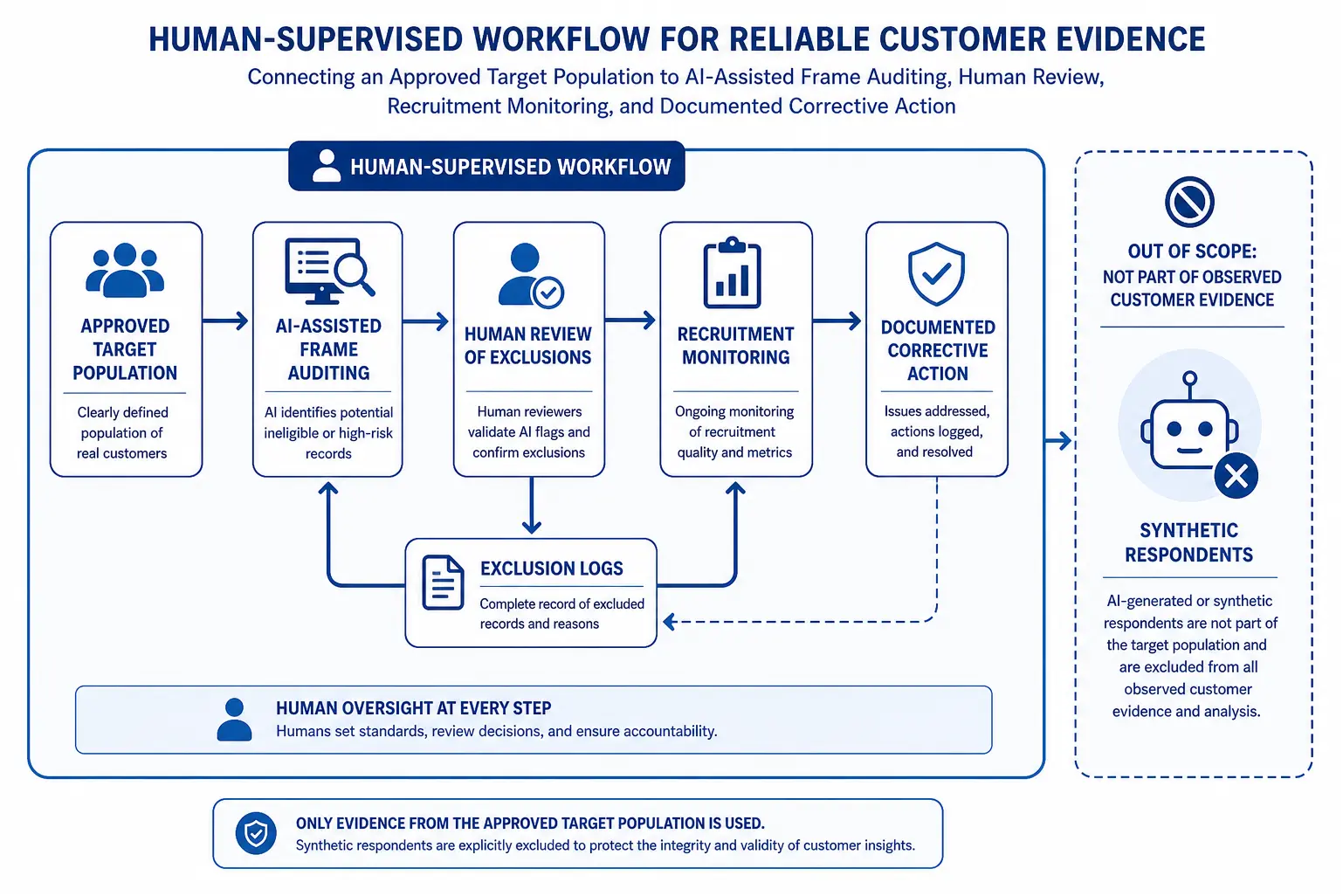
AI assists with frame auditing, duplicate detection, eligibility review, and recruitment monitoring. Language models can translate a research brief into proposed screening questions and flag contradictions for human review.
However, automated exclusions can change who enters your study. Log every rule, inspect rejected records, and check whether decisions disproportionately remove particular audience segments.
AI-generated respondents are not evidence of observed customer behavior. Use synthetic personas to test questionnaires, not to inflate respondent counts.
Keep a researcher accountable for population definitions, selection rules, and corrective actions. Automation should make those decisions more traceable, not conceal them.
Tools & Resources for Sampling Decisions
- R: Free software supporting reproducible random selection and analysis through specialist survey packages.
- Qualtrics: A paid platform for screeners, quotas, and survey management; platform controls do not guarantee representativeness.
- SurveyMonkey Sample Size Calculator: A free planning resource; check assumptions before applying its output.
- AAPOR Standards and Ethics: Professional guidance for transparent research practices and reporting.
Choose the Design Your Decision Requires
The right sampling method connects a defined audience to conclusions your recruitment process actually supports. Start with the decision, audit coverage, and select participants through rules you can explain.
Then pilot recruitment and examine subgroup gaps before scaling. Keep sample size separate from sample quality, and use automation to expose problems rather than disguise them.
To connect research planning with AI-enabled marketing workflows, explore H-in-Q.com’s business AI services. As recruitment becomes more automated, transparent selection will remain the foundation of trustworthy market insight.
Frequently Asked Questions
What is the best sampling method for market research?
The best sampling method depends on your target population, available recruitment frame, and intended conclusions. Use probability selection for defensible population estimates when feasible. Use purposive recruitment for specialist interviews, or transparent quotas for directional surveys when random selection is unavailable. Match the design to the decision.
When should I use stratified sampling instead of simple random sampling?
Use stratified sampling when important population subgroups need reliable representation or separate analysis. Divide your frame into mutually exclusive groups, then select randomly within each group. Oversample small segments when necessary, and apply appropriate weights when estimating results for the overall population rather than individual segments.
Is quota sampling the same as stratified sampling?
Quota sampling is not the same as stratified random sampling because selection within each group is not necessarily random. Both designs control subgroup numbers, but quotas alone do not establish known inclusion probabilities. Matching demographic proportions therefore does not guarantee representative attitudes, behaviors, or purchase intentions.
Can a large sample size fix sampling bias?
A large sample size does not fix systematic sampling bias. Recruiting more people through the same unbalanced channel can produce increasingly precise estimates of the wrong audience. Improve coverage, selection procedures, and response patterns before increasing respondent volume, then assess whether weighting addresses remaining measurable imbalances.
Can I use a customer email list for market research?
A customer email list works when your target population is the customers covered by that list. Check missing records, outdated contacts, duplicates, and consent requirements before recruitment. Do not use customer-only responses to estimate the entire market, because prospects and competitors’ customers remain outside the frame.
How can AI help choose a research sample?
AI can help audit sampling frames, identify duplicate records, recommend recruitment checks, and monitor subgroup completion rates. Researchers must still define the population, approve selection rules, and validate exclusions. AI-generated personas are not observed respondents and should not be counted as customer evidence in survey estimates.

 English
 Français
 Español