

The Industry 4.0 Paradox No One Wants to Admit
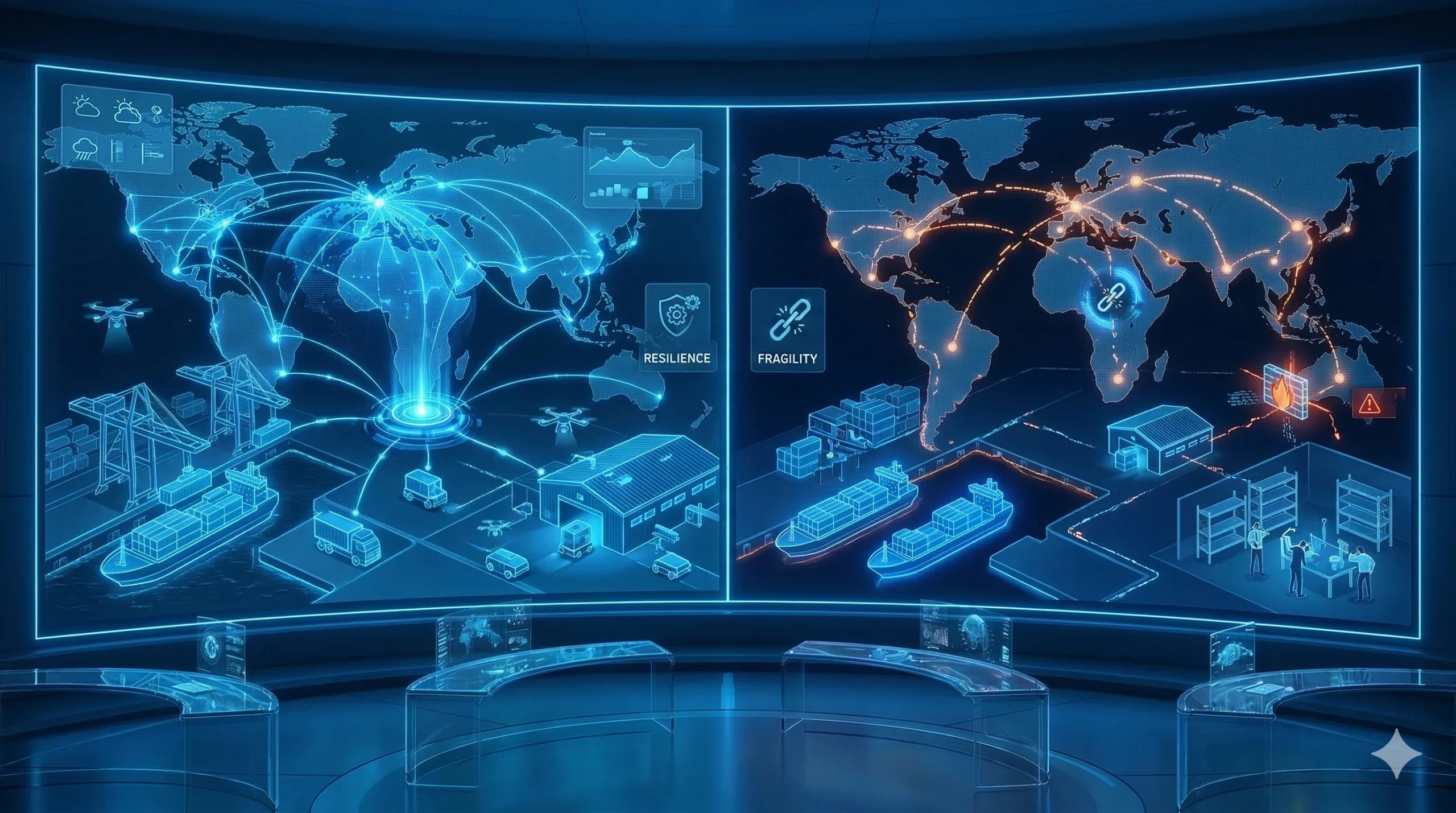
The debate around Industry 4.0 and supply chain resilience is not a nuanced conversation. It is a collision between two fundamentally opposed worldviews. One camp argues that interconnected, AI-powered, sensor-driven supply chains are the most agile systems ever built. The other insists that the same connectivity creates catastrophic single points of failure. Both positions carry partial truth. But only one leads somewhere productive. The COVID-19 pandemic exposed global supply chains as dangerously fragile, yet the companies that recovered fastest were precisely those that had invested deeply in Industry 4.0 infrastructure. This is not coincidence. It is architecture. The question is not whether Industry 4.0 creates risk. Every system does. The question is whether the intelligence it introduces outweighs the complexity it demands. The evidence answers that question clearly.
Industry 4.0 and the New Architecture of Global Supply Chains
How Industry 4.0 Technologies Are Rewiring Operational Infrastructure
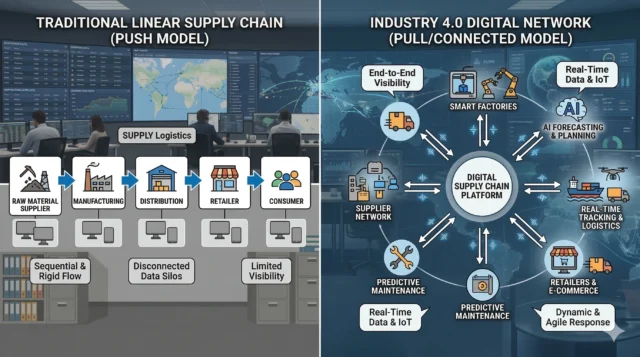
Industry 4.0 is not an upgrade to existing supply chain models. It is a structural reinvention. The integration of IoT sensors, AI-driven analytics, robotics, and cloud platforms has replaced linear, document-heavy logistics with dynamic, self-adjusting networks. According to McKinsey’s analysis of next-shoring and supply chain transformation, companies that have embraced Industry 4.0 principles report measurable improvements in delivery precision and inventory turnover. Goods now carry embedded digital identities. Factories communicate with suppliers in real time. Disruptions trigger automated rerouting before a human manager opens a dashboard. This is not efficiency for its own sake. This is operational sovereignty at scale.
The Hidden Dependencies That Industry 4.0 Creates
Critics argue, with legitimate concern, that Industry 4.0 creates dangerous dependency chains. A single API failure, a cloud outage, or a cybersecurity breach can cascade across an entire network instantly. The more integrated the system, the wider the blast radius of any failure. This is a real risk, and dismissing it would be intellectually dishonest. However, the alternative, which is analog, siloed, paper-based supply chains, proved catastrophically inadequate in 2020, 2021, and 2022. Dependency is not a flaw of Industry 4.0. It is a design challenge that intelligent organizations are actively solving through redundancy layers, edge computing, and decentralized data architecture.
Augmented Reality Elements in Industry 4.0: A Game-Changer for Supply Chain Visibility
How Augmented Reality Elements Are Transforming Industry 4.0 Warehouse Operations
Augmented reality elements represent one of the most operationally disruptive technologies within the Industry 4.0 toolkit. In warehouse environments, AR-equipped workers receive real-time visual overlays, including pick paths, inventory alerts, and quality checkpoints, directly in their field of vision. Deloitte’s research on supply chain digital transformation confirms that organizations deploying augmented reality elements in logistics report measurable reductions in picking errors and training time. AR removes the cognitive gap between information and action. Workers no longer toggle between screens and shelves. Instructions materialize exactly where the task is being performed. The result is a workforce that operates with machine-level precision while retaining human judgment.
Augmented Reality Zone: Redefining Real-Time Decision-Making in Industry 4.0
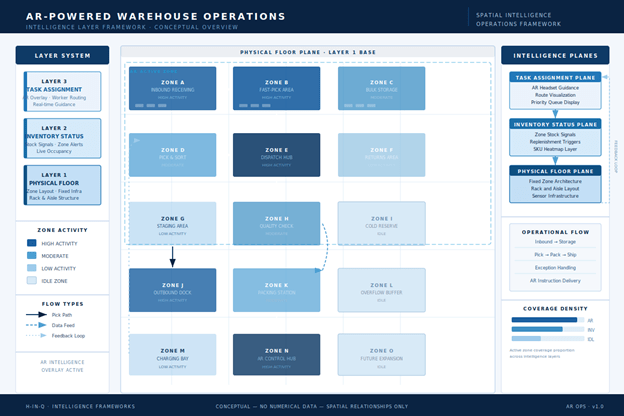
An augmented reality zone is a designated operational area where Industry 4.0 infrastructure enables full AR-assisted workflow management. These zones are not futuristic showrooms. They are live operational environments where every shelf, pallet, and movement is tracked and contextualized. Within an augmented reality zone, supervisors visualize bottlenecks as spatial data overlaid on the physical floor. Route optimization happens in seconds, not shift meetings. When a disruption occurs upstream, the augmented reality zone enables floor teams to adapt their workflow in real time, not retroactively. This is the operational difference between a supply chain that reacts and one that anticipates.
Industry 4.0 and the Resilience Illusion
When Automation Becomes a Single Point of Failure in Industry 4.0
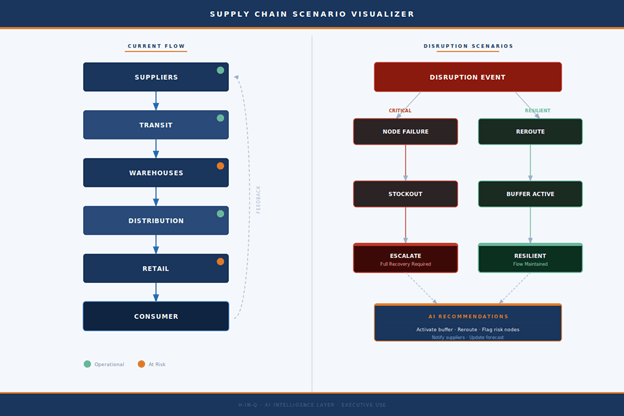
There is a seductive comfort in full automation, and that comfort is precisely what creates vulnerability. When an Industry 4.0 system operates without human checkpoints, its failure is total rather than partial. The 2021 Suez Canal blockage, the 2022 semiconductor shortage, and repeated port shutdowns all demonstrated that even sophisticated logistics networks collapse when a single physical or digital chokepoint is compromised. Automation accelerated the cascade. Critics who argue that Industry 4.0 amplifies fragility are not wrong about the mechanism. They are wrong about the conclusion. The solution is not less automation. It is smarter automation with built-in redundancy and multi-scenario modeling embedded from day one.
The False Security of Hyper-Connected Industry 4.0 Networks
Hyper-connectivity is Industry 4.0’s greatest strength and its most misunderstood liability. Organizations that connect every node in their supply chain gain unprecedented visibility, but they also create attack surfaces that cybercriminals actively exploit. The IBM Cost of a Data Breach Report consistently identifies supply chain-related breaches as carrying above-average financial consequences. The counterintuitive truth is that security must scale with connectivity. Companies that treat cybersecurity as an afterthought within their Industry 4.0 strategy are not building resilient supply chains. They are building elaborate vulnerabilities. The architecture of intelligence must include the architecture of defense, from the first line of code.
Augmented Reality Meta: The Next Layer of Industry 4.0 Supply Chain Intelligence
From Physical to Phygital : What Augmented Reality Meta Changes in Industry 4.0 Logistics
Augmented reality meta represents the convergence of physical logistics environments with persistent digital intelligence layers, what analysts now refer to as phygital operations. Unlike basic AR overlays, augmented reality meta systems retain spatial memory across sessions, workers, and shifts. A pallet repositioned during a morning shift is fully contextualized for the afternoon team, without manual data entry. This persistent layer of digital context, anchored to physical space, eliminates the information decay that plagues traditional shift handovers. According to MIT Technology Review, persistent spatial computing is emerging as a foundational capability for next-generation Industry 4.0 logistics infrastructure. The phygital supply chain is not theoretical. It is operational in leading enterprises today.
Industry 4.0 and Predictive Supply Chain Scenarios Powered by Augmented Reality
The combination of augmented reality and predictive analytics within Industry 4.0 environments creates something categorically new: a supply chain that simulates its own future. AR interfaces allow logistics managers to walk through digital simulations of disruption scenarios, visualizing the downstream impact of a port closure or a supplier delay before it materializes. This is not a planning tool. It is an operational war room available on the floor, in real time. Harvard Business Review has documented that organizations using predictive scenario planning consistently outperform reactive competitors during supply chain disruptions. Augmented reality transforms that planning from a boardroom abstraction into a spatially grounded, actionable experience.
The Efficiency vs. Accountability Debate in Industry 4.0 Environments
Speed Without Oversight: The Operational Risk of Full Automation in Industry 4.0
The efficiency gains of Industry 4.0 are real, documented, and significant. But speed without accountability creates a governance vacuum. Automated procurement systems can lock in contracts, reroute shipments, and adjust pricing without human review. When a machine makes a strategically wrong decision at scale, the damage is instant and wide. Critics of Industry 4.0 argue that removing human judgment from supply chain decisions is a form of organizational irresponsibility. This tension between efficiency and accountability is not resolved by choosing one over the other. The resolution lies in designing systems where automation handles execution at speed while humans retain strategic override authority at every critical decision node.
Who Is Responsible When an Industry 4.0 System Fails?
Accountability in Industry 4.0 supply chains remains one of the most legally and organizationally unresolved questions in modern business. When an AI-driven logistics platform misroutes critical supplies, or an automated procurement system creates an unethical supplier dependency, the liability question has no clean answer. The World Economic Forum has flagged AI accountability in supply chains as a priority governance issue for the decade ahead. Organizations that deploy Industry 4.0 without defining clear accountability frameworks are not being innovative. They are being reckless. Governance structures must evolve at the same pace as the technology. Deployment speed cannot outrun accountability design.
Efficiency vs. Accountability in Industry 4.0 Supply Chains
| Dimension | Full Automation Approach | Human-Supervised Automation |
| Decision Speed | Near-instantaneous | Minutes to hours |
| Error Detection | Algorithmic, pattern-based | Contextual, judgment-based |
| Accountability | Diffused across system | Traceable to human actors |
| Risk Profile | High cascade potential | Contained and manageable |
| Scalability | Unlimited | Dependent on workforce size |
| Recommended Layer | Execution operations | Strategic override control |
Industry 4.0 as a Competitive Weapon: Who Actually Benefits?
Large Enterprises vs. SMEs in the Industry 4.0 Race
The competitive asymmetry created by Industry 4.0 adoption is significant and deliberate. Large enterprises with substantial capital deploy full-stack Industry 4.0 infrastructure, including IoT networks, AI platforms, digital twins, and AR systems, while SMEs struggle to access even basic automation tools. This creates a technology gap that threatens to permanently stratify the supplier ecosystem. Critics argue that Industry 4.0 benefits accrue exclusively to corporations with resources to implement them, leaving smaller players structurally exposed. The counterargument carries weight: cloud-based Industry 4.0 platforms, modular AR solutions, and API-driven integrations are actively democratizing access. The barrier to entry is falling, but organizations must pursue adoption aggressively rather than waiting for parity to arrive on its own.
Augmented Reality Adoption as a Market Differentiator in Industry 4.0
Organizations that have deployed augmented reality within their Industry 4.0 frameworks are not merely more efficient. They are structurally harder to replicate. AR-enabled supply chains create operational muscle memory that compounds over time: better-trained workforces, richer spatial data sets, and faster onboarding cycles. Competitors without augmented reality capabilities face a growing performance gap measured not in percentage points but in structural capacity. McKinsey’s analysis of technology adoption in operations confirms that early movers in AR-assisted logistics consistently outperform laggards across delivery reliability, labor productivity, and error rates. Augmented reality is a durable competitive moat within Industry 4.0 ecosystems.
Industry 4.0 Adoption Readiness: Large Enterprises vs. SMEs
| Capability | Large Enterprises | SMEs |
| IoT Infrastructure | Fully deployed | Partial or absent |
| Augmented Reality Tools | Integrated across operations | Emerging or pilot stage |
| AI-Driven Analytics | Enterprise-grade platforms | Limited, often manual |
| Digital Twin Simulation | Active and operational | Rare |
| Cloud Integration | Multi-cloud architecture | Single platform or none |
| Competitive Positioning | Structurally advantaged | At risk of displacement |
Building Truly Resilient Supply Chains With Industry 4.0
From Reactive to Anticipatory: The Industry 4.0 Resilience Framework
Resilience in supply chains has historically been defined reactively: the ability to recover from disruption. Industry 4.0 redefines resilience as anticipatory, the capacity to detect, model, and neutralize disruptions before they materialize. This shift requires more than technology deployment. It demands an organizational mindset that treats data as infrastructure and predictive modeling as standard operating procedure. The Industry 4.0 resilience framework rests on four reinforcing pillars:
- Real-time visibility across all supply chain nodes without information silos
- Predictive analytics that simulate disruption scenarios before they occur
- Autonomous rerouting capabilities with mandatory human override controls
- Augmented reality elements that translate complex data into floor-level action
Each pillar reinforces the others. Remove one, and the framework collapses.
Augmented Reality Elements as a Human-Machine Collaboration Tool in Industry 4.0
The most enduring contribution of augmented reality elements to Industry 4.0 supply chains is human-machine collaboration. AR does not replace the worker. It amplifies the worker’s capacity to act with precision in complex, data-rich environments. A warehouse operative guided by augmented reality elements makes fewer errors, adapts faster to dynamic task assignments, and requires significantly less supervision than one relying on printed instructions or handheld scanners. This is the human dividend of Industry 4.0: not job elimination, but job elevation. Organizations that frame augmented reality as a workforce threat are fundamentally misreading the technology and actively losing the talent competition in the process.
Industry 4.0 Is Not the Problem. Timidity Is.
The fragility debate around Industry 4.0 and supply chains is, at its core, a debate about organizational courage. Fragile supply chains are not the product of too much technology. They are the product of incomplete adoption, poor governance design, and reluctance to commit fully to digital transformation. Every documented failure of an “Industry 4.0” supply chain traces back to partial implementation: automation without redundancy, connectivity without cybersecurity, speed without accountability. Organizations that have invested fully in Industry 4.0, including augmented reality elements, predictive analytics, digital twins, and augmented reality meta platforms, have demonstrably outperformed cautious competitors through the most severe supply chain stress tests in modern history. The verdict is clear. Industry 4.0 does not increase fragility. It exposes the fragility that was always there and, for the first time, provides the tools to permanently eliminate it.
References
Supply Chain Resilience and Industry 4.0 Transformation — McKinsey & Company
The Future of Supply Chain: Digital Transformation Strategies — Deloitte
Cost of a Data Breach Report: Supply Chain Vulnerabilities — IBM
The Spatial Computing Era and Industry 4.0 Logistics — MIT Technology Review
Building Supply Chain Resilience Through Predictive Planning — Harvard Business Review
AI Governance and Accountability in Supply Chain Operations — World Economic Forum
Industry 4.0 and Augmented Reality in Manufacturing Operations — McKinsey & Company
AI Solutions for Digitalization Factory – Industry 4.0
H-in-Q | Digitalization Solutions AI Data Intelligence