


Tabla de contenidos
- What Is the Role of Sampling Strategies in Global Markets?
- Why Global Sampling Strategies Matter for Businesses in 2026
- Illustrative Case Study: Redesigning a Four-Market Consumer Sample
- Best Practices for Cross-Country Sampling
- How AI Is Changing Global Sampling Strategies in 2026
- Tools & Resources for Global Sampling Strategies
- Conclusion: Build Comparable Evidence Before Scaling
- Preguntas frecuentes
Case Study: Successful Sampling Strategies in Global Markets
A perfectly balanced dashboard can conceal a badly unbalanced customer sample. International teams face this problem when identical online quotas overlook differences in internet access, language, and category participation. Successful sampling strategies address those differences before recruitment begins.
This illustrative case examines a consumer brand comparing four expansion markets. It shows how recruitment choices affect evidence quality without presenting invented results as verified client outcomes.
The approach connects H-in-Q.com’s focus on AI-powered marketing and automation with practical research governance. In this guide, you’ll discover how to structure country samples, monitor recruitment, and evaluate quality improvements before committing expansion budgets.
What Is the Role of Sampling Strategies in Global Markets?
Global sampling strategies are the rules used to select research participants across countries so that evidence supports a defined international business decision. They specify target populations, country allocations, recruitment channels, inclusion criteria, and adjustment methods while accounting for differences in population coverage, language, and market structure.
Comparability does not require identical recruitment. A metropolitan online panel and a mixed telephone-and-online sample can support the same research objective when eligibility, measurement, and analysis remain aligned.
Start with the intended inference. Comparing four markets requires adequate country-level evidence; estimating total regional demand additionally requires defensible market-size weights. These are different objectives, and one allocation rarely optimizes both.
Why Global Sampling Strategies Matter for Businesses in 2026
Coverage gaps remain commercially relevant. The International Telecommunication Union’s historical Facts and Figures 2024 report estimated that 68% of the world’s population used the internet. The remaining population was outside an online-only recruitment frame.
This does not establish any particular panel’s bias. It establishes why researchers must check coverage against their actual target population.
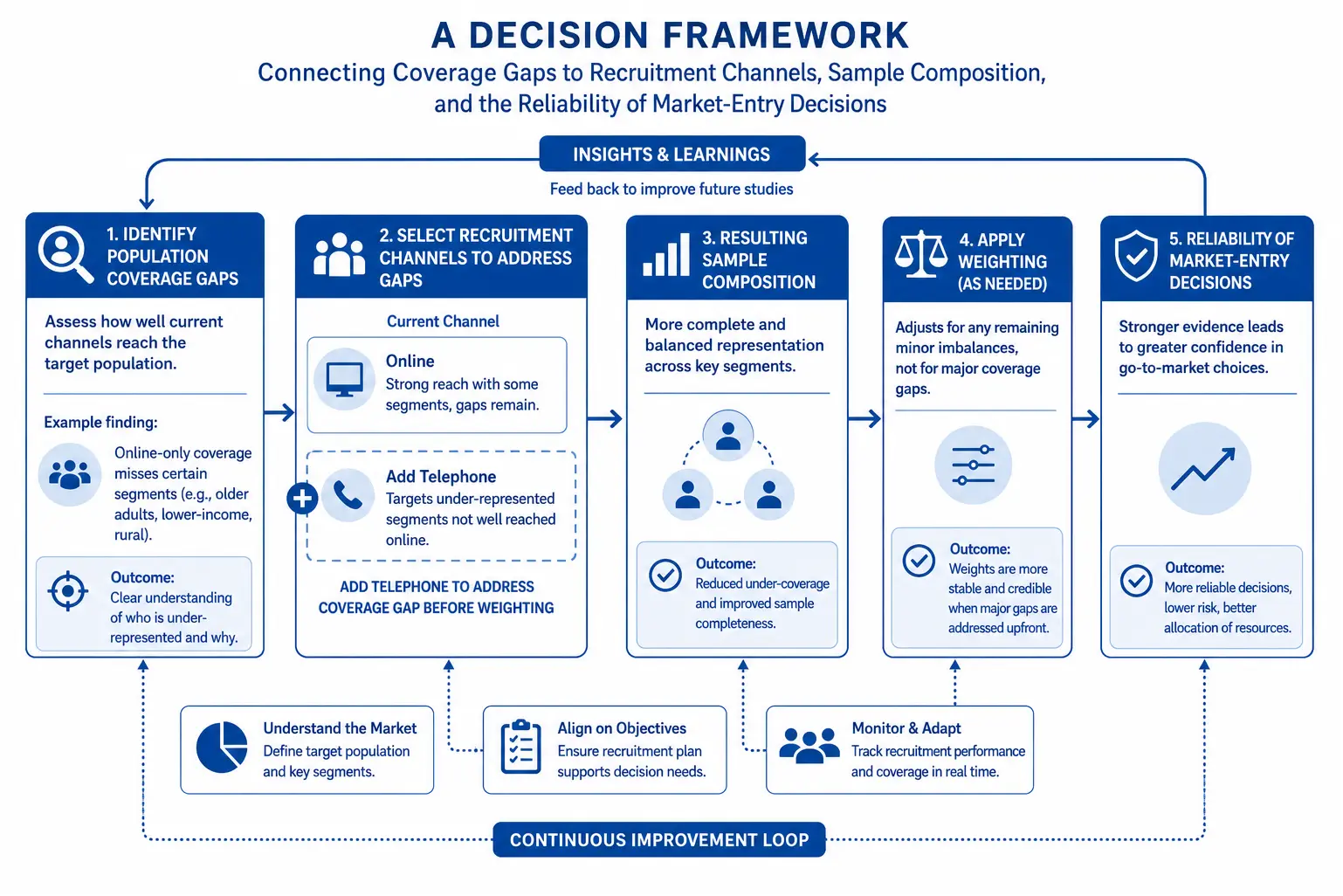
The practical chain is straightforward: coverage determines who can participate, recruitment determines who joins, and sample composition shapes the investment recommendation. Weighting comes afterward; it cannot supply missing customer experiences.
Illustrative Case Study: Redesigning a Four-Market Consumer Sample
Situation: A convenient sample distorted the comparison
A fictional household-products company evaluates Brazil, Germany, India, and Japan. Its decision is which two markets deserve distribution pilots among adults responsible for household purchases.
The initial online pilot underrecruits older shoppers. In this scenario, one country’s verified target benchmark is 35% older adults, but its pilot reaches only 16%. Researchers identify uneven nonmetropolitan coverage as another concern.
Action: Rebuild recruitment before adjusting results
The revised sampling strategies allocate 600 completed interviews per country, totaling 2,400. Equal allocation supports country comparisons; it does not imply equal market size.
Researchers verify eligibility locally, test translated questions, and prioritize age and geography quotas. Telephone recruitment supplements online panels in underserved cells. Interviewers use equivalent questions, and analysts check for mode-related response differences.
Daily monitoring tracks quota gaps, recruitment sources, and exclusions. Duplicate checks and human-reviewed quality flags precede weighting.
Results: Better balance with explicit trade-offs
These are modeled outcomes, not observed client results. The older-adult share reaches 34%, reducing its benchmark gap from 19 percentage points to one. Recruitment costs rise 12% against the original plan.
The modeled weighting-only design effect falls from 1.62 to 1.18. Using sample size divided by that factor, effective sample size rises from approximately 1,481 to 2,034.
Better recruitment reduces dependence on corrective weighting. These figures demonstrate improved balance and weighting efficiency not proven sales growth or population representativeness.
Best Practices for Cross-Country Sampling
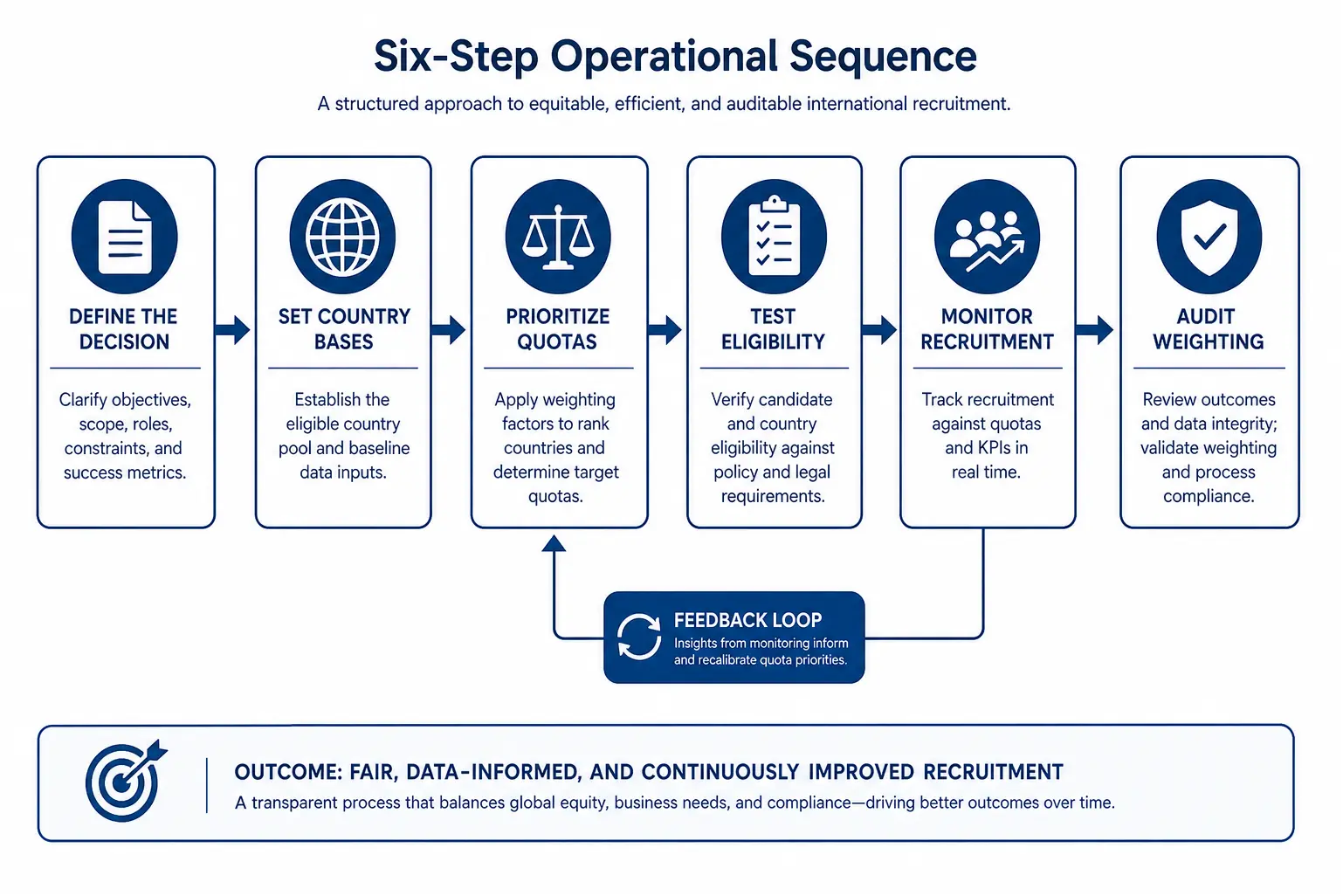
- Define the decision first: country ranking, regional demand estimation, or segment discovery.
- Set country bases around required subgroup comparisons, not an arbitrary global total.
- Use fewer quotas when necessary. Excessive interlocking cells create recruitment bottlenecks without guaranteeing less bias.
- Test purchase responsibility and category eligibility locally before launching.
- Monitor source-level quality and quota gaps daily; investigate changes before accelerating recruitment.
- Audit weights, effective sample sizes, exclusions, and benchmark sources before reporting.
Predefine exclusion rules so disappointing findings never become a reason to remove respondents.
How AI Is Changing Global Sampling Strategies in 2026
AI-assisted sampling strategies shorten the interval between detecting recruitment problems and acting on them. Automated monitoring can flag underfilled cells, unusual completion patterns, and repeated open-ended responses.
Language models also support translation review by identifying inconsistent purchase periods or category definitions. Local researchers must verify those flags before changing questionnaires.
Keep an audit trail of alerts, reviewer decisions, and recruitment changes. Test detection rules across languages and devices to avoid disproportionately excluding legitimate participants.
AI does not make convenience samples representative, and synthetic respondents must not be counted as recruited consumers.
Tools & Resources for Global Sampling Strategies
- R: Free statistical software for reproducible weighting, diagnostics, and country comparisons.
- World Bank Open Data: Free contextual indicators; verify population definitions before using benchmarks.
- Qualtrics: A paid survey platform supporting questionnaire deployment, quotas, and fieldwork monitoring.
- AAPOR standards and ethics resources: Guidance for transparent methods disclosure and responsible survey practice.
Conclusion: Build Comparable Evidence Before Scaling
Successful sampling strategies make country comparisons defensible by addressing coverage before applying statistical corrections. The illustrative case shows why local eligibility checks, complementary recruitment channels, and disciplined monitoring belong in the original design.
Evaluate improvement through benchmark alignment, weighting efficiency, and transparent limitations not a completion total alone. For your next study, document the decision, population, recruitment gaps, and acceptance rules before commissioning fieldwork.
Explore H-in-Q.com’s approach to AI-powered marketing and automation to connect research workflows with accountable execution. Future global studies will reward teams that automate oversight without surrendering methodological judgment.
Preguntas frecuentes
What are the best sampling strategies for global market research?
The best approach matches recruitment methods and sample allocation to the business decision in each country. Establish comparable eligibility rules, prioritize meaningful quotas, and address coverage gaps before fieldwork. Use probability sampling when defensible population estimates are required and an appropriate sampling frame exists.
How many survey respondents do you need per country?
The required sample depends on subgroup comparisons, expected variability, research design, and decision risk. Set country bases using the smallest audience you must analyze reliably. Equal country samples support balanced comparisons, while population-proportional allocation serves a different objective and requires appropriate aggregation weights.
Can you use the same survey panel in every country?
One panel provider can operate across countries, but its audience coverage and recruitment quality require separate validation in each market. Compare demographic reach, respondent sourcing, verification practices, and historical completion patterns. Add recruitment channels where the provider systematically misses relevant groups or locations.
How does AI improve international survey sampling?
AI supports international sampling by flagging recruitment imbalances, suspicious response patterns, and inconsistencies across translated questionnaires. It accelerates monitoring rather than establishing representativeness. Researchers must validate alerts, review local context, protect respondent data, and retain responsibility for recruitment changes and respondent exclusion decisions.
Does weighting fix an unrepresentative global sample?
Weighting adjusts observed sample distributions against suitable population benchmarks, but it does not recover information from groups entirely missing from recruitment. Large weights also reduce precision. Improve coverage first, document calibration variables, inspect weight dispersion, and report the assumptions behind every weighted estimate.
Are the results in this global sampling case study real?
The case study uses an explicitly illustrative scenario, not a documented client engagement or measured commercial outcome. Its sample sizes, costs, and quality indicators demonstrate practical research trade-offs. The figures explain how to evaluate a design without presenting modeled improvements as verified business results.

 English
 Français
 Español