


Tabla de contenidos
- What Is Sampling in Market Research?
- Why Sampling in Market Research Matters for Businesses in 2026
- How to Build Your First Market Research Sample
- Best Practices for Sampling in Market Research
- How AI Is Changing Sampling in Market Research in 2026
- Tools & Resources for Sampling in Market Research
- Turn Your Sampling Plan into a Reliable First Study
- Preguntas frecuentes
Beginner’s Guide to Sampling in Market Research
A thousand answers from the wrong people can mislead more than a hundred relevant interviews. Sampling in market research starts with choosing whose experiences actually answer your business question.
Beginners often distribute a survey first and define their audience afterward. Reverse that sequence to avoid collecting convincing answers from an unsuitable audience.
For readers exploring H-in-Q.com’s focus on AI-powered marketing and business automation, participant selection is an essential research foundation. In this guide, you’ll discover how to define an audience, recruit participants, assess sample size, and use automation responsibly.
What Is Sampling in Market Research?
Sampling in market research is the process of selecting a subset of a defined population to collect information about that population. Researchers specify who qualifies, identify a recruitment source, and choose participants using a documented method. The method determines which conclusions the resulting evidence supports.
Three terms make this practical. Your population is everyone you want to understand. Your sampling frame is the list or source used to reach them. Your sample contains the people selected to participate.
These groups rarely match perfectly. A customer database excludes prospects, while completed responses exclude invited people who declined.
Why Sampling in Market Research Matters for Businesses in 2026
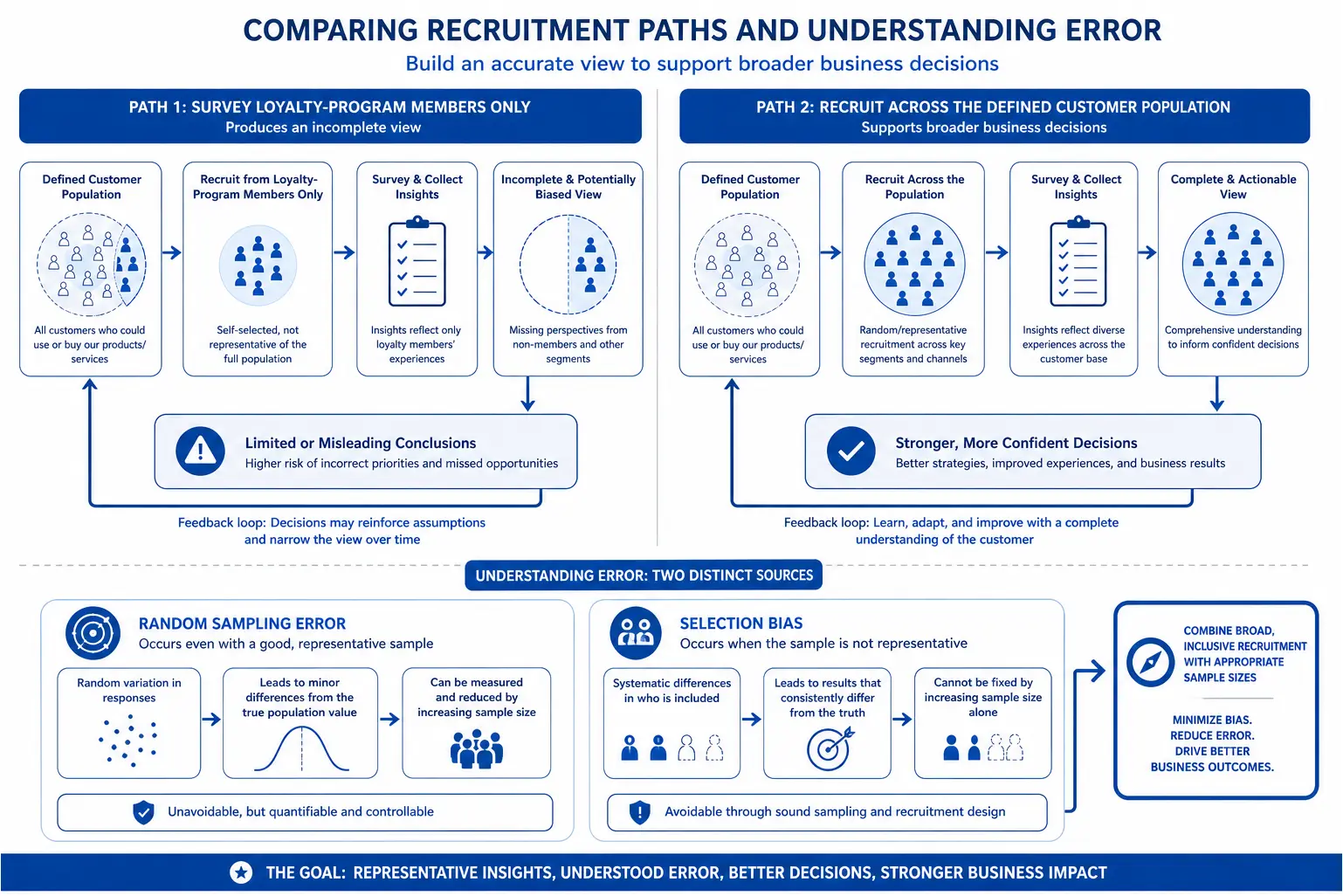
Automated surveys make collecting responses easier; they do not make those responses representative. Surveying loyalty-program members alone, for example, overlooks occasional shoppers and former customers.
Consider a calculated benchmark: approximately 385 completed responses support 95% confidence and a five-percentage-point margin of error under simple random sampling, assuming a large population and maximum variability. That calculation addresses random error, not missing audiences or misleading questions.
The American Association for Public Opinion Research’s best practices explain why sampling methods, recruitment, and transparent reporting matter.
A larger sample reduces random error; it does not automatically remove selection bias. Ignoring that distinction sends product and advertising budgets toward the wrong customers.
How to Build Your First Market Research Sample
1. Start with one decision
Suppose a meal-delivery business wants to understand cancellations. Define the decision first: which service issue deserves investigation? A question about cancellations requires former subscribers, not just enthusiastic current customers.
2. Set clear eligibility rules
Define your population as customers who cancelled during the previous three months. Specify geography and whether trial users qualify. These rules become screening questions that keep recruitment consistent.
3. Check who your list excludes
Use cancellation records as your sampling frame. Check for missing email addresses, duplicates, and customers whose contact preferences prevent recruitment. Think of the frame as a guest list: missing names cannot receive invitations.
4. Choose a selection method
For sampling in market research, distinguish two broad approaches. Probability sampling uses chance-based selection with known selection probabilities. Non-probability sampling recruits through accessibility, judgment, referrals, or quotas.
A random draw from cancellation records supports different claims than an open social-media invitation. Neither method guarantees participation, so document who responds.
5. Plan completed responses and invitations separately
If you need 100 completions and assume a 20% completion rate among invited eligible customers, plan approximately 500 invitations. Treat that rate as a planning assumption, not a promise. Pilot recruitment before committing the entire budget.
Best Practices for Sampling in Market Research
- Write eligibility rules before choosing a survey platform.
- Check recruitment coverage against the population you defined.
- Separate exploratory interviews from surveys intended to estimate percentages.
- Counterintuitively, fix an incomplete recruitment list before buying more responses.
- Plan subgroup sizes before fieldwork; a large total can conceal tiny segments.
- Record recruitment sources, exclusions, invitations, and completed responses.
Finally, report limitations beside findings. Explain whether your results describe respondents, listed customers, or a broader population. This simple habit prevents stakeholders from treating preliminary feedback as a market-wide estimate.
How AI Is Changing Sampling in Market Research in 2026
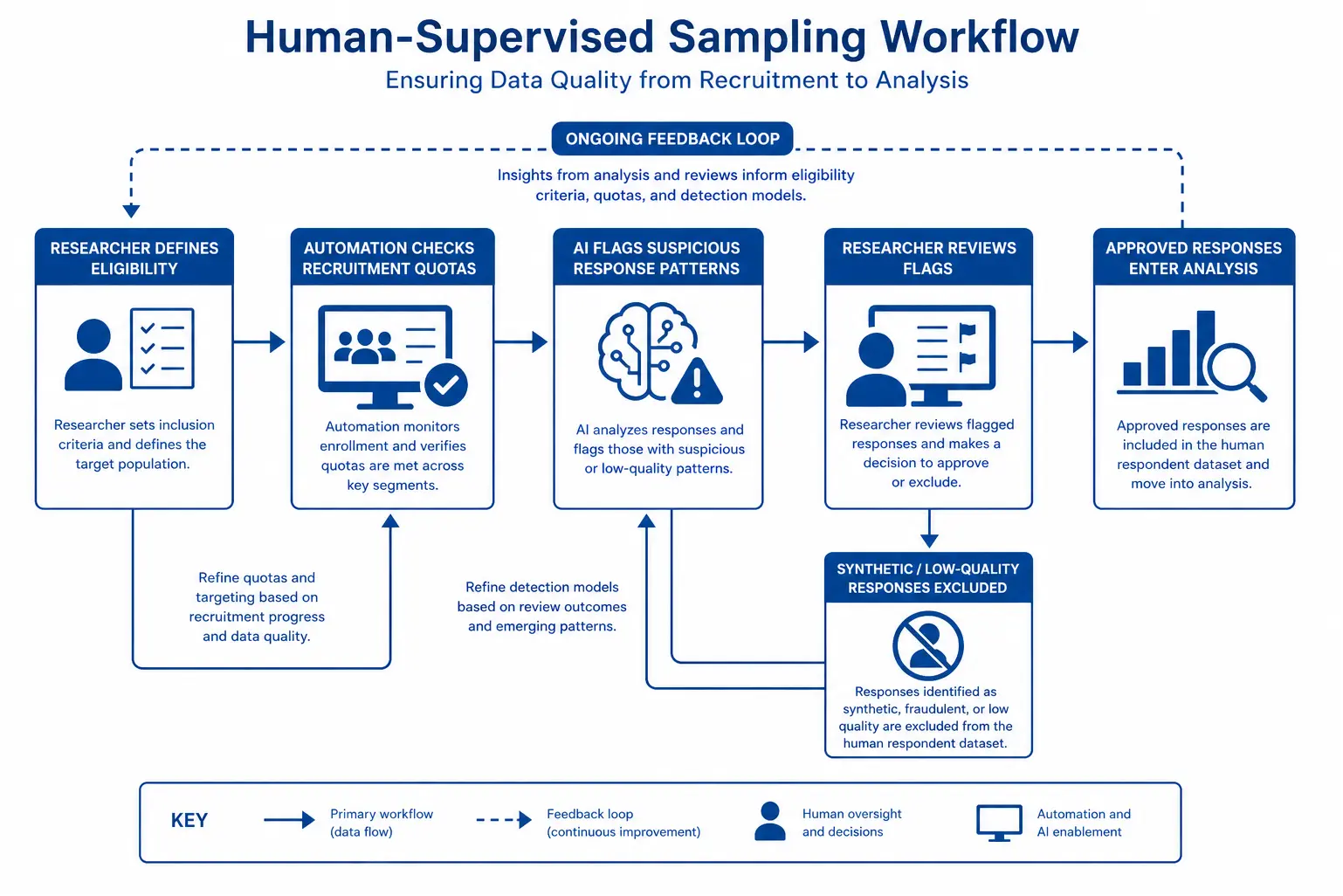
AI-assisted systems can classify open-text screening answers, flag suspicious response patterns, and monitor recruitment quotas. Automation also reduces repetitive work when sending invitations and checking missing fields.
Use sampling in market research as a supervised workflow: define eligibility, automate checks, review flagged cases, and document exclusions. Check privacy requirements before uploading participant information to any model.
AI flags require review because legitimate participants sometimes answer unusually quickly or share devices. Synthetic respondents are not evidence of real customer demand. Use generated answers to test questionnaire logic, never as undisclosed replacements for human participants.
Tools & Resources for Sampling in Market Research
- Google Sheets: A free starting point for tracking eligibility, invitations, and subgroup counts. Restrict access to identifiable information.
- SurveyMonkey: Offers survey distribution and screening features, with capabilities varying by plan.
- Qualtrics: A commercial research platform for questionnaire logic and recruitment management. Confirm panel eligibility before purchasing responses.
- R: Free statistical software for reproducible selection and analysis. Use specialist support for complex designs.
Turn Your Sampling Plan into a Reliable First Study
Good sampling in market research begins with a clear decision and a precisely defined audience. Choose a recruitment source that reaches that audience, then match your selection method to the conclusions you need.
Start with a pilot, inspect participation gaps, and report limitations openly. Software accelerates these tasks, but researchers remain responsible for deciding whose evidence counts.
Explore H-in-Q.com for AI-powered marketing and business automation. Your next study will be more useful when smarter automation supports a better-defined sample.
Preguntas frecuentes
What is sampling in market research?
Sampling in market research means selecting a subset of a defined population to answer a research question. Researchers collect information from those participants instead of contacting everyone. The recruitment method determines which people are represented and how confidently findings apply beyond the respondents.
How many people do I need for a market research survey?
Your required sample size depends on the precision, population, sampling method, and subgroup comparisons your study needs. Under simple random sampling assumptions, approximately 385 completed responses support a 95% confidence level with a five-percentage-point margin of error for a large population at maximum variability.
What is the easiest sampling method for beginners?
Convenience sampling is usually the easiest method because it recruits people you can readily reach. Examples include website visitors or existing email subscribers. Use it for exploratory feedback, but do not present its results as representative of all customers or the wider market.
What is the difference between random sampling and quota sampling?
Random sampling selects participants through a chance-based process with known selection probabilities, while quota sampling recruits until predefined group targets are filled. Quotas improve coverage of selected characteristics, but they do not remove selection bias or automatically justify a conventional margin of error.
Does a larger sample remove sampling bias?
A larger sample does not remove systematic sampling bias. Surveying more people from an incomplete customer list still excludes everyone outside that list. Improve the recruitment source and participation process first, then increase sample size when additional precision or subgroup analysis requires more responses.
Can AI replace real survey participants?
AI-generated respondents cannot establish what real customers think or how common an opinion is within a population. Use simulated responses to test questionnaire logic or generate hypotheses. Validate business decisions with genuine participants, and clearly separate synthetic material from collected human research data.

 English
 Français
 Español