


Direct Answer
A competitive analysis template is a structured framework for systematically documenting and comparing competitors across defined categories — pricing, features, positioning, marketing, and customer sentiment — to identify strategic gaps and opportunities. A free competitive analysis uses public sources like company websites, Google search results, SimilarWeb, review sites, and social media in place of paid intelligence platforms, covering roughly 60-70% of what a paid tool would surface.
Introduction
Sixty-eight percent of sales deals involve a head-to-head competitor, yet the average sales team rates its own competitive preparedness at just 3.8 out of 10 — a gap that costs deals every single week, not because the competitor is necessarily better, but because nobody documented how to beat them. A competitive analysis fixes this, but only if it’s built on real data instead of guesses about what “the other guy” is probably doing. This guide walks through exactly how to run a full competitive analysis using entirely free tools, gives you a ready-to-use template, and shows you where to source credible data for every field. At H-in-Q, we ran this exact process on our own market (the AI agency space in MENA) because we needed to know precisely where Zendesk AI, HireVue, and Qualtrics were strong before we could position against them honestly. In this guide, you’ll get the same step-by-step process, at zero cost.
What Is a Competitive Analysis Template: The Definition That Actually Matters
A competitive analysis template is a structured framework for systematically documenting and comparing competitors across defined categories — typically pricing, product features, market positioning, marketing strategy, and customer sentiment. It organizes scattered research into a side-by-side comparison you can actually act on, distinguishing between direct competitors (selling the same product to the same buyers), indirect competitors (solving the same problem a different way), and emerging competitors (startups or adjacent players moving into your space).
A competitive analysis is only as strong as the data behind it; a spreadsheet full of confident guesses isn’t intelligence, it’s noise with a nice format. The template structure matters less than the discipline of sourcing every field from something verifiable rather than an assumption. This is also where AI tools genuinely help: they can draft the structure and summarize public information quickly, but they can’t access real-time data or verify their own claims. Every AI-generated data point still needs a human source check.
Why Competitive Analysis Matters for Businesses in 2026
The visibility gap is larger than most teams assume. 44% of companies admit to having zero competitor visibility. According to a 2025 Crayon report, nearly half the market is making strategic decisions with no structured view of who they’re actually up against. Meanwhile, businesses that run a structured competitive analysis program consistently see higher revenue growth than those that don’t.
The cost of skipping this shows up directly in lost deals. When 68% of sales conversations involve a named competitor and your team can’t speak confidently to the comparison, you’re not just losing individual deals; you’re signaling a lack of preparation that undermines trust in the entire pitch. A documented, sourced competitive analysis turns “I think we’re better because…” into a specific, defensible answer your sales team can actually use.
How to Do a Competitive Analysis for Free: Step-by-Step
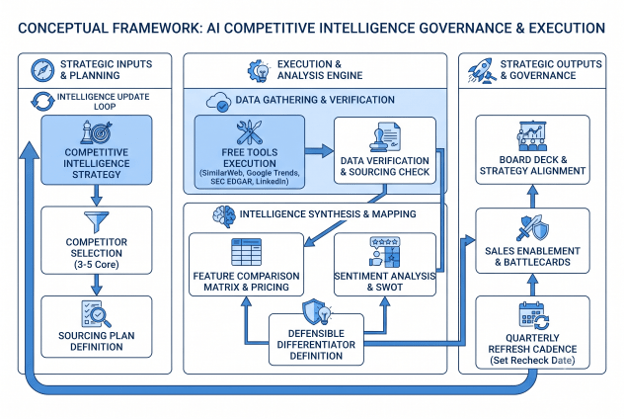
- List every company a prospect might consider instead of yours. Cover three categories: direct competitors (same product, same buyer), indirect competitors (different solution, same problem), and emerging competitors (startups or adjacent players — check Crunchbase funding rounds and LinkedIn job postings for early signals).
- Narrow to 3–5 competitors for detailed analysis. Beyond five, depth suffers. If you have a longer list, group the smaller players into a “long tail” summary and focus detailed work on whoever actually shows up in your sales deals.
- Establish the industry baseline first. Before profiling individual competitors, pull free industry-level context — search volume trends from Google Trends, category size estimates from public reports, and general market direction — so every competitor is measured against the same backdrop.
- Gather basic company data. Product, mission, location, company size, web presence, and tagline — sourced directly from each competitor’s website, LinkedIn page, and Google search results.
- Compare pricing and positioning. Document publicly listed pricing where available (or note “not public” rather than guessing), and record how each competitor describes their own value proposition in their own words.
- Build a feature comparison matrix. Break down product features side-by-side in a simple grid: your product in one column, each competitor in the next. Focus on the features that actually come up in sales conversations, not every feature that exists.
- Run qualitative research on customer sentiment. Pull review site comments, social mentions, and support forum threads from platforms like G2 and Trustpilot. This is where you learn what customers are actually happy or frustrated about — information that never appears in a features list.
- Complete a SWOT analysis for each competitor. Strengths and weaknesses are things the competitor controls; opportunities and threats are external factors. This step turns raw data into an actual strategic read.
- Translate findings into a defensible differentiator. Ask: what can we do that competitors cannot easily replicate? Map competitor weaknesses directly to your roadmap — a weakness in their onboarding is an opportunity in yours.
- Set a recheck cadence. In fast-moving markets, a competitive analysis can go stale in 30 days. The step most teams skip is revisiting it — schedule a quarterly refresh at minimum.
Free Data Sources for Every Template Field
| Field | Free Source |
|---|---|
| Company size, funding | Crunchbase, LinkedIn |
| Pricing (if public) | Competitor pricing page, G2/Capterra listings |
| Website traffic estimate | SimilarWeb (free tier) |
| SEO footprint | Google search, free keyword tools |
| Customer sentiment | Review sites (G2, Trustpilot), Reddit, social mentions |
| Public company financials | SEC EDGAR (10-K, 10-Q filings) |
| Hiring/expansion signals | LinkedIn job postings |
| Industry benchmarks | Census Bureau, BLS, industry association reports |
Free tools cover roughly 60–70% of what a paid competitive intelligence platform provides — enough for most startups and small businesses to build a credible, sourced analysis without an enterprise subscription.
Competitive Analysis Best Practices: What Works, What Wastes Time
| Practice | Why It Matters |
|---|---|
| Source every field, don’t estimate | An unsourced “estimated revenue” field produces a confident-looking document built on guesses |
| Cap detailed analysis at 3–5 competitors | Spreading across 10+ competitors sacrifices the depth that makes analysis useful |
| Include indirect competitors | Direct-only analysis misses the real reason many deals stall: a different category entirely |
| Separate what you know from what you infer | Keeping this line visible is what separates analysis from speculation |
| Map weaknesses to your actual roadmap | A competitor’s confusing pricing is only useful if you act on it with your own transparent pricing |
| Refresh at least quarterly | A competitive analysis can go stale within 30 days in fast-moving markets |
The most common and costly mistake: running the analysis once for a pitch deck or board meeting and never updating it. A competitive landscape document from eight months ago is often actively misleading, not just outdated.
How AI Is Transforming Competitive Analysis in 2026
AI tools like Perplexity and ChatGPT can now generate a rough competitive analysis framework and summarize publicly available information about a competitor in seconds — genuinely useful for the first 20% of the work, structuring the document and pulling together an initial company overview. What AI cannot do is access real-time data, query proprietary databases, or verify its own claims, which means every AI-generated data point still requires a human source check before it goes into a board deck or investor conversation.
Where AI adds the most real value is synthesis at scale: reading through hundreds of competitor reviews to surface sentiment patterns, or scanning job postings across five companies to flag expansion signals a human researcher would take hours to notice manually. At H-in-Q, our free Competitive Analysis Template pairs this AI-assisted research summarization with the sourced structure above, so teams get speed without sacrificing the verification that makes an analysis defensible.
Tools & Resources for Competitive Analysis
- H-in-Q Competitive Matrix builder — free, sourced, ready to copy.
- H-in-Q CrossTab Builder — for primary research on customer sentiment toward competitors.
- SimilarWeb (free tier) — traffic and engagement estimates.
- Google Trends — category and search demand context.
Pair this with our Survey Template Builder for primary research on customer sentiment, and see our full breakdown of free vs. paid market research tools for when it’s worth upgrading beyond this stack.
FAQ
What is a competitive analysis template?
It's a reusable framework — usually a spreadsheet or document — for comparing your business against direct and indirect competitors across pricing, product features, positioning, and marketing strategy, turning scattered research into a structured decision matrix.
How do you do a competitive analysis for free?
Combine free tools like Google search, SimilarWeb's free tier, company websites, review sites, and SEC EDGAR (for public companies) with a structured template. Free sources cover roughly 60-70% of what paid competitive intelligence platforms provide.
How many competitors should you include in an analysis?
Most frameworks recommend 3-5 competitors for detailed analysis. Beyond that, depth suffers — group smaller competitors into a "long tail" summary rather than analyzing them in equal detail.
How many competitors should you include in an analysis?
Most frameworks recommend 3-5 competitors for detailed, in-depth analysis. Beyond that, group smaller players into a brief "long tail" summary rather than spreading detailed research too thin.
What's the difference between direct and indirect competitors?
Direct competitors sell the same product to the same buyer, the other results when someone searches your category. Indirect competitors solve the same problem a different way, like a spreadsheet competing with dedicated project management software.
Conclusion
A competitive analysis is only useful if it’s built on sourced, verifiable data and revisited regularly, not a one-time spreadsheet full of confident guesses filed away after a board meeting. Identify 3–5 competitors worth detailed analysis, source every field from a specific free tool, build out pricing, features, and sentiment comparisons, and translate every competitor weakness into something on your own roadmap. With 44% of companies admitting zero competitive visibility, even a basic, properly sourced analysis puts you ahead of nearly half the market. Ready to build yours? H-in-Q’s free cross tab builder gives you the full structure and source list above, ready to fill in today.