


Introduction
A focus group with the right participants and the wrong discussion guide produces two hours of pleasant conversation and almost no usable insight. A well-structured guide turns that same two hours into the clearest qualitative signal a research budget can buy. A typical professionally moderated focus group costs $5,000–$15,000 per session in 2026, including recruitment, incentives, moderator fees, and facility, and a full two-to-three session study totals $10,000–$25,000 for most US teams. That budget buys nothing if the session runs off-track, misses critical research areas, or lets one participant dominate while the others stay quiet.
The difference between a session that justifies that investment and one that produces a follow-up session to get the answer the first one should have provided is not the participants, not the moderator, and not the platform. It is the quality of the discussion guide. The structure connecting the questions, the timing that keeps the session from running long, and the probes that turn a surface-level answer into a genuine insight. These are guide decisions made before the session opens. Skip the guide, and you will miss key topics or run out of time on the ones that matter most.
This article walks through exactly how to build a focus group discussion guide from scratch: the structure, the timing, the probe logic, and the three deep-dive tracks that match your research objective to the right question format. It includes a complete copy-paste template with realistic timing, and a free interactive Discussion Guide Builder from H-in-Q that generates a ready-to-use, timed guide in minutes, so your next session generates insight rather than conversation.
What Is a Focus Group Discussion Guide? The Definition That Actually Matters
A focus group discussion guide is a structured document a moderator uses to run a qualitative research session. It lists the topics and questions to cover, suggests timing for each section, and includes probes to deepen participant responses.
It is a guide, not a rigid script. A skilled moderator adapts it in the moment while keeping the session on track and on time. This distinguishes it from a moderator script, which is fully written out and read verbatim, a format that produces cleaner logistics and much weaker conversation.
The core structure follows a predictable arc: a warm-up that puts participants at ease, three to four core discussion topics that consume roughly half the session, and a wrap-up that captures final, prioritized thoughts. A discussion guide is not a survey read aloud. Its job is to create a natural conversation that still systematically covers your research objectives. A guide that reads like a questionnaire kills the group dynamic that makes focus groups valuable in the first place; participants stop talking to each other and start answering the moderator like a one-way interview.
The richest insights in qualitative research come from unexpected threads the discussion guide did not anticipate. A guide that is too rigid prevents exactly that. Its job is to set the direction and protect the timeline, not to script every exchange.
Why a Strong Discussion Guide Matters for US Businesses in 2026
Focus groups are strongest for exploring attitudes, perceptions, and reactions to concepts before a business invests in building or launching them. That value only holds if the session surfaces honest, specific reactions instead of polite consensus. Without a well-designed guide, sessions veer off track, miss crucial areas of inquiry, and fail to generate the qualitative insight the research budget was commissioned to produce.
The real cost shows up in wasted recruiting spend, not just the session cost, but the compounding expense of running an additional session to get the answer the first one should have delivered. A poorly structured guide that fails to surface genuine insight wastes participant time, moderator time, incentive spend, and the entire recruitment cycle. A well-crafted guide gets it right the first time by keeping the group focused while still creating the conditions for unexpected discoveries to surface.
There is a second, less discussed cost: the insight that never gets captured because the session ran out of time before reaching the question that mattered most. This is the moderator time-management failure that well-structured timing prevents. Every section of a good discussion guide has a time budget that protects the most important research territory from being crowded out by a warm-up that ran long or a first topic that went deep in the wrong direction.
In 2026, post-session AI analysis tools have reduced the time from session close to insight delivery by 70–80% compared to manual transcript coding. The bottleneck in focus group research is no longer the analysis; it is the session quality. And session quality starts with the discussion guide.
How to Write a Focus Group Discussion Guide: 8 Steps
Step 1: Define Your Research Objective Precisely
Write one sentence describing exactly what you need to learn; not a broad aspiration, but a specific, answerable research question. “Understand why users abandon checkout at the payment screen” is a research objective. “Learn about the shopping experience” is not. The precision of your objective determines the quality of every question that follows from it. Vague objectives produce vague guides that produce vague sessions.
Test your objective against this standard: if someone read it without additional context, could they write a discussion guide question that would directly address it? If not, sharpen it before writing a single question.
Step 2: Decide Your Participant Profile and Group Size
Most focus groups run with 6–8 participants. Fewer than 5 limits the group dynamic that makes focus groups valuable; you lose the cross-participant reactions, the moments where one person’s answer triggers a completely different perspective from another. More than 10 makes it difficult for everyone to contribute meaningfully, and dominant participants crowd out quieter ones. Plan your participant profile with the same precision you applied to your objective: demographics, behavioral qualifiers, and at least one disqualifying criterion that filters out people whose opinions are irrelevant to your specific research question.
Overrecruit by 20–30% to account for last-minute no-shows. A group of 6 that drops to 4 on the day produces a structurally different dynamic than you planned for, and not a better one.
Step 3: Plan for Multiple Groups, Not Just One
One focus group gives you anecdotal data that could be entirely driven by that specific group’s dynamics. Two groups is the minimum for any meaningful pattern identification. If the same themes appear across both groups independently, they reflect something real in your target audience rather than one group’s collective mood. Three to six groups is the standard for most US product research questions, with diminishing returns on genuinely new themes appearing after that point.
Designing your research program around a single focus group is the single most common structural error in qualitative research planning, and it is a decision usually driven by budget pressure rather than methodology.
Step 4: Write the Warm-Up Section
Open with low-stakes, easy questions that build rapport and get everyone talking before the real topic starts. The warm-up serves three functions: it normalizes speaking in a group setting, it gives the moderator calibration data on each participant’s communication style and energy, and it establishes the conversational tone that will carry through the session.
Warm-up questions should be personally relevant but not threatening; questions about recent purchases, category usage, or general attitudes toward the broad topic space. They should never touch your specific research hypothesis. If participants are already primed toward your concept before the core discussion begins, you have contaminated the most valuable part of the session: the unprompted reaction to your stimulus. Budget 10 minutes for warm-up and protect it from running long.
Step 5: Build 3–4 Core Discussion Topics
This is the bulk of your session; roughly half the total time. Structure questions to move from broad to specific within each topic: start with open-ended exploratory questions that surface the participant’s unprompted thinking, then move into likes and dislikes once you have established baseline attitudes, then into scenario walkthroughs where you introduce your specific stimulus or concept.
The broad-to-specific movement mirrors how people naturally organize their own thinking. A participant who is asked for their final opinion before their context is established will give you a more performative, less genuine answer than one who has first been invited to describe their experience in their own words.
Step 6: Write Probes for Every Core Question
A probe is a short, neutral follow-up that deepens a surface-level answer. “Can you say more about that?” “What made you feel that way?” “Can you give me an example from the last few months?” Plan 2–3 probes per core question rather than relying on improvisation.
Improvised probes are inconsistent across sessions; a moderator who probes differently based on how they feel in the moment produces data that cannot be reliably compared across groups. Planned probes create consistency without rigidity: the moderator knows what to reach for when a participant gives a short answer, and that consistency makes the cross-session comparison meaningful.
The most powerful single probe in qualitative research is the simplest: silence. A moderator who is comfortable holding three seconds of quiet after a participant’s response will frequently hear the participant add the most honest, least rehearsed version of what they were actually thinking.
Step 7: Eliminate Yes/No Questions Entirely
“Did you like it?” shuts down discussion. “What was your reaction when you first saw it?” opens it. This is not a stylistic preference; it is the structural difference between a question that produces a single data point and a question that produces the reasoning, emotion, and context that makes qualitative research worth the investment.
Review every question in your guide before the session. Any question answerable with a single word fails the open-ended test. Rewrite it as a “what,” “how,” or “walk me through” question that requires the participant to construct a response rather than select one.
Step 8: Write the Wrap-Up
Close with a prioritization or reflection question that surfaces what participants actually rank as important; not what they mentioned most frequently during the session, but what they choose when forced to choose. “Of everything we discussed today, what matters most to you in deciding to buy?” is a wrap-up question. It functions as a final validity check on everything that preceded it: if participants prioritize something they barely mentioned during the session, that divergence is itself a significant finding.
Budget 5 minutes for wrap-up and end on time. Participants who feel their time is respected are more likely to participate in future research. Moderators who consistently run over time are less likely to be trusted with panel access.
Ready-to-Use Focus Group Discussion Guide Template
Session length: ~80 minutes | Group size: 6–8 participants
Introduction & Warm-Up: 10 Minutes
Moderator introduction, purpose of the session, recording and confidentiality notice.
“There are no wrong answers, we want your honest reactions, positive and negative. We’re here to learn from you, not test you.”
Warm-up question: “Tell us your name and one thing you’ve bought recently that you’re happy with, what made it the right choice?”
[Moderator note: Keep this light and fast. The goal is normalizing participation, not collecting data. Move on at the 10-minute mark regardless of where the conversation is.]
Topic 1: Overall Category Beliefs and Perceptions – 10 Minutes
“When you think about [category], what comes to mind first?”
“How does it make you feel? What associations does it carry for you?”
Probe: “Can you tell me more about that? Where does that association come from?”
[Moderator note: This section is about unprompted mental models, do not introduce brand names or product names yet.]
Topic 2: Current Behavior – 15 Minutes
“Walk me through the last time you [relevant task or purchase]. What happened from start to finish?”
“Which brands or options did you consider? Which did you rule out immediately, and why?”
“What drove your final choice? What would have made you choose differently?”
Probe: “Any other reasons? What else played into it?”
[Moderator note: Listen for language, the exact words participants use to describe drivers and barriers are the most commercially valuable output of this section. Note verbatim quotes.]
Topic 3: Deep-Dive Module – 40 Minutes
Choose ONE track based on your research objective. Use only the track that matches what you are trying to learn. Each track runs the full 40 minutes.
Piste A : Test de concept / de produit
À utiliser quand : vous testez un nouveau produit, service ou une nouvelle fonctionnalité avant d’investir dans son développement.
- Réaction à chaud (10 min)
« Nous allons vous présenter quelque chose. Prenez un moment pour [lire / regarder], puis partagez votre première réaction : qu’est-ce qui vous marque, qu’est-ce qui vous intrigue, quelles interrogations ou réserves cela soulève-t-il ? »
Relance : « Dites-m’en plus. Qu’est-ce qui a précisément attiré votre attention ? »
- Exploration détaillée : bénéfices, freins, amélioration (10 min)
« Qu’avez-vous aimé ? Qu’avez-vous moins aimé ? Qu’est-ce qui le rendrait plus convaincant ? »
Relance : « Qu’est-ce qui devrait changer pour que le point qui vous gêne disparaisse ? »
« À qui recommanderiez-vous cela, et à qui ne le recommanderiez-vous pas ? Pourquoi ? »
« Sur une échelle de 1 à 10, quelle est la probabilité que vous achetiez ceci si c’était disponible aujourd’hui ? Qu’est-ce qui explique cette note ? »
Relance : « Qu’est-ce qui devrait changer pour que votre note augmente de deux points ? »
- Comparaison d’options (10 min)
« Si vous deviez choisir entre [Option A] et [Option B], laquelle préféreriez-vous, et pourquoi ? »
Relance : « Qu’est-ce qui devrait changer pour que l’autre option vous convainque ? »
« Qu’est-ce qui manque à chaque option pour être parfaite selon vous ? »
- Prix et confiance à l’achat (10 min)
« Qu’est-ce qui vous ferait hésiter à payer pour cela ? De quoi auriez-vous besoin pour vous sentir en confiance sur le prix ? »
Relance : « Quelles informations devraient être visibles pour que vous ayez suffisamment confiance pour agir ? »
« Si ce produit coûtait [prix], est-ce que cela vous semblerait juste, trop cher, ou étonnamment abordable ? Pourquoi ? »
Relance : « Et si le prix incluait [service / garantie / option], votre perception changerait-elle ? »
Note pour l’animateur : Prévoyez des supports physiques ou visuels clairs (maquette, prototype, mockup) et laissez au moins 60 secondes de silence avant la première réaction, pour éviter l’effet d’entraînement du premier participant qui parle.
Piste B : Usages et attitudes
À utiliser quand : vous voulez comprendre le comportement actuel, les attitudes et les besoins non satisfaits dans une catégorie, avant de concevoir une solution.
- Cartographie de l’usage actuel (12 min)
« Comment gérez-vous actuellement [problème / tâche] ? Décrivez-moi votre approche habituelle, étape par étape. »
« Quelles variantes achetez-vous ou utilisez-vous ? Dans quel contexte, à quelle fréquence, en quelle quantité, à quel moment, à quel endroit, à quel prix ? »
Relance : « Est-ce que cette habitude a changé au cours des 12 derniers mois ? Qu’est-ce qui a déclenché ce changement, le cas échéant ? »
- Satisfactions et frustrations (10 min)
« Qu’est-ce qui fonctionne bien dans votre façon actuelle de gérer cela ? Qu’est-ce qui vous frustre le plus ? »
Relance : « D’autres frustrations ? Que se passe-t-il quand cette frustration atteint son pic ? »
« Racontez-moi la dernière fois où cette situation vous a vraiment posé problème. Qu’avez-vous fait ? »
- Arbitrages entre options (9 min)
« Si vous deviez choisir entre [Option A] et [Option B] pour votre situation, laquelle conviendrait le mieux, et pourquoi ? »
Relance : « Qu’est-ce qui devrait changer pour que l’autre option devienne le meilleur choix pour vous ? »
« Dans un monde idéal, à quoi ressemblerait la solution parfaite pour ce besoin ? »
- Freins au changement et confiance (9 min)
« Qu’est-ce qui vous ferait hésiter à essayer une nouvelle solution dans cette catégorie ? De quoi auriez-vous besoin pour dépasser cette hésitation ? »
Relance : « Quelles informations devraient être visibles pour que vous ayez suffisamment confiance pour essayer une nouvelle option ? »
« Qui, dans votre entourage, influence vos décisions dans ce domaine ? Comment ? »
Note pour l’animateur : Cette piste fonctionne particulièrement bien en amont d’un travail d’idéation ou de conception produit : gardez les questions ouvertes et évitez d’introduire vos propres hypothèses de solution avant la fin de la session.
Piste C : Test de discours / de message
À utiliser quand : vous testez un texte publicitaire, un message ou une communication de marque avant d’investir en média.
- Réaction à chaud (10 min)
« Nous allons vous montrer un texte ou un message. Prenez un moment pour le lire, puis partagez votre première réaction : qu’est-ce qui vous marque, qu’est-ce qui résonne, qu’est-ce qui vous semble étrange ou soulève des questions ? »
Relance : « Dites-m’en plus. Qu’est-ce qui vous a particulièrement marqué ? »
- Analyse du langage et de la clarté (10 min)
« Qu’avez-vous aimé dans la façon dont c’est formulé ? Qu’est-ce qui sonnait juste ? Qu’est-ce qui sonnait faux ou manquait de clarté ? »
Relance : « Qu’est-ce qui rendrait la partie peu claire plus compréhensible ? Quel mot ou quelle expression utiliseriez-vous à la place ? »
« En un mot, comment décririez-vous le ton de ce message ? Est-ce le ton que vous attendez de cette marque ? »
- Comparaison de versions (10 min)
« Si vous deviez choisir entre [Version A] et [Version B], laquelle vous parle le plus directement, et pourquoi ? »
Relance : « Qu’est-ce qui devrait changer pour que l’autre version vous convainque ? »
« Qu’est-ce que chaque version vous dit sur la marque qui l’a écrite ? »
- Passage à l’action et crédibilité (10 min)
« Qu’est-ce qui vous ferait hésiter à agir suite à ce message ? De quoi auriez-vous besoin, en plus, pour vous sentir en confiance ? »
Relance : « Quelles informations rendraient ce message suffisamment crédible pour que vous passiez à l’étape suivante ? »
« Si vous voyiez ce message sur les réseaux sociaux plutôt qu’ici, votre réaction serait-elle différente ? Pourquoi ? »
Note pour l’animateur : Testez toujours au moins deux versions du message, jamais une seule : sans point de comparaison, les participants ont tendance à valider poliment ce qu’on leur montre plutôt qu’à exprimer une préférence réelle.
Wrap-Up – 5 Minutes
“Of everything we discussed today, what matters most to you in making a decision about [topic / category]?”
“Any final thoughts or reactions we haven’t had a chance to cover?”
[Moderator note: End on time. Thank participants by name. Confirm incentive delivery process before closing.]
Discussion Guide Best Practices: What Works, What Wastes Time
| Practice | Why It Works |
| Write probes alongside every question, not on the fly | Improvised probes are inconsistent across sessions and hard to compare |
| Ban yes/no questions entirely | They shut down discussion instead of generating it |
| Move broad to specific within each topic | Mirrors how people naturally organize their thinking |
| Bold or bracket all moderator notes | Keeps stage directions clearly separate from what participants hear |
| Plan for at least two groups (three to six is standard) | One group risks being driven entirely by that specific group’s dynamics |
| Choose one deep-dive track per session, not all three | Splitting focus across tracks produces surface-level data on everything |
| Keep the guide flexible in the room | Skip a question when time runs short rather than rushing every section |
| End every session on time | Respects participant commitment and protects panel trust |
The most common mistake new moderators make: treating the guide as a script to read verbatim instead of a structure to guide from. The richest insights usually come from following an unexpected thread the guide did not anticipate. A guide that is too rigid prevents exactly that by filling every available minute with pre-planned questions rather than leaving space for the conversation to go somewhere genuinely surprising.
How AI Is Transforming Focus Group Research in 2026
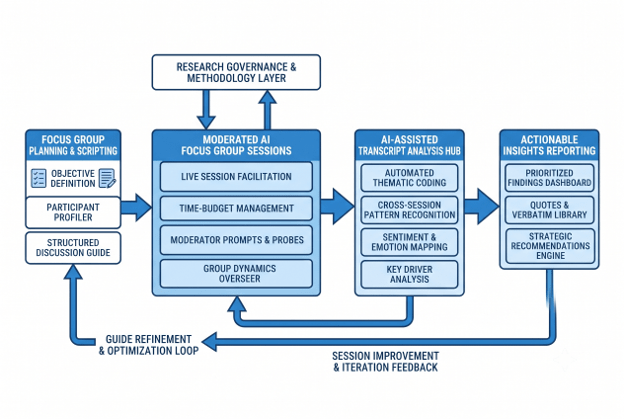
Analyzing focus group transcripts used to mean a researcher manually reading through hours of recordings, coding themes by hand across every session. A three-session focus group program that previously required 80–120 hours of manual thematic coding now takes under 12 hours with AI-assisted analysis, a 70–80% reduction in analysis time without any reduction in analytical quality. AI transcription and analysis tools identify recurring themes, consensus points, and cross-session divergence automatically, turning days of post-fieldwork work into an afternoon of review.
This is changing how discussion guides get built before the session, not just how transcripts get analyzed after it. AI tools can now structure your topics, suggest probe language, and generate timing recommendations based on your stated research objective, encoding methodological best practices that previously required a senior research professional to apply.
H-in-Q’s free Discussion Guide Builder applies exactly this logic: it guides you step-by-step through objective definition, participant profile, topic structure, probe writing, and timing, then generates a complete, ready-to-use guide you can export and adapt for your next session. The same AI infrastructure that powers HiVox-in-Q’s community focus group platform is accessible as a free planning tool for any US researcher preparing a qualitative study, regardless of whether they run the session on H-in-Q’s platform or their own. HiVox-in-Q AI focus groups
The session structure and the post-session synthesis both move faster when the guide is built correctly from the start. A poorly structured guide produces a session that is difficult to analyze regardless of how good the AI transcription is, because the data collected is shallow, inconsistent, or missing the probing depth that makes qualitative findings actionable.
Tools for Focus Group Research in 2026
- H-in-Q Discussion Guide Builder: Free and interactive. Answer a few guided questions about your objective, participants, and research track, and export a complete, timed discussion guide ready to adapt for your next session.
- H-in-Q Sample Structure & Quotas Simulator: Free quota planning tool for the quantitative sample design that often precedes or follows a focus group program. →
- HiVox-in-Q: H-in-Q’s AI-powered community focus group platform for running real-participant sessions. Your completed discussion guide imports directly. Native EN/FR/ES/AR support.
- Converse-in-Q: Conversational AI survey platform for the quantitative study that most focus group programs pair with for validation.
- Looppanel / BTInsights: AI analysis tools for processing focus group recordings and transcripts after the session closes. Starting at $30/month.
FAQ: Focus Group Discussion Guide
What is a focus group discussion guide?
A focus group discussion guide is a structured document a moderator uses to run a qualitative research session. It lists the topics, questions, and timing for each section, and includes probes to deepen participant responses. It is a guide, not a rigid script. a skilled moderator adapts it in the moment while keeping the session on track and within its time budget.
How long should a focus group discussion guide be?
Most sessions run 60–90 minutes total, structured as roughly 10 minutes of warm-up, 10–15 minutes of category exploration, 40–45 minutes of core deep-dive discussion, and 5 minutes of wrap-up. The guide itself should be 3–5 pages. detailed enough for the moderator to follow without reading verbatim, with every section timed and every core question accompanied by 2–3 written probes.
What is the difference between a discussion guide and a moderator script?
A moderator script is written out fully and read verbatim during the session. A discussion guide is a structured outline with key questions and probes that leaves room for the moderator to follow unexpected threads, manage group dynamics, and adapt to what participants actually say. Guides produce richer, more natural conversation than scripts; which is the entire point of focus group research.
How many participants should be in a focus group?
Most research programs recommend 6–8 participants per group. Fewer than 5 limits the range of perspectives and reduces the group dynamic that makes focus groups valuable. More than 10 makes it difficult for every participant to contribute meaningfully, and dominant personalities tend to crowd out quieter voices who may represent important segments of your target audience.
How many focus groups should you run?
Two groups is the minimum for any meaningful comparison; one group risks producing findings that reflect that specific group's dynamics rather than your target audience's actual attitudes. Three to six groups is the standard for most US product research questions, with genuinely new themes typically saturating after three or four sessions. When themes repeat consistently across groups without introducing new information, you have reached saturation and additional groups will not change your conclusions.
What questions should you avoid in a focus group?
Avoid yes/no questions entirely; they produce single data points where the research needs context, reasoning, and emotion. Replace closed questions like "Did you like it?" with open ones like "What was your reaction when you first saw it?" Also avoid compound questions ("What did you think of the design and the price?"), participants will answer one and ignore the other. One question, one answer, every time.
Conclusion
A focus group discussion guide is the difference between a session that produces two hours of pleasant small talk and one that surfaces the exact insight your business needed to hear. Build it around a single clear objective, structure it from warm-up through core topics to wrap-up, choose the deep-dive track that matches your research goal, and write 2–3 probes alongside every core question instead of improvising follow-ups in the room.
Run at least two groups before drawing conclusions. End every session on time. And treat the guide as a direction-setter, not a script; the most valuable insight from your next focus group is almost certainly going to come from a thread the guide did not anticipate, and the moderator needs the flexibility to follow it.
H-in-Q’s free Discussion Guide Builder removes the blank-page problem entirely. Answer a few guided questions about your objective, participants, and research track; the tool generates a complete, timed guide you can export and adapt in minutes. Your next session can start with a structure that works rather than one built on assumptions. Build your discussion guide free →
The session that generates the insight you need starts with the guide you write today.