


Tabla de contenidos
- What Is Sampling in Market Research?
- Why Sampling in Market Research Matters for Businesses in 2026
- Seven Sampling Decisions to Resolve Before Recruitment
- Best Practices for Defensible Sampling Decisions
- How AI Is Changing Sampling in Market Research in 2026
- Tools & Resources for Sampling Decisions
- Turn Sampling Choices Into Defensible Research
- Preguntas frecuentes
A thousand responses from the wrong people still answer the wrong business question. Sampling in market research determines whose experiences shape your conclusions. Before debating survey wording, establish whether recruitment reaches the people your decision actually concerns.
H-in-Q.com’s focus on AI-powered marketing and business automation makes this distinction especially relevant: faster analysis cannot repair an unsuitable respondent pool. In this guide, you’ll discover seven practical decision areas, supported by answers to common implementation questions.
What Is Sampling in Market Research?
Sampling in market research is the process of selecting a subset of a defined target population to collect evidence about that population. Researchers specify eligibility, choose recruitment sources, and apply selection procedures. The design determines which conclusions are defensible and how uncertainty should be assessed and reported.
Distinguish the population you want to understand from the people your recruitment system actually reaches. That difference creates coverage gaps before anyone answers a question.
Why Sampling in Market Research Matters for Businesses in 2026
Under simple random sampling, 1,000 completed responses produce a maximum margin of sampling error of approximately ±3.1 percentage points at 95% confidence for a large population. That calculation excludes coverage errors, nonresponse bias, and misleading questions.
The American Association for Public Opinion Research’s best practices emphasize matching research design to objectives and evaluating sources of error. Otherwise, an apparently precise demand estimate can direct advertising spending toward an overrepresented customer segment.
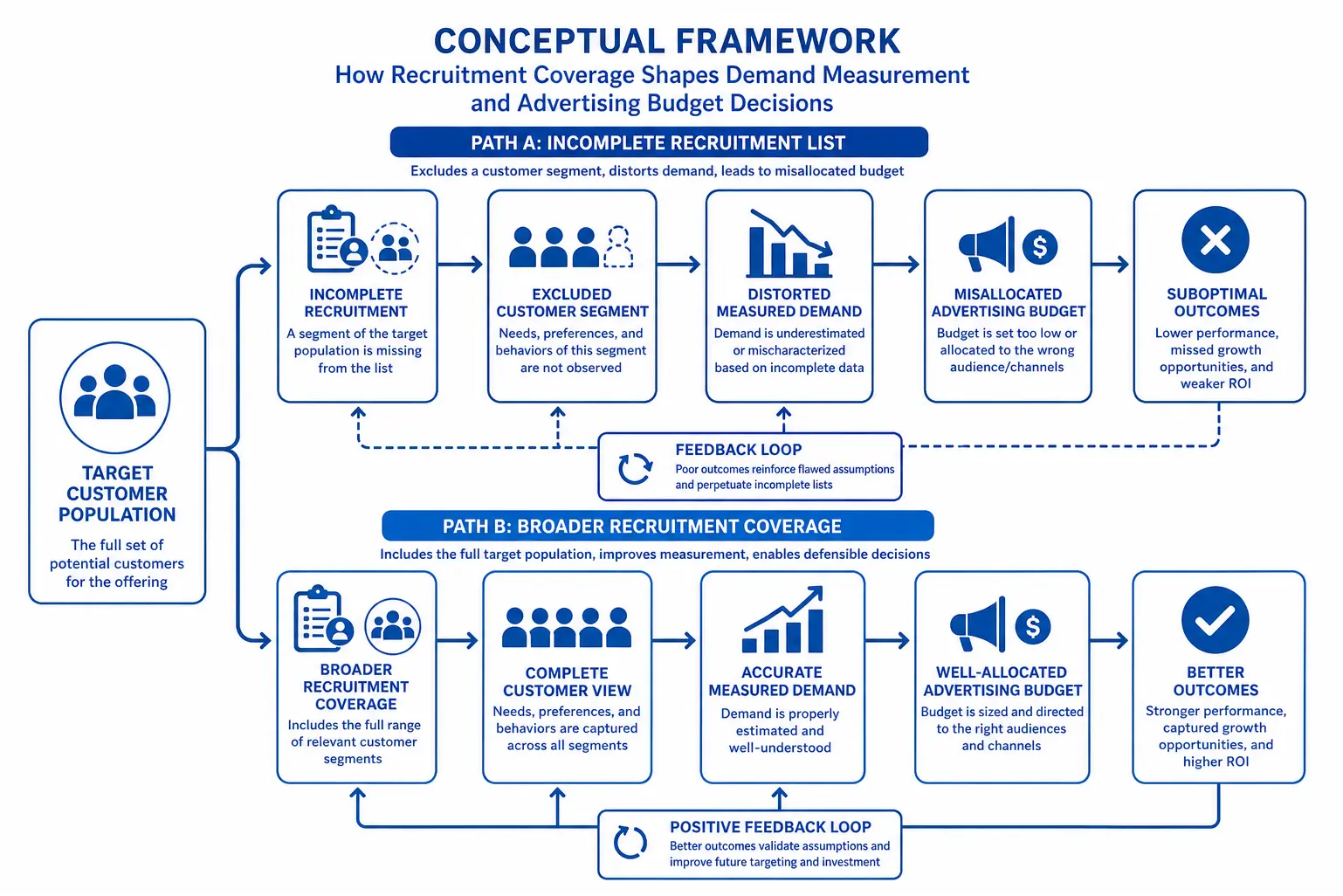
Seven Sampling Decisions to Resolve Before Recruitment
First, work through seven connected questions: Who qualifies? Which recruitment frame reaches them? Is probability selection feasible? What precision is necessary? Which subgroups need separate analysis? How will response quality be checked? What limitations must accompany the findings?
For example, a subscription business studying cancellations needs former customers, not just active newsletter readers. Define the cancellation window and contact permissions before choosing a panel or calculating sample size. These decisions prevent efficient recruitment from becoming efficiently collected misinformation.
Best Practices for Defensible Sampling Decisions
- Write eligibility rules before recruiting; include geography, relevant behavior, and decision-making role.
- Calculate sample requirements for each essential subgroup, not merely the overall study.
- Set quotas using credible benchmarks connected to your research question.
- Pilot recruitment and screening before committing the full fieldwork budget.
- Accept fewer verified respondents rather than filling quotas with questionable participants.
- Document exclusions, weighting, recruitment sources, and remaining coverage gaps.
A larger sample reduces random sampling error; it does not automatically reduce selection bias.
How AI Is Changing Sampling in Market Research in 2026
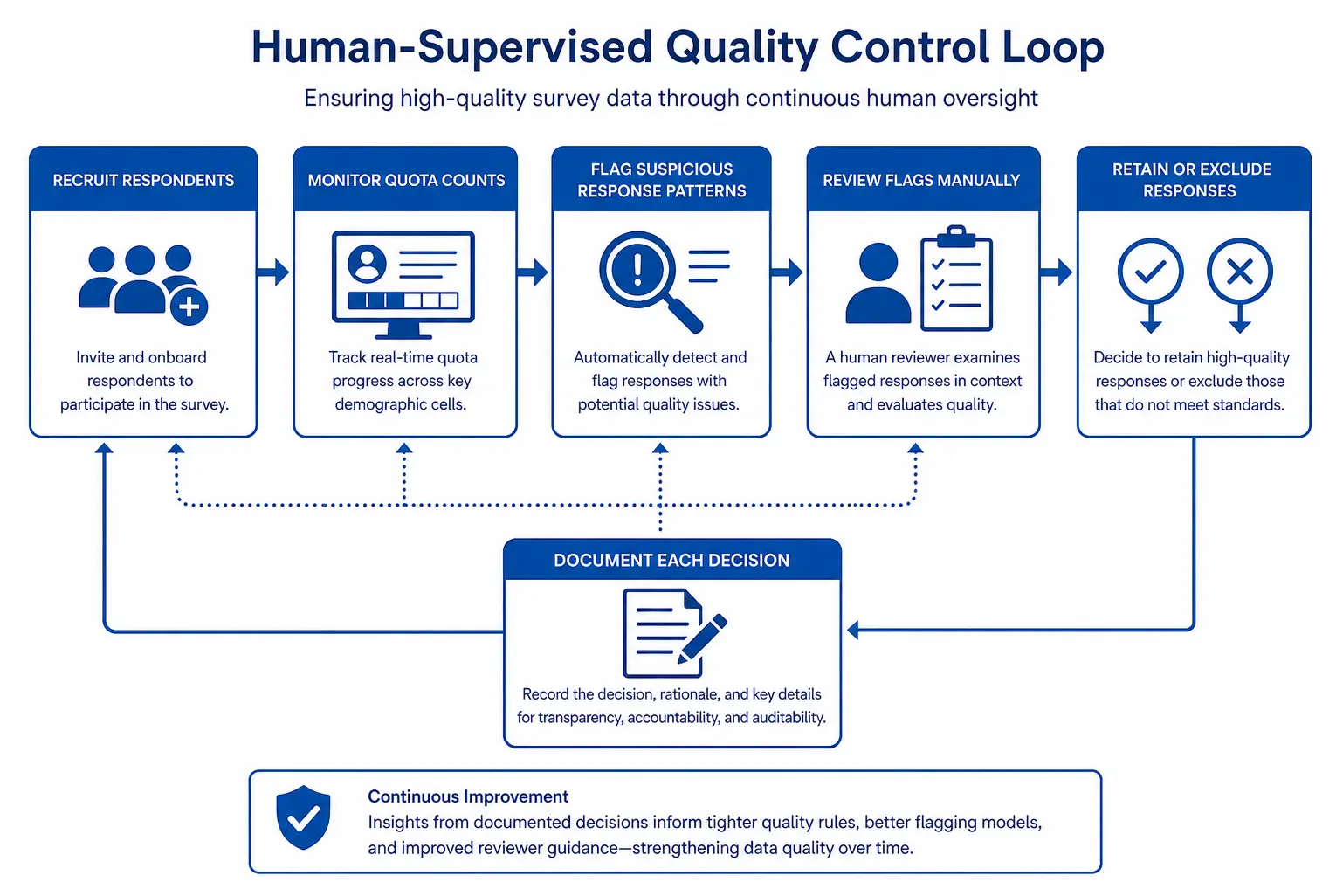
AI-assisted workflows can flag duplicate wording, inconsistent screening answers, unusual completion speeds, and coordinated response patterns. Automation also supports quota monitoring, allowing researchers to pause oversupplied groups and redirect recruitment.
However, suspicious signals require human review: legitimate respondents sometimes answer quickly or use similar language. Establish exclusion rules before analysis, retain audit logs, and test whether exclusions disproportionately affect particular groups. Synthetic respondents belong in questionnaire testing, not undisclosed replacements for measured customer opinions.
Tools & Resources for Sampling Decisions
- U.S. Census Bureau: Free population benchmarks for relevant U.S. demographic comparisons.
- R: Free statistical software supporting reproducible sample calculations and survey analysis.
- Qualtrics: Paid survey capabilities for screening, quotas, and fieldwork management; check plan availability.
- AAPOR: Professional guidance on survey methodology, transparency, and research quality.
Turn Sampling Choices Into Defensible Research
Reliable sampling in market research starts with a defined population and recruitment methods suited to the decision. Calculate precision honestly, check coverage before fieldwork, and use automation to support accountable quality control.
Explore H-in-Q.com’s approach to AI and business automation. As research workflows accelerate, documented sampling decisions will remain essential to trustworthy insights.
Preguntas frecuentes
What is sampling in market research?
Sampling in market research means selecting a subset of a defined population to investigate that population’s characteristics or opinions. Researchers specify eligibility, identify recruitment sources, and select participants using an explicit method. The resulting evidence supports broader conclusions only when the design, coverage, and analysis justify those conclusions.
How many survey respondents do I need?
Your required sample size depends on precision, population variability, subgroup reporting, and sampling design. For a large population, about 385 completed responses estimates a proportion within approximately five percentage points at 95% confidence under simple random sampling and maximum variability. Increase recruitment for incomplete responses and separate subgroup estimates.
What is the difference between probability and nonprobability sampling?
Probability sampling gives each population member a known, nonzero selection probability; nonprobability sampling does not. Random selection supports design-based estimates of sampling uncertainty. Convenience recruitment, opt-in panels, and purposive selection require additional assumptions when extending findings beyond respondents, even when demographic quotas match the intended population closely.
How do I choose the right sampling method?
Choose your sampling method by matching the business decision to population access, precision requirements, and available resources. Start by defining who qualifies and whether a usable sampling frame exists. Then compare recruitment options, subgroup requirements, likely exclusions, costs, and the strength of claims each design supports.
How can I reduce sampling bias?
Reduce sampling bias by improving population coverage, recruitment procedures, and participation across relevant groups. Compare your recruitment frame with the target population before fieldwork. Monitor participation gaps during collection, diversify recruitment channels where necessary, and assess remaining differences before applying weights or making population-level claims from results.
Are quotas enough to make a sample representative?
Quotas alone do not make a sample representative because matching selected characteristics leaves other selection differences unresolved. A sample matching age and region can still overrepresent enthusiastic customers or frequent internet users. Choose quotas tied to the research objective, then evaluate recruitment coverage and differences beyond those quotas.
Can I report a margin of error for an online panel?
A conventional design-based margin of error is appropriate only when the panel’s probability design supports that calculation. Opt-in panels generally do not qualify. Report recruitment methods, sample composition, weighting, and limitations instead; any model-based uncertainty interval needs its assumptions and calculation method clearly explained alongside the estimate.
Does weighting fix an unrepresentative survey sample?
Weighting adjusts observed sample imbalances but does not automatically fix an unrepresentative sample. It works best when reliable population benchmarks exist and adjustment variables relate to participation and survey outcomes. Examine extreme weights and effective sample size, and disclose that unmeasured selection differences remain after weighting is applied.
Can AI-generated respondents replace real survey participants?
AI-generated respondents do not replace recruited human participants when research aims to measure real customer behavior or opinion. Their outputs reflect model training and prompting rather than independently observed population responses. Use them for questionnaire testing or hypothesis generation, then validate decision-critical findings with eligible human respondents.
How should I sample a niche B2B audience?
Sample a niche B2B audience by defining company eligibility and respondent authority before recruitment begins. Verify industry, company size, role, and involvement in the relevant purchase. Use specialist recruitment sources, document screening failures, and avoid treating several employees from one company as independent buying organizations during analysis.

 English
 Français
 Español