


Table des matières
- What Is a Conjoint Audit?
- Why Conjoint Audits Matter for Businesses in 2026
- How to Run Conjoint Audits from Study Design to Pricing Approval
- 1. Define the commercial decision and failure tolerance
- 2. Verify recruitment provenance and buyer eligibility
- 3. Audit the experimental design and survey experience
- 4. Combine independent respondent-quality signals
- 5. Freeze rules and document every disposition
- 6. Estimate models and inspect identification
- 7. Validate predictions and stress-test recommendations
- 8. Release an auditable decision package
- Best Practices for Pricing Research Quality Control
- How AI Is Changing Conjoint Audits in 2026
- Tools & Resources for Conjoint Audits
- Make Pricing Approval Depend on Evidence
- Questions fréquemment posées
High-Stakes Pricing & Conjoint Audits: Protect Your Revenue from Tainted Survey Data
A pricing model can converge perfectly and still recommend the wrong price. Statistical fit does not establish that respondents were genuine, qualified, attentive, or answering a commercially realistic question.
Conjoint audits address that gap before research becomes a revenue commitment. They examine the complete chain from recruitment and survey design to estimated preferences, demand simulations, and management approval.
The stakes extend beyond a disappointing research presentation. A distorted price coefficient can reshape packaging, weaken discount rules, and send a sales organization into negotiations with false confidence. Once those decisions reach contracts or public price lists, reversing them becomes expensive.
H-in-Q.com’s focus on business AI and automation provides a practical lens: automate repeatable checks, preserve evidence, and reserve consequential decisions for accountable experts. Treat the audit as decision control, not a cosmetic data-cleaning exercise.
This guide focuses on choice-based pricing studies, including feature trade-offs, subscription tiers, and product bundles. In this guide, you’ll discover how to detect contamination, validate model behavior, measure commercial exposure, and establish an approval process that protects revenue.
What Is a Conjoint Audit?
Conjoint audits are structured evaluations of respondent authenticity, survey design, choice behavior, model estimation, and pricing simulations. They determine whether a conjoint study supports a defensible commercial decision by testing data integrity, predictive performance, and recommendation stability under documented exclusions, alternative assumptions, and independent validation.
A standard quality check asks whether the dataset contains duplicates, incomplete records, or implausibly fast completions. An audit goes further. It asks whether the recommended price survives reasonable challenges to the evidence and analytical choices.
For example, removing suspicious respondents may improve apparent model fit while changing the preferred subscription tier. The audit must explain both effects rather than celebrating cleaner diagnostics alone. Better-looking data is not automatically more representative data.
Conjoint audits also distinguish three problems that require different remedies. Fraud concerns deliberate misrepresentation. Inattention concerns weak engagement with the task. Specification error concerns a model or questionnaire that fails to represent the buying decision. A genuine respondent can still produce unusable evidence when the task is unrealistic.
The unit of review therefore extends beyond the respondent. Auditors inspect individual tasks, recruitment sources, market segments, experimental versions, estimation settings, and simulator assumptions. They connect each finding to its potential effect on the commercial recommendation.
This discipline matters when teams use hierarchical Bayes estimation, automated dashboards, or self-service simulators. Sophisticated software reduces analytical friction, but it does not establish authenticity, representativeness, or market calibration. Those properties require separate evidence and explicit review.
Why Conjoint Audits Matter for Businesses in 2026
Pricing research converts small differences in observed choices into large commercial commitments. Contamination does not need to dominate a sample to alter a close decision between competing prices, packages, or launch configurations.
A historical Pew Research Center analysis of bogus online respondents found approximately 4% to 7% of respondents in the studied opt-in sources were bogus. That finding is not a prevalence estimate for pricing studies in 2026. It demonstrates why sample authenticity requires measurement rather than assumption.
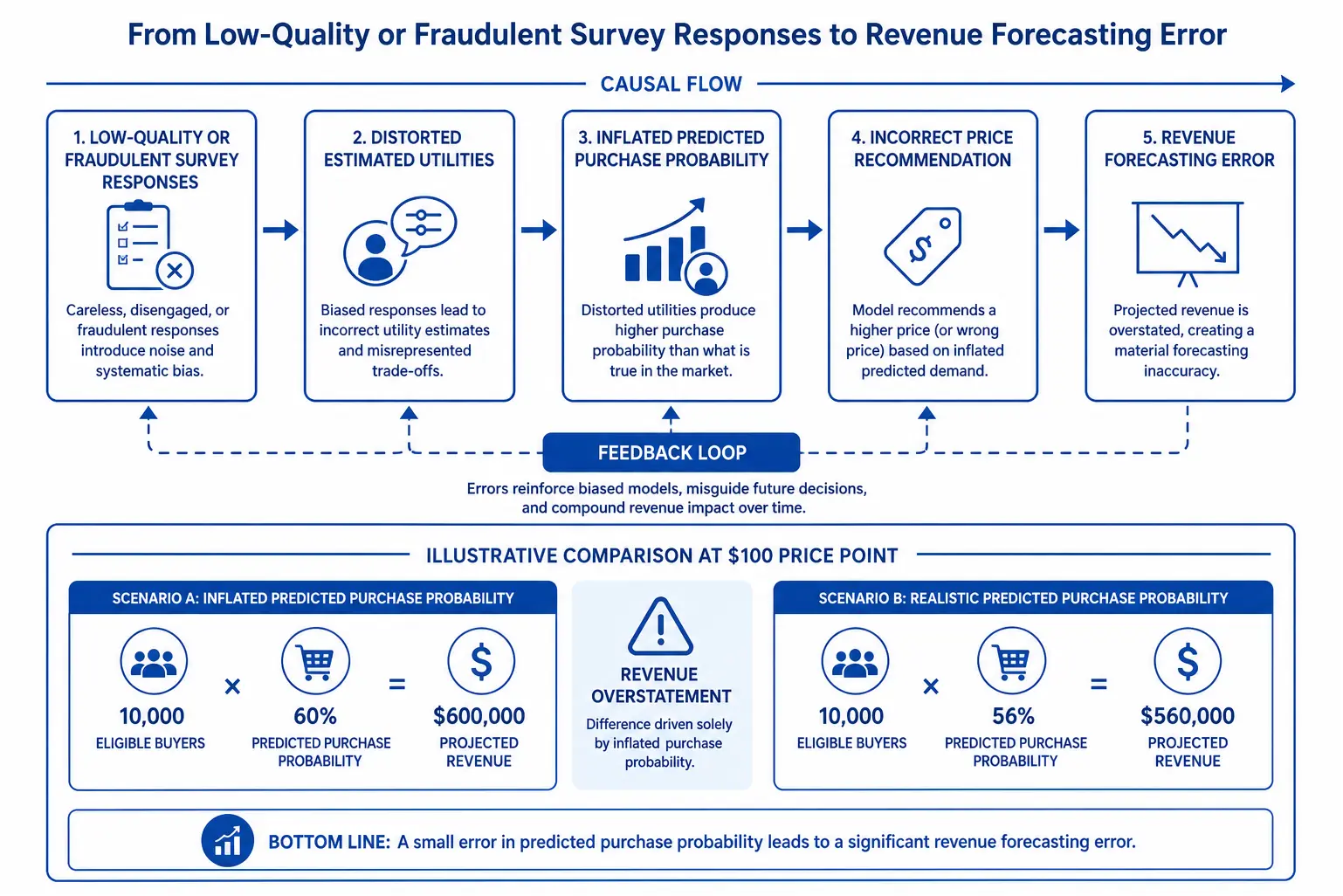
The commercial transmission mechanism is straightforward: contaminated choices distort estimated utilities; distorted utilities change predicted demand; changed demand alters the recommended price. A recommendation can remain numerically precise throughout this chain while becoming commercially unreliable.
Consider an explicitly illustrative forecast involving 10,000 eligible buyers and a $100 price. A predicted purchase probability of 60% implies $600,000 in revenue. At 56%, the same calculation produces $560,000. The $40,000 gap equals 6.7% of the original forecast, before costs, retention, or competitive reactions.
This example does not assume survey fraud always inflates demand. Depending on response patterns, contamination can flatten price sensitivity, exaggerate premium-feature appeal, or create false demand for cheaper configurations.
Conjoint audits therefore protect more than forecast accuracy. They protect launch budgets, margin targets, product roadmaps, and the credibility of research-led decisions. They also give procurement teams an evidence-based way to challenge sample providers without relying on accusations.
A pricing recommendation is defensible only when its assumptions and data-quality decisions are reproducible.
How to Run Conjoint Audits from Study Design to Pricing Approval
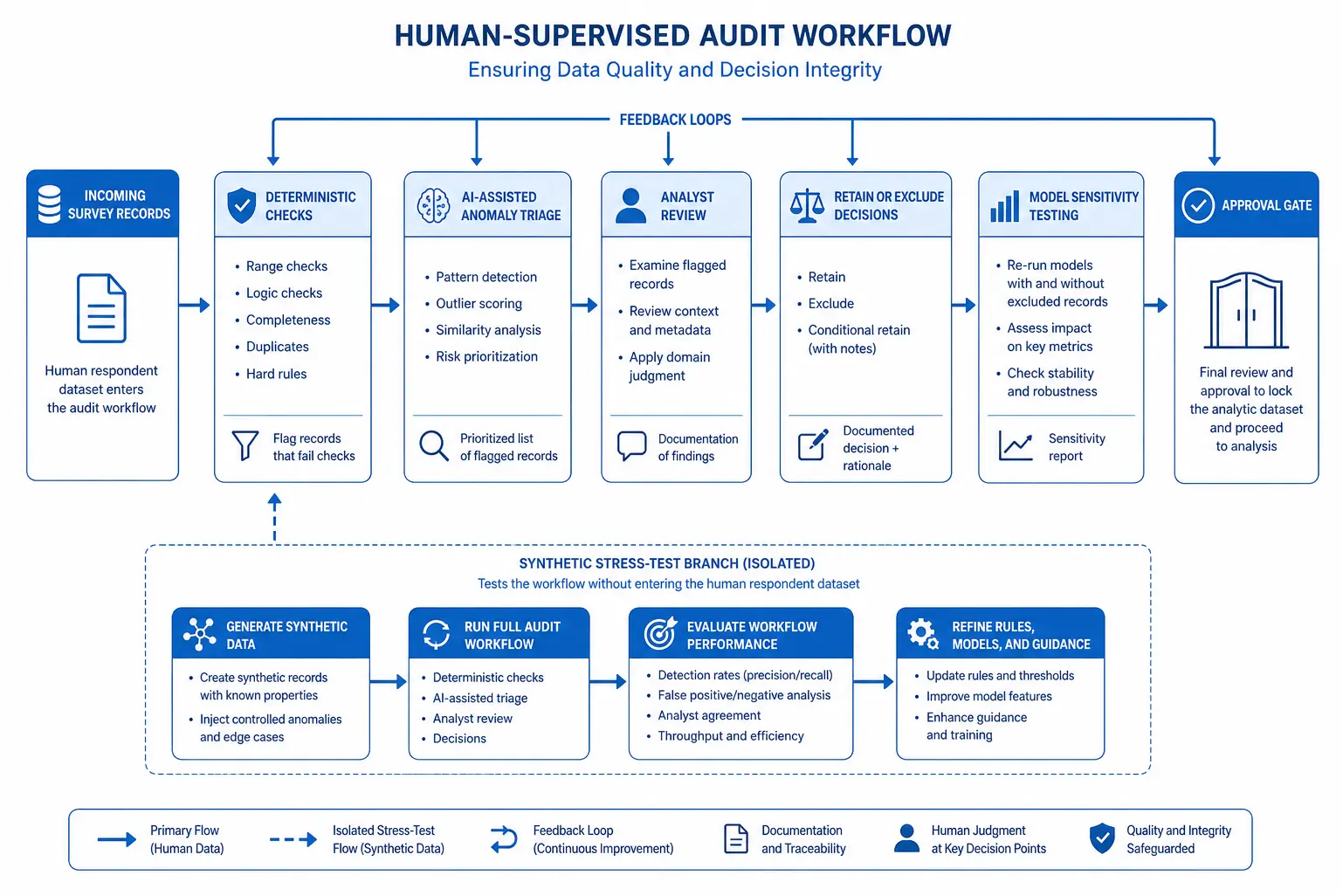
Build the audit before fieldwork begins. Retrospective cleaning cannot recover missing provenance, repair unobserved experimental errors, or establish independent validation that nobody collected. The following workflow integrates prevention, investigation, modeling, and decision governance.
1. Define the commercial decision and failure tolerance
Specify the actual decision: launch price, renewal increase, package architecture, or feature monetization. Record the eligible market, sales channel, planning horizon, and financial objective. Revenue maximization and contribution-margin maximization are different objectives and require different simulator inputs.
Next, define escalation conditions before seeing results. Examples include a changed preferred price, an unacceptable margin downside, or unstable segment recommendations. Set tolerances according to business exposure, not a universal statistical cutoff.
2. Verify recruitment provenance and buyer eligibility
Require source-level recruitment records, incentive details, deduplication methods, screening rules, and available consented fraud signals. Preserve a source identifier for every respondent. Where suppliers use multiple upstream sources, request that structure rather than accepting one blended vendor label.
Verify that participants influence the relevant purchase. In business markets, distinguish users, technical evaluators, budget owners, and final approvers. Use realistic role questions and contradictory-answer checks without publishing screening answers or collecting unnecessary personal information.
3. Audit the experimental design and survey experience
Check attribute definitions, level balance, prohibited combinations, price ranges, randomization, and design identifiability. Confirm that pricing varies enough to estimate sensitivity without creating impossible offers. Test mobile rendering so important attributes never disappear below an unnoticed scroll boundary.
Include an appropriate no-purchase option when the real buyer can decline every offer. Reserve suitable holdout tasks for validation, recognizing that predictable dominance checks and predictive holdouts serve different purposes. Pilot the questionnaire with qualified buyers before scaling fieldwork.
4. Combine independent respondent-quality signals
Evaluate task timing, duplicate patterns, screening contradictions, repeated selection positions, unusual attribute neglect, and available recruitment integrity signals. Assess timing relative to task complexity and the respondent’s own behavior, not only an arbitrary completion-speed threshold.
Create a review queue when several independent indicators align. Conjoint audits should not classify a respondent as fraudulent merely for preferring cheap products or repeatedly selecting the same brand. Preserve legitimate heterogeneity, including noncompensatory decision rules.
5. Freeze rules and document every disposition
Write exclusion rules before comparing preferred prices across cleaned datasets. Separate definite ineligibility, confirmed duplicates, technical failures, and unresolved quality concerns. Give each reviewed record a reason code and retain the supporting evidence under appropriate access controls.
Maintain at least three analysis populations: the full eligible dataset, the prespecified cleaned dataset, and a stricter sensitivity dataset. This makes cleaning consequences visible. If rules change after inspection, disclose the change and rerun the comparison transparently.
6. Estimate models and inspect identification
Check convergence, parameter uncertainty, price-response shape, coding, and segment-level stability. For hierarchical models, examine the influence of priors and shrinkage, especially in small segments. Good aggregate fit does not establish accurate individual preferences or reliable monetary estimates.
Inspect willingness-to-pay calculations separately. A weak or near-zero price coefficient can produce extreme ratios even when other utilities appear plausible. Consider model specifications appropriate to the research question, and report monetary uncertainty rather than a single unsupported premium.
7. Validate predictions and stress-test recommendations
Evaluate held-out choice tasks without repeatedly tuning to them. Where available, compare predictions with experiments, transaction patterns, renewal outcomes, or other independent observations. Distinguish relative preference shares from market demand; distribution, awareness, competition, and availability affect realized sales.
Run conjoint audits across cleaning populations, source exclusions, weighting assumptions, and plausible simulator settings. Report whether the preferred action changes, not just whether coefficients move. For weighted analyses, inspect effective sample size and avoid treating weight-adjusted counts as additional independent observations.
8. Release an auditable decision package
Deliver the recommended action alongside uncertainty, downside scenarios, rejected alternatives, and unresolved limitations. Include a respondent disposition summary, source comparisons, validation results, and reproducible estimation settings. Name the research owner and commercial approver so accountability remains explicit.
Approve only when the recommendation survives the agreed challenges. Otherwise, narrow the decision, collect targeted evidence, or run a controlled market test. Archive a versioned dataset and analysis package so future teams can reconstruct exactly what supported the launch.
Best Practices for Pricing Research Quality Control
The strongest conjoint audits separate suspicious observations from inconvenient findings. Use these six practices to keep operational pressure from becoming analytical bias. Assign an owner to each control and document exceptions before approval.
| Practice | Exact implementation |
|---|---|
| Preserve unusual but credible buyers | Review counterintuitive preferences against eligibility and task evidence. Do not exclude respondents simply because their choices contradict the pricing team’s expectations. |
| Compare sources before pooling | Estimate source-level quality indicators and preference patterns. Investigate whether differences reflect buyer composition, recruitment methods, or contamination before treating them as interchangeable. |
| Keep validation genuinely separate | Define holdout evaluation before estimation. Repeatedly changing the model to improve holdout results turns validation evidence into another training input. |
| Report decision stability | Show recommended prices across cleaning populations and reasonable assumptions. Flag reversals explicitly rather than burying them in coefficient appendices. |
| Separate exclusions from weighting | Remove records for documented eligibility or integrity failures. Apply weights for defensible population alignment, and disclose the resulting effective sample size. |
| Require an independent challenge | Ask an analyst outside the original modeling team to reproduce key outputs and propose one credible alternative explanation for the recommendation. |
The counterintuitive principle is to retain some uncomfortable data. A highly price-sensitive customer is not automatically inattentive. Likewise, a buyer who always selects one trusted brand may reflect a real procurement constraint.
Conjoint audits become more useful when review thresholds distinguish commercial instability from harmless numerical movement. A small utility shift matters when it reverses a package decision; a larger shift matters less when every credible scenario supports the same action.
How AI Is Changing Conjoint Audits in 2026
AI expands the speed and coverage of pricing-study review. Its most useful role is triage: examining screening narratives, identifying contradictory explanations, summarizing source differences, and generating reproducible checks for analyst review.
LLMs can compare open-ended answers with purchase-role descriptions and flag records needing investigation. Statistical anomaly detection can identify unusual combinations of timing and choice behavior. Neither establishes fraudulent intent, and polished language does not establish respondent authenticity.
The business-AI approach introduced earlier applies directly: automate evidence preparation, keep consequential judgments reviewable, and measure whether the automation improves decisions. A flagged record needs a documented reason and an accountable reviewer, not an unexplained model score.
Use a controlled workflow. Remove unnecessary identifiers before processing text. Log model versions, prompts, structured outputs, reviewer actions, and subsequent overrides. Test triage performance on an adjudicated sample and track false positives across relevant buyer groups.
Synthetic respondents serve a separate purpose. They can stress-test questionnaire logic, simulate scripted response attacks, and reveal whether an audit detects known contamination patterns. They do not independently establish customer demand, willingness to pay, or revenue potential.
Synthetic respondents can test an audit workflow; they cannot independently validate real customer demand.
Keep synthetic records outside the human estimation dataset unless the study explicitly investigates a clearly labeled hybrid method. Even then, report provenance and validate the resulting recommendation against independent market evidence.
Finally, protect the audit from uploaded instructions embedded in respondent text. Treat survey answers as untrusted data, restrict tool permissions, and prevent automated systems from changing exclusion rules or approving prices without human authorization.
Tools & Resources for Conjoint Audits
Select tools according to the evidence they preserve and the checks they enable. No platform replaces a documented audit protocol, independent validation, or qualified pricing judgment. Confirm features and licensing before selecting a workflow.
- Sawtooth Software: Commercial conjoint research software for designing studies, estimating preferences, and running market simulations. Use its outputs alongside external respondent-quality records and sensitivity analyses.
- Qualtrics: A commercial survey platform supporting configurable survey workflows and data exports. Verify which metadata and quality-control features are available in your specific license.
- R: Free statistical software for reproducible data checks, source comparisons, weighting diagnostics, visualization, and scenario analysis. Store scripts with versioned inputs and explicit dependencies.
- Stan: Free, open-source probabilistic programming software for custom Bayesian models. Use it when specialist analysts need transparent model specification and detailed estimation diagnostics.
- ESOMAR: Industry guidance and professional resources for research standards, online sample evaluation, and supplier due diligence. Use these resources to strengthen procurement questions and governance documentation.
Make Pricing Approval Depend on Evidence
Conjoint audits protect revenue by testing the entire decision chain, not merely removing suspicious respondents. Genuine participants, identifiable models, realistic simulations, and reproducible analysis all contribute to a defensible pricing recommendation.
Start by defining the commercial decision and acceptable downside. Preserve recruitment provenance, establish review rules before examining outcomes, and compare recommendations across credible cleaning and modeling scenarios. Then validate against evidence that was not used to build the recommendation.
Use AI to accelerate investigation and documentation, while keeping respondent exclusion and pricing approval under human control. When uncertainty changes the preferred action, collect additional evidence instead of presenting precision that the study has not earned.
Ready to connect research quality controls with accountable automation? Explore AI and automation support for your business.
The next generation of pricing research will be judged by how well its decisions survive scrutiny, not how quickly its dashboards produce answers.
Questions fréquemment posées
What is a conjoint audit in pricing research?
A conjoint audit checks whether survey design, respondent quality, model estimation, and simulations support a defensible pricing decision. It traces evidence from individual choice tasks through willingness-to-pay estimates and revenue forecasts. The result is a documented recommendation to approve, revise, or stop a proposed pricing action.
How do you detect fraudulent responses in a conjoint survey?
Detect fraudulent conjoint responses by combining identity checks, response-pattern analysis, task timing, eligibility verification, and manual review. No single indicator establishes fraud. Investigate respondents with several independent warning signs, then test whether excluding those records materially changes estimated price sensitivity or the recommended product configuration.
Should fast respondents always be removed from conjoint analysis?
Fast respondents should not be removed automatically from conjoint analysis. Experienced buyers often make legitimate choices quickly, especially when attributes are familiar. Evaluate speed alongside task complexity, within-person timing patterns, screening consistency, and choice behavior. Document exclusions before comparing final models to prevent outcome-driven data cleaning.
How can bad survey data distort willingness to pay?
Bad survey data distorts willingness to pay by changing estimated trade-offs between price and product features. Inattentive choices can flatten estimated price sensitivity, while systematic response patterns can inflate particular features. Monetary estimates become especially unstable when the modeled price coefficient approaches zero or the price specification is inappropriate.
Can AI-generated respondents validate a pricing conjoint study?
AI-generated respondents can stress-test a conjoint workflow, but they do not independently validate real customer demand. Their outputs depend on model training, prompts, and assumed customer profiles. Keep synthetic records separate from human responses, label their purpose, and validate pricing recommendations against independent observations of actual customer behavior.
What should a conjoint audit report include?
A conjoint audit report should include sample provenance, survey design checks, exclusion rules, respondent-quality findings, model diagnostics, holdout performance, and pricing sensitivity results. It should also identify assumptions, uncertainty, decision owners, and approval conditions. Preserve reproducible code and a respondent disposition log so another analyst can reconstruct the recommendation.