


Table des matières
- What Are Sampling Techniques?
- Why Sampling Techniques Matter for Businesses in 2026
- 10 Sampling Techniques and When to Use Each
- Best Practices for Choosing and Applying Sampling Techniques
- How AI Is Changing Sampling Techniques in 2026
- Tools & Resources for Sampling Techniques
- Choose a Sampling Method Your Decision Can Support
- Questions fréquemment posées
10 Essential Sampling Techniques for Accurate Market Research
A larger sample does not repair a systematically biased recruitment process. Surveying thousands of loyal customers still misses people who abandoned your brand. Choosing appropriate sampling techniques determines whose experiences inform pricing, positioning, and product decisions.
H-in-Q.com’s focus on AI-powered marketing makes evidence quality especially relevant: automation scales decisions, including poorly informed ones. In this guide, you’ll discover ten methods, their practical uses, and the safeguards that make findings defensible.
What Are Sampling Techniques?
Sampling techniques are procedures for selecting a subset of people, businesses, or observations from a defined population for research. Probability techniques use random selection with known, nonzero inclusion probabilities. Nonprobability techniques use access, judgment, quotas, or referrals, supporting different kinds of analysis and different limits on generalization.
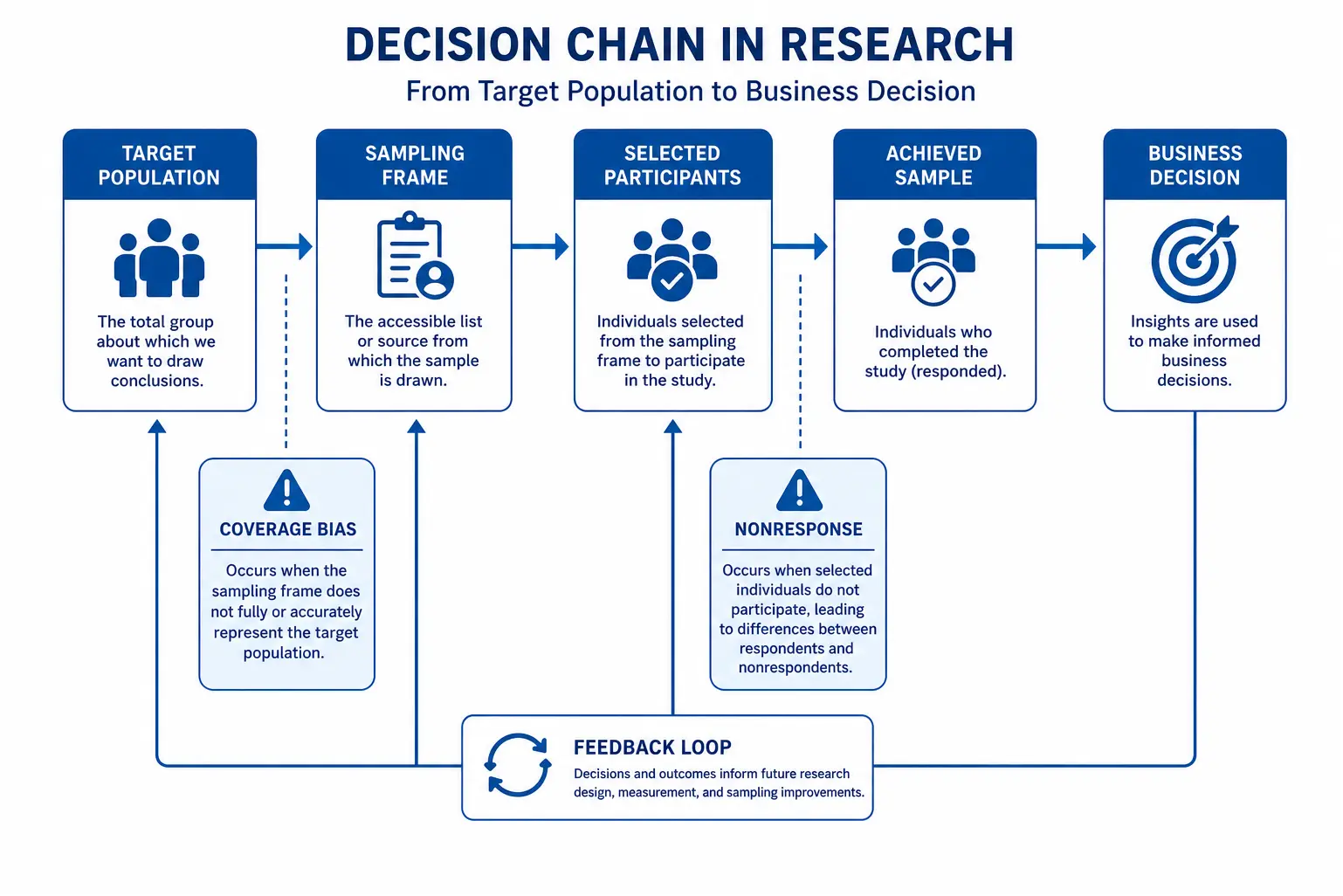
Start with the decision, not the questionnaire. Estimating market penetration requires broader population coverage than interviewing procurement directors about purchasing barriers. Distinguish your target population from your sampling frame: the customer database, directory, or other source used for selection.
Why Sampling Techniques Matter for Businesses in 2026
Automated survey distribution increases recruitment speed without guaranteeing coverage. A mobile-only invitation excludes people without usable mobile access; an email survey misses contacts with outdated addresses.
Le U.S. Census Bureau’s sampling and estimation methodology illustrates why selection, weighting, and estimation belong together.
For a large population, approximately 385 completed responses provide a 95% confidence level and ±5 percentage-point margin of error under simple random sampling, assuming a proportion near 50%. Clustering changes precision, and this calculation excludes coverage and nonresponse bias.
Sample size controls random uncertainty; sample selection controls who gets represented.
10 Sampling Techniques and When to Use Each
-
Simple random sampling. Randomly select records from a complete, deduplicated population list. Use it for straightforward population estimates when every eligible unit has a known, equal selection probability.
-
Systematic sampling. Choose a random starting point, then select every kth record. Check the ordering first: recurring patterns aligned with the interval distort selection.
-
Stratified random sampling. Divide the population into nonoverlapping groups, then randomly sample within each. Oversample smaller priority segments for comparisons, applying appropriate weights when estimating population totals.
-
Cluster sampling. Randomly select natural groups, such as stores, then survey all eligible units inside them. It reduces fieldwork travel, but similarity within clusters generally reduces precision.
-
Multistage sampling. Randomly select regions, then outlets, then customers within selected outlets. Record probabilities at every stage so weighting and variance estimation reflect the actual design.
-
Convenience sampling. Recruit readily accessible participants, such as website visitors or event attendees. Use it for early questionnaire testing, not unsupported estimates of the entire market.
-
Quota sampling. Recruit until predefined segment targets are filled without requiring random selection. Monitor recruitment sources because demographic balance alone does not eliminate self-selection bias.
-
Purposive sampling. Deliberately recruit participants with relevant expertise or experience, such as recent enterprise buyers. Define eligibility criteria beforehand to keep selection aligned with the research question.
-
Snowball sampling. Ask eligible participants to refer other qualified people. For hard-to-reach audiences, start with several independent networks to reduce dependence on one social circle.
-
Consecutive sampling. Recruit every eligible participant encountered during a specified period until recruitment closes. Apply consistent screening, while acknowledging that venue and timing still restrict population coverage.
Best Practices for Choosing and Applying Sampling Techniques
- Define eligibility, geography, and the decision before choosing recruitment channels.
- Audit duplicate records, missing groups, and outdated contact information.
- Calculate requirements for key subgroups, not just the total sample.
- Counterintuitively, recruit fewer redundant respondents and redirect budget toward undercovered groups.
- Track invitations, eligibility, completions, and exclusions separately by recruitment source.
- Report design limitations alongside estimates; never present a conventional probability-sample margin of error for an opt-in sample without justified assumptions.
How AI Is Changing Sampling Techniques in 2026
AI assists with classifying open-ended screening answers, flagging suspicious response patterns, and identifying recruitment imbalances. Automated dashboards also show which segments need additional outreach.
However, inferred demographic labels introduce classification errors. Validate them against consented, reliable information before using them for eligibility or weighting.
AI-generated respondents are simulations, not evidence of customer behavior. Use synthetic responses to stress-test questionnaires, then validate findings with real participants. Keep human review over exclusions, audit automated decisions, and distinguish recruitment optimization from changes that alter selection probabilities.
Tools & Resources for Sampling Techniques
- R: Free statistical software for reproducible selection, weighting, and survey-design analysis through specialist packages.
- Qualtrics: Commercial survey software supporting screening and quota workflows; verify features against your subscription.
- SurveyMonkey: Free and paid survey plans for piloting questions and collecting responses; recruitment still determines coverage.
- AAPOR: Professional guidance on survey transparency, sampling quality, and reporting standards.
Choose a Sampling Method Your Decision Can Support
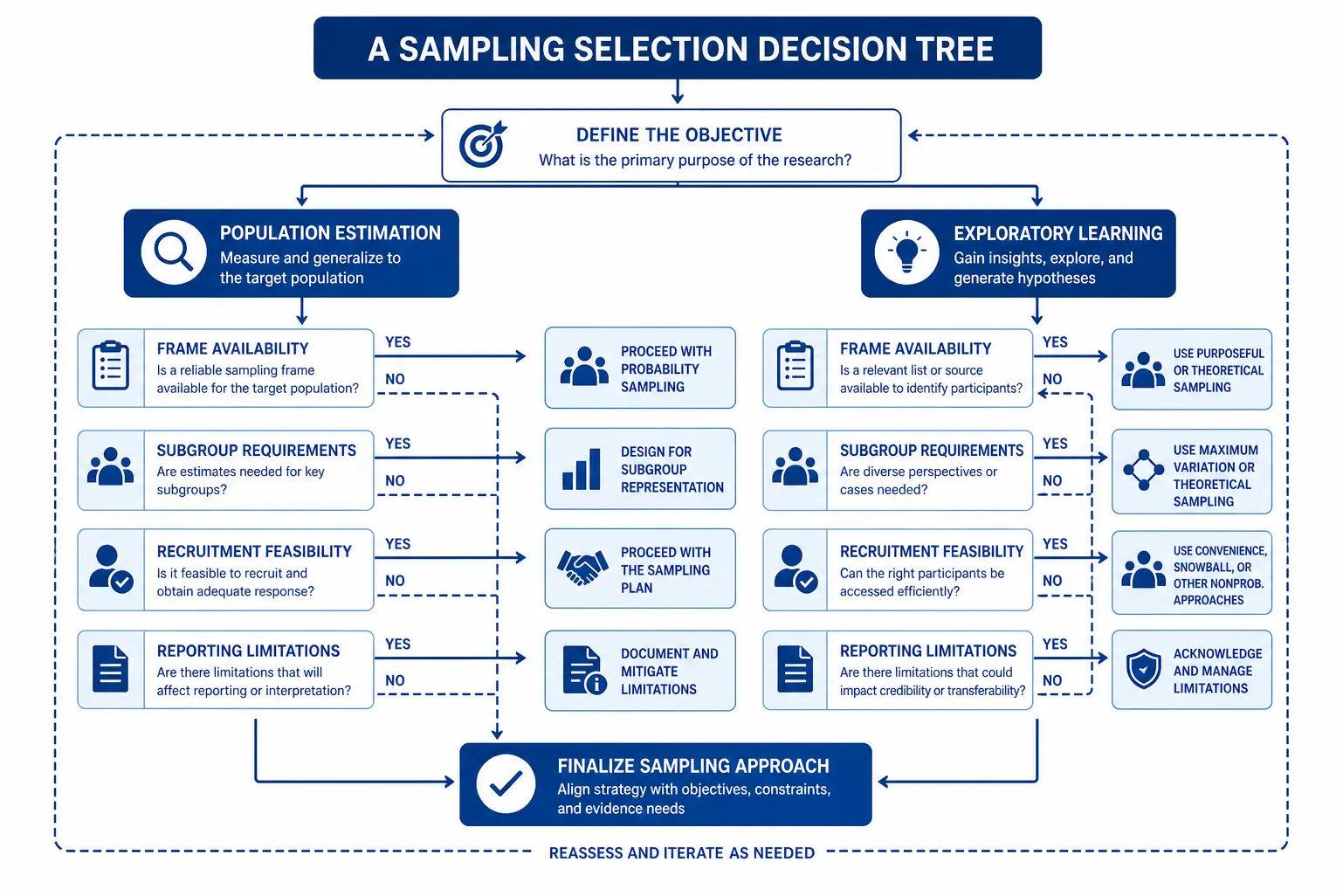
Effective sampling techniques match recruitment to the claim you need to make. Use probability designs for defensible population estimation and targeted nonprobability approaches for exploration, while stating their limits.
Before launching, check population coverage, subgroup requirements, and analysis assumptions. Then document how participants entered your study. Explore H-in-Q.com for AI-powered marketing and automation. As research workflows become more automated, transparent selection will remain central to trustworthy business decisions.
Questions fréquemment posées
What are the main types of sampling techniques?
Sampling techniques fall into probability and nonprobability methods. Probability methods use random selection with known, nonzero inclusion probabilities. Nonprobability methods select participants through availability, quotas, judgment, or referrals. Choose between them according to your research objective, population access, and intended claims.
Which sampling technique is best for market research?
The best sampling technique depends on the decision your research supports. Stratified random sampling suits population estimates requiring subgroup comparisons. Purposive sampling suits specialist interviews. Before choosing, assess your sampling frame, recruitment budget, access constraints, and the precision required for each audience segment.
What is the difference between stratified sampling and quota sampling?
Stratified sampling randomly selects participants within population subgroups, while quota sampling fills subgroup targets without requiring random selection. Both organize recruitment around characteristics such as age or region. Only the probability-based version supports design-based inference when inclusion probabilities and other necessary design information are available.
How many survey respondents do I need?
Required respondent numbers depend on precision, population variability, subgroup analysis, and sampling design. Under simple random sampling, approximately 385 completed responses support a 95% confidence level and five-percentage-point margin of error for a large population proportion near 50%, before accounting for nonresponse or design effects.
Can AI replace real survey respondents?
AI-generated respondents cannot establish what real customers think, buy, or experience. Synthetic responses support questionnaire testing and hypothesis development, but they are not observed customer evidence. Validate AI-assisted research against recruited participants, and clearly distinguish simulated outputs from measured market findings in every report.
How do I reduce sampling bias in market research?
Reduce sampling bias by improving population coverage, using appropriate recruitment channels, and monitoring participation differences. Compare your achieved sample against credible population benchmarks, investigate missing groups, and document exclusions. Weighting addresses measured imbalances under assumptions; it does not automatically repair missing audiences or unobserved differences.

 English
 Français
 Español