


Direct Answer

When should a business upgrade from free to paid market research tools? Upgrade when response volume consistently exceeds free-tier caps, when you need historical or longitudinal trend data, or when researcher hours spent working around a limit exceed what a subscription costs. Before that point, free tools like Google Trends and Census Business Builder are sufficient for a defensible, investor-credible analysis.
Introduction
At pre-seed stage, investors don’t expect a $5,000 third-party market report; they expect a defensible bottom-up calculation citing two or three free sources, and pulling out a credit card too early is often solving a problem you don’t actually have yet. The free-vs-paid decision isn’t about which tool has more features; it’s about matching your research spend to your actual stage, decision stakes, and data volume. Upgrade too early and you’re paying for capacity you’re not using. Upgrade too late and you’re burning researcher hours working around limits a $25/month plan would eliminate instantly. This guide breaks down exactly where the free-to-paid line sits, category by category, so you know precisely when to keep using free tools and when a subscription finally pays for itself. At H-in-Q, we built our entire calculator and template suite free because most of the research decisions early-stage businesses make don’t require a paid platform at all; they require the right free tool used correctly.
What Actually Separates Free and Paid Market Research Tools
Free market research tools provide a genuinely viable starting point for most research questions; the gap between free and paid isn’t quality, it’s volume, depth, and automation. A free survey tool and a paid one ask the same kind of questions; the paid version simply removes response caps, adds skip logic, and layers in dashboards that save time at scale. Paid tools add data depth (historical trend data, larger respondent panels), automation (AI-powered analysis, CRM integrations), and scale (thousands of responses instead of dozens).
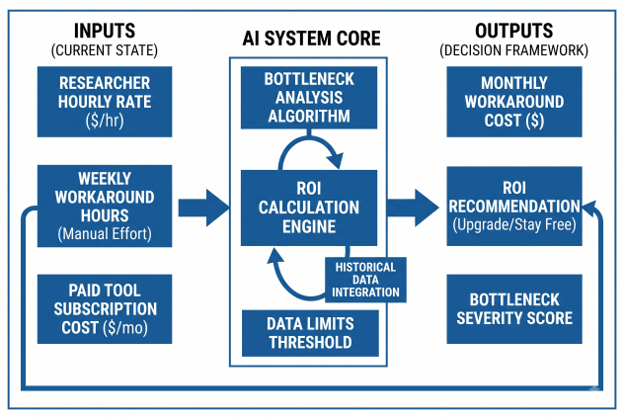
The decision to upgrade isn’t about budget, it’s about ROI: if a free tool’s limits cost you more researcher hours than a subscription would, the subscription already paid for itself. This reframes the question from “can I afford this” to “is this actually the bottleneck right now,” and for most early-stage businesses, the honest answer is that free tools aren’t yet the limiting factor.
Why This Decision Matters for Businesses in 2026
The cost of getting this decision wrong runs in both directions. Businesses that upgrade prematurely pay recurring subscription costs for capacity — response volume, integrations, historical data — they’re not close to using, quietly inflating burn rate during the stage when cash matters most. Businesses that stay on free tools too long hit a different cost: researcher hours spent manually working around a 40-response survey cap or a relative-only trend chart, when a $25/month plan would have solved the problem in minutes.
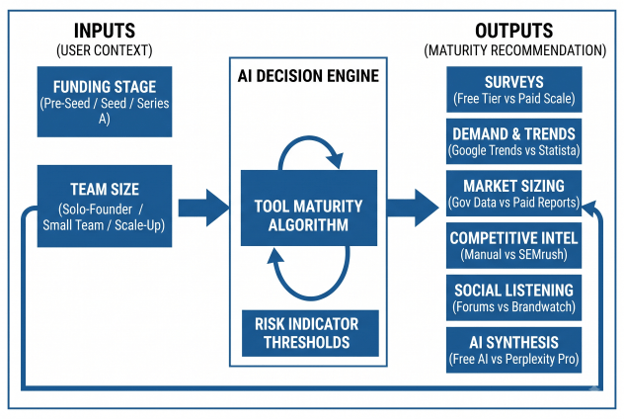
The right approach scales with funding stage. At pre-seed, a defensible bottom-up analysis citing free sources — a standard Y Combinator advises founders to lean on — is not just acceptable; it’s what investors expect. By Series A, the same free-tier report starts inviting analyst pushback, and a paid data source becomes the more credible, more efficient choice.
Free vs Paid Market Research Tools, By Category
| Category | Free Option | Free-Tier Limit | Paid Option | When Paid Wins |
|---|---|---|---|---|
| Surveys | Google Forms, SurveyMonkey Basic | SurveyMonkey: 10 questions, 40 responses | SurveyMonkey ($25/mo), Typeform ($25–50/mo) | Response volume regularly exceeds ~40, or skip logic/branding is needed |
| Demand & trends | Google Trends | Relative data only, no search volume counts | Statista ($199+/mo), Exploding Topics | You need actual search volume numbers, not just trend direction |
| Market sizing / secondary data | Census.gov, SBA.gov | Broad datasets, not company-specific | Statista, Gartner, IBISWorld reports | Investor or board deck needs third-party validation beyond bottom-up math |
| Competitive intelligence | SimilarWeb free tier, manual research | Limited traffic/keyword depth | Crayon ($15K–45K/yr), SEMrush ($165/mo) | Competitive monitoring needs to be continuous, not one-time |
| Social listening | Manual search on Reddit, X, forums | No automated alerts or sentiment scoring | Brandwatch, Awario ($29/mo) | You need real-time brand monitoring across many channels at once |
| AI research synthesis | ChatGPT, Perplexity, Claude free tiers | No real-time data access, usage caps | Perplexity Pro ($20/mo), enterprise AI platforms | Team-wide usage, deep research mode, or workflow integrations are needed |
How to Decide: Free vs Paid Best Practices
| Signal | What It Means |
|---|---|
| Response volume consistently exceeds free-tier caps | Move to paid — you’re already paying in wasted workaround time |
| You need historical or longitudinal data | Free tools like Google Trends show relative direction, not the depth paid platforms track over years |
| The decision is high-stakes (funding, major pivot) | Defensibility matters more than cost; a paid, citable source strengthens the case |
| You need integrations with your existing stack | Free tools rarely integrate with CRM or BI systems the way paid platforms do |
| You’re spending more researcher hours working around limits than a subscription costs | This is the clearest ROI signal — frame the decision in hours saved, not just dollars spent |
| You’re pre-seed or validating a first idea | Stay free — investors expect bottom-up math from free sources at this stage, not a paid report |
The most common mistake in this decision: treating “free vs paid” as a single company-wide choice rather than a per-category decision. Most mature research stacks run free tools for some categories (secondary research, demand validation) and paid tools for others (ongoing social listening, large-scale surveys) simultaneously.
How AI Is Changing the Free vs Paid Calculation in 2026
AI has quietly narrowed the gap between free and paid tools more than any other shift in 2026. Free-tier AI tools like Perplexity and ChatGPT now handle synthesis and secondary research tasks that used to require a paid analyst subscription — summarizing industry reports, drafting first-pass competitor overviews, and generating survey question sets, all within a free account. This has pushed the free-to-paid line further out for early-stage businesses than it sat even two years ago.
What AI still can’t replace is real-time data access, proprietary databases, and primary research — the categories where paid tools retain their clearest advantage. The businesses winning in 2026 aren’t necessarily the ones with the largest research budgets; they’re the ones who correctly identify which specific research bottleneck actually justifies a paid tool, rather than upgrading everything at once. At H-in-Q, our free tool suite is built around exactly this principle: cover the calculations and templates that most businesses need at zero cost, so any paid budget goes toward the one or two categories — like ongoing social listening or large-panel surveys — where it actually moves the needle.
Tools & Resources: The H-in-Q Free Stack
- H-in-Q Sample Size Calculator — statistically correct respondent counts, free.
- H-in-Q TAM SAM SOM Calculator — defensible market sizing without a paid report.
- H-in-Q NPS Calculator — loyalty benchmarking against 2026 standards.
- H-in-Q Cross-Tab Generator — segment analysis without Excel or SPSS.
- H-in-Q Focus Group Discussion Guide Template — timed, ready-to-run qualitative structure.
- H-in-Q Competitive Analysis Template — sourced competitor comparison framework.
Explore the complete free market research toolkit, or start with our step-by-step guide on how to do market research for free.
FAQ
Are free market research tools good enough for a startup?
Yes, for pre-seed and early validation. Free tools like Google Trends, government databases, and Google Forms support a defensible bottom-up analysis; investors at this stage expect exactly that, not a paid third-party report.
When should a business upgrade to paid market research tools?
Upgrade when response volume consistently exceeds free-tier caps, when you need historical or longitudinal data, when integrations with your existing tools matter, or when you're spending more time working around limits than a subscription would cost.
What are the limitations of free market research tools?
Common limits include capped survey responses (SurveyMonkey's free plan allows 10 questions and 40 responses), relative-only trend data (Google Trends doesn't show actual search volume), and no historical or longitudinal tracking.
How much do paid market research tools cost?
Entry-level paid survey tools start around $25/month; competitive intelligence platforms range from $29/month to $15,000–45,000/year for enterprise tools like Crayon, and data platforms like Statista start around $199/month.
Can you combine free and paid market research tools?
Yes, most mature research stacks run free tools for some categories (secondary research, demand validation) while paying for others (ongoing social listening, large-scale surveys) at the same time, rather than choosing one approach company-wide.
What free tools should I use before I raise funding?
Google Trends and Census Business Builder for demand validation, government data for market sizing, and Google Forms for direct customer surveys. This combination supports a defensible bottom-up pitch deck without any paid research spend.
Conclusion
The free-vs-paid decision isn’t a single choice you make once; it’s a per-category judgment that should track your actual stage, decision stakes, and data volume, not a blanket assumption that paid always means better. Stay free for demand validation, market sizing, and early-stage surveys; consider paid tools only where response volume, historical data needs, or high-stakes decisions genuinely justify the cost. Most early-stage businesses have more research runway on free tools than they assume. The H-in-Q free suite covers seven of the categories in this guide at zero cost, so your first paid dollar goes exactly where it earns the clearest return.