


Table of Contents
- What Is Survey Bot Detection and Data Cleansing
- Why Survey Bot Detection Matters for Businesses in 2026
- How to Detect and Eliminate Survey Bots: Step-by-Step
- Best Practices for Survey Bot Prevention and Detection
- How AI Is Changing Survey Bot Detection in 2026
- Tools and Resources for Survey Bot Detection
- Conclusion
- Frequently Asked Questions
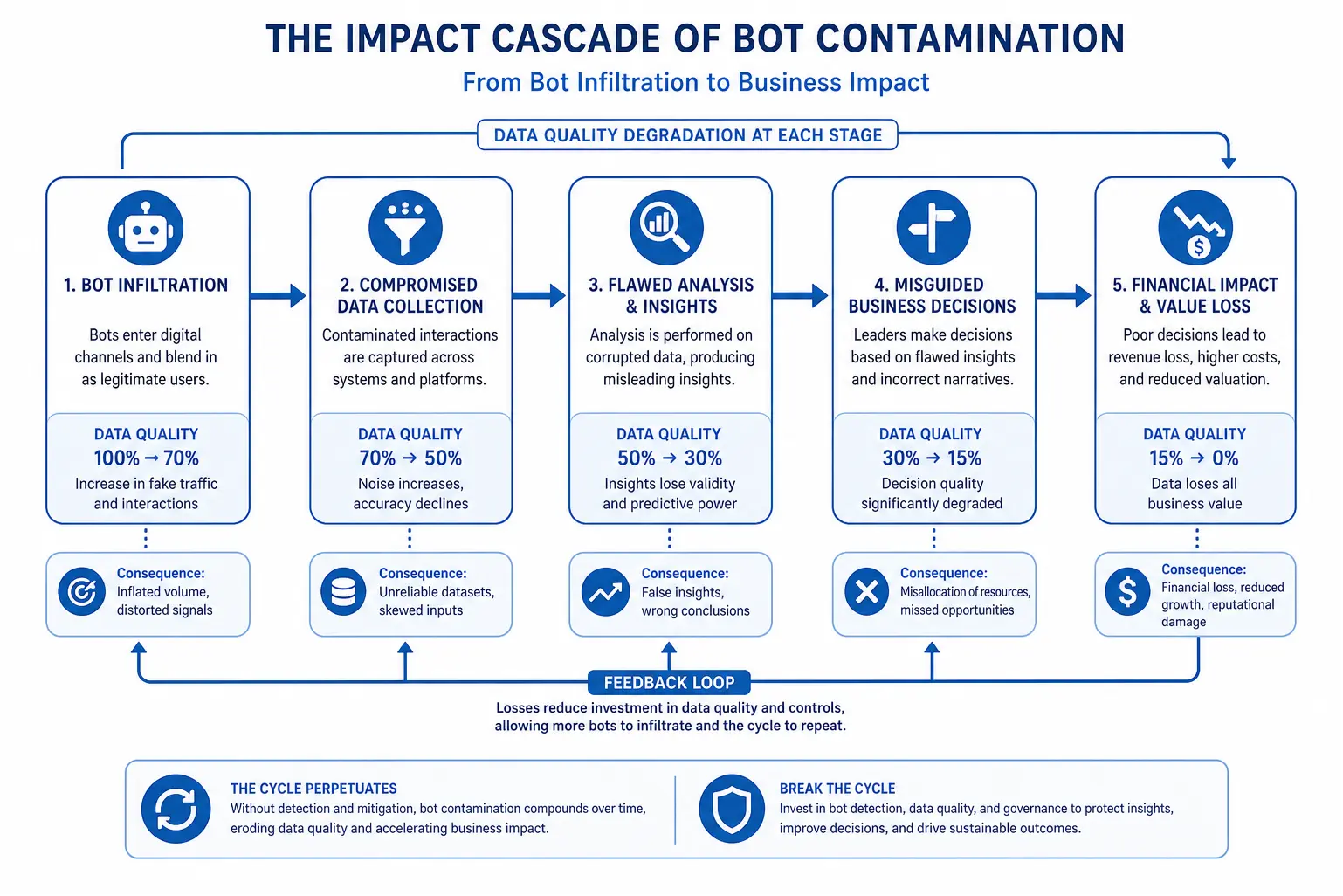
Between 10% and 40% of responses in typical online surveys come from bots, not humans. This contamination renders insights unreliable, wastes research budgets, and leads executives to make strategic decisions based on fabricated data. As bot sophistication increases in 2026, the ability to detect and eliminate survey bots has become a core competency for any organization relying on primary research. The financial stakes are enormous: companies spend millions on market research only to discover their data sets are compromised by automated responses, click farms, and sophisticated fraud networks. Goign forward, it is key to be able to recover data integrity by implementing systematic bot detection protocols that identify fraudulent responses before they corrupt analysis. In this guide, you’ll discover the exact step-by-step process to detect and eliminate survey bots, protect your data quality, and ensure your research investments deliver genuine insights.
What Is Survey Bot Detection and Data Cleansing
Survey bot detection is the systematic process of identifying automated, fraudulent, or non-human responses within survey data through behavioral analysis, response pattern evaluation, and technical validation checks. Data cleansing then removes or flags these contaminated responses to preserve the integrity of the remaining dataset and ensure analysis reflects genuine human perspectives.
The challenge extends beyond simple automation. Modern survey bots range from crude scripts that select random answers to sophisticated AI-powered systems that mimic human response patterns, vary completion times, and even provide coherent open-ended text. Some operations employ human click farms where low-wage workers complete surveys en masse using stolen or fabricated identities. Detection requires a multi-layered approach that examines technical fingerprints, behavioral anomalies, logical inconsistencies, and response quality simultaneously.
The cleansing process is equally nuanced. Removing all suspicious responses risks introducing bias by eliminating legitimate outliers or unusual but genuine perspectives. Keeping contaminated data guarantees flawed insights. Effective cleansing balances sensitivity and specificity, establishing clear thresholds for removal while flagging borderline cases for human review. The goal is not perfect purity but rather achieving a confidence level where remaining data reliably represents your target population.
Why Survey Bot Detection Matters for Businesses in 2026
The economic impact of bot-contaminated survey data has reached crisis levels. According to a 2026 Insights Association report, organizations waste an estimated $3.2 billion annually on compromised market research, with individual companies losing an average of $250,000 per year to fraudulent data. These figures account only for direct research costs, not the downstream consequences of flawed strategic decisions based on fabricated insights.
The problem accelerates as bot technology advances. Where 2023-era bots exhibited obvious patterns like impossibly fast completion times or perfectly straight-lined responses, 2026 bots incorporate machine learning to randomize timing, vary answer patterns, and generate plausible open-ended responses using large language models. Some sophisticated operations even simulate realistic demographic distributions and maintain consistent personas across multiple surveys. Traditional red flags no longer suffice.
The business consequences extend across every function that relies on customer insights. Product teams launch features nobody wants because fake users claimed interest. Marketing departments allocate millions to channels that test well with bots but fail with real customers. Pricing strategies optimize for fictional willingness-to-pay. Brand tracking studies show sentiment improvements that exist only in fraudulent responses. Each contaminated data point compounds into strategic misalignment that can take quarters to recognize and years to correct.
Regulatory pressure adds urgency. As data privacy laws tighten globally, organizations face increasing liability for using personal data obtained through fraudulent means. Survey responses collected via stolen identities or misrepresented purposes create legal exposure. Compliance teams now demand documented data quality protocols that demonstrate reasonable efforts to exclude fraudulent responses before processing personal information.
How to Detect and Eliminate Survey Bots: Step-by-Step
Step 1: Establish baseline quality metrics before data collection begins. Define acceptable ranges for completion time, straight-lining rates, open-ended response quality, and technical consistency. Document your target sample characteristics and expected response distributions. These benchmarks allow real-time monitoring during fieldwork and provide objective standards for post-collection cleansing. Without predefined thresholds, cleansing becomes arbitrary and defensible exclusions become difficult.
Step 2: Implement technical fingerprinting during survey deployment. Capture IP addresses, device types, browser signatures, screen resolutions, and geolocation data for every response. Enable JavaScript-based behavioral tracking that records mouse movements, keystroke patterns, and interaction timing. Deploy honeypot questions invisible to human respondents but visible to bots. These technical markers create the foundation for automated detection algorithms and provide forensic evidence when investigating suspicious patterns.
Step 3: Monitor data quality in real-time during active fieldwork. Set up automated alerts that trigger when completion rates spike abnormally, when multiple responses originate from identical IP addresses, or when straight-lining exceeds thresholds. Real-time monitoring allows immediate intervention to close compromised survey links, block suspicious IP ranges, or pause fieldwork for investigation. Waiting until data collection completes means contamination spreads unchecked through your entire sample.
Step 4: Run automated detection algorithms on completed responses. Apply rule-based filters that flag responses failing basic quality checks: completion times under minimum thresholds, identical IP addresses, duplicate device fingerprints, impossible geographic combinations, or straight-lined response patterns. Layer machine learning models trained on known bot characteristics to identify subtle anomalies in response patterns, timing variations, and answer correlations that human reviewers would miss.
Step 5: Conduct manual review of open-ended responses. Sample 10-20% of text responses, focusing on those flagged by automated systems. Look for copy-pasted text, nonsensical answers, responses in wrong languages, or AI-generated text with telltale patterns like excessive formality or unnatural phrasing. GPT-detection tools can help identify LLM-generated responses, though determined fraudsters increasingly use techniques to evade these detectors. Human judgment remains essential for borderline cases.
Step 6: Cross-validate responses against logical consistency rules. Check whether answers to related questions contradict each other, whether demographic combinations are plausible, and whether stated behaviors align with reported attitudes. A respondent claiming to be a 25-year-old retired executive who never uses technology but completes surveys on mobile devices exhibits obvious inconsistencies. Build a library of logical rules specific to your survey content and automatically flag violations.
Step 7: Apply attention check and trap question analysis. Review performance on embedded attention checks, instructed response items, and trap questions designed to catch inattentive or automated respondents. A single failure might indicate distraction, but multiple failures across different check types strongly suggests bot or fraudulent completion. Weight these failures alongside other quality indicators rather than using them as sole exclusion criteria.
Step 8: Score and segment responses by confidence level. Assign each response a composite quality score based on all detection criteria. Segment data into high-confidence (clearly legitimate), medium-confidence (some flags but plausible), low-confidence (multiple serious flags), and exclude (definite fraud) categories. This tiered approach allows sensitivity analysis where you compare results across confidence segments to assess how much contamination affects conclusions.
Step 9: Document all cleansing decisions with audit trails. Record which responses were excluded, which criteria triggered exclusions, and what impact removal had on sample composition and key metrics. This documentation proves essential for defending research validity to stakeholders, satisfying regulatory requirements, and refining detection protocols for future surveys. Transparency about data quality builds credibility even when reporting imperfect cleansing outcomes.
Step 10: Reweight remaining data to restore representativeness. After removing fraudulent responses, check whether your cleaned sample still matches target population characteristics. Apply post-stratification weights to correct imbalances introduced by differential fraud rates across demographic segments. Bots often cluster in specific demographic profiles, so removal can inadvertently skew your sample unless you adjust for these distortions.
Best Practices for Survey Bot Prevention and Detection
1. Use multi-factor authentication for panel access. Require email verification, phone number confirmation, and CAPTCHA completion during panel registration. Layer these barriers to raise the cost and effort required for fraudulent accounts. Single-factor authentication makes bot infiltration trivially easy, while three or more factors dramatically reduce fraud rates even though they also reduce legitimate completion rates slightly.
2. Randomize question order and response options. Bots programmed to select specific positions or follow predetermined patterns struggle when question sequences and answer positions change for each respondent. This randomization also reduces order effects in legitimate responses, improving data quality on multiple dimensions simultaneously.
3. Implement progressive profiling across multiple surveys. Rather than collecting all demographic data in a single screener, gather information gradually across multiple survey completions. This approach makes it harder for fraudsters to maintain consistent fake personas and allows you to verify whether reported characteristics remain stable over time. Legitimate respondents show consistency, while bots and click farms exhibit demographic drift.
4. Set minimum completion times based on reading speed research. Calculate the theoretical minimum time required to read all question text and response options at average adult reading speeds, then add buffer for thinking time. Responses completed faster than this threshold are physically impossible for legitimate respondents. Be careful with mobile respondents who may legitimately complete faster due to familiarity with survey formats.
5. Monitor for suspicious velocity patterns. Track how quickly respondents move through question sequences. Bots often exhibit unnaturally consistent timing between questions, while humans show natural variation with occasional pauses. Responses with standard deviations in question timing below certain thresholds warrant investigation, as do perfectly linear progression patterns.
6. Analyze open-ended responses for AI-generated text markers. Large language models produce text with characteristic patterns: balanced structure, formal tone, lack of typos, and generic phrasing. Tools like GPTZero can flag potentially AI-generated content, though human review remains necessary since legitimate respondents increasingly use AI assistance. Look for responses that sound like they came from ChatGPT rather than a real customer.
7. Cross-reference email domains and IP geolocation. Check whether respondent email domains match their stated countries and whether IP addresses align with claimed locations. Mismatches don’t always indicate fraud VPNs and international travel create legitimate discrepancies but they warrant additional scrutiny when combined with other red flags.
8. Establish reputation scoring for panel members. Track individual respondent quality over time, flagging those with histories of borderline responses, failed attention checks, or suspicious patterns. Weight current survey quality scores with historical reputation data. Respondents with consistently poor quality across multiple surveys likely represent either chronic satisficers or fraudulent accounts.
How AI Is Changing Survey Bot Detection in 2026
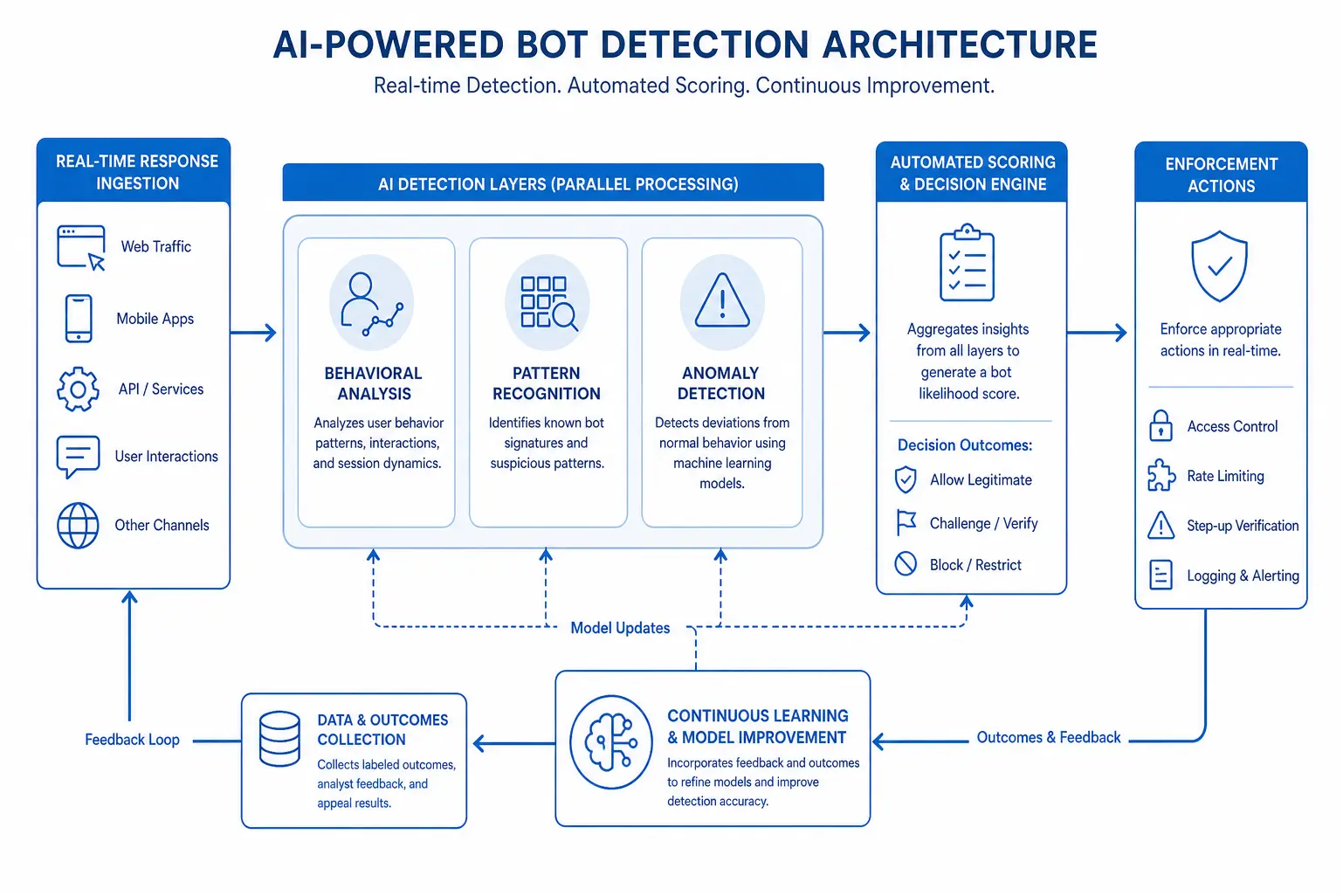
Artificial intelligence has transformed bot detection from a reactive, rule-based process into a predictive, adaptive system. Machine learning models trained on millions of responses now identify subtle patterns that human analysts would never notice: micro-variations in response timing, correlations between answer combinations, and behavioral fingerprints unique to automated systems. These models achieve detection accuracy rates above 95% while processing thousands of responses per second.
Natural language processing has revolutionized open-ended response analysis. Advanced NLP models assess text quality, coherence, specificity, and emotional authenticity at scale. They flag generic responses, detect copy-pasted text, identify AI-generated content, and even evaluate whether sentiment expressed in open-ends aligns with structured question responses. This capability makes open-ended questions valuable quality indicators rather than analysis bottlenecks.
Behavioral biometrics represent the frontier of bot detection. AI systems analyze mouse movement patterns, keystroke dynamics, scroll behavior, and device orientation changes to distinguish human interaction from automated scripts. Even sophisticated bots struggle to replicate the micro-variations and natural inconsistencies that characterize genuine human behavior. These biometric signals provide detection capabilities that fraudsters cannot easily reverse-engineer or circumvent.
The arms race continues as fraudsters deploy their own AI systems. Bot operators now use machine learning to study detection algorithms and adapt their tactics. They employ generative AI to create plausible open-ended responses and reinforcement learning to optimize response patterns that evade detection. This escalation demands continuous model retraining and multi-layered defense strategies. Organizations need to put in place AI detection systems that evolve alongside fraud techniques, maintaining effectiveness as bot sophistication increases.
Real-time AI monitoring enables proactive intervention during active surveys. Instead of discovering contamination after fieldwork completes, AI systems detect anomalous patterns as they emerge and automatically trigger protective responses: blocking suspicious IP ranges, requiring additional verification steps, or alerting research teams to investigate. This shift from post-hoc cleansing to real-time prevention dramatically reduces data contamination rates.
Tools and Resources for Survey Bot Detection
Cloudflare Bot Management provides enterprise-grade bot detection at the network level, analyzing traffic patterns and device fingerprints to block automated requests before they reach your survey platform. The system uses machine learning trained on global traffic data to distinguish bots from humans with high accuracy.
reCAPTCHA Enterprise from Google offers advanced bot protection that goes beyond simple image selection, using invisible behavioral analysis to assess whether interactions are human. The risk scoring system allows you to set custom thresholds and apply different verification levels based on suspicion scores.
Dedupe.io specializes in identifying duplicate and fraudulent survey responses through sophisticated fingerprinting algorithms. The platform analyzes IP addresses, device characteristics, and response patterns to flag potential fraud with detailed evidence supporting each flagged case.
Qualtrics Fraud Detection integrates quality scoring directly into the survey platform, automatically flagging suspicious responses based on completion time, straight-lining, and attention check failures. The system provides dashboards showing data quality metrics in real-time during fieldwork.
Quality Control by Cint offers programmatic quality verification for panel-sourced surveys, screening respondents through multiple validation layers before survey access and monitoring response quality throughout completion. The service includes post-collection cleansing with detailed quality reports.
GPTZero helps detect AI-generated text in open-ended survey responses, analyzing linguistic patterns characteristic of large language models. While not perfect, the tool provides useful signals when evaluating text response authenticity alongside other quality indicators.
Conclusion
The ability to detect and eliminate survey bots has evolved from a nice-to-have quality check into an essential competency for any organization relying on survey research. As bot sophistication increases throughout 2026, the gap widens between companies that implement rigorous, multi-layered detection protocols and those that accept contaminated data as inevitable. The step-by-step process outlined here from establishing baseline metrics through real-time monitoring, automated detection, manual review, and documented cleansing provides a defensible framework that protects research investments and ensures insights reflect genuine human perspectives. Best practices like multi-factor authentication, behavioral biometrics, and AI-powered pattern recognition raise barriers that make fraud economically unviable for most bot operators. The integration of artificial intelligence into detection systems has fundamentally shifted the balance, enabling real-time prevention rather than post-hoc cleanup. Organizations that master these techniques gain competitive advantage through superior data quality, while those ignoring bot contamination risk strategic decisions built on fabricated foundations. Explore how H-in-Q.com can help you implement enterprise-grade bot detection systems that evolve alongside fraud techniques. The future of reliable market research belongs to organizations that treat data quality as a continuous, technology-enabled discipline rather than a one-time cleanup task.
Frequently Asked Questions
What percentage of survey responses are typically bots?
Industry studies show that 10-30% of online survey responses come from bots or fraudulent sources, with the percentage climbing to 40% or higher in poorly secured panels. The exact rate depends on panel quality, screening mechanisms, and survey topic sensitivity.
Can survey bots pass CAPTCHA tests?
Yes, sophisticated survey bots can bypass standard CAPTCHA tests using automated solving services, machine learning models, or human farms. Modern bot detection requires multi-layered verification beyond CAPTCHA, including behavioral analysis and response pattern evaluation.
How long does survey data cleansing take?
Manual survey data cleansing typically takes 2-5 hours per 1,000 responses depending on complexity. Automated AI-powered cleansing tools can process the same volume in minutes while maintaining higher accuracy through consistent rule application and pattern recognition.
What is the cost of bot-contaminated survey data?
Bot-contaminated data costs businesses an average of $250,000 annually in wasted research spend and flawed decisions, according to 2026 industry analysis. This includes direct survey costs, misallocated marketing budgets, and opportunity costs from incorrect strategic pivots.
Should I remove all suspicious responses from surveys?
Remove responses that clearly fail multiple validation checks, but flag borderline cases for review rather than automatic deletion. Overly aggressive filtering can introduce bias by removing legitimate but unusual responses, while too lenient filtering allows contamination.
How often should I audit my survey data for bots?
Conduct bot detection audits on every survey wave before analysis, with quarterly deep audits of your panel quality and detection effectiveness. Real-time monitoring during active surveys allows immediate intervention when bot attacks occur.