


Table of Contents
- What Is Synthetic Data in Market Research
- Why Synthetic Data and Small Sample Sizes Matter for Businesses in 2026
- How to Implement Synthetic Data for Small Sample Augmentation: Step-by-Step
- Best Practices for Using Synthetic Data with Small Samples
- How AI Is Changing Synthetic Data and Small Sample Sizes in 2026
- Tools and Resources for Synthetic Data in Market Research
- Conclusion
- Frequently Asked Questions
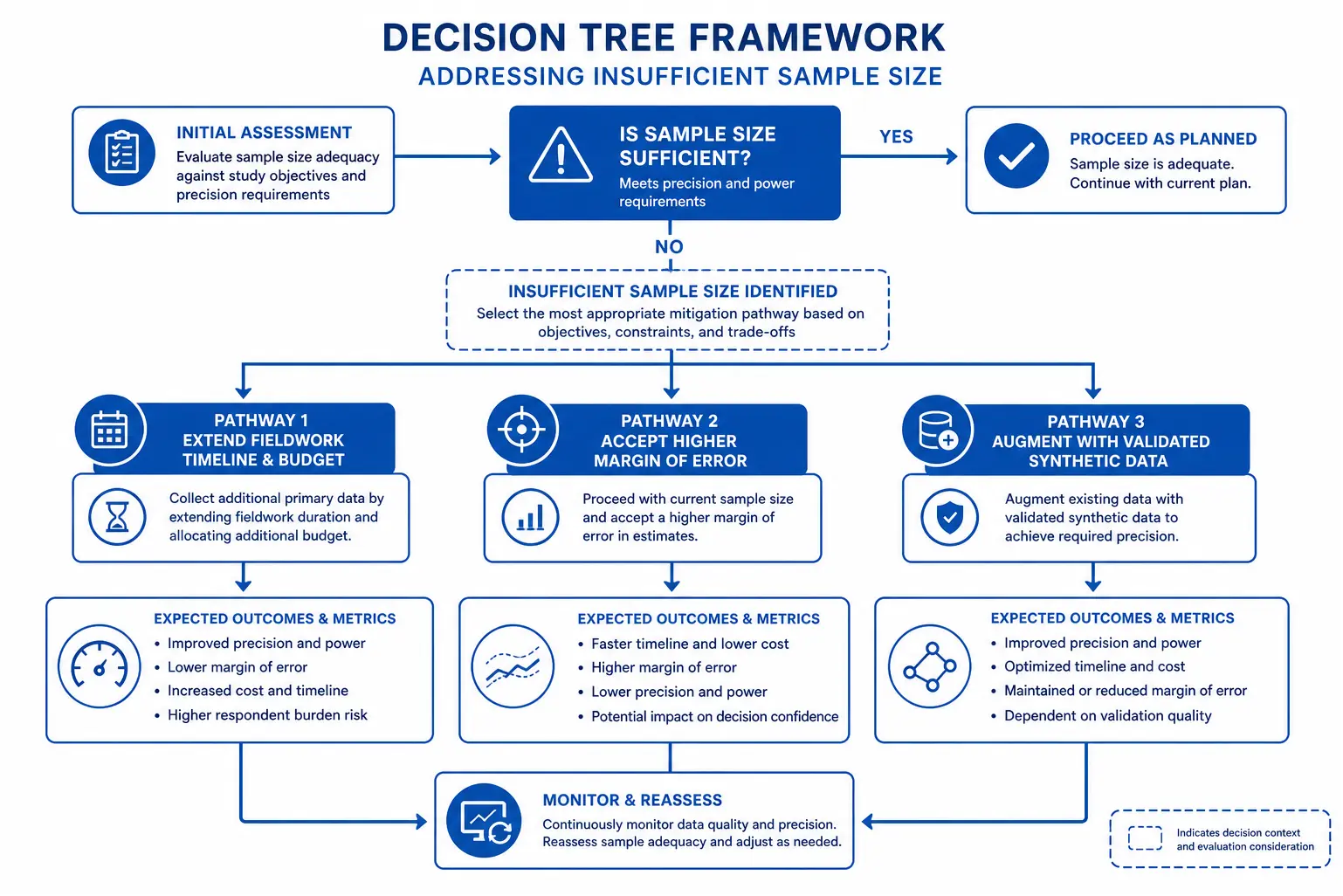
Market researchers face a recurring dilemma: sample sizes that deliver statistical confidence often exceed budget and timeline constraints, yet decisions demand certainty. A technology client needs to understand adoption barriers across twelve industry verticals but can afford only 40 interviews per segment. A consumer brand requires regional preference data but has exhausted its panel in smaller markets. Traditional solutions extend fieldwork, accept wider confidence intervals, or make decisions on insufficient data all carry significant costs or risks.
Synthetic data presents a fourth option: AI-generated respondents that mirror the statistical properties of real samples, potentially boosting confidence without additional fieldwork. The approach raises immediate questions about validity, appropriate use cases, and the boundary between augmentation and fabrication. The answer is not whether synthetic data works, but when and how to deploy it responsibly.
In this guide, you’ll discover the precise conditions under which synthetic data strengthens small samples, the validation framework that separates credible augmentation from statistical fiction, and the step-by-step methodology for combining real and synthetic respondents without compromising research integrity.
What Is Synthetic Data in Market Research
Synthetic data in market research consists of AI-generated survey responses or participant records that replicate the statistical distributions, correlations, and patterns found in a baseline set of real respondent data, without representing actual individuals. These synthetic respondents are created through machine learning models trained on genuine survey results, producing additional data points that expand sample size while preserving the underlying market characteristics observed in the original fieldwork.
The technique emerged from data science and privacy-preserving analytics, where synthetic datasets allow analysis without exposing real individuals. Market research applications adapt this approach to address a specific constraint: the gap between the sample size research methodology requires and the sample size budget or logistics permit. When a study collects 75 responses but needs 200 for segment-level confidence, synthetic data can generate the additional 125 records based on patterns in the original 75.
This is fundamentally different from imputation or weighting. Imputation fills missing values within existing records; weighting adjusts the influence of collected responses. Synthetic data creates entirely new records that did not exist, simulating how additional real respondents would likely answer based on the relationships the model learned. The validity depends entirely on whether the baseline sample accurately represents the population and whether the model captures genuine patterns rather than noise or bias.
Why Synthetic Data and Small Sample Sizes Matter for Businesses in 2026
The economic pressure on research budgets intensified through 2026 and into 2026, while the demand for granular, segmented insights accelerated. A 2026 industry trends report found that 68% of insights teams faced budget cuts or freezes, yet stakeholder requests for segment-specific data increased by an average of 34% year-over-year. This creates an impossible equation: more granularity requires larger samples, but budgets support fewer respondents.
Small sample sizes produce two critical business problems. First, confidence intervals widen to the point where insights become directional rather than actionable a preference score of 62% with a ±12% margin of error at 95% confidence tells leadership almost nothing useful. Second, subgroup analysis becomes statistically invalid when segment sizes drop below 30-50 respondents, yet business questions increasingly focus on niche segments: decision-makers in specific industries, users of competing products, or regional micro-markets.
The cost of addressing small samples through traditional fieldwork is prohibitive. Recruiting an additional 100 B2B respondents in a specialized role can add $15,000-$30,000 to project costs and extend timelines by 3-4 weeks. For organizations running dozens of studies annually, these incremental costs compound into seven-figure budget impacts. The alternative making strategic decisions on statistically insufficient data carries even greater risk when those decisions involve product launches, market entry, or significant capital allocation.
Synthetic data offers a third path only if it meets two conditions: the baseline sample is representative and unbiased, and the synthetic generation process preserves genuine market patterns without introducing artificial relationships. When these conditions hold, synthetic augmentation can narrow confidence intervals, enable valid subgroup analysis, and deliver actionable insights at a fraction of incremental fieldwork costs.
How to Implement Synthetic Data for Small Sample Augmentation: Step-by-Step
Step 1: Establish your baseline sample quality threshold. Before considering synthetic augmentation, audit your existing sample for representativeness and bias. Calculate response rates, compare respondent demographics to known population parameters, and test for non-response bias by comparing early versus late respondents. If your baseline sample is skewed or non-representative, synthetic data will amplify those flaws. A minimum of 30-50 real respondents per segment you intend to augment provides sufficient foundation; below this, the synthetic model learns noise rather than signal.
Step 2: Select the appropriate synthetic generation method. For structured survey data, conditional generative models like Conditional Tabular GANs or Bayesian networks work well because they preserve correlations between variables if age correlates with product preference in real data, the synthetic data maintains that relationship. For simpler augmentation, parametric bootstrapping resamples from the empirical distributions of your real data. The choice depends on data complexity: multivariate dependencies require GANs or VAEs, while univariate or simple bivariate patterns work with bootstrapping or SMOTE techniques adapted from machine learning.
Step 3: Train your model on the real baseline data. Split your real responses into training (70-80%) and holdout validation (20-30%) sets. Train the synthetic generation model only on the training portion. Configure the model to learn joint probability distributions across all survey variables, not just marginal distributions, so synthetic respondents exhibit realistic combinations of attributes. For example, if real data shows that enterprise customers rarely select the lowest price tier, the synthetic model must preserve this pattern rather than generating enterprise respondents randomly distributed across price preferences.
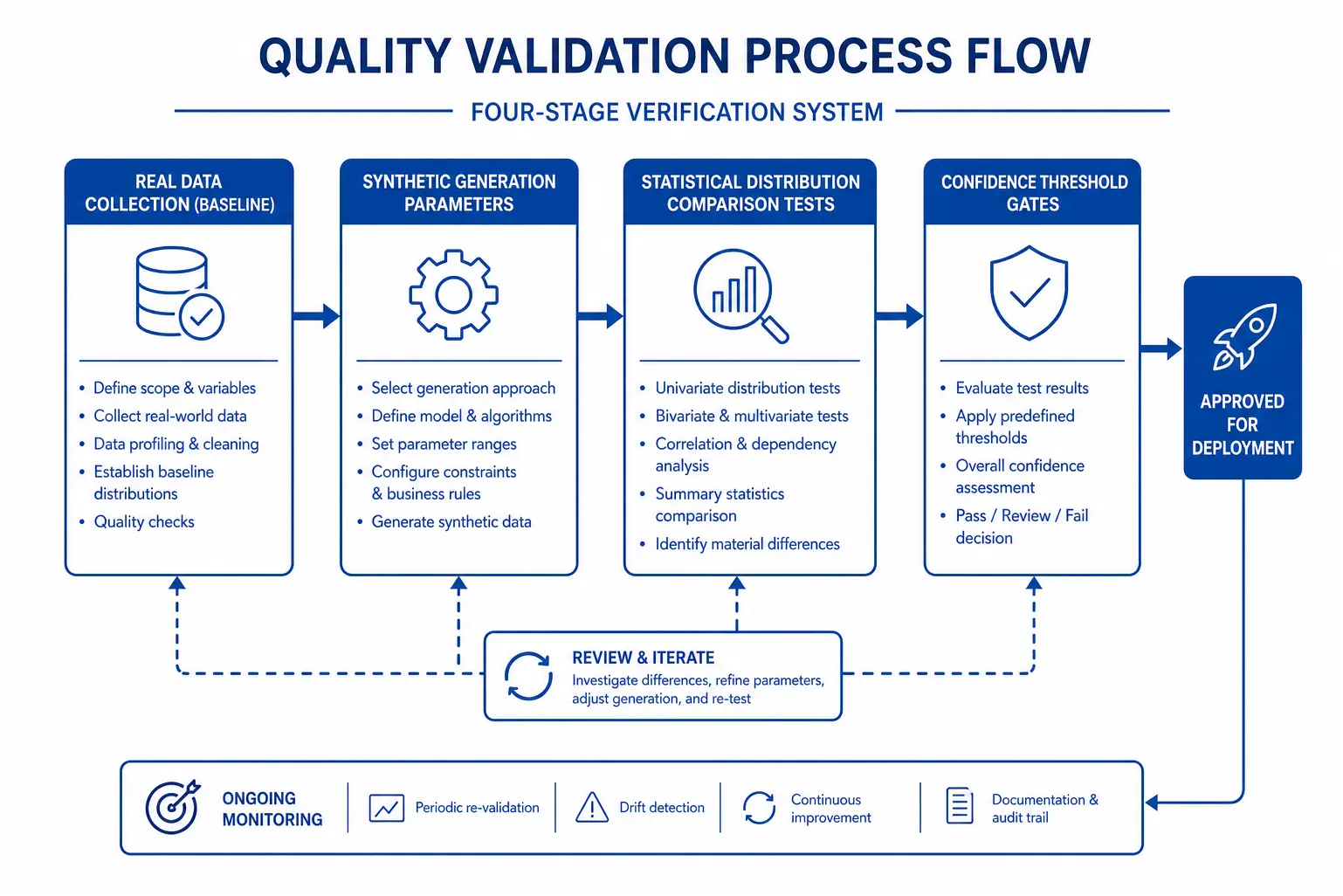
Step 4: Generate synthetic records and validate against holdout data. Produce synthetic respondents in the quantity needed to reach your target sample size. Compare the statistical properties of synthetic data against the holdout validation set using distributional tests: chi-square tests for categorical variables, Kolmogorov-Smirnov tests for continuous variables, and correlation matrices to verify relationships between variables match. Calculate the Kullback-Leibler divergence between real and synthetic distributions values below 0.1 indicate good fidelity. If validation fails, adjust model parameters or collect more baseline data before proceeding.
Step 5: Combine real and synthetic data with clear documentation. Merge your real baseline sample with validated synthetic records, maintaining flags that identify which records are real versus synthetic. This transparency is essential for downstream analysis and stakeholder communication. Weight the combined dataset if your synthetic generation over-represents certain segments. Document the augmentation methodology, validation results, and any limitations in a technical appendix that accompanies research deliverables.
Step 6: Conduct sensitivity analysis on key findings. Re-run your primary analyses using only the real baseline data, then compare results to the augmented dataset. If conclusions change materially, the synthetic data may be introducing bias or the baseline sample was too small to reliably augment. Key metrics should remain directionally consistent, with the augmented data primarily narrowing confidence intervals rather than shifting point estimates. Significant shifts indicate the synthetic model is not generalizing correctly.
Step 7: Disclose synthetic augmentation to stakeholders. Present findings with explicit statements about sample composition: “Analysis based on 75 real respondents augmented with 125 validated synthetic respondents to enable segment-level analysis.” Explain the validation process and sensitivity analysis results. Stakeholders must understand that synthetic data is a modeling technique with assumptions and limitations, not a replacement for genuine human responses. Transparency builds credibility and prevents misinterpretation.
Best Practices for Using Synthetic Data with Small Samples
1. Never exceed a 2:1 synthetic-to-real ratio. When synthetic records outnumber real responses by more than two-to-one, the dataset reflects model assumptions more than actual market behavior. A 50-real, 100-synthetic composition is the practical limit; beyond this, diminishing returns set in and validation becomes unreliable. If you need more than 2x augmentation, the baseline sample is too small to augment responsibly.
2. Validate on out-of-sample real data, not the training set. A model that perfectly replicates its training data proves nothing about generalization. Always hold out 20-30% of real responses for validation, then test whether synthetic data matches this unseen portion. This simulates how well synthetic respondents represent the broader population your baseline sample was drawn from.
3. Avoid synthetic augmentation for exploratory or hypothesis-generating research. Synthetic data works when you’re estimating known parameters with greater precision preference shares, satisfaction scores, feature importance. It fails when you’re discovering unexpected patterns or generating new hypotheses, because the model can only reproduce relationships it learned from baseline data. Genuine surprises come from real respondents.
4. Use domain constraints to prevent implausible synthetic records. Configure your generation model with business logic rules: enterprise customers don’t have budgets under $10K, users of Product A can’t simultaneously be non-aware of your brand, respondents aged 18-24 are unlikely to be C-suite executives. These constraints prevent the model from generating statistically possible but practically impossible combinations that would never appear in real fieldwork.
5. Re-validate when applying synthetic data to new questions. A model trained on brand awareness and consideration data does not automatically generalize to pricing sensitivity or feature preferences. If your research objectives expand beyond the original baseline survey scope, collect new real data for those questions rather than assuming the synthetic model transfers. Each research domain requires its own validation.
6. Document the provenance of every synthetic record. Maintain metadata showing which baseline respondents or patterns contributed to each synthetic record’s generation. This traceability allows you to trace unexpected results back to their source and identify if a small number of real respondents are disproportionately influencing the synthetic sample, which would indicate overfitting.
How AI Is Changing Synthetic Data and Small Sample Sizes in 2026
Generative AI models, particularly large language models fine-tuned on survey response patterns, have transformed synthetic data generation from a specialist data science technique into an accessible research tool. Platforms now allow researchers to upload baseline survey data and receive validated synthetic respondents within hours, with automated statistical validation and sensitivity analysis built into the workflow. This democratization means insights teams without dedicated data scientists can responsibly augment small samples.
The most significant advancement is contextual synthetic generation, where models understand survey question semantics and generate responses that maintain logical consistency across related questions. Earlier synthetic methods treated each variable independently, sometimes producing respondents who loved a product but would never recommend it. Modern LLM-based approaches understand that satisfaction, likelihood to recommend, and repurchase intent correlate logically, generating synthetic respondents whose answer patterns reflect genuine consumer psychology.
AI-powered validation has also evolved beyond simple distributional tests. Current systems compare synthetic data against external benchmarks industry norms, historical trend data, or parallel studies to detect when synthetic augmentation produces results that diverge from broader market reality. This external validation catches cases where both real and synthetic data are internally consistent but collectively unrepresentative, a failure mode earlier methods missed. New approaches implement hybrid research systems where AI continuously monitors sample quality during fieldwork, flagging when specific segments are underpowered and recommending either targeted recruitment or validated synthetic augmentation based on real-time statistical analysis. This dynamic approach optimizes the real-versus-synthetic mix for each study, allocating budget to segments where real responses are most critical and using synthetic augmentation where it adds confidence without compromising validity.
Tools and Resources for Synthetic Data in Market Research
Synthetic Data Vault (SDV) is an open-source Python library specifically designed for generating synthetic tabular data that preserves statistical properties and relationships. It offers multiple modeling approaches from simple Gaussian copulas to deep learning GANs, with built-in evaluation metrics for validation. Free and well-documented, it’s ideal for research teams with technical capabilities.
MOSTLY AI provides an enterprise platform for synthetic data generation with a focus on privacy and accuracy, offering both cloud and on-premise deployment. The platform includes automated quality reports comparing synthetic to real data across dozens of statistical measures. Pricing is usage-based, with a free tier for datasets under 100,000 records.
Gretel.ai combines synthetic data generation with differential privacy guarantees, particularly valuable when baseline data includes sensitive information. The platform uses transformer-based models that excel at maintaining complex correlations in survey data. It offers API access and a web interface, with pay-per-generation pricing starting around $0.01 per synthetic record.
DataSynthesizer from the University of Washington is an academic tool focused on privacy-preserving synthetic data, using Bayesian networks to model variable relationships. While less polished than commercial options, it’s free and includes detailed documentation on validation approaches. Best suited for researchers comfortable with Python and statistical validation.
SMOTE and ADASYN are resampling techniques originally developed for imbalanced machine learning datasets but adaptable to survey augmentation. Implemented in the Python imbalanced-learn library, these methods generate synthetic records by interpolating between existing real respondents. They work well for simple augmentation needs without requiring complex model training.
Qualtrics XM Discover has integrated AI-powered sample augmentation features in 2026, allowing researchers to upload baseline data and receive synthetic respondents with automated validation against the Qualtrics benchmark database. This integration streamlines the workflow for teams already using the Qualtrics platform, though it requires an enterprise license.
Conclusion
Synthetic data represents a powerful tool for addressing the persistent tension between statistical rigor and research budget constraints, but only when deployed with strict validation and appropriate use cases. The technique works when baseline samples are representative, when augmentation ratios remain conservative, and when researchers treat synthetic respondents as a modeling technique rather than a replacement for genuine human insight. The confidence boost synthetic data provides is real and measurable, narrowing intervals and enabling subgroup analysis that small samples alone cannot support.
The key insight is that synthetic data and small sample sizes are not a binary choice between real fieldwork and AI-generated responses, but a spectrum of hybrid approaches where each method plays to its strengths. Real respondents provide ground truth and capture unexpected patterns; synthetic augmentation extends that foundation to deliver statistical confidence where budget or logistics constrain additional recruitment. The organizations that succeed with this approach maintain transparency, validate rigorously, and recognize the boundaries beyond which synthetic data introduces more risk than value.
As AI capabilities advance through 2026, the technical barriers to synthetic augmentation continue to fall, but the methodological discipline required remains constant. The same research principles that govern sampling, weighting, and statistical inference apply equally to synthetic data perhaps more so, given the additional layer of modeling assumptions. Explore how H-in-Q.com can help your organization implement validated synthetic data approaches that boost confidence without compromising research integrity. The future of market research is not choosing between real and synthetic respondents, but orchestrating both to deliver insights that are simultaneously rigorous, timely, and cost-effective.
Frequently Asked Questions
Can synthetic data completely replace real respondents in market research?
No, synthetic data cannot completely replace real respondents. It augments existing samples by filling gaps in underrepresented segments or testing scenarios, but always requires a foundation of genuine human responses to ensure the synthetic data reflects actual market behavior and attitudes accurately.
What is the minimum real sample size needed before adding synthetic data?
A minimum of 30-50 real respondents per segment provides sufficient statistical foundation for synthetic augmentation. Below this threshold, the synthetic data risks amplifying biases present in the small baseline, producing unreliable insights that appear statistically confident but lack validity.
How do you validate that synthetic respondents match real market behavior?
Validation compares statistical distributions, response patterns, and correlations between real and synthetic datasets using chi-square tests, KL divergence measures, and holdout validation. Real responses are split into training and test sets, with synthetic data validated against the unseen test portion to confirm generalization.
Does synthetic data work for qualitative research or only quantitative surveys?
Synthetic data works primarily for quantitative research where statistical patterns can be learned and replicated. Qualitative research requires genuine human narratives, emotional nuance, and contextual depth that current AI cannot authentically generate without producing fabricated experiences that mislead stakeholders.
What are the regulatory risks of using synthetic data in market research?
Regulatory risks include misrepresentation if synthetic data is presented as real respondent feedback, potential violations of research ethics standards, and liability if decisions based on synthetic insights cause harm. Always disclose synthetic augmentation to stakeholders and maintain clear documentation of methodology and validation.
How much does synthetic data reduce market research costs compared to traditional fieldwork?
Synthetic data typically reduces incremental sample costs by 60-80% compared to additional fieldwork, since generating synthetic respondents costs pennies per record versus $5-50 per real respondent. However, initial real data collection and validation infrastructure represent fixed costs that synthetic augmentation does not eliminate.