


Tabla de contenidos
- What Is Agentic AI in Market Research?
- Why Agentic AI Needs Evidence Gates Before Research Budgets Scale
- How to Implement Agentic AI: 10 Workflow Upgrades
- Expert Controls That Prevent Synthetic Confidence from Becoming Business Risk
- How AI Is Changing Market Research Workflows in 2026
- Tools and Resources for Accountable AI Research
- Build Faster Research Without Weakening the Evidence
- Preguntas frecuentes
2026 Agentic AI and Synthetic Respondents: 10 Ways AI Is Redefining Market Research Workflows
A thousand synthetic answers still do not equal a thousand customer interviews. Agentic AI accelerates market research, but speed becomes expensive when generated responses are mistaken for observed behavior.
The opportunity is practical: automate repetitive coordination while preserving evidence standards. Researchers gain time for interpretation, and decision-makers receive clearer explanations of what findings support.
H-in-Q.com’s focus on AI-powered marketing, automation, and business AI provides a practical lens: connect research tasks without surrendering accountability. This guide separates useful automation from unsupported shortcuts.
In this guide, you’ll discover ten workflow applications, validation rules, useful tools, and an implementation path for 2026.
What Is Agentic AI in Market Research?
Agentic AI in market research is the use of goal-directed AI systems that plan and execute connected research tasks within defined permissions. These systems coordinate tools, information, and checkpoints across a workflow, while human researchers retain responsibility for methodology, participant protection, interpretation, and decisions.
A chatbot answers a prompt. An agent follows a controlled sequence: retrieve an approved questionnaire, propose revisions, run checks, and request approval before publishing.
Synthetic respondents are different. They generate simulated answers using models, profiles, and supplied context. They are not recruited participants, and their responses are not independent observations.
This distinction matters in 2026 because both technologies enter the same workflow. Agents coordinate research; synthetic respondents supply modeled material for testing. Neither removes the need for representative sampling or independent validation.
Why Agentic AI Needs Evidence Gates Before Research Budgets Scale
Faster production increases the cost of weak controls. A flawed questionnaire replicated across markets creates more rework, not better insight.
The NIST AI Risk Management Framework organizes risk management around four functions: Govern, Map, Measure, and Manage. Research teams can translate these into ownership, use-case boundaries, validation, and corrective action.
For example, reducing questionnaire preparation from ten hours to seven represents a 30% improvement. That is an illustrative target, not an established industry benchmark; include review and rework when measuring it.
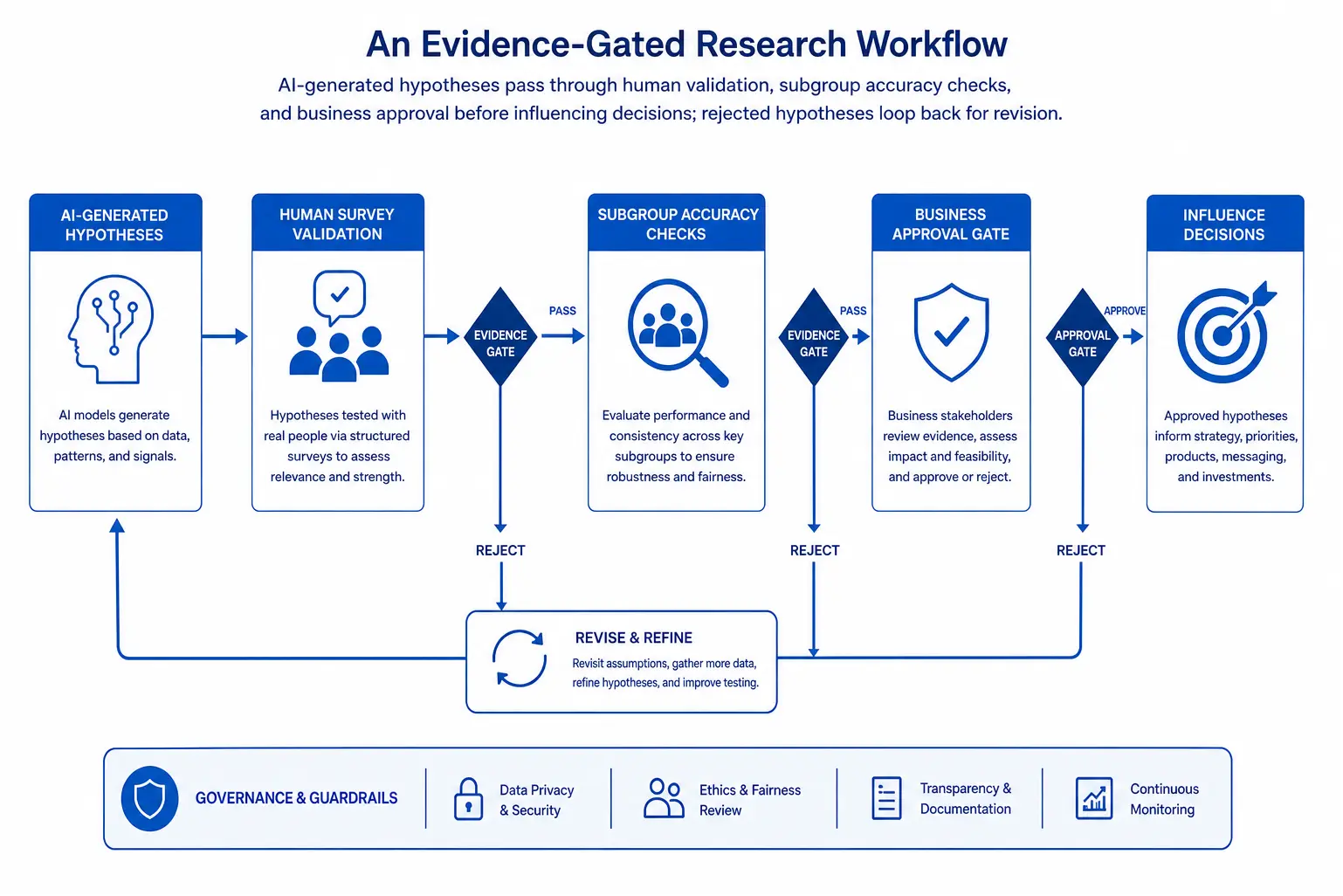
Synthetic agreement is not evidence of market demand. Require human validation before findings influence pricing, positioning, or launch investment.
How to Implement Agentic AI: 10 Workflow Upgrades
-
Translate briefs into research plans. Give the agent an approved objective and decision context. Require a researcher to approve audiences, methods, and exclusions before execution.
-
Draft survey questions against explicit rules. Check neutrality, reading level, and single-concept wording. Compare assisted design time against a manual baseline rather than assuming a 30% gain.
-
Test routing with synthetic respondents. Generate edge-case journeys through eligibility and branching logic. Treat successful completion as a programming check, not proof of respondent comprehension.
-
Coordinate recruitment without inventing participants. Automate scheduling and quota monitoring through approved systems. Keep eligibility verification and participant consent separate from generated profiles.
-
Flag suspicious responses for review. Combine completion speed, contradictions, and duplication signals. Never reject participants solely because their language differs from model expectations.
-
Code open-ended answers consistently. Start with a researcher-approved codebook and human-coded sample. Review disagreements and track changes before processing the remaining responses.
-
Explore synthetic hypotheses separately. Use simulations to identify objections or overlooked segments. Label outputs clearly and test consequential hypotheses with recruited participants.
-
Automate reproducible analysis. Generate scripts from a signed-off analysis plan. Check weighting, missing values, denominators, and subgroup sizes before interpreting differences.
-
Draft traceable insight reports. Require every numerical claim to reference an approved table. Distinguish participant quotations, analyst interpretations, and generated summaries.
-
Localize and preserve learning. Have native-language researchers review Japanese wording for Tokyo studies. Store approved instruments, limitations, and outcomes in a searchable research repository.
Expert Controls That Prevent Synthetic Confidence from Becoming Business Risk
- Keep a human holdout. Reserve independent participant data for validation, never prompt tuning.
- Define acceptance before testing. Set decision-specific tolerances for ranking errors and subgroup deviations.
- Preserve disagreement. Investigate conflicting outputs instead of averaging them into artificial consensus.
- Use fewer synthetic personas initially. A small, testable set exposes assumptions better than thousands of opaque simulations.
- Track total study cost. Include recruitment, subscriptions, integration, review, and failed runs.
- Minimize sensitive inputs. Confirm retention settings, access permissions, and applicable privacy obligations before uploading data.
Validate the decision, not just the model output. A plausible response is insufficient when the business needs reliable segment-level evidence.
How AI Is Changing Market Research Workflows in 2026
Agentic AI connects previously isolated tasks: questionnaire revision triggers routing tests, approved data triggers analysis, and verified tables populate draft reports. The benefit comes from controlled handoffs, not unrestricted autonomy.
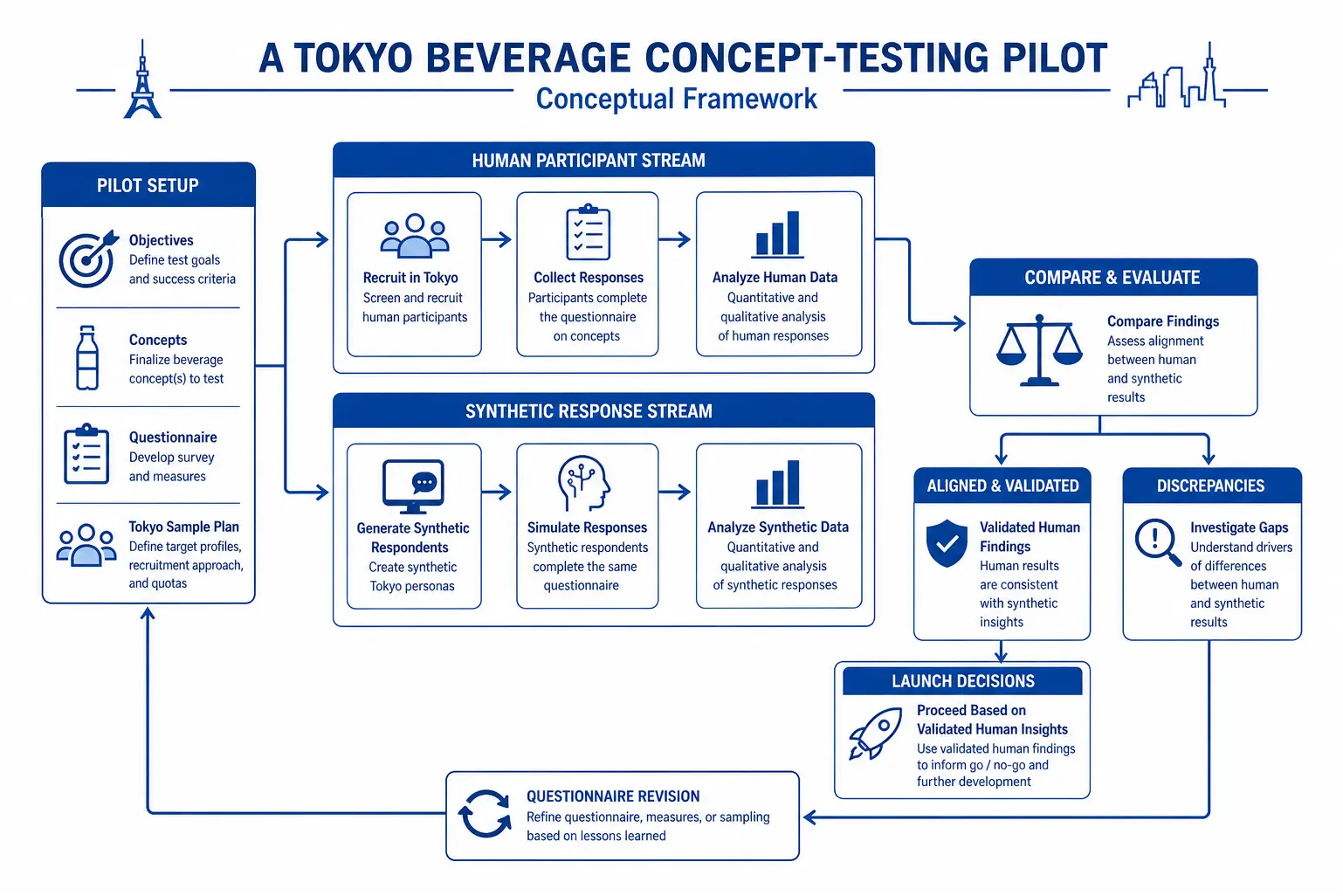
Consider an illustrative Tokyo beverage study, not a claimed client result. Synthetic profiles expose ambiguous questions; recruited consumers then evaluate concepts. Researchers compare patterns and investigate discrepancies before recommending launch actions.
Japanese-language review remains essential, alongside appropriate recruitment and Japan’s Personal Information Protection Commission guidance. A translated questionnaire alone does not establish local validity.
Tools and Resources for Accountable AI Research
- Qualtrics: A paid survey platform for questionnaire delivery and research workflows. Verify available features against your subscription.
- LangGraph: An orchestration framework for stateful agent workflows. Budget for engineering, hosting, and monitoring.
- R: Use the free R statistical computing environment for reproducible analysis and validation scripts.
- Dovetail: A commercial research repository for organizing qualitative evidence and collaborative interpretation.
- Prolific: A paid participant-recruitment platform for human research. Confirm audience availability, eligibility, and study requirements.
Select tools by workflow fit, exportability, privacy controls, and total operating cost not demonstration quality alone.
Build Faster Research Without Weakening the Evidence
Agentic AI creates value when it removes repetitive work while keeping research decisions accountable. Start with one bounded workflow, establish its baseline, and measure time saved alongside quality and rework.
Keep synthetic respondents in their proper role: useful for testing and hypothesis exploration, but separate from observed customer evidence. Then expand automation only after independent validation demonstrates acceptable performance.
Explore H-in-Q.com’s AI and automation expertise to identify a practical starting point for your research workflow. The strongest research programs in 2026 will combine faster execution with evidence that decision-makers can inspect and trust.
Preguntas frecuentes
What is agentic AI in market research?
Agentic AI in market research uses goal-directed software agents to coordinate research tasks within defined permissions. These systems connect activities such as questionnaire drafting, data checks, analysis, and reporting. Researchers remain responsible for study design, participant protection, interpretation, and approval of consequential decisions.
Can synthetic respondents replace real survey participants?
Synthetic respondents do not provide a general replacement for real survey participants. They generate modeled answers rather than independently observed human evidence. Use them to test questionnaires and explore hypotheses, then validate decision-relevant findings with actual participants, especially when studying unfamiliar populations or sensitive purchasing behavior.
Can AI reduce survey design time by 30%?
A 30% reduction is a measurable pilot target, not a universal performance guarantee. Establish baseline design hours, then measure assisted drafting, programming, review, and rework together. Reducing a ten-hour process to seven hours meets that target only when questionnaire quality and approval standards remain unchanged.
Is AI market research cheaper than traditional research?
AI-assisted research is cheaper when verified labor savings exceed software, integration, validation, and oversight costs. Repetitive coding and reporting offer useful starting points. Human recruitment and specialist review remain necessary for many studies, so compare total cost per decision-ready study rather than generation costs alone.
How do you check synthetic respondent data quality?
Check synthetic data against an independent human benchmark using measures relevant to the research decision. Compare segment distributions, concept rankings, response variation, and failure rates across repeated runs. Keep benchmark participants outside model tuning, document model versions, and reject outputs that miss predefined acceptance thresholds.
What should companies consider when using AI research in Tokyo?
Companies conducting AI-assisted research in Tokyo should prioritize Japanese-language testing, locally appropriate recruitment, and privacy review. Validate question wording with native-language researchers and check differences across relevant customer segments. Review obligations under Japan’s APPI, including applicable requirements for personal information handling and international data transfers.

 English
 Français
 Español