


Table des matières
- What Is Random Sampling?
- Why Random Sampling Matters for Businesses in 2026
- How to Implement Random Sampling Step by Step
- Expert Tips for Better Random Sampling
- How AI Is Changing Random Sampling in 2026
- Tools & Resources for Random Sampling
- Build Research Decisions on Auditable Selection
- Questions fréquemment posées
The Ultimate Guide to Random Sampling in 2026
A bigger survey does not repair a biased invitation list. Random sampling makes selection auditable, but reliable market estimates also require coverage and participation checks. H-in-Q.com’s focus on AI-powered marketing makes this distinction relevant: faster research needs statistical controls, not just automation. In this guide, you’ll discover how to select participants, calculate sample requirements, and supervise AI-assisted workflows.
What Is Random Sampling?
Random sampling is a probability-based selection process in which population members have known, nonzero chances of inclusion through a random mechanism. In simple random sampling, every possible sample of a specified size has an equal selection probability. This supports population estimation and quantification of sampling uncertainty.
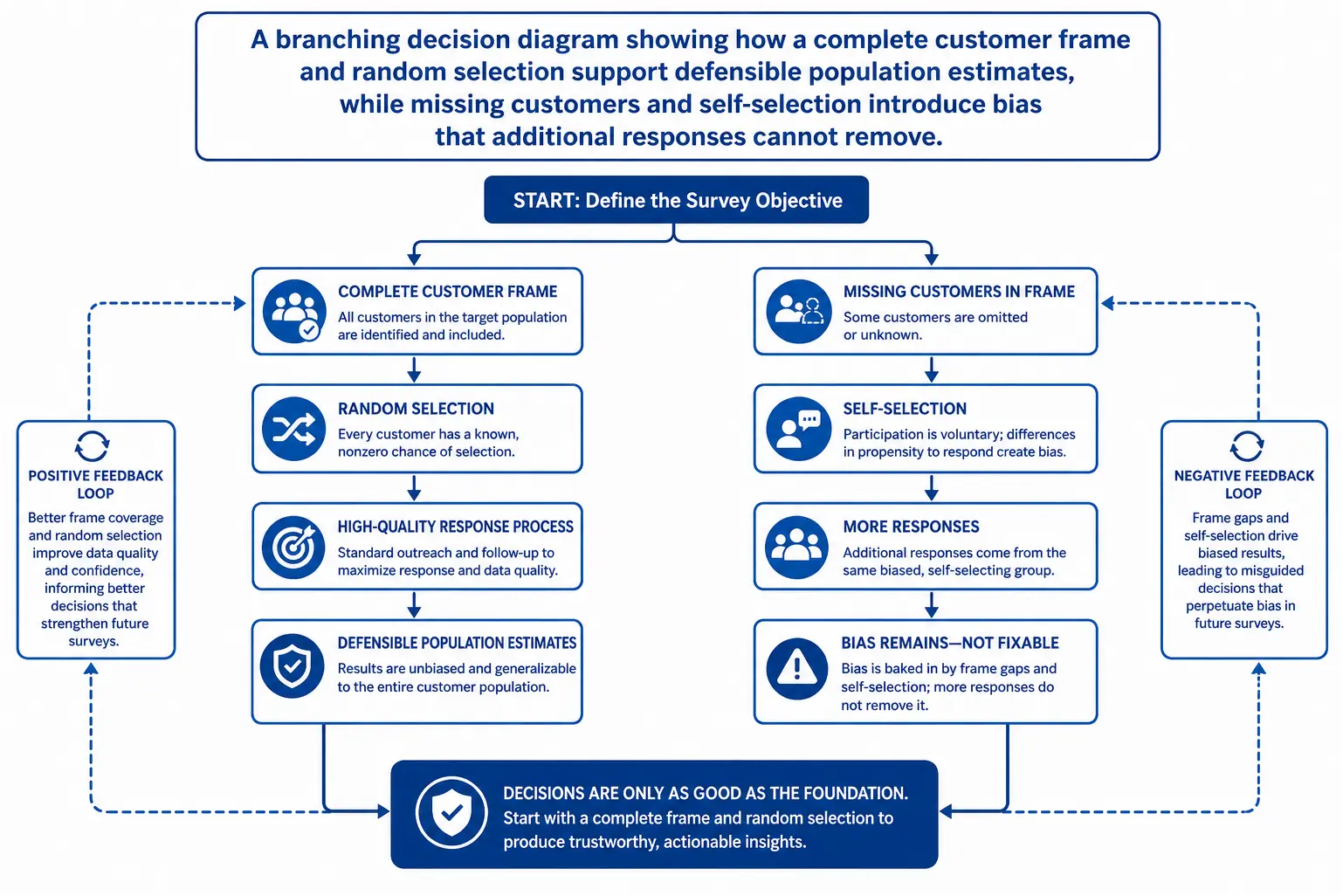
Distinguish the target population from the sampling frame: the actual list used for selection. A customer database excludes prospects unless they appear in that frame. Also, random selection differs from an open survey link, where participants select themselves.
Why Random Sampling Matters for Businesses in 2026
Pricing, positioning, and retention decisions require evidence beyond your most vocal customers. A probability design provides a defensible basis for estimating what the defined market thinks.
For illustration, 385 completed responses provide approximately ±5 percentage points of precision at 95% confidence, assuming a large population, simple random selection, and maximum proportion variability. This calculation describes sampling uncertainty, not every survey error; consult the NIST statistical handbook for statistical foundations.
Precision measures uncertainty; it does not certify representativeness. Ignoring coverage gaps turns apparently precise percentages into expensive targeting mistakes.
How to Implement Random Sampling Step by Step
1. Specify the decision and population
Define who qualifies, the reference period, and the decision threshold. “Active paying accounts at the selection date” is more operational than “our customers.” Choose whether the unit is a person, household, or account.
2. Build and inspect the frame
Export eligible records, assign stable IDs, remove duplicates, and document exclusions. Compare coverage against known population totals. Multiple contacts at one account create unequal account-level selection chances unless explicitly handled.
3. Choose the selection design
Use simple random sampling for straightforward population estimates. Use stratified selection when essential regions or customer tiers need guaranteed coverage. Disproportionate allocation requires weights for overall estimates; cluster designs require analysis reflecting clustering.
4. Calculate completed-response requirements
For proportions, use n₀ = z²p(1 − p)/e². With z = 1.96, p = 0.5, and e = 0.05, round upward to 385. This assumes a large population and simple random selection. For sampling without replacement, apply n = n₀/[1 + (n₀ − 1)/N] when the sampling fraction is substantial.
5. Budget invitations separately
Divide required completions by anticipated response rate. At an assumed 20% response rate, 385 completions require approximately 1,925 invitations. This plans fieldwork capacity; it does not guarantee completions or eliminate nonresponse bias.
6. Draw and preserve the sample
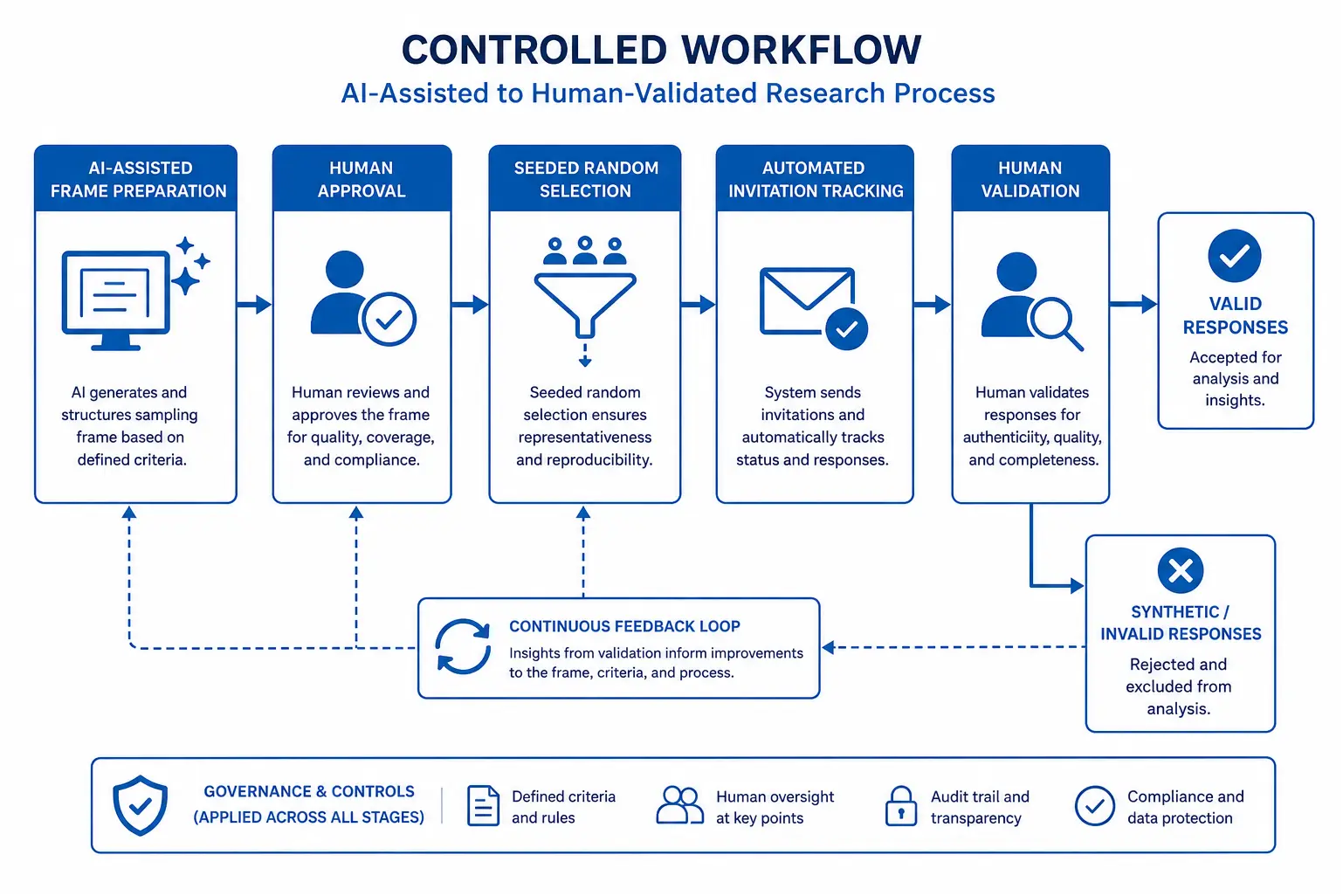
Select IDs without replacement using a seeded random-number generator. Save the frame snapshot, code, software version, seed, and selected IDs. Record row order because changing it changes the selection.
7. Field consistently and analyze correctly
Standardize invitations and reminders. Release any reserves through predefined random batches, never convenient substitutions. Compare respondents with frame benchmarks, document weighting assumptions, and calculate design-appropriate uncertainty. Report eligibility, invitations, completions, exclusions, and limitations alongside findings.
Expert Tips for Better Random Sampling
- Audit coverage first. Additional responses from an incomplete frame leave excluded groups invisible.
- Keep eligibility rules fixed during fieldwork; log necessary amendments.
- Oversample small priority segments deliberately, then weight combined estimates appropriately.
- Do not replace every nonrespondent immediately. Consistent follow-ups preserve the contact protocol.
- Separate survey weights from sales-value weights; they answer different questions.
- Report participation using AAPOR’s Standard Definitions. A response rate alone does not measure nonresponse bias.
How AI Is Changing Random Sampling in 2026
AI assistants help draft selection code, identify duplicate records, and flag unusual participation patterns. However, deterministic rules should govern eligibility, while tested statistical software performs selection.
Require human approval before accepting AI-suggested exclusions. Otherwise, automated cleaning silently changes the population. Keep personal information out of unapproved models and review generated code against a small test dataset.
Synthetic respondents support questionnaire testing, not population inference. Preserve the distinction between simulated answers and observed human responses.
Tools & Resources for Random Sampling
- R: Free, scriptable selection and statistical analysis; save scripts for reproducibility.
- NumPy: Free seeded generators for Python workflows; specify selection without replacement.
- Excel: Accessible spreadsheet selection; freeze random values and archive the workbook.
- Qualtrics: Commercial survey distribution and response tracking; validate the underlying recruitment design separately.
Build Research Decisions on Auditable Selection
Effective random sampling connects a defined population, documented selection, and design-aware analysis. Audit the frame before expanding fieldwork, distinguish invitations from completions, and investigate participation differences before presenting findings. Automation accelerates these tasks without replacing their statistical foundations.
Explore H-in-Q.com’s AI and automation expertise to identify research workflow opportunities. In 2026, trustworthy research will depend on making automated processes more transparent, not merely faster.
Questions fréquemment posées
What is the difference between random sampling and random assignment?
Random sampling selects participants from a population, while random assignment allocates participants to experimental groups. The first supports population estimates; the second supports causal comparisons between treatments. A study can use either method independently, so random assignment does not establish that its participants represent the target market.
How many responses do I need for a random sample?
You need approximately 385 completed responses to estimate a proportion within five percentage points at 95% confidence under simple random sampling assumptions. That calculation assumes maximum variability and a large population. Smaller subgroups, tighter precision, clustering, and expected nonresponse change the required sample or invitation count.
Is sending a survey to random email addresses random sampling?
Sending surveys to random email addresses qualifies only when those addresses come from a defined population frame with known selection probabilities. Arbitrary addresses do not establish population coverage. Duplicate accounts, inactive inboxes, and unequal ownership of email addresses also require attention before interpreting the resulting responses.
Can Excel select a random sample?
Excel can select a sample by assigning RAND values to eligible records, sorting those values, and taking the required number of rows. Freeze the generated values before sorting or editing. Save the source file and selected IDs because spreadsheet recalculation otherwise changes the selection.
Does random sampling eliminate bias?
Random sampling controls selection through a probability mechanism, but it does not eliminate every source of bias. Missing population groups, survey nonresponse, misleading questions, and inaccurate answers still distort findings. Researchers must evaluate coverage, participation, and measurement separately rather than treating random selection as a universal quality guarantee.
Can AI-generated respondents replace a random sample?
AI-generated respondents cannot replace real respondents when estimating attitudes or behaviors in a defined human population. Their outputs reflect model behavior rather than known selection probabilities and observed participation. Use synthetic responses to test questionnaires or analysis pipelines, then collect actual responses for population-level market estimates.

 English
 Français
 Español