


The Customer Experience Revolution Nobody Asked For, And Everyone Needed
For decades, businesses competed on price. Then they competed on product quality. Today, the only battleground that truly matters is customer experience. The debate is no longer whether companies should invest in it; it is whether artificial intelligence is the right engine to drive it forward. Skeptics argue that AI strips service of its human warmth, reducing relationships to algorithms. Advocates counter that AI is the only technology capable of delivering the personalized, real-time, frictionless experience that modern customers now demand as a baseline, not a luxury. The stakes are enormous. McKinsey’s research on customer experience leadership consistently shows that top performers generate revenue growth two to three times faster than laggards. This article cuts through the noise and arrives at a clear verdict: AI-powered customer experience is not a trend, it is the new infrastructure of competitive business.
Why Customer Experience Has Become the Ultimate Business Battleground
The Shift From Product-Centric to Customer Experience-Centric Strategy
The product era is over. What companies sell matters far less than how customers feel throughout every interaction with a brand; before, during, and after the purchase. This structural shift has forced organizations to rethink their entire operating model. Customer experience now encompasses every touchpoint: digital interfaces, support channels, post-purchase engagement, and proactive outreach. Brands that continue to treat experience as an afterthought pay a measurable price; higher churn, weaker retention, and eroding loyalty. Harvard Business Review frames this as the “experience economy”, where emotional resonance and seamless journeys create more durable competitive advantages than any product feature ever could.
What Traditional Service Models Can No Longer Deliver
Legacy service models were built for predictability; standardized scripts, reactive support queues, and one-size-fits-all communication. They worked when customer expectations were low and competition was local. Neither condition applies today. Customers expect instant responses, contextual awareness, and seamless experiences across every channel simultaneously. Traditional models cannot scale to meet these demands without exploding operational costs. The workforce required to deliver personalized customer experience manually at enterprise scale simply does not exist at viable economics. This is a structural limitation that only intelligent automation can resolve.
How AI Is Redefining Customer Experience at Scale
From Reactive Support to Predictive Analytics-Powered Customer Experience Engagement
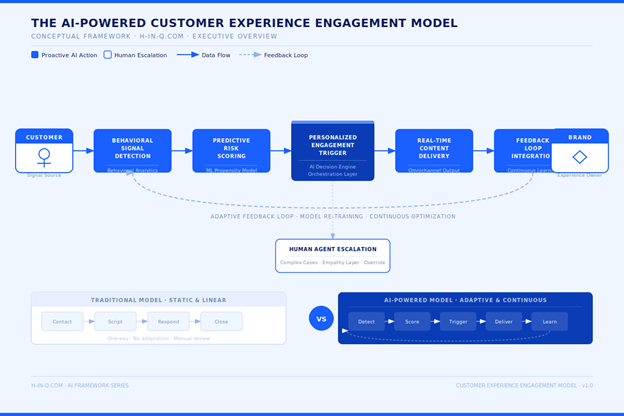
The most significant shift AI introduces to customer experience is the move from reactive to proactive engagement. Traditional service waits for a problem to arise. Predictive analytics-powered systems identify patterns in customer behavior, flag potential friction points, and intervene before dissatisfaction materializes. A subscription platform detecting early churn signals and triggering a personalized retention offer is not science fiction; it is current operational reality for leading technology companies. IBM’s research on AI in customer service confirms that proactive AI engagement reduces churn significantly while simultaneously improving lifetime value metrics across industries.
Real-Time Personalization in Marketing as a Competitive Weapon for Customer Experience
Personalization in marketing has evolved from a nice-to-have differentiator into a survival requirement. AI enables brands to deliver individualized content, offers, and communications at a scale and speed no human team could replicate. Real-time personalization analyzes browsing history, purchase patterns, location data, and behavioral signals to construct a dynamic experience unique to each individual customer. The competitive implications are severe: brands that master personalization in marketing capture disproportionate market share, while those serving generic messaging to segmented audiences are not competing; they are retreating.
The Case Against AI in Customer Experience: A Devil’s Advocate Perspective
When Automation Replaces Empathy: The Human Cost of AI-Driven Customer Experience
The opposition to AI in customer experience is not irrational. Critics raise a legitimate concern: that optimizing for efficiency systematically destroys the emotional depth that makes service meaningful. A chatbot resolving a billing dispute cannot detect the anxiety behind a customer’s words. An automated retention offer cannot replace the reassurance a skilled human advisor provides to a long-term client facing a complex problem. Human connection drives loyalty in ways that algorithmic precision cannot fully replicate. This argument carries particular weight in high-stakes industries; banking, healthcare, insurance where customers need to feel heard, not processed.
Trust, Data Privacy, and the Fragility of AI-Driven Customer Experience Relationships
Data is the fuel of AI-powered customer experience and also its greatest vulnerability. Every personalized interaction requires extensive data collection, storage, and processing. Customers increasingly understand this exchange and are growing uncomfortable with it. A single data breach or opaque algorithmic decision can permanently damage trust that a brand spent years building. Regulatory pressure is intensifying globally, with frameworks like GDPR placing strict boundaries on data exploitation. Deloitte’s digital trust research confirms that trust is now a primary driver of customer loyalty, and AI mismanagement actively erodes it.
AI vs. Human Service: Where Each Delivers Superior Customer Experience
| Dimension | AI-Powered Approach | Human-Led Approach |
| Response Speed | Instant, 24/7 availability | Limited by working hours and capacity |
| Scalability | Unlimited concurrent interactions | Constrained by headcount |
| Personalization Depth | Data-driven, real-time adaptation | Intuitive but inconsistent |
| Emotional Intelligence | Limited contextual empathy | High – especially in complex situations |
| Cost Efficiency | Significantly lower at scale | Higher operational cost |
| Trust Building | Dependent on data transparency | Naturally relational |
| Error Recovery | Rule-based, may escalate poorly | Flexible, adaptive resolution |
Predictive Analytics and the New Science of Anticipating Customer Experience Needs
How Predictive Analytics Transforms the Customer Experience Pipeline
Predictive analytics does not simply analyze what customers have done; it calculates what they are likely to do next and prescribes the optimal brand response. This transforms the entire customer experience pipeline from a series of reactive events into a continuously optimized system. Machine learning models trained on behavioral data identify patterns invisible to human analysts: micro-signals that precede churn, purchase readiness indicators, and satisfaction thresholds. The result is a service architecture that acts before customers articulate their needs. McKinsey’s analysis of personalization ROI confirms that companies excelling at predictive engagement generate significantly more revenue than industry averages.
Industries Already Winning With Predictive Customer Experience Intelligence
The application of predictive analytics to customer experience is no longer theoretical. Retail giants use purchase history and browsing data to predict demand and personalize product recommendations in real time. Streaming platforms have built entire business models on behavioral prediction engines that keep users engaged. Financial institutions deploy predictive models to identify customers approaching critical decision points like mortgage renewal, an investment threshold, and engage them with tailored guidance before they seek competitors. Healthcare providers use predictive intelligence to anticipate needs and reduce friction in care coordination. These are scaled competitive advantages, not pilot programs.
Personalization in Marketing : From Gimmick to Customer Experience Growth Engine
The Architecture of Hyper-Personalized Customer Experience Journeys
Hyper-personalization is not about inserting a customer’s first name into an email subject line. It is a comprehensive architecture that maps individual behavioral data to dynamic content, timing, channel selection, and offer construction; simultaneously, in real time. AI makes this architecture operational at scale. Every interaction generates new data, which refines the model, which improves the next interaction. This feedback loop creates compounding personalization value over time. The brands executing this architecture are not simply delivering better customer experience, they are creating switching costs so high that rational alternatives for customers begin to disappear.
Why Generic Messaging Is Now a Customer Experience Brand Liability
Sending the same message to an entire customer base is no longer neutral; it is actively damaging. Customers who receive irrelevant communications do not ignore them. They disengage, unsubscribe, and form negative brand associations. In a market where personalization in marketing is widely available, generic messaging signals that a brand either does not understand its customers or does not consider them worth the effort. Both perceptions destroy loyalty. MIT Technology Review’s analysis of AI in marketing reinforces that personalization directly correlates with engagement rates, revenue per customer, and long-term retention. Generics are competitive liability.
Personalization Maturity Model in Customer Experience
| Maturity Level | Personalization Approach | Customer Experience Impact |
| Level 1: Basic | Name insertion, demographic segmentation | Minimal differentiation |
| Level 2: Behavioral | Purchase history, browsing-based recommendations | Moderate engagement improvement |
| Level 3: Contextual | Real-time channel and timing optimization | Strong retention impact |
| Level 4: Predictive | Anticipatory offers before expressed need | High loyalty and lifetime value |
| Level 5: Hyper-Personal | Individual AI models per customer | Transformational experience differentiation |
The Hybrid Model: AI Efficiency Meets Human Accountability in Customer Experience
Where AI Should Lead and Where Humans Must Remain in Control of Customer Experience
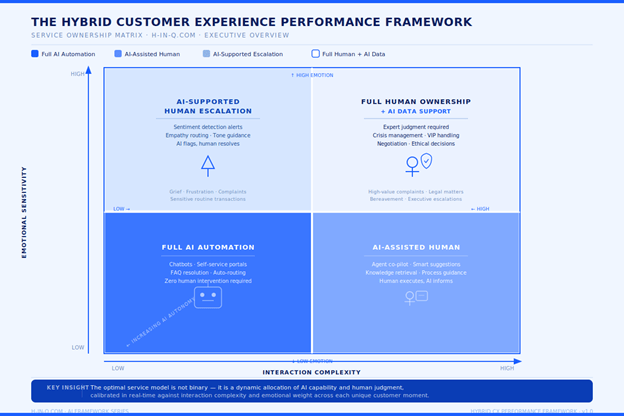
The binary debate between AI and human service misrepresents how leading organizations actually operate. The most effective customer experience frameworks are hybrid: AI handles scale, speed, and personalization, while human agents manage complexity, emotional escalation, and high-stakes decisions. This division is not compromise, it is intelligent architecture. AI should own first-contact resolution, proactive engagement, and real-time personalization. Humans should own relationship-critical conversations and advisory roles requiring judgment. World Economic Forum research on AI and the future of work confirms that the most resilient organizations design human-AI collaboration rather than substitution.
Building a Customer Experience Strategy That Scales Without Losing Soul
Scaling customer experience through AI without degrading its humanity requires deliberate design. Companies must establish clear escalation protocols, train AI systems on empathy-sensitive language patterns, and maintain robust human oversight of automated decisions. Brand voice must remain consistent across AI-generated and human-delivered interactions. Feedback loops between customer sentiment data and model refinement must be institutionalized, not improvised. Culture, not technology, ultimately determines whether AI-powered customer experience feels like a genuine relationship or a transactional interface.
View AI Powered CX Case Studies
What the Numbers Don’t Tell You About AI-Powered Customer Experience
The Hidden Implementation Challenges of Customer Experience Transformation Companies Rarely Admit
The business case for AI-powered customer experience is compelling on paper. The reality of implementation is considerably more complex. Data quality is the first barrier: AI systems are only as intelligent as the data they are trained on, and most organizations discover their customer data is fragmented, inconsistent, and riddled with gaps. Integration with legacy systems creates costly delays. Change management resistance from service teams who perceive AI as a threat consistently undermines deployment timelines. These are not reasons to abandon AI investment, they are arguments for investing in foundational data infrastructure before deploying customer-facing AI systems at scale.
Measuring Customer Experience Beyond Satisfaction Scores in the AI Era
Net Promoter Score and satisfaction surveys measure sentiment at a single moment. They do not capture the cumulative, dynamic nature of AI-powered customer experience. Forward-thinking organizations are building measurement frameworks that include behavioral loyalty indicators:
- Repeat purchase velocity and cross-channel engagement depth
- Proactive service uptake rates and self-service resolution trends
- Lifetime value trajectory modeled against AI engagement touchpoints
- Unstructured sentiment analysis across social, support, and review channels
Satisfaction scores are lagging indicators. Behavioral loyalty metrics, powered by predictive analytics, are the leading indicators that actually predict business performance.
AI-Powered Customer Experience Is the Future and the Present Standard
The debate about whether AI-powered customer experience is a fad misunderstands the nature of structural market shifts. Fads reverse. This one will not. The convergence of predictive analytics, real-time personalization in marketing, and intelligent automation has permanently raised the floor of customer expectations. Businesses that treat AI as an optional enhancement are not being cautious, they are falling behind a standard their competitors are actively setting.
The critics who champion human service over AI are not wrong about empathy’s value. They are wrong about where that argument leads. The answer is not less AI, it is smarter AI, deployed with human oversight, ethical data governance, and relentless focus on genuine customer value.
Organizations that build this capability now will define the next decade of service excellence. Those that wait will spend the decade after trying to recover the ground they surrendered.
References
- The Value of Getting Personalization Right — McKinsey & Company
- The New Science of Customer Emotions — Harvard Business Review
- AI in Customer Service — IBM Institute for Business Value
- Digital Trust in the AI Era — Deloitte Global
- How AI Is Transforming Customer Engagement — MIT Technology Review
- The Future of Jobs and AI Collaboration — World Economic Forum
Read Also : AI Customer Experience: Personalization vs. Surveillance