


The survey response that reveals exactly why your last five deals were lost is one you will never receive. B2B buyers do not fill out competitor preference surveys. They do not disclose which vendors they shortlisted before your SDR ever reached out. They do not explain why they chose a competitor at the end of an 11-month evaluation cycle. They research, evaluate, compare, and often decide; in channels your traditional research tools cannot see.
This is the defining research challenge of B2B in 2026. According to Loganix’s 2026 B2B AI Buying Behavior Analysis; a synthesis of six independent studies covering 680 million citations, 73% of B2B buyers now use AI tools like ChatGPT and Perplexity in their purchase research. Forrester’s State of Business Buying 2026 found generative AI has become the single most cited meaningful interaction type for B2B purchase research. And research from 6sense and Gartner consistently finds that 70–80% of the B2B buying journey happens before a buyer ever contacts a vendor; with 94% finalizing vendor preferences before direct sales interaction begins.
Traditional market research was not designed for a buyer who completes most of their evaluation before you know they exist. AI market research is. This article explains how B2B companies use AI to understand buyers, competitors, and market dynamics, without depending on the survey responses that buyers increasingly do not provide.
The B2B Research Problem That Surveys Cannot Solve
Traditional B2B market research relies on the assumption that buyers will tell you what they think when you ask. That assumption was always imperfect. In 2026, it has become structurally inadequate for a specific reason: the majority of B2B buying evaluation now happens in the dark funnel.
The dark funnel refers to every buyer interaction with your brand, your competitors, and your category that leaves no trace in your marketing analytics. A VP of Sales asks ChatGPT to compare the top CRM platforms for mid-market SaaS companies. Your brand either appears in that answer or it does not, and you will never know which unless you have specific AI citation tracking in place. A director-level buyer browses your G2 profile anonymously, reads your competitor’s reviews, and forms a strong preference; without filling a form, clicking an ad, or registering any signal in your CRM. A procurement leader asks two trusted colleagues in a private Slack community which vendors they would avoid, and your name comes up in a way that kills the deal before a proposal is ever submitted.
None of these interactions are accessible through surveys. All of them are research-rich with buyer intelligence that should be shaping your product positioning, messaging strategy, sales enablement, and competitive response. AI-powered research approaches can surface proxies for these signals; not perfectly, but substantially better than any survey-based method can.
Why B2B Buyer Research Is Fundamentally Different From B2C
Before covering the specific AI methods, the structural differences between B2B and B2C buyer research matter, because they explain why the tools and approaches differ.
B2B purchases involve buying committees, not individuals. Gartner’s research shows the average B2B buying group for a complex solution involves 6–10 stakeholders with different priorities, different information needs, and different objections. A single survey of “the buyer” misses 80% of the decision-making ecosystem. AI-powered approaches can monitor signal from across the buying group, tracking intent activity at the account level rather than the individual level.
B2B purchases have longer, non-linear evaluation cycles. The average B2B buying cycle runs 10–11 months. Consumer behavior surveys are irrelevant across this timeline; buyer priorities, competitive set, and internal politics all shift. Continuous AI monitoring provides the rolling intelligence that periodic surveys structurally cannot.
B2B buyers are increasingly AI-native researchers. PYMNTS reported in March 2026 that information asymmetry; the seller advantage that once justified extensive sales engagement, has been effectively eliminated by AI. Buyers now have access to aggregated market intelligence, real-time pricing benchmarks, peer reviews, and predictive analytics without ever speaking to a vendor. Research says AI search traffic converts at 14.2% versus Google organic’s 2.8%; a 5.1x advantage. The buyers who find you through AI are already informed, already comparative, and often already pre-decided.
The 5 AI Market Research Methods That Reach B2B Buyers Before They Reach You
Method 1: Intent Data Monitoring – See Who Is Actively Researching Your Category
Intent data is third-party intelligence about which companies are actively consuming content related to your product category, your competitors, and the business problems you solve before they contact you or visit your website.
AI-powered intent data platforms like Bombora, 6sense, and TechTarget aggregate behavioral signals across thousands of publisher websites, review platforms, and content networks. When a company’s employees consistently read articles about CRM migration, evaluate CRM vendors on G2, and search for CRM comparison guides, the platform surfaces that company as an in-market account with elevated intent, often 60–90 days before they make direct contact with any vendor.
For B2B market research, intent data serves three specific purposes. It validates whether there is real, active demand for your category in target market segments. It identifies which competitors buyers are evaluating alongside you, revealing your actual competitive set rather than your assumed one. And it surfaces the specific content topics buyers consume during evaluation, revealing the information needs and objections that your marketing and sales content should be addressing.
The B2B companies with the strongest competitive positioning in 2026 are not just monitoring who is in market, they are using intent data to understand why buyers in their category are evaluating, which problems they are trying to solve, and which framing resonates with in-market accounts before a single sales conversation begins.
Key tools: Bombora (third-party intent across 5,000+ publisher sites), 6sense (account-level intent with AI-powered buying stage prediction), TechTarget (intent from technology media consumption), G2 Buyer Intent (review site intent; accounts researching your category on G2).
Method 2: AI Citation and Visibility Monitoring – Track What Buyers Find When They Ask AI
The new first step of B2B vendor evaluation is not a Google search. It is a query in ChatGPT, Perplexity, or Google AI Overviews asking something like: “What are the best project management platforms for enterprise software teams?” or “Compare the top cybersecurity vendors for mid-market financial services companies.”
The answer that AI generates determines which vendors enter the buyer’s consideration set and which never do. With 73% of B2B buyers using AI tools in their research, being mentioned (or not mentioned) in AI-generated vendor summaries has become a direct pipeline driver. Loganix’s analysis found that AI search traffic converts at 14.2% compared to Google organic’s 2.8%, confirming that buyers arriving from AI recommendations are high-intent and pre-validated.
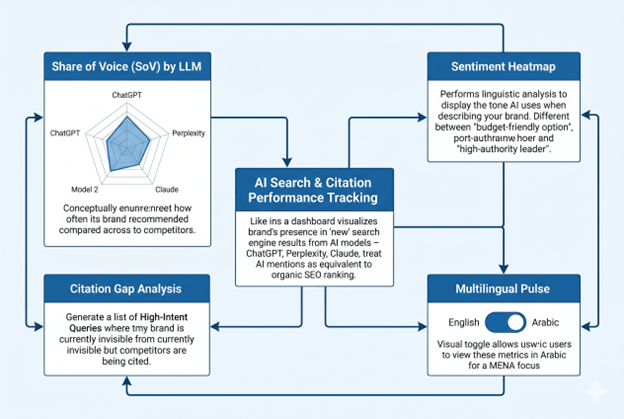
AI citation monitoring tools; including SEMrush‘s AI Visibility Toolkit, Otterly.AI, and manual sampling, track how often and how accurately your brand appears in AI-generated responses to category queries. For B2B market research, this monitoring reveals: which competitors AI systems consistently cite alongside you (your actual AI-visible competitive set), which use cases and positioning points AI associates with your brand, and where your brand’s AI presence is weakest relative to competitors.
For brands and agencies operating across global and MENA markets, H-in-Q.com’s BuzzPulse-in-Q delivers multilingual e-reputation monitoring and social listening across 20+ languages and dialects—including Arabic, French, Spanish, and English. It tracks brand mentions, detects sentiment and emotion shifts, flags reputation risks in real time, and benchmarks competitive share of voice across social media, forums, news, blogs, and review platforms; providing the multilingual brand intelligence picture that English-only tools cannot deliver.
Method 3: Review Site Intelligence; Mine the Authentic Buyer Voice
B2B review platforms; G2, Trustpilot, Capterra, Gartner Peer Insights, contain the most authentic, detailed, and comparatively structured buyer feedback available in the market. Buyers describe specific use cases, compare specific features to specific competitors, explain exactly what problems a product solved and which it did not, and provide context about their company size and industry.
This data is public, continuous, and structurally richer than most survey data; and most B2B companies are not systematically mining it for market research intelligence. AI-powered NLP analysis of review platforms delivers four specific research capabilities. Sentiment trend tracking shows how buyer perception of your product and competitors is shifting over time. Feature-level analysis identifies which specific capabilities buyers consistently praise or criticize. Competitive comparison analysis surfaces which competitors buyers directly compare you to in reviews, and what drives preference in those comparisons. Win/loss signals appear in language patterns: reviews that mention “switched from [competitor]” or “chose this over [competitor]” reveal the specific factors that drove competitive outcomes.
Tools like Crayon and Brandwatch automate the collection and NLP analysis of review site content at scale. For teams running manual analysis, a structured monthly review of your top 20 G2 reviews and your top three competitors’ top 20 reviews produces competitive intelligence that many enterprise research programs never generate.
Method 4: Dark Funnel Signal Aggregation – Surface What Buyers Do Before They Find You
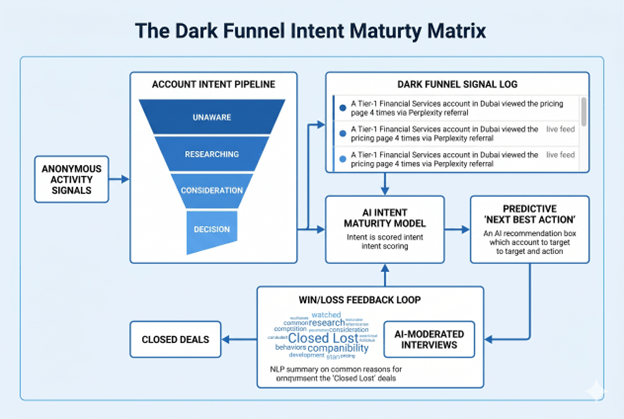
The dark funnel; the 70–80% of the B2B buying journey happening in invisible channels; is not fully illuminable. But it is partially surfaceable through a combination of AI-powered signal detection tools that provide directional intelligence about buyer behavior that traditional analytics miss entirely.
Website visitor identification tools like RB2B and Clearbit Reveal identify the companies of anonymous website visitors who never fill a form, turning invisible browsing behavior into named account intelligence. When a company you have been targeting visits your pricing page three times in two weeks without converting, that behavior is a high-intent signal that your standard CRM has no record of.
Third-party intent platforms like Bombora and 6sense detect content consumption signals across publisher networks, surfacing companies researching your category on external sites that neither you nor your competitors control.
Community listening tools monitor mentions in LinkedIn posts, Reddit threads, and public Slack community discussions for brand mentions, competitor comparisons, and category conversations. While private Slack channels remain genuinely dark, public community content often surfaces the peer recommendation dynamics that influence B2B decisions most heavily.
Self-reported attribution surveys the simplest and most underused dark funnel tool, ask demo requesters and new customers “How did you hear about us?” in an open-text format. The answers consistently reveal channels (AI recommendation, colleague referral, podcast, community) that attribution models credit to “direct” or “branded search.”
Method 5: Conversational Win/Loss Research – Understand Why You Win and Lose
Win/loss analysis is the highest-value and most consistently neglected B2B market research practice. When a deal closes (whether you win or lose), the buyer holds intelligence that would fundamentally improve your positioning, your product roadmap, and your competitive response if you could access it. Most B2B companies conduct ad hoc win/loss calls sporadically. AI has made systematic win/loss research accessible at scale.
AI-moderated win/loss interviews use conversational platforms to conduct structured interviews with recent buyers, both those who chose you and those who chose a competitor. Unlike human-led win/loss calls, which often produce socially polished answers shaped by the buyer’s relationship with the account owner, AI-moderated interviews produce more candid responses on sensitive comparative questions. Buyers are more likely to explain exactly why a competitor’s pricing structure was more compelling, or why your sales process created friction, when speaking to an AI moderator rather than to the sales team they are trying not to offend.
H-in-Q.com’s Converse-in-Q platform conducts adaptive conversational research studies—including win/loss interviews, customer satisfaction surveys, brand studies, concept tests, and employee feedback—across 45+ languages and dialects simultaneously. Unlike rigid survey forms, it engages respondents in natural, open-ended dialogue that feels human, automatically coding qualitative responses and delivering structured insights ready for BI tools. For global B2B companies operating across MENA and international markets, this provides the depth and multilingual research coverage that traditional methods rarely achieve.
For teams not ready to invest in a dedicated platform, a structured win/loss survey using an AI survey tool like Attest; sent to recent buyers within 30 days of deal close, produces directional intelligence that improves over time as response volume accumulates.
How AI Is Changing the B2B Buyer Intelligence Landscape
Several structural shifts are making AI-powered buyer research increasingly essential for B2B companies, not just valuable.
Information asymmetry between buyers and sellers has effectively been eliminated. PYMNTS reported in March 2026 that procurement teams now have access to aggregated market intelligence, real-time pricing benchmarks, peer reviews, and predictive analytics without relying on vendor input. The result is that B2B deals are increasingly decided before sellers know they exist. The research advantage that B2B sellers once held is gone. The only competitive response is investing in buyer intelligence that is as sophisticated as what buyers now use to evaluate vendors.
The B2B buying committee is expanding, not contracting. Forrester’s State of Business Buying 2026 found that buying groups are growing as buyers expand internal stakeholders to reduce risk. More stakeholders means more diverse information needs, more evaluation criteria, and more decision points where AI-sourced intelligence shapes the outcome. Research that understands the full buying committee, not just the primary contact; is increasingly necessary for competitive win rates.
B2B buyers use AI primarily but do not fully trust it. Forrester found that 36% of B2B buyers felt more confident in their decisions because of generative AI research, but 20% felt less confident because they encountered unreliable or inaccurate information. This trust gap creates a specific research opportunity: B2B companies that build high-quality, AI-citable content that AI systems retrieve accurately are building a trust advantage in the buyer research phase that competitors relying on lower-quality content cannot match.
Building Your B2B AI Research Stack
The most effective B2B AI research stack addresses the full spectrum of buyer intelligence needs, from pre-funnel category intent through post-sale win/loss learning.
A practical stack for most B2B companies combines four layers. First-party behavioral intelligence: Website visitor identification (RB2B, Clearbit Reveal) combined with CRM behavioral tracking to surface anonymous account signals. Third-party intent data: One intent platform (Bombora, 6sense, or G2 Buyer Intent) to detect in-market accounts before they make contact. Competitive and category monitoring: A social listening, e-reputation, and competitive intelligence tool (Brandwatch, Crayon, or BuzzPulse-in-Q for multilingual coverage across 20+ languages and dialects) to track competitor activity, brand sentiment, review site trends, and category conversations. Win/loss and buyer interview intelligence: A systematic process for collecting and analyzing post-deal buyer feedback, either through AI-moderated interview tools or structured AI survey platforms.
The integration layer; connecting these signals to your CRM so that sales has account-level context before every conversation, is where the research stack creates its highest commercial value. Signal detection without activation is not market research. It is just data.
What B2B Research to Keep Traditional
Not everything about B2B market research should shift to AI methods. Three research needs still require traditional human-led approaches.
Executive stakeholder mapping for strategic accounts requires the relationship intelligence and conversational nuance that human-led discovery conversations provide. Understanding the political dynamics of a buying committee at a target enterprise account is not a signal detection problem; it is a relationship intelligence problem.
New market entry validation for categories where public behavioral data is limited or skewed requires structured primary research with qualified respondents to generate the validated baseline that AI signal monitoring cannot produce from insufficient signal volume.
Product strategy research for genuinely novel capabilities where no existing behavioral data exists because no one has searched for, reviewed, or discussed the capability you are building; requires human-designed concept testing and qualitative exploration that AI tools cannot generate from behavioral signals that do not yet exist.
👉See how AI compares to traditional research for B2B decisions
How AI Is Transforming B2B Market Research in 2026
The B2B market research landscape is shifting in three directions simultaneously. Buyer intelligence is moving upstream: the research signals that matter most happen earlier in the buying cycle, in channels that traditional methods cannot access, requiring AI-powered approaches to surface them. Research is becoming continuous: the quarterly brand tracker and annual competitive landscape report are being replaced by always-on signal monitoring that updates in real time. Research is becoming predictive: intent data and AI-powered buyer modeling are enabling B2B companies to identify in-market accounts and anticipate buyer needs before buyers self-identify; shifting the research function from reactive analysis to proactive intelligence.
For B2B companies operating across multiple markets and languages, the multilingual dimension of this shift is particularly significant. The B2B buyer who researches vendors in Arabic, French, or Spanish is using the same AI tools and following the same dark funnel behavior patterns as English-language buyers, but most B2B research programs have no infrastructure to monitor those channels. H-in-Q.com builds cross-market B2B buyer intelligence for companies whose growth requires understanding buyers across language markets simultaneously.
👉 Read the full case study on B2B AI market research ROI →
Frequently Asked Questions: B2B AI Market Research
Frequently Asked Questions: B2B AI Market Research
How do B2B companies do market research with AI?
B2B companies use five primary AI research methods: intent data monitoring to detect in-market accounts before contact, AI citation tracking to understand what buyers find during AI-assisted research, review site intelligence to mine authentic buyer feedback and competitive comparisons, dark funnel signal aggregation to surface pre-funnel buyer behavior, and conversational win/loss research to understand deal outcomes systematically. Together these methods reach the 70–80% of the B2B buying journey that happens before buyers contact a vendor.
What is the dark funnel and why does it matter for B2B research?
The dark funnel is the portion of the B2B buying journey happening in channels traditional analytics cannot track; AI tool queries, private community conversations, anonymous review site browsing, peer recommendations, and LinkedIn DMs. Research consistently finds that 70–80% of B2B evaluation happens in these channels before buyers contact vendors. AI-powered intent data, social listening, and AI citation monitoring provide proxy signals for this behavior; surfacing buyer intelligence that surveys and web analytics structurally cannot access.
Why don't traditional surveys work for B2B market research?
Traditional surveys fail B2B research for three structural reasons. First, B2B buying involves committees of 6–10 stakeholders; a single respondent survey misses most of the decision-making ecosystem. Second, B2B evaluation cycles run 10–11 months, making point-in-time surveys poorly timed for most of the cycle. Third and most critically, 94% of B2B buyers finalize vendor preferences before direct interaction; meaning the most consequential research and evaluation has already happened before any survey could be administered.
What AI tools do B2B companies use for market research in 2026?
The core B2B AI research stack includes: Bombora or 6sense for third-party intent data, G2 Buyer Intent for review site intent signals, RB2B or Clearbit Reveal for anonymous website visitor identification, Crayon for competitive intelligence automation, Brandwatch or BuzzPulse-in-Q for multilingual social listening and e-reputation monitoring across 20+ languages and dialects, and Converse-in-Q for AI-moderated conversational research studies (win/loss interviews, surveys, brand studies) across 45+ languages. The right combination depends on company size, budget, and primary research gap.
How is the B2B buying journey changing in 2026?
Three changes define the 2026 B2B buying journey. Buyers are AI-native researchers: 73% use ChatGPT, Perplexity, or similar tools in their research process, and AI search converts at 5.1x the rate of Google organic. Decisions are happening earlier and more independently: 94% of buyers finalize preferences before vendor contact, and information asymmetry between buyers and sellers has effectively been eliminated by AI. And buying committees are expanding Forrester finds groups are growing as buyers expand stakeholder involvement to reduce risk in uncertain markets.
How do I start B2B AI market research on a limited budget?
Start with free or low-cost methods that generate immediate B2B intelligence. Install a website visitor identification tool (RB2B has a free tier) to surface anonymous account activity. Run monthly manual queries in ChatGPT and Perplexity for your top 3 category questions to audit your AI citation presence. Read your 20 most recent G2 reviews and your top competitors' 20 most recent reviews with a competitive framing. Set up Google Alerts for competitor names. Add an open text "How did you hear about us?" field to your demo request form. These five steps cost nothing and deliver meaningful B2B buyer intelligence within the first month.
Conclusion
B2B market research has a fundamental structural problem: the buyers who matter most are the ones you cannot reach with surveys. They evaluate anonymously, they research through AI tools that leave no footprint in your analytics, they validate through peer communities your attribution software cannot see, and they finalize preferences before your sales team has a single conversation.
AI market research does not solve this problem completely. But it surfaces substantially more buyer intelligence than traditional methods by monitoring the signals that buyers do leave; intent patterns in content consumption, reviews on neutral platforms, AI citation behavior, behavioral signals on anonymous site visits, and win/loss patterns in deal outcomes.
The B2B companies building this intelligence infrastructure now are not just improving their research programs. They are building a buyer understanding advantage that compounds over time; each data point, each intent signal, each win/loss interview making their positioning sharper, their timing better, and their competitive response faster than companies still waiting for survey results that buyers increasingly do not provide.
Ready to build a B2B buyer intelligence program that reaches buyers before they reach you? H-in-Q.com designs custom AI research infrastructure for B2B companies operating across US and global markets. book your free strategy call →