


AI vs traditional market research : A concept test that once required three weeks and $15,000 now takes three hours on a modern AI research platform. That single data point from Ditto’s 2026 market research buyer’s guide, captures what is happening to the $140 billion global market research industry faster than any trend report can. Andreessen Horowitz describes the shift plainly: companies have spent billions on research constrained by slow surveys, biased panels, and lagging insights. AI is ending that constraint. But it is not ending the need for human-led research. Understanding exactly where AI wins, where traditional methods still hold the advantage, and where the two work best together is the most important market research decision US businesses will make in 2026.
This guide gives you the complete head-to-head comparison; cost, speed, accuracy, depth, and use cases, so you can build the right research infrastructure for your organization.
What Is the Difference Between AI and Traditional Market Research?
Traditional market research collects consumer data through structured methods; surveys, focus groups, in-depth interviews, and observational studies, and analyzes it manually through a defined process that takes weeks to deliver results. It has been the foundation of business decision-making for decades, generating validated, primary data that businesses cannot get anywhere else.
AI market research uses machine learning, natural language processing (NLP), and predictive analytics to automatically collect, analyze, and interpret consumer data at scale from social media, review sites, customer support transcripts, behavioral signals, and survey responses. Instead of waiting for a structured process to complete, AI monitors consumer signals continuously and surfaces insights in hours, not months.
The distinction matters because these two approaches answer fundamentally different research questions. Traditional research answers “what do our target customers think and why?” with statistical validity and human depth. AI research answers “what are consumers doing and saying right now, at scale?” with speed and breadth. Knowing which question your business needs answered and which method answers it better, is the starting point for every research investment decision.
The Business Case: Why the Comparison Matters More Than Ever in 2026
According to Qualtrics’ 2026 Market Research Trends report, 95% of researchers now use AI tools regularly or are experimenting with them. The divide is no longer between organizations using AI and those that are not. It is between organizations with a deliberate AI research strategy and those still running undifferentiated pilots without clear ROI.
The pressure behind that shift is real. The volume of consumer data generated every day; across social platforms, review ecosystems, support channels, and digital touchpoints, has structurally outpaced the capacity of manual research processes. A quarterly brand tracker cannot detect the sentiment shift that happened last Tuesday. A six-week survey project cannot inform the product decision that needs to be made this Friday. Traditional research timelines were designed for a slower information environment than the one US businesses now operate in.
At the same time, AI research is not a wholesale replacement. The organizations extracting the most value from AI are not the ones that eliminated traditional research. They are the ones that reallocated their research budget; using AI for continuous monitoring and rapid hypothesis testing, and reserving traditional methods for the strategic validation and qualitative depth that algorithms cannot supply.
understand when AI replaces vs complements traditional research
AI vs Traditional Market Research: Head-to-Head Comparison
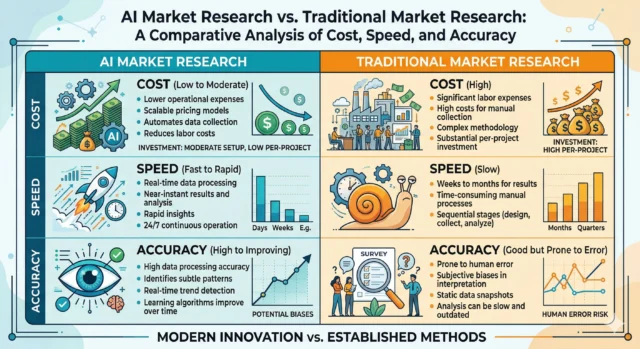
| Dimension | Traditional Research | AI-Powered Research |
| Time to insight | 4–12 weeks per study | Hours to days |
| Cost per study | $15,000–$100,000+ | $500–$5,000/month (subscription) |
| Data sources | Surveys, focus groups, interviews | Social media, reviews, behavioral data, surveys |
| Scale | Hundreds to thousands of respondents | Millions of data points simultaneously |
| Depth of insight | High -captures nuance, emotion, motivation | Moderate -detects patterns, sentiment, trends |
| Primary data | Yes -generates new, proprietary data | Mostly secondary -analyzes existing signals |
| Real-time monitoring | No -point-in-time snapshots | Yes -continuous, always-on |
| Accuracy on structured questions | High -statistically validated | Moderate -depends on data quality |
| Competitive intelligence | Limited -requires dedicated research | Strong -automated continuous tracking |
| Human expertise required | High -study design, moderation, analysis | Moderate -interpretation and strategy |
| Best for | “Why” questions, validation, strategic decisions | “What” questions, monitoring, trend detection |
Where Traditional Market Research Still Wins
Traditional research methods have genuine, durable advantages that AI does not eliminate. Understanding them is as important as understanding AI’s strengths, particularly for US businesses making high-stakes strategic decisions.
Primary data generation is irreplaceable. AI analyzes data that already exists in the public domain; social media posts, review content, behavioral signals. Traditional research generates new, proprietary data that competitors cannot access. When a business needs to understand how a specific segment of customers evaluates a new product concept, or why a particular competitor is gaining share, only primary research can produce that answer. No algorithm can survey a defined audience that has not yet spoken publicly.
Qualitative depth requires human connection. A skilled moderator leading a focus group can probe the emotional motivations behind a consumer preference, follow an unexpected thread, and surface the “why” behind a behavior that no survey question anticipated. AI sentiment analysis can tell you that consumer satisfaction is declining. It cannot tell you that satisfaction is declining because your packaging feels cheap, which a group of eight consumers revealed in a 90-minute discussion that went somewhere no survey instrument would have reached.
Statistical validation remains the standard for consequential decisions. When a business is making a decision that involves significant capital allocation; a product launch, a brand repositioning, an entry into a new market, the research underpinning that decision needs to meet a standard of statistical rigor that traditional survey methodology is designed to deliver. AI social listening produces directional signals. Traditional research produces validated conclusions.
Traditional research costs have real context. A basic online survey delivering 400 responses costs between $5,000 and $15,000. A full focus group study with multiple groups runs $10,000 to $50,000 per session. An enterprise research program with multiple methodologies can reach six figures. Those costs reflect genuine value: expert study design, rigorous sampling, validated analysis, and proprietary findings that no competitor can replicate. The question is not whether those costs are justified; they often are, but whether AI can absorb the portion of that budget currently going to work that does not require human expertise to execute.
Where AI Market Research Wins Decisively
AI has created permanent, structural advantages in specific research workflows that make traditional methods unable to compete on those dimensions.

Speed and continuous monitoring change the research model entirely. Traditional research delivers insights from a moment in time, weeks after that moment has passed. AI social listening monitors brand sentiment, competitive activity, and consumer conversations in real time; 24 hours a day, across millions of sources simultaneously. For US businesses in fast-moving categories, the ability to detect a brewing brand reputation issue or a competitor pricing change within hours rather than weeks is not a marginal improvement. It is a different category of strategic capability.
Scale unlocks pattern detection that human analysis cannot achieve. AI can process a year’s worth of customer support transcripts in minutes, identifying the specific product feature generating the most frustration across 50,000 interactions. A human analyst team doing the same work manually would need months and might miss the pattern entirely. The insights AI finds at scale are not just faster versions of human insights, they are often insights that human analysis would never reach at all.
Cost efficiency democratizes research access. A traditional enterprise research program that once cost $200,000 annually; a series of quarterly brand trackers, concept tests, and customer satisfaction studies, can now be partially replaced or substantially augmented by an AI platform subscription at a fraction of that cost. For mid-market US businesses that previously could not afford research at enterprise scale, AI platforms have removed the budget barrier entirely for a significant share of research use cases.
Predictive modeling shifts research from reactive to proactive. Traditional research tells you what consumers think now, based on data collected weeks ago. AI predictive analytics uses historical patterns to forecast what consumers are likely to do next, often identifying emerging trends 4 to 6 weeks before they appear in survey data. For product teams and marketing planners, that lead time is the difference between anticipating a shift and reacting to it.
Read more about ai vs traditional market research
The Hybrid Approach: What the Best Research Programs Look Like in 2026
The binary framing of “AI vs traditional” misrepresents how leading research organizations actually operate. The strongest research programs in 2026 are hybrid by design, allocating AI and traditional methods to the specific research questions each answers best.
The operating model looks like this. AI handles continuous monitoring: brand sentiment tracking, competitive intelligence, social listening, and rapid trend detection. This runs in the background, always on, flagging signals that require attention. Traditional research handles strategic depth: the annual brand equity study, the product concept validation before a major launch, the qualitative exploration of a new consumer segment. These are triggered by specific strategic questions, not run on a fixed calendar.
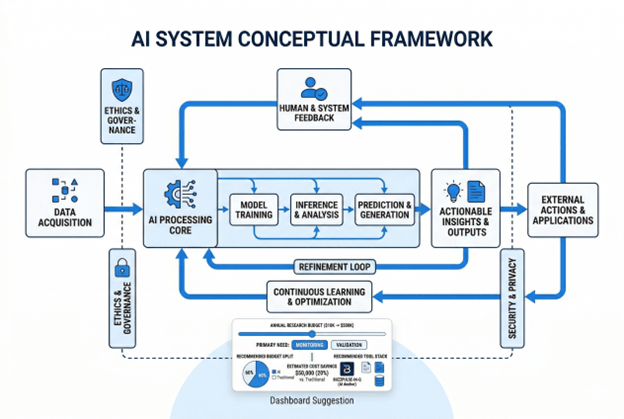
The AI output feeds the traditional work. Instead of designing a survey with no prior signal about what consumers think, research teams use AI-detected patterns to sharpen their hypotheses before commissioning primary research. Instead of running a focus group and hoping it surfaces the right themes, they enter the group knowing from AI analysis which themes are already appearing at scale, and probe the human dimension of those signals specifically. This integration compounds the value of both methods: AI makes traditional research more targeted and efficient; traditional research validates and explains what AI detects.
H-in-Q.com’s approach to AI-powered market research is built on exactly this principle; using AI to deliver continuous consumer and brand intelligence that feeds, rather than replaces, the strategic research decisions that require human expertise. For US businesses evaluating how to restructure their research infrastructure, the starting question is not “AI or traditional?” It is “which workflows belong in each category, and how do we connect them?”
AI vs traditional market research sources :
View H-in-Q’s AI powered Market Research Solutions
Engage Your Community with focus group online
How AI Is Redefining the Traditional Research Industry in 2026
The disruption extends beyond individual businesses adjusting their research mix. Andreessen Horowitz describes AI as enabling a fundamental restructuring of the $140 billion market research industry, one where the labor-intensive, agency-driven model of custom research is being systematically replaced by software infrastructure that delivers comparable insights at orders-of-magnitude lower cost.
Early-stage AI research companies are growing quickly, signing large enterprise deals, and absorbing budget that previously went to traditional research firms and consulting agencies. The most advanced players are now deploying synthetic personas and digital twins, AI-generated consumer proxies that simulate audience responses without recruiting human participants. In academic testing, these synthetic participants reached approximately 88% relative accuracy in reproducing their human counterparts’ responses. The practical implication is that the cost and time barrier to primary consumer research is collapsing, and any US business that treats this as a future trend rather than a current reality is already behind.
The traditional research firms that survive will be those that successfully integrate AI into their workflows; using it to automate the data processing that consumed most of their operating cost, and refocusing human expertise on the interpretation, strategy, and primary data generation that algorithms still cannot replace. The firms that resist that transition are competing with software on software’s terms, a competition they cannot win.
AI vs traditional market research sources : how-ai-and-micro-surveys-are-changing-the-market-research
Tools for Each Approach
Building the right hybrid research program requires matching tools to research type.
For AI-powered continuous monitoring and analysis, the leading platforms include Brandwatch for social listening, Crayon for competitive intelligence, BuzzPulse-in-Q for multilingual real-time brand signal tracking, and Quantilope for AI-automated quantitative surveys. For teams starting with a free entry point, Perplexity AI delivers capable secondary research and trend analysis at no cost.
For traditional primary research, established methodologies remain: online surveys via platforms like Attest and SurveyMonkey for quantitative consumer data; focus group platforms and qualitative research agencies for depth interviews and concept testing; and full-service research firms for complex multi-methodology programs requiring statistical rigor and expert analysis.
The integration layer is where the real value lives. Research teams that can route AI-detected signals directly into traditional research design, using social listening findings to sharpen focus group discussion guides, or using brand tracking data to prioritize survey hypotheses, are compressing both the cost and the timeline of their research cycle simultaneously.
AI vs traditional market research sources :
👉See the 7 best AI market research tools for 2026
👉 How AI market research works: the 6-step process
👉 Read more about AI vs traditional market research
Frequently Asked Questions: AI vs Traditional Market Research
AI vs traditional market research
Is AI better than traditional market research?
Neither is universally better, they answer different questions. AI is faster, cheaper, and better at scale and continuous monitoring. Traditional research generates proprietary primary data with statistical validity and human depth. The strongest research programs use both: AI for always-on monitoring and rapid trend detection, traditional methods for strategic validation and qualitative insight.
What are the main limitations of traditional market research?
Traditional market research has four core limitations. It is slow, projects typically take 4 to 12 weeks from design to delivery. It is expensive, studies cost $15,000 to $100,000 or more. It is a point-in-time snapshot, by the time results arrive, market conditions may have shifted. And it relies on respondents accurately self-reporting their opinions, which does not always match actual behavior.
How much does AI market research cost compared to traditional?
Traditional research projects cost $15,000 to $100,000+ per study, depending on methodology and scope. AI market research platforms typically run $500 to $5,000 per month on subscription, covering continuous monitoring and analysis across multiple data sources. A full-year AI platform subscription often costs less than a single traditional research project of comparable scope.
Can AI replace focus groups and surveys in 2026?
AI cannot replace focus groups and surveys because it cannot generate new primary data or replicate the emotional and motivational depth of human-led qualitative research. AI can replace the manual data processing, coding, and reporting that makes traditional research slow and expensive. The emerging standard is AI-assisted research; AI handles scale and speed, human researchers lead study design, moderation, and strategic interpretation.
What is the most accurate form of market research?
Accuracy depends on what you are measuring. Traditional surveys with rigorous sampling methodology provide statistically validated answers to defined questions. AI social listening provides highly accurate real-time detection of sentiment patterns and trends across large datasets. Neither is universally more accurate, each is more accurate for the specific type of insight it is designed to produce.
What does hybrid market research look like in practice?
A hybrid research program uses AI for continuous monitoring; brand sentiment tracking, competitive intelligence, social listening; and traditional methods for strategic depth studies triggered by specific business questions. AI output informs traditional research design: social listening findings sharpen survey hypotheses and focus group discussion guides. Traditional research validates and explains what AI detects at scale.
Conclusion
The “AI vs traditional market research” debate is built on a false premise. The question is not which approach wins — it is which approach answers which question. AI wins on speed, scale, cost efficiency, and continuous monitoring. Traditional research wins on primary data generation, qualitative depth, and statistical validation. The businesses extracting the greatest value from their research infrastructure in 2026 are those that have stopped treating these as competing choices and started treating them as complementary capabilities.
The practical starting point is straightforward. Identify your most time-sensitive research workflows, brand monitoring, competitive tracking, trend detection, and migrate those to AI platforms. Identify your highest-stakes strategic research needs; product validation, brand equity measurement, new segment exploration, and protect the traditional primary research investment those decisions require. Connect the two so that AI signals feed traditional research design. Build from that foundation.
Ready to build a research infrastructure that combines AI speed with strategic depth? H-in-Q.com designs custom AI research systems for US businesses that need both.
book your free strategy session →