


Three years ago, if a small business owner wanted the kind of consumer insight their Fortune 500 competitors were running on, they had two options: spend $15,000 on a research agency study they could not quite afford, or make decisions without it. That trade-off is over. AI market research for small businesses has eliminated the budget barrier that once made enterprise-grade market research inaccessible to small teams, and the numbers confirm how fast small businesses are responding.
According to the U.S. Chamber of Commerce, small business generative AI usage jumped from 40% to 58% in a single year. Salesforce reports that 91% of SMBs using AI report revenue increases. The SBA found the AI adoption gap between small and large businesses shrank from 1.8x to 1.2x in 2025 alone, a compression that took broadband internet a decade to achieve. Small businesses are not just catching up to enterprise AI capability. In specific research use cases, they are matching it.
This guide gives you a practical, budget-tiered roadmap: the exact tools to use at every budget level, the specific research jobs each one handles, and the order in which to build your small business AI research stack from zero.
What AI Market Research Actually Means for a Small Business
AI market research, in a small business context, refers to using artificial intelligence tools to understand your customers, your competitors, and your market, faster and at lower cost than traditional survey and agency methods. It does not require a data science team, a research budget, or technical expertise. It requires knowing which question you need answered, and which tool answers it.

For a small business owner, the practical value of AI market research shows up in four specific decisions: validating whether there is real demand for a new product or service before investing in it, understanding what customers actually complain about, in their own words, not survey language, tracking what competitors are doing and how the market is responding to them, and identifying the questions your potential customers are asking online so you can answer them before competitors do.
Traditional research methods addressed all four of these questions, but at a cost and timeline that put them out of reach for most small businesses. AI has restructured the economics of consumer insight so completely that a capable research stack for a small business now costs less per month than a single dinner meeting with a consultant.
See more on how AI market research works
Why Small Businesses Can No Longer Afford to Skip Market Research
The most common reason small business owners skip market research is the assumption that it is expensive, slow, and designed for bigger organizations. All three assumptions were accurate in 2020. None of them are accurate in 2026.
The competitive reality is straightforward. Your competitors, even the small ones are using AI tools to monitor customer sentiment, identify market gaps, and track what you are doing. A QuickBooks survey found that 68% of U.S. small businesses now use AI regularly. The businesses not using it are not saving time by avoiding it. They are making decisions blind while their competitors make decisions with data.
The opportunity cost of skipping research is concrete. A product launch built on an untested assumption about customer demand is not just a risk; it is an avoidable risk. A marketing campaign targeting the wrong customer pain point does not just underperform; it underperforms against a competitor who validated their message with AI-assisted consumer research before spending a dollar on media.
According to the SBA, 83% of growing small businesses have adopted AI, compared to just 55% of declining ones. That correlation is not coincidental. It reflects the compounding decision quality that comes from research-backed choices. The question is not whether AI market research is relevant to your small business. It is how to build the right stack for your current budget.
The 3-Phase AI Market Research Budget Ladder for Small Businesses
The most common mistake small business owners make when building a research capability is trying to invest in everything at once. The right approach is sequential: start with free tools that answer your most immediate questions, add paid tools when specific gaps become expensive, and build toward a lightweight but complete research infrastructure as revenue allows.
Phase 1: The Free Stack ($0/month): Validate Before You Invest
Every small business should be running this research stack before spending a dollar on paid tools. These four free tools cover the most critical early-stage research jobs.
Perplexity AI (Free tier) is your secondary research engine. Use it to answer competitive landscape questions, market sizing estimates, trend identification, and industry background research, all with cited sources you can verify. A research task that would take a junior analyst two hours on Google now takes three minutes on Perplexity. Ask it: “What are the top three customer complaints about [competitor] in 2026?” and you get a structured, sourced answer instantly.
Google Trends (Free) is your demand validation tool. Before you invest in a new product line, service offering, or content strategy, check whether search demand for that topic is growing, flat, or declining. Google Trends shows relative search interest over time, geographically filtered to the US market you care about. It takes 90 seconds and has saved countless small businesses from launching into a declining market.
AnswerThePublic (Free tier) is your customer question map. It surfaces the actual questions real people are typing into search engines about your category, your competitors, and your product type. The free tier delivers hundreds of real question queries that reveal what your potential customers do not understand, what problems they are trying to solve, and what language they use to describe their needs. This directly informs your product positioning, your website copy, and your content strategy.
Reddit and Google Reviews (Free manual research) are your unfiltered customer voice. Search Reddit for your product category or your competitors’ brand names. Read the top threads. Read the most helpful Google reviews for your three nearest competitors. This takes 30 minutes and produces qualitative consumer insight of a quality that traditional focus group recruiters charge thousands of dollars to replicate.
View H-in-Q’s conversational AI market research solution : Converse-in-Q
Phase 2: The Starter Stack ($50–$200/month): Add Competitive Intelligence
Once your business has validated its core offer and is generating revenue, the research investment that pays back fastest is competitive intelligence. Two tools cover this at small business price points.
Semrush Starter Plan (from ~$117/month) gives you visibility into what your competitors rank for online, how much organic traffic their website receives, which keywords they are targeting in paid search, and what content is driving their growth. For a small business investing in digital marketing, this is the single highest-ROI research tool available. Knowing exactly which search terms your competitors are winning, and which gaps they have left open turns content and SEO strategy from guesswork into a precision exercise.
Brand24 (from $199/month) monitors brand mentions, competitor mentions, and category conversations across social media, news, forums, and review sites in real time. For small businesses where brand reputation is built one customer interaction at a time, the ability to see every public mention of your brand, and every complaint about your competitors, as it happens is both protective and strategic. The platform’s AI sentiment analysis automatically flags negative mentions that require a response, and surfaces positive signals that can be amplified.
Phase 3: The Growth Stack ($200–$500/month): Add Consumer Survey Capability
At this investment level, a small business gains access to primary consumer research; the ability to survey real customers and potential customers with structured questions and get back validated, quantitative answers.
Attest or SurveyMonkey Genius (from ~$200–$399/month) provides AI-powered survey creation, quality-controlled respondent panels, and automated insight summaries from open-ended responses. For a small business testing a new product concept, validating a pricing decision, or measuring customer satisfaction across a growing customer base, a single survey cycle on one of these platforms delivers the equivalent of a $10,000 traditional research project; in days, not weeks.
Converse-in-Q (H-in-Q.com) adds conversational AI research capability for businesses that need qualitative depth at scale. Instead of structured survey questions, Converse-in-Q conducts adaptive AI-led conversations with customers, following up on unexpected responses, probing for the “why” behind stated preferences, and synthesizing findings across hundreds of conversations automatically. For small businesses in customer-intensive verticals where understanding motivation matters as much as measuring satisfaction, this approach produces qualitative insight that surveys alone cannot reach.
See more of our AI market research for small businesses solutions
5 Specific Research Jobs AI Handles for Small Businesses Right Now
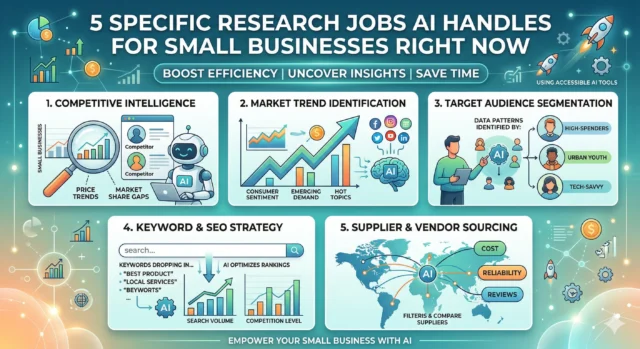
Understanding what AI research tools can do in abstract terms is less useful than seeing the specific business decisions they support. Here are the five research jobs where AI delivers the most immediate value for small businesses.
Competitor pricing and positioning analysis. Use Perplexity AI to research how your three nearest competitors describe their offers, what price points they publish, and what customer complaints appear in their reviews. This takes 20 minutes and produces a competitive positioning map that a traditional agency would charge thousands of dollars to build.
Customer demand validation for new offers. Use Google Trends and AnswerThePublic before launching any new product, service, or content initiative. If search demand is flat or declining for your intended category, you have saved yourself from a costly launch into a contracting market. If demand is rising, you have validated the direction and identified the specific questions customers are already asking about it.
Customer sentiment monitoring. Use Brand24 or a similar social listening tool to track what customers are saying about your brand and your category in real time. A single negative review pattern; three customers in one week mentioning the same problem, is a product or service fix signal that traditional research would catch in a quarterly survey, three months too late.
Content strategy and SEO intelligence. Use Semrush to identify the keywords your competitors rank for that you do not. Use AnswerThePublic to find the questions customers ask that no one in your category is answering well. Combine both outputs into a content calendar that targets gaps in your market, customer questions with real search volume and no quality answer currently ranking.
Pre-launch concept testing. Use an AI survey platform to test two or three product concepts, pricing structures, or messaging variations with a panel of real consumers in your target demographic before committing to a launch. A 200-response survey on Attest costs a fraction of the production budget it validates or redirects, making it one of the highest-ROI research investments available to a small business.
View the Best AI market research tools in 2026
What AI Market Research Cannot Do for a Small Business
Knowing the limits of AI research is as important as knowing its capabilities, particularly for small business owners making high-stakes decisions on limited resources.
AI market research tools analyze data that already exists; public reviews, social media content, search data, and behavioral signals. They cannot generate new primary data about a customer segment that has not yet spoken publicly, or about a product concept that does not yet exist in the market. For those questions: “will my target customer pay $99 for this?” or “which of these two product concepts resonates more deeply?” primary research with real respondents remains the only reliable method.
AI sentiment analysis works well on clear, direct language. It degrades on irony, cultural nuance, and highly specialized industry vocabulary. Outputs should be treated as directional intelligence, not statistical conclusions, until validated against human judgment.
AI tools replace the cost and time of research, they do not replace the judgment required to interpret what the research means for your specific business. The competitive advantage belongs to the small business owner who combines AI-generated insights with genuine knowledge of their customer, their category, and their competitive position, not to the one who outsources all judgment to an algorithm.
View H-in-Q’s smart AI solutions
How AI Is Leveling the Research Playing Field for Small Businesses in 2026
The structural shift is real and accelerating. SMEs are expected to register the highest AI adoption CAGR of any business segment through the next decade, according to Fortune Business Insights. The tools that were enterprise-only three years ago are now accessible at price points designed specifically for small teams.
The practical consequence for small businesses is the elimination of the research budget as a competitive moat. Large competitors cannot protect their insight advantage simply by spending more on research agencies when the same insights are available to a small business owner with a Perplexity subscription and 30 minutes of weekly research time. The competitive advantage in consumer intelligence now belongs to the business with the better research process, not the bigger research budget.
H-in-Q.com’s suite of AI tools, including conversational research platforms like Converse-in-Q, is specifically designed to make this level of consumer intelligence accessible to businesses of every size, including those operating without a dedicated research function. The infrastructure exists. The only variable is whether your business builds its research capability now or cedes that ground to competitors who already have.
See the difference between AI and traditional market research
Frequently Asked Questions: AI Market Research for Small Businesses
AI Market Research for Small Businesses: Get Enterprise Insights on a Startup Budget (2026)
How do small businesses do market research with AI?
Small businesses use AI for market research through a tiered approach. Start with free tools, Perplexity AI for competitive research, Google Trends for demand validation, AnswerThePublic for customer question mapping. Add paid competitive intelligence tools like Semrush or Brand24 when revenue allows. Layer in consumer survey capability with platforms like Attest for validating new products and pricing decisions. The full stack costs $0 to $500 per month.
What free AI tools can small businesses use for market research?
The most capable free AI research tools for small businesses are Perplexity AI for secondary research and competitive analysis, Google Trends for demand and seasonal pattern analysis, AnswerThePublic for customer question and keyword research, and Reddit plus Google Reviews for unfiltered customer sentiment. These four free tools cover the most critical early-stage research needs for any small business.
Is AI market research affordable for startups and small businesses?
Yes. A fully capable small business AI research stack costs between $0 and $200 per month, less than the cost of a single traditional market research survey. Free tools like Perplexity and Google Trends handle competitive landscape research and demand validation. Paid tools like Semrush (from ~$117/month) and Brand24 (from ~$199/month) add competitive intelligence and social monitoring. Enterprise research that once cost $15,000 per study is now accessible on subscription.
How do I research my competitors as a small business using AI?
Start with Perplexity AI, search your competitor's brand name and ask for a summary of their positioning, pricing, and customer complaints. Use AnswerThePublic to see what questions customers ask about their products. Use Google Trends to compare search demand for your brand versus theirs over time. For deeper competitive intelligence, Semrush reveals exactly which keywords they rank for online and which content is driving their traffic. Brand24 monitors their social mentions in real time.
What is the best AI tool for small business market research?
For small businesses just starting, Perplexity AI is the best single tool; it is free, fast, covers secondary research and competitive analysis with cited sources, and requires no technical expertise. For businesses ready to invest, Semrush is the highest-ROI paid tool for understanding your competitive digital landscape. For primary consumer research on a budget, Attest provides AI-powered surveys with validated respondent panels at a fraction of traditional agency costs.
Conclusion
AI market research is no longer a luxury for small businesses. It is the most accessible competitive intelligence infrastructure in the history of consumer insight, available at $0 per month for basic capability, $200 per month for a complete competitive monitoring stack, and $500 per month for a full research program that includes primary consumer surveys.
The three phases are straightforward: start with free tools to validate and monitor, add competitive intelligence as revenue grows, layer in consumer survey capability when you need validated answers for high-stakes decisions. Each phase builds on the last, and each tool in the stack pays back its cost in sharper decisions, faster product iteration, and marketing that targets the pain points your customers are actually expressing.
The small business owners building this research habit now are not just moving faster than competitors who skip it. They are building a compounding insight advantage, better data leading to better decisions, leading to more revenue and customer understanding, leading to even better data. Start with the free tools today.
Ready to add AI-powered conversational research to your small business stack? H-in-Q.com builds affordable AI research solutions for small and growing businesses.
book your free strategy session →