


Introduction
B2B focus group research has always been harder than B2C. Your participants are not consumers recruited from a panel; they are procurement directors, IT managers, CFOs, and department heads whose time is measured in calendar blocks, whose opinions are shaped by organizational politics, and who will not spend 90 minutes in a research facility for a $75 incentive. The typical B2B buying decision now involves 13 internal stakeholders and 9 external influencers, according to Forrester’s State of Business Buying 2026. Understanding how those stakeholders think, what concerns them, and what language moves them is the difference between a product that sells and a product the sales team has to explain for six months.
Traditional in-person B2B focus groups solved this problem poorly. Geographic dispersion meant flying people to a facility or running regional sessions that multiplied the budget. Confidentiality concerns in group settings — where participants from competing companies might recognize each other — suppressed honest responses on competitive topics. Executive schedules made live session attendance a logistical nightmare. And the $30,000–$60,000 cost for a basic B2B qualitative program put it out of reach for most mid-size US companies.
AI focus groups solve every one of these structural problems. Asynchronous AI-moderated sessions fit executive schedules without requiring live attendance. Private contribution formats eliminate confidentiality anxiety in group research. Geographic reach is unlimited by design. And a 60–80% cost reduction makes professional B2B buyer research economically viable for companies that previously made product and positioning decisions on anecdotal sales feedback. H-in-Q’s market research team has run AI-assisted B2B research programs across technology, SaaS, professional services, and enterprise software categories. This guide distills what makes B2B AI focus groups different from B2C and everything you need to run one this month.
🟡 Direct Answer
B2B AI focus groups are AI-moderated research sessions with business buyers, procurement professionals, or end users that replace in-person sessions entirely. They solve the four structural problems of traditional B2B qualitative research: difficulty recruiting busy executives, geographic dispersion across decision-makers, confidentiality concerns in group settings, and the 6–8 week timeline that makes traditional research impractical for fast-moving B2B product and marketing decisions. Asynchronous AI moderation lets a 15–20 person session run over 48–72 hours instead of a single live meeting, at 60–80% lower cost than a traditional in-person program.
Why B2B Buyer Research Is Different — and Why Most Companies Do It Wrong
Before understanding how AI fixes B2B qualitative research, it helps to see what specifically makes B2B research harder than B2C, because four structural differences drive every methodology decision that follows.
Difference 1: Your Participants Are Professionals With Real Opportunity Costs
A B2C focus group participant earns $50–$75 to share opinions about laundry detergent. A B2B focus group participant is a VP of Operations whose billable hour or organizational impact value is 10–20x that figure. Recruiting them requires a different value proposition: not just an incentive, but a framing that makes participation professionally relevant — a contribution to industry research, early access to findings, or direct influence over a product they use.
This opportunity-cost reality has a downstream effect on session design: B2B participants will give you 15–20 minutes of focused, substantive response on their own schedule. They will not give you 90 minutes at 6pm on a Tuesday.
Difference 2: Buying Decisions Are Organizational, Not Individual
69% of B2B buyers chose a different software vendor than initially planned based on AI guidance, and one-third purchased from a vendor they had never heard of before, according to G2’s March 2026 survey of 1,076 buyers. The implication for research is significant: the person who evaluates your product is frequently not the person who approves the purchase, and the concerns of the evaluator, the budget holder, and the end user are genuinely different.
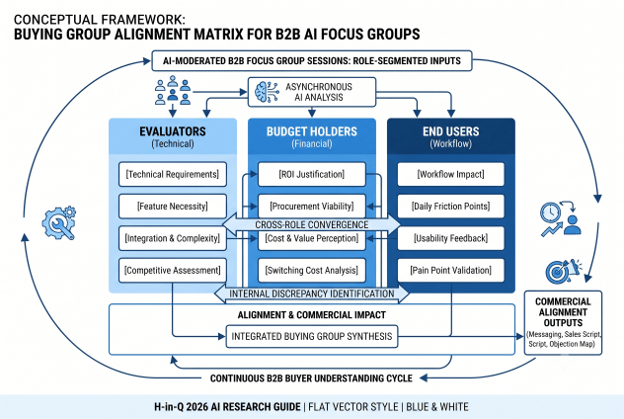
B2B research that recruits only one role type produces a partial picture of the buying process. The most actionable B2B research maps the full buying group — the evaluator’s technical concerns, the budget holder’s ROI framing, and the end user’s workflow impact — because all three must be addressed in your messaging, sales process, and product design.
Difference 3: Confidentiality Concerns Suppress Honesty in Group Settings
B2B participants discussing vendor evaluation, competitive tools, or organizational challenges are acutely aware that another participant in a live session might be a colleague, a competitor, or someone who knows their manager. This confidentiality anxiety systematically suppresses honest responses in live group settings — particularly on the topics that matter most for B2B research: budget constraints, dissatisfaction with current solutions, and competitive switching triggers.
Asynchronous AI-moderated sessions eliminate this dynamic entirely. Each participant contributes independently, without real-time awareness of other participants’ responses. The result is markedly more candid disclosure on competitive and organizational topics than any live group format can produce.
Difference 4: The Research Objectives Are Fundamentally Different
B2C research asks: does this appeal to our target consumer? B2B research asks: does this reduce the organizational risk our buyer perceives, address the business case they need to build internally, and fit the workflow of the people who will use it daily? These require different discussion guides, different stimulus presentations, and different analysis frameworks.
The most common mistake in B2B qualitative research is applying B2C research design to a B2B objective. Questions about emotional appeal, personal preference, and aspirational identity are largely irrelevant in B2B. Questions about integration complexity, procurement approval likelihood, competitive switching cost, and organizational ROI justification are central — and almost never asked in B2B programs that borrowed their methodology from consumer research.
The 5 B2B Research Questions AI Focus Groups Answer Best
Before designing any B2B AI focus group, identify which of these five research categories your objective falls into. Each maps to a distinct discussion guide structure and stimulus presentation approach.
Category 1: Messaging and Positioning Validation
The question: Which of our positioning statements resonates most strongly with a specific buyer role? What language do buyers use to describe the problem we solve?
Why it matters: 61% of the B2B buying journey completes before the buyer contacts a vendor. The messaging on your website, category page, and AI search citations must resonate independently, without a sales rep present to explain and adapt. Positioning research with real buyers produces the exact vocabulary and benefit framing that converts self-directed research into pipeline.
AI focus group advantage: Community AI platforms capture the precise language buyers use unprompted, before you show them your messaging — producing the linguistic raw material for copy that mirrors buyer thinking rather than internal brand language.
Category 2: Buyer Journey and Decision Process Mapping
The question: How do buyers in your target segment actually evaluate, justify, and purchase solutions in your category? Who is involved, what concerns arise at each stage, and what breaks deals?
Why it matters: Most B2B companies build their sales process and marketing funnel on assumptions made by founders and sales reps, not validated buyer research. The gap between assumed and actual buying process is typically where pipeline stalls.
AI focus group advantage: Asynchronous AI moderation lets participants describe their buying process at length, without the time pressure of a live session, and probes each stage with consistent depth — friction points, internal approval dynamics, and competitive evaluation criteria that human moderators typically address inconsistently across participants.
Category 3: Competitive Differentiation and Switching Triggers
The question: What would make a buyer currently using a competitor consider switching to you? What concerns would they need resolved first?
Why it matters: Competitive positioning built without genuine buyer research consistently underestimates switching costs and overestimates the persuasiveness of feature comparisons. Real buyers describe switching triggers in concrete, organizational terms — a failed integration, a price increase, a missed SLA, a champion who left — not the abstract terms internal teams typically use to frame differentiation.
AI focus group advantage: The private contribution format produces more candid competitive disclosures than any live group setting. Participants describe current-solution frustrations and switching considerations more honestly when not performing for a group, and the AI probes those disclosures consistently across all participants.
Category 4: Feature Prioritization and Product Feedback
The question: Among the features you’re considering for the next release, which do buyers actually need? Which solve real workflow problems, and which are solutions to problems buyers don’t have?
Why it matters: Product roadmaps built without buyer validation consistently over-invest in technically interesting features and under-invest in features that remove workflow friction — a gap that costs 6–12 months of engineering time per major release cycle.
AI focus group advantage: End users give more candid workflow feedback in AI-moderated asynchronous sessions than in any format where their manager or vendor is present, and AI moderation ensures every participant’s perspective is captured at equivalent depth — preventing the loudest voice in the room from defining the roadmap.
Category 5: Pricing and Value Perception
The question: At what price point does your product feel like fair value? Where does it feel too expensive to justify to procurement? What business case framing makes the investment defensible internally?
Why it matters: B2B pricing decisions made without buyer research consistently miss the organizational dynamics that determine whether a deal closes. The real question is never simply “is this too expensive?” — it is “can the evaluator justify this to their CFO, and what ROI framing makes that justification viable?”
AI focus group advantage: Price sensitivity is a confidential topic participants discuss more honestly in private contribution formats. The AI can probe the specific ROI calculation each participant would need to present internally — producing the exact business case framing your sales team needs to close deals, not just a price-tolerance data point.
How to Run a B2B AI Focus Group: 6 Steps With B2B-Specific Guidance
Step 1: Define Your Buyer Role Segments — Not Just Your Target Company Profile
The most common B2B research setup mistake is defining participants by company characteristics (“director-level at SaaS companies with 200–500 employees”) without specifying the functional role and the point in the buying process being researched.
A complete B2B participant definition answers four questions:
- What is their job function and seniority? (VP of Product vs. Product Manager: genuinely different research outputs)
- What is their organizational role in the buying decision? (Evaluator, budget holder, end user, or champion)
- What is their current solution context? (Category user, competitor customer, or currently solving the problem manually)
- What is their company context? (Industry vertical, company size, growth stage if relevant)
For research that requires understanding multi-stakeholder buying dynamics, run separate AI sessions for each role type and compare findings across them. The differences between what evaluators, budget holders, and end users prioritize are often more commercially valuable than the consensus across all three.
Step 2: Build a B2B-Specific Discussion Guide
B2B discussion guides differ from B2C in structure, framing, and depth targets. Use this B2B-adapted framework:
B2B AI FOCUS GROUP DISCUSSION GUIDE TEMPLATE

CONTEXT SETTING (10 minutes)
Q1: "Walk us through how your team currently handles [category problem].
    Who is involved, what tools do you use, and where does the process
    break down most often?"
Q2: "When you last evaluated a new solution in this category, what
    triggered the search? Walk us through how that evaluation unfolded —
    who was involved and what criteria mattered most."

PROBLEM DEPTH (15 minutes)
Q3: "What is the single biggest frustration with how you currently
    solve [problem]? Give a specific example from the last 90 days."
Q4: "If you could change one thing about the tools or processes your
    team uses for [category], what would it be and why?"

STIMULUS REACTION (20 minutes)
Q5: "[Present messaging/concept/feature description] What is your first
    reaction? What feels right, and what raises questions?"
Q6: "If you were evaluating this for your team, what would you need to
    know before recommending it to your manager or procurement? What
    would be the hardest part of justifying it internally?"

COMPETITIVE AND SWITCHING (10 minutes)
Q7: "What would have to happen — or fail to happen with your current
    solution — before you would seriously consider switching?"

CLOSE (5 minutes)
Q8: "Is there anything important about how your organization evaluates
    or purchases [category] solutions that our questions didn't give
    you space to share?"
Four B2B-specific discussion guide rules:
- Rule 1 — Ask about organizational dynamics, not individual preferences. “Would you use this?” is the wrong question. “Would you recommend this to your procurement team, and what would they ask?” is the right one.
- Rule 2 — Probe the internal justification process explicitly. The business case a buyer must build to get a purchase approved is the most valuable data in B2B research, and it’s almost never captured in surveys. Ask directly: “How would you justify this to your CFO?”
- Rule 3 — Ask about their current solution before showing them yours. Participants who have articulated their current frustrations evaluate your solution against a concrete mental model rather than abstract criteria.
- Rule 4 — Include a confidentiality acknowledgment in the participant briefing. Confirming that responses won’t be attributed to them or their organization measurably increases candor on competitive and organizational topics.
Step 3: Recruit B2B Participants Strategically
B2B recruitment is the most operationally complex part of the process. Three sources work, in order of data quality:
Source 1: Your Own CRM
Your existing customers or prospects are the most contextually relevant participants for most B2B research objectives. A personalized email from the account manager or customer success team consistently produces participation rates of 25–40%, well above panel recruitment rates.
Source 2: B2B Specialist Recruitment Panels
For research requiring participants outside your existing customer base:
- Respondent.io — strong for SaaS, technology, and marketing professional profiles
- UserInterviews — broad B2B coverage across functions and industries
- GLG (Gerson Lehrman Group) — best for C-suite, specialist, and hard-to-reach professionals; premium pricing reflects the access level
- Evidenza — built specifically for niche B2B professional audiences (CFOs, healthcare specialists) where standard panels have limited coverage
Source 3: LinkedIn-Targeted Outreach
For very specific professional profiles (“VP of Supply Chain at US manufacturers with 500–2,000 employees”), LinkedIn Sales Navigator or organic outreach allows precise targeting that panels cannot match. Response rates are lower (typically 5–15%), but participant quality is highest. Budget 2–3 weeks for LinkedIn recruitment versus 2–3 days for panel recruitment.
B2B participant incentives for 2026:
| Role level | Incentive per 60-minute session |
|---|---|
| Individual contributor / analyst | $75–$100 |
| Manager / director | $100–$200 |
| VP / C-suite | $200–$500 |
| Specialized professional (physician, attorney, engineer) | $300–$600 |
Underpaying B2B participants by more than 30% below these benchmarks produces high no-show rates and lower-quality responses. B2B professionals have genuine opportunity costs — respect them in your incentive structure.
Step 4: Configure for Asynchronous, Not Live
The async format is a structural advantage for B2B respondents: executives and specialists who cannot commit to a 90-minute synchronous group will give 12 minutes of substantive answers in their own time.
Configure a 48–72 hour participation window rather than a fixed live session time. Send calendar invitations with a link participants can access any time within the window. Set the expected participation time at 15–25 minutes, not 60–90 minutes — B2B professionals underestimate how much they will contribute once engaged, so a realistic starting estimate improves initial participation rates.
For multilingual B2B research — US brands researching MENA enterprise buyers, Francophone markets, or Spanish-speaking Latin American business professionals — HiVox-in-Q‘s native multilingual infrastructure eliminates the translation quality issues that plague B2B research across language boundaries.
Step 5: Run Separate Sessions by Role Type
For multi-stakeholder buying group research, the temptation is to save budget by mixing evaluators, budget holders, and end users in a single session. Resist it. Mixed-role sessions produce data contaminated by status dynamics — junior participants defer to senior ones, technical evaluators defer to budget holders — and the research output reflects social hierarchy rather than genuine role-based perspective differences.
Run separate 15–20 participant sessions for each role type:
- Session A — Evaluators (the people who technically assess solutions)
- Session B — Budget holders (the people who approve the investment)
- Session C — End users (the people who use the solution daily)
Compare findings across sessions to identify where the buying group is aligned and where it diverges. The divergences are typically where deals stall — the evaluator recommends a solution, the budget holder asks an ROI question the evaluator can’t answer, and the process resets. Research that identifies these divergence points gives sales and marketing the exact gaps to close.
Step 6: Translate Findings Into Sales and Marketing Assets
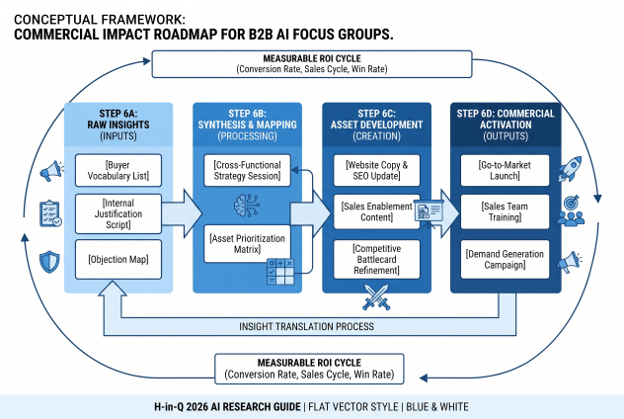
B2B AI focus group findings have a higher density of directly usable commercial output than any other research format. Four outputs to extract from every B2B AI research program:
- The buyer’s vocabulary list — the exact phrases, analogies, and metaphors participants used to describe the problem you solve, in their words. This becomes the foundation for website copy, sales deck language, and SEO content that mirrors how buyers think.
- The internal justification script — a synthesis of how participants described the business case they’d need to build to get your solution approved internally. This becomes ROI-calculator framing and “help your champion sell internally” content.
- The objection map — a ranked list of concerns and blocking questions raised before participants would recommend or approve your solution, organized by role type. This is the foundation for your FAQ and competitive battlecards.
- The competitive switching trigger list — the specific failure modes and trigger events that would make participants consider switching from their current solution. This informs competitive messaging and outbound prospecting.
How AI Is Changing B2B Buyer Understanding in 2026
The B2B buyer of 2026 is more informed, more skeptical, and more self-directed than any previous generation. Half of B2B software buyers now start their research with AI chatbots, and 69% end up choosing a different vendor than they originally planned, based on AI-generated comparisons and recommendations that happen entirely without vendor involvement.
This shift creates an urgent research imperative: you cannot influence a buying process you do not understand. Companies that know precisely how their target buyers evaluate solutions, frame internal justifications, and respond to competitive claims in 2026 will consistently win the deals that happen before anyone talks to sales. Companies that are guessing will lose those deals to competitors whose messaging was built from real buyer research.
The B2B research programs winning in 2026 treat buyer understanding as a continuous operational capability, not an annual project. A monthly AI focus group cycle — 15–20 B2B professionals per session, one specific buyer question per study, findings delivered in 48 hours — costs $2,000–$4,000 per month. The insight it produces directly informs website copy, sales sequences, competitive positioning, and product roadmap decisions. The ROI is measurable in conversion rate improvements, sales cycle compression, and win rate changes against specific competitors. 8 Ways AI Is Transforming Focus Group Research in 2026 breaks down the broader shifts driving this pace of change.
H-in-Q’s HiVox-in-Q platform is built for exactly this continuous B2B research model — community AI focus groups that accommodate busy professional schedules through asynchronous participation, native multilingual support for US companies researching enterprise buyers across language markets, and AI analytical infrastructure that delivers role-segmented findings within 48 hours of session close.
Tools for B2B AI Focus Group Research in 2026
- HiVox-in-Q — Community AI focus groups with asynchronous participation, multilingual support, and real-time AI analysis. Best for B2B companies researching multi-role buying groups across US and international markets.
- Perspective AI — Individual AI-moderated conversation format. Strong probing depth for complex B2B research questions. Free study to start.
- Evidenza — B2B synthetic persona platform specializing in hard-to-recruit professional audiences (CFOs, healthcare specialists, legal professionals).
- Respondent.io / UserInterviews — B2B specialist recruitment panels for sourcing qualified professional participants across job titles and industries.
- GLG (Gerson Lehrman Group) — Premium C-suite and specialist recruitment for high-seniority B2B research programs.
- Looppanel / BTInsights — AI analysis layers for teams processing high volumes of B2B qualitative data, starting around $30/month.
For a full breakdown of every category of AI research tool — not just focus group platforms — see 7 Best AI Focus Group Platforms in 2026 and 7 Best AI Market Research Tools in 2026. If you’re setting up your first project, How to Run an AI Focus Group in 48 Hours and The Ultimate Guide to AI-Powered Focus Groups walk through the process in more depth than fits in a B2B-focused guide.
AI Focus Groups for B2B Companies
How do AI focus groups work differently for B2B vs. B2C companies?
B2B AI focus groups differ from B2C in four key ways: participants are targeted by job title, seniority, and buying role rather than demographics; asynchronous formats accommodate executive schedules without requiring live session attendance; confidentiality protocols are stricter because participants discuss competitive and organizational topics; and research objectives center on buying process mapping, messaging validation, and multi-stakeholder justification framing rather than consumer preference or emotional appeal.
How do you recruit B2B professionals for AI focus groups?
Three sources work in order of quality: your own CRM (customers and prospects with direct category experience); B2B specialist panels like Respondent.io, UserInterviews, or GLG (fastest timeline, broadest reach); and LinkedIn-targeted outreach for highly specific professional profiles. B2B incentives run $100–$200 for manager-level participants and $200–$500 for VP/C-suite. Screener qualification must include job title, company size, and a behavioral qualifier confirming direct category involvement.
How much do B2B AI focus groups cost?
A single B2B AI-assisted session with 15–20 professional participants costs $3,000–$8,000 depending on participant seniority and recruitment source. A complete three-role buying group research program — separate sessions for evaluators, budget holders, and end users — costs $8,000–$20,000 total. This compares to $40,000–$80,000 for a traditional in-person B2B qualitative program of equivalent scope, a 60–75% cost reduction.
Can AI replace in-person B2B focus groups?
For most B2B research objectives — messaging validation, buyer journey mapping, competitive positioning, feature prioritization, and pricing perception — AI focus groups deliver equivalent insight quality to in-person sessions at dramatically lower cost with no geographic constraints. In-person B2B sessions retain an advantage for physical product evaluation requiring hands-on interaction and relationship-building research where stakeholder presence has strategic value beyond the research output itself. AI Focus Groups vs. Traditional Focus Groups covers this trade-off in more detail.
What is the best AI platform for B2B focus group research?
For community-based B2B focus groups with asynchronous participation and multilingual support, HiVox-in-Q is the recommended platform for US companies researching diverse professional audiences. For individual deep-dive conversations with senior B2B professionals, Perspective AI offers strong probing depth and a free-study entry point. For hard-to-recruit niche professional audiences, Evidenza's synthetic B2B persona platform provides directional insight at low cost when real-participant recruitment is impractical.
How many B2B participants do you need for reliable findings?
For a single-role AI focus group session, 15–20 participants produces reliable thematic saturation — the point at which additional responses stop introducing new themes. For multi-stakeholder buying group research, run 15–20 participants per role type (evaluator, budget holder, end user) in separate sessions, then compare findings across roles. B2B sessions should never mix role types; status dynamics between senior and junior participants systematically distort findings in mixed-role research settings.
Conclusion
The B2B buyer of 2026 makes most of their purchasing journey before you know they exist. They research your category with AI tools, compare you to competitors through AI-generated syntheses, and form positioning judgments based on the messaging they encounter in that self-directed process — 61% of the buying journey completes before the buyer contacts a vendor. The companies that built their messaging, sales materials, and competitive positioning from real buyer research win disproportionately in that self-directed phase.
AI focus groups give you direct access to the exact language, specific concerns, internal justification dynamics, and competitive switching triggers of your actual target buyers — without in-person sessions, without a six-figure research budget, and without an eight-week timeline that makes findings irrelevant by the time they arrive. The methodology is available, the tools are mature, and the ROI is measurable in conversion rates, sales cycle length, and competitive win rates.
H-in-Q’s HiVox-in-Q platform delivers community AI focus groups purpose-built for B2B research: asynchronous participation for busy professionals, role-segmented session design, multilingual support for US companies with international buyer bases, and AI analytical infrastructure that delivers buying group findings within 48 hours of session close.
The buying journey your next customer is on right now will complete before they contact you. Make sure your messaging was built from research.