

Introduction
Sixty years of focus group research in 2026 methodology changed less between 1960 and 2020 than it has changed in the last three years. Generative AI simulation tools are on track to disrupt the $140 billion global market research industry in 2026, according to Harvard Business Review and the transformation is not happening at the margins. It is restructuring the core economics, methodology, and competitive dynamics of qualitative research in ways that affect every US marketing team running consumer insight programs today.
The 8 shifts below are not predictions. They are changes already underway backed by adoption data, venture capital, and the operational decisions of the largest consumer research programs in the US. H-in-Q’s AI market research team has mapped each one against what it means in practice for US marketing and insights teams. By the end of this article, you will understand not just what is changing, but what your team needs to do about each shift before it becomes a competitive disadvantage.
What Is Driving the AI Focus Group Research Revolution?
Three converging forces are accelerating AI’s transformation of focus group research simultaneously, and understanding all three is necessary to understand why the pace of change has accelerated so dramatically in 2026.
First, the underlying AI technology has crossed a practical capability threshold. Large language models can now generate synthetic personas with sufficient behavioral fidelity to produce directionally reliable qualitative research output, something that was not true as recently as 2023. Second, the cost economics have inverted. A focus group study that cost $50,000–$500,000 using traditional methods can now be approximated at 10–100x lower cost using AI synthetic approaches at scale. Third, the market research industry is responding with significant capital, AI digital twin startup Simile raised $100 million in a Series A led by Index Ventures in early 2026, one of dozens of major investments reshaping the competitive landscape.
72% of insights teams now use AI in qualitative research, up from 31% just two years ago (Greenbook GRIT Report, 2025). That adoption curve is not a gradual transition; it is an acceleration that is leaving episodic, high-cost, traditional research programs behind at increasing speed.
Trend 1: Research Is Moving from Episodic to Continuous
The most structurally significant change AI is making to focus group research is not speed or cost; it is cadence. Traditional focus groups happen episodically: once per quarter, once per launch cycle, once per annual planning period. The $20,000–$50,000 cost and 6–8 week timeline made continuous research economically impossible for all but the largest enterprise research programs.
AI focus group platforms have collapsed that barrier. A 48-hour AI-assisted session costs $2,000–$8,000. A synthetic persona study costs $100–$500. At those economics, weekly consumer research is not a luxury; it is a standard operating procedure available to any US marketing team with a mid-sized budget.
The teams running weekly AI research cycles in 2026 will have a compounding insight advantage over competitors running quarterly traditional studies, and that advantage will be nearly impossible to close in 2027. The insight is simple: the team that knows more about their consumer more recently will consistently make better product, messaging, and creative decisions. Frequency of research compounds into quality of decisions.
The operational shift this requires is significant. Research moves from a project with a defined start and end to a continuous workflow. Discussion guides get shorter and more focused. Analysis turnaround time becomes the binding constraint rather than recruitment. And the role of the insights team shifts from producing quarterly reports to providing a continuous intelligence feed into decision-making processes across the organization.
Trend 2: Synthetic Personas Are Going Mainstream and Getting Sophisticated
Synthetic personas; AI-generated audience representations built from behavioral and demographic data, moved from experimental to mainstream in 2026. Qualtrics’ 2026 Market Research Trends report identifies five distinct categories of synthetic research: synthetic personas, synthetically derived insights, simulated individual-level data, digital twins, and simulated conversations, a taxonomy that did not exist as a formal industry framework two years ago.
The capability sophistication has advanced significantly. Early synthetic personas were essentially demographic templates; “35-year-old suburban mother of two”, that produced generic, predictable outputs. Current platforms generate personas grounded in proprietary behavioral data, purchase history, attitudinal research, and real-time market signals. Synthetic personas informed by predictive AI and real-time trend signals enable consumer understanding to evolve from static documentation to dynamic modeling, from periodic validation to continuous anticipation, according to Market Logic’s 2026 research.
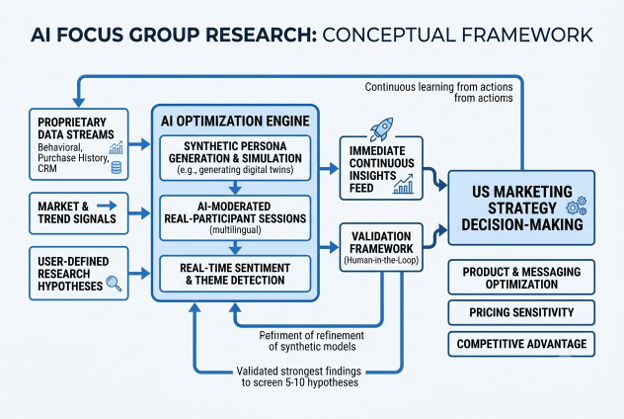
For US marketing teams, the practical implication is that synthetic personas are now reliable enough for concept screening, messaging refinement, and pricing sensitivity analysis, the three highest-frequency research use cases in most marketing organizations. The workflow that is emerging as best practice: use synthetic personas in Phase 1 to screen 5–10 hypotheses, then validate the 2–3 strongest candidates with real-participant AI sessions before committing to final decisions.
Trend 3: AI Digital Twins Are Entering Enterprise Research Programs
Digital twins represent the next evolution beyond synthetic personas. Where a synthetic persona is a generalized representation of an audience segment, a digital twin is a virtual replica of a specific, known individual; built from detailed survey responses, past behavioral data, purchase history, and CRM interactions, and updated continuously as new data arrives.
CVS Health has already tested product placement across synthetic populations representing over 9,000 stores using digital twin technology. The global digital twin market is projected to grow from $13–16 billion in 2023 to $138–195 billion by 2030; driven heavily by consumer research and marketing applications.
For focus group research specifically, digital twins enable a capability that has no traditional equivalent: the ability to return to the same synthetic consumer months later, after product refinements or market shifts, and run the same study again with a participant who “remembers” previous interactions. This creates longitudinal research continuity at a cost that makes it viable for continuous tracking programs.
The current limitation is validation. The EU AI Act’s high-risk provisions activate in August 2026, and California’s CPPA automated decision-making rules are already in effect as of January 2026; creating a regulatory environment where synthetic research outputs used to inform significant business decisions will require documented validation against real human behavior. US research programs adopting digital twins in 2026 should build human-in-the-loop validation into their workflow from day one, not as an afterthought.
Trend 4: AI Is Systematically Eliminating the Four Structural Biases of Traditional Research
Traditional focus group research has four well-documented structural biases that skilled moderation can manage but never eliminate: groupthink, social desirability bias, moderator influence, and dominant-voice distortion. AI is not just reducing these biases; it is architecturally eliminating three of them and significantly reducing the fourth.
Groupthink disappears when every participant’s response is captured independently before group dynamics are introduced. Social desirability bias drops when participants interact with an AI rather than a human moderator in a group setting; research by Conveo found 83% of respondents feel more open with AI interviewers than human moderators. Moderator influence is eliminated by design: an AI moderator applies the same probing standard to every participant in every session, without fatigue, preference, or unconscious steering.
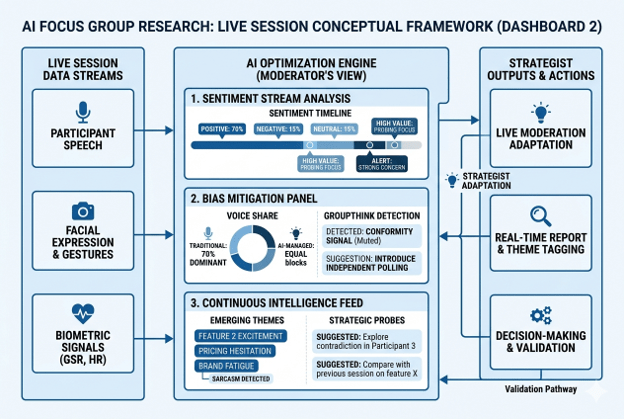
Dominant-voice distortion; where 2–3 vocal participants account for 60–70% of speaking time in a traditional focus group; is the most commercially significant bias AI eliminates. Every participant in an AI-moderated session receives equal probing depth regardless of their communication style. The quiet participant who represents your core buyer segment but rarely speaks up in group settings now generates as much usable data as the articulate participant who dominated every traditional session you ran.
The net effect is a structural improvement in data quality that applies to every AI focus group session, consistently and automatically. Traditional research improvement requires better moderators, better recruitment, and better facilitation; all variable, expensive, and difficult to scale. AI bias reduction is baked in.
Trend 5: Multilingual and Multi-Market Research Is Collapsing in Cost and Time
Running simultaneous focus group research across multiple languages and markets was, until recently, a logistical and financial undertaking available only to the largest enterprise research programs. Recruiting bilingual moderators, managing translation quality, coordinating across time zones, and ensuring cultural nuance was preserved across language versions routinely added 60–80% to research program costs and 3–4 weeks to timelines.
AI is dismantling this barrier at every layer of the process. Multilingual AI moderation platforms handle session facilitation natively in multiple languages without translation overhead. AI transcription and analysis systems process responses in the original language before surfacing cross-market theme comparisons. And community-based platforms like HiVox-in-Q support real-participant sessions globally; allowing US brands to research different languages audiences in a single session configuration rather than multiple separate research programs.
👉 HiVox-in-Q multilingual platform
For US brands with international growth goals, this shift makes multi-market consumer research a standard quarterly activity rather than an annual enterprise project. The insight gap between US-only brands and globally informed brands; which has historically been a function of research budget rather than research intent; is closing.
Trend 6: Real-Time Sentiment Detection Is Replacing Post-Session Analysis
Traditional focus group analysis followed a sequential model: run the session, transcribe the recording, code themes manually, and write the report. The gap between session and insight was measured in weeks. The analysis happened entirely in retrospect, and by the time findings arrived, the contextual memory of the session had faded for everyone involved.
AI real-time sentiment analysis inverts this model. Modern AI focus group platforms tag emotional responses, flag high-value moments, and surface emerging themes as the session runs. A moderator monitoring a live AI-assisted session in 2026 sees sentiment scores updating in real time, hears alert flags when a participant expresses strong concern or unexpected enthusiasm, and can introduce targeted follow-up probes while the relevant context is still fresh.
The downstream impact on insight quality is significant. Real-time flagging means the most commercially important moments in a session are identified and pursued in the moment, not discovered three weeks later in a transcript when there is no opportunity to follow up. Post-session analysis still happens, but its role shifts from discovery to validation and report structuring. The discovery work now happens live.
NLP engines in 2026 are recognizing not just positive and negative sentiment but sarcasm, urgency, hedging, and brand fatigue, the subtle emotional signals that experienced human moderators have always read but that qualitative research reports have never systematically captured. This capability is transforming the depth of insight that AI analysis can surface from a standard 60-minute focus group session.
Trend 7: The Moderator’s Role Is Shifting from Operator to Strategist
One of the most consequential and least-discussed transformations AI is making in focus group research is the redefinition of the human moderator’s role. Traditional moderation was 70% operational: managing logistics, keeping the discussion on track, ensuring equal participation, taking notes, and handling technical issues. The strategic interpretation of what participants were actually saying and why it mattered, occupied maybe 30% of the moderator’s cognitive bandwidth during a session.
AI-moderated platforms flip this ratio. The operational layer is handled entirely by the platform. The human moderator’s entire attention is now available for what they do best: noticing the contradiction between what a participant says and how they say it, identifying the unexpected thread that the discussion guide did not anticipate but deserves aggressive pursuit, and building a real-time analytical model of what the session is revealing that goes beyond what any individual response can show.
This shift is elevating the quality of moderators who adapt to it and making those who do not adapt redundant. The research teams that are thriving in 2026 are not using AI to replace their moderators; they are using AI to upgrade their moderators from session operators to insight strategists. The operational work that consumed most of a moderator’s time has been automated. The strategic work that created most of a moderator’s value has been amplified.
For US research buyers, this shift means the selection criteria for a research partner is changing. The right question is no longer “how experienced is your moderation team?” It is “how does your moderation team use AI to go deeper than the discussion guide anticipated?”
Trend 8: Insight Validation Is Becoming Non-Negotiable as Synthetic Research Scales
The final trend is the one most AI focus group vendors are slowest to discuss: as synthetic research scales, the risk of acting on AI-generated insights that do not accurately reflect real consumer behavior is growing proportionally. Validated synthetic insight is becoming a requirement, not a differentiator. Only platforms with humans-in-the-loop and continuous benchmarking will survive the next wave of enterprise scrutiny, according to BluePill AI’s 2026 market research predictions.
The validation imperative is being reinforced from multiple directions simultaneously. Regulatory pressure; the EU AI Act and California’s CPPA are creating legal accountability for AI-generated research outputs used in significant business decisions. Enterprise procurement teams, burned by early synthetic research investments that produced confident but inaccurate findings, are demanding validation protocols before signing contracts. And the research community’s own credibility standards are catching up with the synthetic research category’s commercial growth.
The best practice emerging in 2026 is a hybrid validation model: synthetic AI research generates and screens hypotheses, real-participant AI sessions validate the strongest findings, and a sample of traditional research periodically benchmarks AI outputs against human behavior baselines. This is not just risk management; it is the architecture that produces the most reliable research output at the lowest total cost. Every synthetic research finding your organization acts on should have a documented validation pathway before it influences a significant decision.
H-in-Q’s research suite is built around this validation architecture; combining HiVox-in-Q’s real-participant community focus groups with Converse-in-Q’s conversational AI surveys and BuzzPulse-in-Q’s social listening layer to create a full-stack insight program where every finding can be validated across multiple data sources.
👉 H-in-Q AI market research suite
What These 8 Trends Mean for US Marketing Teams in 2026
The eight trends above are not independent developments; they are a coordinated restructuring of how consumer insight is generated, validated, and used. The practical implications for US marketing teams cluster around three strategic decisions.
Decision 1: Build a continuous research capability, not a project-based one. The teams winning on consumer insight in 2026 run research weekly, not quarterly. Technology makes this economically viable. The question is whether your organization’s research culture and workflow can adapt to continuous input rather than periodic reports.
Decision 2: Adopt a hybrid methodology, not a binary one. The fastest-moving US research programs are not choosing between AI and traditional; they are sequencing them strategically. Synthetic for screening, AI-assisted for validation, traditional for stakeholder conviction. Build the full stack, not just one layer.
Decision 3: Validate everything synthetic before acting on it significantly. The competitive advantage of AI research speed is real. The risk of acting on AI-generated findings that do not reflect actual consumer behavior is equally real. Build human-in-the-loop validation into every AI research program before it influences a significant budget or launch decision.
Tools Driving the AI Focus Group Research Transformation in 2026
- HiVox-in-Q: Community AI focus groups combining real-participant authenticity with AI analytical infrastructure. Native multilingual support for global markets. 👉 HiVox-in-Q
- Simile: AI digital twin platform for enterprise-scale synthetic consumer simulation. Recently raised $100M Series A.
- Looppanel / BTInsights: AI analysis layers that compress post-session thematic coding from weeks to hours.
- Converse-in-Q: Conversational AI survey platform for continuous real-participant tracking. 👉 Converse-in-Q
- BuzzPulse-in-Q: Social listening and brand intelligence platform for validating focus group findings against real-world consumer signals. 👉 BuzzPulse-in-Q
FAQ: AI Transforming Focus Group Research in 2026
How is AI changing focus group research in 2026?
AI is changing focus group research across eight dimensions: shifting research from episodic to continuous, mainstreaming synthetic personas, introducing AI digital twins, eliminating structural research biases, collapsing multilingual research costs, enabling real-time sentiment detection, redefining the moderator's strategic role, and creating new validation requirements as synthetic research scales. The net effect is a 80–90% cost reduction and timeline compression from weeks to hours for most research use cases.
Are traditional focus groups becoming obsolete?
Traditional focus groups are not becoming obsolete; they are becoming selective. In 2026, the right use case for traditional in-person focus groups is narrowing to four scenarios: research requiring physical product interaction, research where observing social dynamics is the objective, high-stakes decisions needing stakeholder observation, and genuinely unprecedented product categories. For the remaining 80% of research objectives, AI focus groups deliver equivalent or superior data quality at dramatically lower cost and time.
What are AI digital twins in market research?
AI digital twins in market research are virtual replicas of specific consumer types built from behavioral data, survey responses, purchase history, and CRM interactions. Unlike static synthetic personas, digital twins update continuously as new data arrives and can be queried repeatedly over time; simulating how the same consumer segment would respond to different concepts, messages, or market conditions across multiple research cycles.
How does AI reduce bias in qualitative research?
AI eliminates three of the four structural biases in traditional focus groups by design. Groupthink is removed by capturing independent responses before group dynamics are introduced. Social desirability bias drops because participants interact with an AI rather than a human observer. Moderator influence is eliminated through consistent AI probing standards applied equally to every participant. The dominant-voice problem; where 2–3 participants generate 60–70% of data disappears when AI ensures equal contribution depth across all respondents.
What is continuous consumer research and why does it matter?
Continuous consumer research is a model where qualitative insights are generated on a weekly or faster cadence rather than episodically once per quarter. AI focus group economics; $100–$8,000 per study versus $7,000–$30,000 for traditional — make continuous research financially viable for the first time for most US businesses. Teams running continuous research cycles compound their consumer understanding over time, consistently outperforming competitors making decisions based on stale quarterly data.
How should US marketing teams respond to these AI research trends?
Three strategic actions matter most in 2026: build a continuous research capability by adopting AI-assisted platforms that make weekly consumer insight economically viable; adopt a hybrid methodology that sequences synthetic AI screening, real-participant validation, and selective traditional research; and implement human-in-the-loop validation protocols for all synthetic research before it influences significant business decisions. Teams that execute all three will have a compounding insight advantage that will be difficult for competitors to close.
Conclusion
The eight transformations above share a common thread: AI is not making focus group research incrementally better — it is making it structurally different. The economics, the cadence, the bias profile, the geographic reach, and the role of the human researcher are all changing simultaneously. The $140 billion global market research industry is reorganizing around these shifts in real time, and the US marketing teams that adapt their research practice to this new architecture will consistently outperform those that do not.
The competitive window for building these capabilities is open now. By 2027, the gap between continuous AI-powered research programs and episodic traditional programs will be a compounding data advantage that cannot be closed by budget alone. H-in-Q’s market research suite; anchored by HiVox-in-Q’s community AI focus groups, Converse-in-Q’s conversational surveys, and BuzzPulse-in-Q’s social intelligence layer; is designed to give US marketing teams all eight of these capabilities in a single integrated research stack.
Explore the full H-in-Q market research suite →
The brands that understand their consumers most deeply, most recently, and most continuously will win. That was always true. What is new in 2026 is that AI has made it affordable for every US marketing team to be that brand.