


Introduction
Only 23% of businesses that use surveys actually leverage market research to guide their strategy, and more than half of workers say they’re unsure how to even get the data they need to do their jobs, according to SurveyMonkey’s own research. That gap isn’t a data problem; it’s a template problem. Most teams either write survey questions from scratch every time or reach for a generic questionnaire that doesn’t map to any specific decision, producing data nobody actually acts on. This guide gives you 7 ready-to-use market research survey templates, each built around one clear business decision, with copy-paste question sets you can launch today. At H-in-Q, we built a free Survey Template Builder because founders kept sending us survey drafts that tried to answer five different questions at once and answered none of them well. In this guide, you’ll get templates for the seven research situations that come up most often; pick the one that matches your decision and go.
Direct Answer: Free market research survey templates are pre-built question sets designed for a specific research goal — such as testing a new product concept, measuring brand awareness, or evaluating pricing sensitivity — that businesses can copy and customize instead of writing survey questions from scratch. The seven most useful templates cover product/concept testing, pricing sensitivity, brand awareness, customer profiling, competitive perception, purchase behavior, and post-purchase satisfaction, each built around one clear business decision.
What Makes a Market Research Survey Template Actually Useful
A useful market research survey template is built around one specific business decision, not a general attempt to “learn about customers.” The template tells you exactly what question type to use, how many questions to include, and where in the survey to place demographic questions (always at the end; leading with them feels impersonal and hurts completion rates). A survey template only saves time if it maps to a decision. A generic questionnaire produces generic, unusable data, regardless of how many questions it contains.
Most published template libraries offer dozens of near-duplicate options that blur together. The seven below are deliberately narrow: each answers one distinct question your business is likely asking right now, whether that’s “should we launch this product,” “what should we charge,” or “do people even know we exist.”
Why Survey Templates Matter for Businesses in 2026
The data gap most businesses face isn’t a lack of tools, but a lack of structure. With 54% of workers unsure how to source the data they need, the barrier is rarely the survey platform itself; it’s knowing what to ask and in what order. A well-structured template removes that uncertainty entirely, turning a blank page into a 10-minute customization task.
The cost of skipping proper survey structure shows up in decisions made on incomplete or contaminated data. A pricing survey that also tries to measure brand awareness produces weak signal on both. Businesses that use a single-objective template per survey consistently get cleaner, more actionable data than businesses that try to cover everything in one long questionnaire, and they get it with fewer respondents, since focused surveys see higher completion rates.
7 Free Market Research Survey Templates
1. Product/Concept Testing Survey (10 questions)
Use when: deciding whether to launch a new product or feature before committing development resources.
- On a scale of 1-10, how appealing is this concept to you?
- What problem would this solve for you, if any?
- What would you expect to pay for this?
- What, if anything, would stop you from using this?
- How does this compare to what you currently use to solve this problem?
2. Pricing Sensitivity Survey (6 questions)
Use when: setting or testing a new price point before launch or a repricing decision.
- At what price would this feel too expensive to consider?
- At what price would this feel so cheap you’d question the quality?
- At what price would this feel like a good deal?
- At what price would this feel expensive but still worth considering?
- How does this pricing compare to alternatives you currently use?
3. Brand Awareness Survey (10 questions)
Use when: measuring how well-known your brand is within your target market, or tracking awareness over time.
- Have you heard of [brand] before today?
- Where did you first hear about [brand]?
- What three words would you use to describe [brand]?
- Which of these brands are you familiar with? [list including competitors]
- How likely are you to consider [brand] for [category] in the future?
4. Customer Profiling Survey (8 questions)
Use when: building or validating buyer personas and understanding who your actual customers are.
- What is your role in the purchasing decision for [category]?
- What is your company size / household size?
- What tools or products do you currently use for [problem area]?
- What’s your biggest challenge related to [problem area]?
- Demographic/firmographic questions (placed last)
5. Competitive Perception Survey (7 questions)
Use when: understanding how your brand stacks up against named competitors in the customer’s mind.
- Which of these companies would you consider for [category]? [list]
- What makes [competitor] appealing to you, if anything?
- What would make you switch from your current provider?
- How do you currently rate [brand] against [competitor] on price, quality, and service?
6. Purchase Behavior Survey (9 questions)
Use when: understanding how and why customers make purchase decisions in your category.
- How often do you purchase products in this category?
- What factors most influence your purchase decision? [rank]
- Where do you typically research before purchasing?
- What would make you delay or cancel a planned purchase?
7. Post-Purchase Satisfaction Survey (6 questions, pairs with NPS)
Use when: measuring satisfaction and loyalty after a purchase or renewal event.
- How satisfied are you with your recent purchase? (1-5 scale)
- Did the product meet your expectations?
- What’s the main reason for your rating?
- On a scale of 0-10, how likely are you to recommend us? (standard NPS question)
Survey Template Best Practices: What Works, What Wastes Time
| Practice | Why It Works |
|---|---|
| One objective per survey | Mixing goals (pricing + awareness) weakens the signal on both |
| Demographics last, not first | Leading with them feels impersonal and lowers completion rates, a pattern Pew Research Center’s question-order testing confirms consistently |
| Keep it to 10-15 questions max | Longer surveys see meaningfully higher drop-off past the halfway point |
| Use a mix of question types | Ratings, multiple choice, and one open-ended question capture both quant and qual data |
| Pilot test with 5-10 people first | Catches confusing wording before it contaminates your full dataset |
| Size your sample before launching | A perfectly worded survey with too few responses still produces unreliable data |
The most common mistake with template use: customizing the wording so heavily that the template’s original structure, and the objective it was built for gets lost. Adapt the language, not the underlying logic of what each question is measuring.
How AI Is Transforming Survey Design in 2026
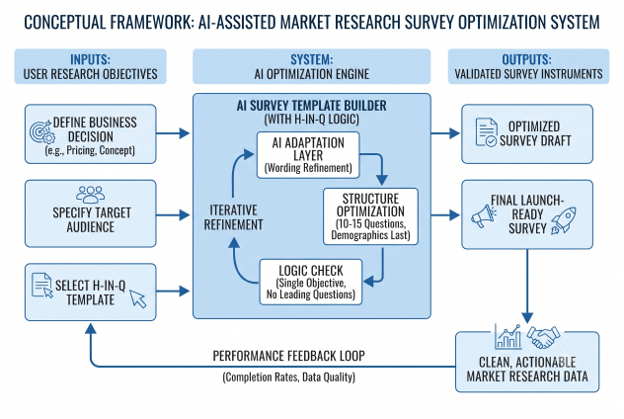
Writing a survey used to mean starting from a blank page or a generic template and hoping the wording didn’t accidentally lead respondents toward a particular answer. AI tools can now review draft survey questions for leading language, double-barreled questions (asking two things at once), and ambiguous wording before a single response comes in; catching mistakes that used to only surface after the data was already contaminated.
AI is also changing how quickly a template becomes a live survey. Instead of manually adapting a generic pricing template to your specific product and audience, AI-assisted survey builders can generate a first draft tailored to your category in seconds, which you then refine rather than write from scratch. At H-in-Q, our free Survey Template Builder uses exactly this approach; start from one of the seven structures above, and let AI adapt the wording to your specific product before you launch.
Tools & Resources for Survey Design
- H-in-Q Survey Template Builder: free, AI-assisted customization of all 7 templates above.
- H-in-Q Sample Size Calculator: confirm you’re inviting enough respondents before launch.
- H-in-Q NPS Calculator: pairs directly with the Post-Purchase Satisfaction template.
- H-in-Q Focus Group Discussion Guide Template: for qualitative follow-up once survey data raises new questions.
Conclusion
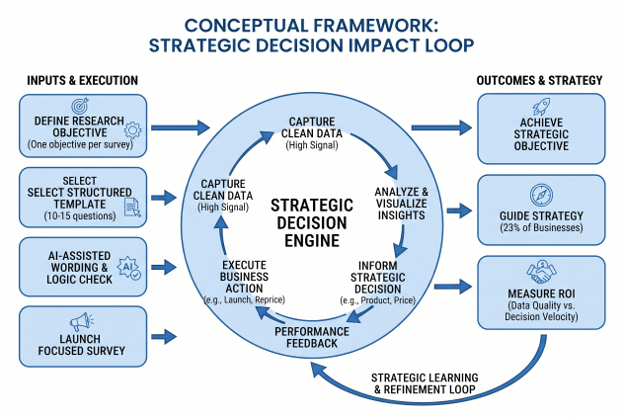
The gap between businesses that use market research effectively and businesses that don’t isn’t a tooling gap, it’s a structure gap, and the fix is picking the right template for the decision you’re actually trying to make. Whether you’re testing a new concept, setting a price, measuring brand awareness, or profiling your customer base, each of the seven templates above maps to one clear objective and one clean dataset. Only 23% of businesses currently use surveys to guide real strategy; matching the right template to the right decision is the fastest way to move into that group. Ready to launch? H-in-Q’s free Survey Template Builder lets you start from any of these seven structures and customize the wording to your product in minutes.