

The assumption that ran most consumer research programs for the past 30 years was simple: to understand your customers, you ask them. You design a survey, recruit respondents, collect their answers, and analyze what they said. That assumption is collapsing, not because consumers have stopped having opinions, but because the combination of AI-generated behavioral data, synthetic consumer simulation, and real-time signal monitoring has produced a fundamentally different research model.
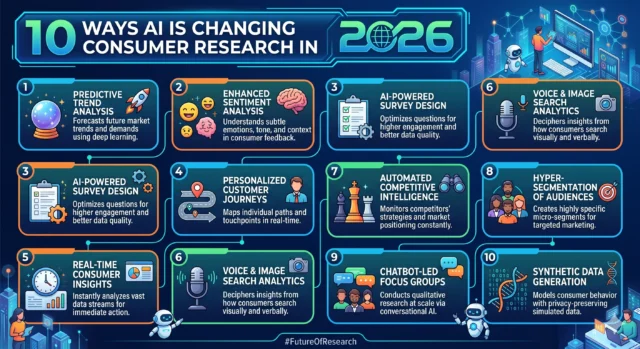
Consumer use of AI applications grew 62% over the past two years, according to IBM’s 2026 Consumer Research Study covering 18,000 consumers across 23 countries. Adobe’s 2026 AI and Digital Trends report found that roughly a quarter of consumers now cite AI-powered platforms like ChatGPT as their primary research tool for purchase decisions. The consumer is changing. The tools businesses use to understand them are changing even faster. Here are the 10 most significant shifts, and what each one means for US businesses in 2026.
1. Real-Time Behavioral Monitoring Is Replacing Quarterly Survey Waves
Traditional brand tracking operated on a fixed cadence: quarterly or annual survey waves that measured brand health at a single point in time. By the time results were delivered, the market moment they described had already passed. AI-powered social listening and behavioral monitoring has replaced that static rhythm with continuous intelligence.
AI platforms now monitor brand mentions, sentiment shifts, competitive activity, and emerging consumer topics across millions of sources simultaneously, 24 hours a day. A sentiment shift that would previously appear in a quarterly tracker three months later now surfaces as an alert within hours. The practical consequence is that brands can detect a brewing reputation issue, a competitor misstep, or an emerging category need in real time rather than reacting to it post-hoc.
Qualtrics‘ 2026 research confirms the urgency: only 3 in 10 consumers now explain why they leave a brand. Direct survey feedback is declining; meaning the signal about what consumers actually think is moving into behavioral data and passive monitoring rather than structured questionnaires. Brands that rely solely on survey waves to understand consumer sentiment are working with an increasingly incomplete picture of their market.
2. Synthetic Personas Are Disrupting Traditional Focus Groups
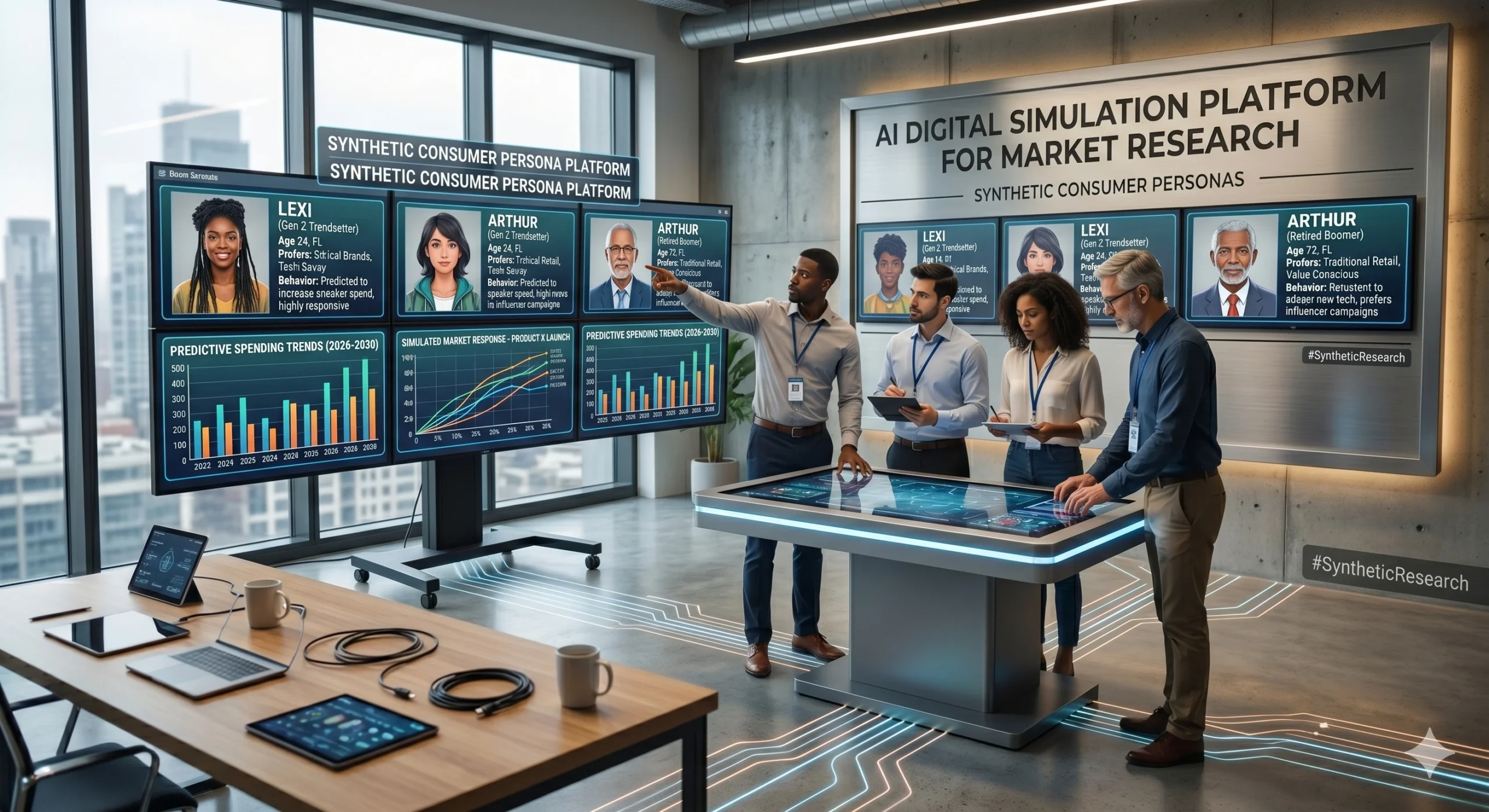
One of the most significant shifts in consumer research in 2026 is the emergence of synthetic personas, AI-generated virtual consumers built from real behavioral and demographic data that simulate how actual customer segments respond to products, pricing, and messaging.
Simile, a Stanford spinout, raised $100 million in Series A funding in February 2026 specifically to build AI digital twins for enterprise consumer research. Enterprise clients including CVS Health are using the platform to simulate hundreds of thousands of customer agents simultaneously, testing product placement decisions across virtual populations representing thousands of stores. The company reports 80–85% accuracy in behavioral prediction tasks.
Across the broader synthetic research category, calibrated synthetic consumers achieve up to 90% alignment with real human survey data on structured research tasks like pricing, ranking, and concept testing, according to PyMC Labs’ published validation data. Analysts project that synthetic data will account for more than 50% of market research inputs by 2027. For US businesses, the implication is direct: concept testing, pricing research, and message testing can now be conducted at a fraction of traditional focus group cost, and in hours instead of weeks.
3. NLP Has Made Unstructured Feedback the Most Valuable Research Asset
For decades, the most important consumer data; the raw, unfiltered language customers use to describe their experiences, frustrations, and desires, was also the hardest to analyze. Open-ended survey responses, support transcripts, online reviews, and social media posts required manual coding that was too slow and expensive to do at scale. NLP has changed that entirely.
Natural language processing algorithms now read and categorize unstructured text at a speed and scale no human analyst team can match. A brand can analyze every customer support interaction from the past two years, every online review across every platform, and every relevant social media mention, and receive a structured, thematic summary of consumer sentiment, pain points, and emerging needs in hours. The insight generated from that analysis often exceeds what structured survey research produces, because it captures what consumers actually say in their own language rather than their responses to predetermined questions.
The shift matters because consumers are increasingly expressive in unstructured channels and increasingly non-responsive in structured ones. Survey response rates have been declining for years. The consumers who are sharing detailed, authentic opinions about brands and products are doing so on Reddit, in review platforms, and in support interactions, and NLP is the key that unlocks that data for research purposes.
4. AI Is Detecting Consumer Emotion, Not Just Opinion
Early sentiment analysis classified consumer text as positive, negative, or neutral; a useful but shallow signal. The NLP models available in 2026 go significantly further. Advanced emotion detection models identify specific emotional states: frustration, excitement, trust, confusion, brand fatigue, and loyalty; providing research teams with a richer signal than simple sentiment polarity.
This shift matters because consumer purchase decisions are driven more by emotion than stated preferences. A customer who describes a product as “fine” in a survey scores neutrally. The same customer’s review that uses language patterns associated with mild disappointment and unmet expectations represents a different, more actionable signal. AI emotion detection surfaces those patterns across thousands of interactions simultaneously; revealing emotional undercurrents in consumer behavior that structured surveys consistently miss.
For brand managers and product teams, the practical value is early warning capability. Emotion detection models flag brand fatigue or building dissatisfaction before it appears as churn or negative reviews. The research signal arrives in time to respond, not after the damage is visible in sales data.
5. Consumer Discovery Has Moved From Search to AI Conversation: Changing What Research Measures
The consumer journey itself is changing in ways that directly alter what market research needs to measure. Adobe’s 2026 AI and Digital Trends report found that roughly 25% of consumers now cite AI-powered platforms as their primary research tool, ahead of brand websites and online reviews. IBM’s study found that consumers increasingly want AI to move beyond answering questions to acting on their behalf: monitoring prices, comparing options, and completing purchases within a conversational interface.
This shift; which IBM describes as “agentic commerce” means the discovery and evaluation stages of the consumer journey are increasingly happening inside AI systems, invisible to traditional tracking methods. A consumer who asks ChatGPT which brand of running shoes to buy and then purchases based on that recommendation never visited a brand website, never clicked a search result, and never left a trace in the behavioral data streams that traditional research monitors.
The brands that are not actively measuring their visibility in AI-generated recommendations are missing the research signal that increasingly determines purchase decisions. This requires an entirely new measurement discipline; AI Overviews monitoring, LLM citation tracking, and conversational commerce analytics, that most US research programs have not yet built.
6. Predictive Analytics Has Shifted Research From Reactive to Proactive
Traditional consumer research was inherently backward-looking: it measured what consumers thought and did in the past, then extrapolated implications for future decisions. Predictive analytics powered by machine learning has inverted that orientation, enabling research teams to forecast consumer behavior before it manifests in observable data.
AI predictive models identify emerging trends in consumer behavior 4 to 6 weeks before they appear in traditional survey data, based on leading indicators in behavioral signals, social conversation patterns, and purchase data. For product teams and marketing planners, that lead time is the difference between anticipating a market shift and reacting to it.
The application range is broad. Consumer demand forecasting gives retail and FMCG brands advance signal on product category trends before inventory decisions need to be made. Churn prediction identifies individual accounts showing behavioral patterns associated with departure, enabling retention intervention before the decision is made. Trend emergence detection surfaces emerging consumer needs in a category before competitors have identified and responded to them. Each application represents a research capability that simply did not exist in the traditional survey-based paradigm.
7. AI Is Enabling Micro-Segmentation That Traditional Research Could Never Achieve
Traditional consumer segmentation grouped people into broad demographic and psychographic categories; millennials who value sustainability, price-sensitive buyers in suburban markets, because the data collection and analysis costs of more granular segmentation were prohibitive. AI machine learning has eliminated that constraint.
Unsupervised learning algorithms now identify micro-cohorts, consumer clusters defined by patterns in their actual behavior rather than by researcher-defined categories. These clusters often reveal segments that no research brief would have anticipated: a premium group of eco-conscious night-shift workers who purchase differently from eco-conscious consumers overall, or a subset of price-sensitive buyers who respond to urgency messaging in ways that the broader price-sensitive segment does not.
The value of AI-driven micro-segmentation is not just analytical precision. It is commercial precision. Marketing campaigns targeting AI-identified micro-cohorts consistently outperform campaigns built on traditional demographic segments because they reflect how consumers actually behave rather than how demographers categorize them.
8. Conversational AI Research Is Replacing Structured Surveys for Qualitative Depth
One of the most persistent limitations of quantitative surveys is their inability to follow an unexpected response. If a survey respondent provides an answer that contradicts the researcher’s hypothesis, a questionnaire cannot ask a follow-up question. A skilled human moderator can, but that moderation has always been expensive, slow, and limited in scale.
AI-led conversational research platforms now conduct adaptive interviews that adjust dynamically based on each respondent’s previous answers. They follow unexpected threads, probe for the “why” behind stated preferences, and synthesize qualitative findings across hundreds or thousands of simultaneous conversations. The result is qualitative depth at quantitative scale, a research capability that previously required choosing between the two.
H-in-Q’s Converse-in-Q platform is built on exactly this principle, conducting AI-led conversations with consumers that produce the motivational and emotional depth of qualitative interviews across sample sizes that quantitative surveys achieve. For US businesses that need to understand the “why” behind consumer behavior at scale, this represents a structural improvement over the survey-moderated trade-off that defined research design for decades.
👉 See how AI market research tools work
9. The Direct Survey Is Declining as Consumers Become Less Responsive
One of the most underreported shifts in consumer research is not a new AI capability, it is the structural decline of the method that has anchored the industry for 50 years. Survey response rates have been falling steadily for a decade, but the trend has accelerated. Qualtrics’ 2026 global consumer experience report found that only 3 in 10 consumers now explain why they leave a brand, down from significantly higher rates in prior years.
The implication is that the research infrastructure built on structured survey data is facing a data quality problem that AI makes more visible, not less. Survey-only research programs are operating on declining sample quality, increasing non-response bias, and a growing gap between the consumers who respond to surveys and those who do not. The respondents willing to complete a 15-minute survey in 2026 are a less representative sample of the consumer population than they were in 2006.
AI research addresses this not by fixing surveys but by supplementing them with data sources that do not depend on consumer willingness to respond. Behavioral data, social listening, and passive signal monitoring capture consumer signals from the full population, including the majority who will not answer a survey, providing a more complete and representative picture of market reality.
10. Gen Alpha Is Entering the Market and Resetting Research Expectations Entirely
Every significant generational shift has required consumer research to adapt its methods, its vocabulary, and its underlying assumptions about how people form and express preferences. Gen Alpha, the first generation to grow up with AI as a permanent fixture of daily life, represents the most fundamental reset consumer research has faced.
Matt Britton, CEO of Suzy and author of Generation AI, describes the shift precisely: Gen Alpha interacts with technology conversationally by default. They expect systems to understand context, remember their preferences, and evolve with them. They are less responsive to traditional survey formats, less tolerant of irrelevant content, and more comfortable delegating decisions to AI systems than any previous generation. Adweek’s analysis of 2026 consumer AI trends confirms: questions from AI-native consumers are more specific, more contextual, and more outcome-oriented than those of previous generations, and they arrive closer to a decision from the start.
For consumer research programs, this means the methods designed to understand previous generations are increasingly misaligned with the behaviors and preferences of the consumers who will drive market growth over the next two decades. Brands that do not evolve their research infrastructure to capture AI-native consumer behavior will find their insight programs are measuring a population that is no longer representative of their growth market.
Tools Powering These 10 Shifts
The transitions described above are powered by a specific set of AI research capabilities. Real-time behavioral monitoring runs on social listening platforms like Brandwatch and BuzzPulse-in-Q. Synthetic persona research operates on platforms like Simile, Panoplai, and Conveo. NLP and emotion detection are embedded in modern social intelligence and survey analysis platforms. Conversational research is available through adaptive interview platforms including Converse-in-Q. Predictive analytics is accessible through machine learning platforms like Pecan.
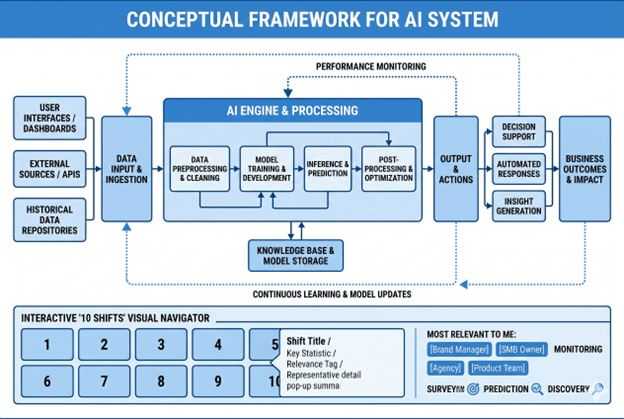
For US businesses building or upgrading their research infrastructure, the practical path is not to adopt all ten capabilities simultaneously. It is to identify which of these ten shifts most directly affects your current research blind spots, and address that gap first.
Compare the 7 best AI market research tools for your specific needs
Frequently Asked Questions: AI and Consumer Research in 2026
Frequently Asked Questions: AI and Consumer Research in 2026
How is AI changing consumer research in 2026?
AI is changing consumer research through ten specific shifts: replacing quarterly surveys with real-time monitoring, enabling synthetic personas that simulate consumer responses, making NLP analysis of unstructured feedback scalable, detecting consumer emotion not just opinion, tracking AI-mediated consumer discovery, enabling predictive rather than reactive research, powering micro-segmentation based on actual behavior, conducting conversational research at scale, addressing declining survey response rates, and adapting to Gen Alpha's AI-native consumer expectations.
What is a synthetic persona and how is it used in market research?
A synthetic persona is an AI-generated virtual consumer built from real behavioral and demographic data. Researchers use synthetic personas to test product concepts, pricing structures, and messaging variations against simulated audience responses, without recruiting real participants. Leading synthetic research platforms achieve up to 90% alignment with real human survey data on structured research tasks. Simile raised $100 million in early 2026 to build enterprise-grade AI digital twins for this purpose.
How is consumer behavior itself changing because of AI?
IBM's 2026 Consumer Research Study found consumer use of AI applications grew 62% in two years. About 25% of consumers now use AI platforms as their primary research tool for purchase decisions. Consumers increasingly want AI to act on their behalf; monitoring prices, comparing options, and completing transactions, not just answer questions. This "agentic commerce" shift means purchase decisions are increasingly made inside AI conversations, invisible to traditional research tracking.
Why are survey response rates declining and what does that mean for research?
Survey response rates have been declining for years due to survey fatigue, mobile device friction, and changing consumer behavior. Qualtrics' 2026 research found only 3 in 10 consumers now explain why they leave a brand, a significant decline in direct feedback willingness. The practical consequence is that survey-only research programs are working with increasingly non-representative samples. AI research supplements surveys with behavioral monitoring and passive signal detection that captures the full population, not just survey respondents.
What is agentic commerce and why does it matter for consumer research?
Agentic commerce refers to consumers using AI tools to not just research but actively execute purchase decisions; delegating price monitoring, comparison shopping, and transaction completion to AI agents. IBM's 2026 study found this is the fastest-growing consumer AI behavior. For researchers, it means a significant and growing share of purchase decisions are happening inside AI systems that traditional tracking methods cannot monitor — requiring new measurement approaches focused on AI recommendation visibility.
How should US businesses respond to these 10 consumer research shifts?
The most effective response is prioritization rather than wholesale transformation. Identify which of the ten shifts most directly affects your current research blind spots. If brand monitoring is reactive, add real-time social listening. If product testing is slow and expensive, pilot synthetic persona research. If survey response rates are declining, augment with behavioral data and NLP-based unstructured feedback analysis. Build the capability that solves your most expensive current research problem first, then expand from that foundation.
Conclusion
Ten shifts. Each one changing a different part of how US businesses understand their consumers. Taken together, they describe a research landscape where the speed, cost, and depth of consumer insight have fundamentally changed — and where the businesses investing in the right capabilities are compounding an understanding advantage that grows harder to close with every research cycle.
The shifts are not uniform in their urgency for every business. Real-time monitoring matters most for brands where reputation moves fast. Synthetic persona research matters most for businesses running frequent product and concept tests. Predictive analytics matters most for businesses where consumer behavior shifts affect inventory, pricing, or campaign timing. Gen Alpha awareness matters most for brands building for the next decade rather than the current one.
The common thread is that the research infrastructure built on quarterly surveys and manual analysis is no longer sufficient for the competitive intelligence requirements of 2026. The tools to replace it, and augment it; are available, accessible, and affordable at every business size.
Ready to build a consumer research program that captures these ten shifts? H-in-Q.com designs AI-powered research infrastructure for US businesses. book your free strategy call →