


Table des matières
- What Is Synthetic Data in Market Research?
- Where Can Synthetic Data Reduce Research Waste in 2026?
- How to Implement Synthetic Data for Validated Market Insights
- Which Validation Rules Prevent False Consumer Confidence?
- How AI Is Changing Market Research Respondent Simulation in 2026
- Tools and Resources for Synthetic Data Research
- Expand Research Coverage Without Replacing Consumer Evidence
- Questions fréquemment posées
Synthetic Data and AI-Generated Respondents in Market Research: 3 Key Use Cases for 2026 Expansion
A thousand simulated answers still provide no independent evidence that a thousand customers agree. Synthetic data offers research teams faster experimentation, but speed becomes valuable only when simulations face real-world checks.
For organizations expanding in 2026, the opportunity is practical: screen more ideas, investigate evidence gaps, and improve questionnaires before purchasing fieldwork. The danger is treating plausible language as measured consumer demand.
H-in-Q.com’s AI-powered marketing and business automation focus provides a practical lens: connect research automation to explicit decisions and measurable quality controls.
In this guide, you’ll discover three expansion use cases, implementation steps, validation safeguards, and tools for building a disciplined research workflow.
What Is Synthetic Data in Market Research?
Synthetic data in market research is artificially generated information designed to reproduce selected statistical or behavioral patterns in a defined population. It includes simulated records and modeled survey responses. Researchers use it to test methods, explore scenarios, and supplement analysis, while validating decision-relevant results against independently collected human evidence.
AI-generated respondents are a related method, not a synonym. A language model answering as a fictional shopper produces simulated responses; a statistical generator creates records resembling an underlying dataset.
Both require a defined population and intended use. Neither establishes current purchasing intent simply because its output sounds convincing.
Unlike traditional surveys, simulations support rapid iteration without repeated recruitment. Human surveys provide observations from actual participants, although sampling and questionnaire errors still require management.
Where Can Synthetic Data Reduce Research Waste in 2026?
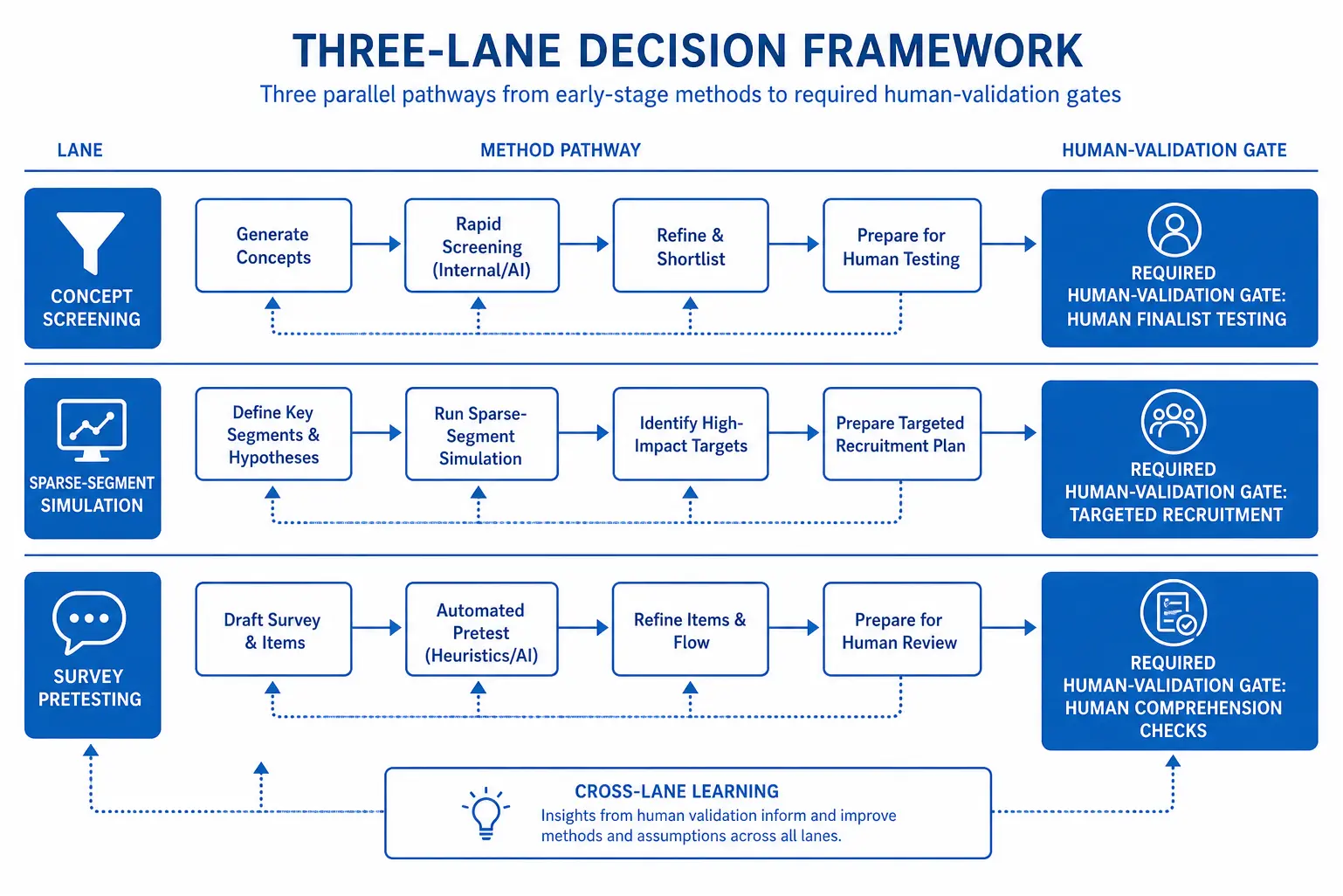
Three applications offer a disciplined starting point for expansion research:
- Concept screening: Explore reactions to packaging or messaging, then test shortlisted concepts with people.
- Sparse-segment simulation: Examine assumptions about underrepresented groups and identify where additional recruitment is necessary.
- Survey pretesting: Detect confusing wording, missing response options, and broken questionnaire routing before human comprehension checks.
These applications also make privacy governance commercially relevant. Under GDPR Article 83, specified infringements attract maximum fines of €20 million or 4% of worldwide annual turnover, whichever is higher. Generated records are not automatically anonymous.
Consider an illustrative regional retailer screening delivery messages. Simulation helps identify questions worth testing; local respondents establish whether the shortlisted promises match actual shopping priorities. Without that distinction, inexpensive experimentation becomes expensive misdirection.
How to Implement Synthetic Data for Validated Market Insights
-
Define one reversible decision. Start with selecting message variants for human testing, not forecasting an entire market. Specify the population, business question, and prohibited uses.
-
Audit the evidence. Document permissions, collection dates, sample composition, and missing groups. Regional applications require local category evidence, not translated national stereotypes.
-
Reserve an independent benchmark. Separate human responses before developing prompts or generators. Keep this benchmark out of tuning so evaluation measures generalization rather than reproduction.
-
Choose the appropriate generator. Use tabular methods for structured records and language models for simulated interviews or questionnaire checks. Record model versions, instructions, and generation settings.
-
Set acceptance rules before testing. Compare distributions, concept rankings, and subgroup errors. For example, a team can require agreement on the top-ranked concept and reject materially distorted regional results.
-
Approve, label, and monitor outputs. Have researchers review discrepancies and disclosure risks. Label simulated findings clearly, track corrections, and repeat validation after source-data or model changes.
Which Validation Rules Prevent False Consumer Confidence?
Apply these checks before circulating a synthetic data study:
| Rule | Practical action |
|---|---|
| Generate fewer answers first | Validate a small pilot before increasing volume; repetition does not create independent evidence. |
| Test subgroup errors | Check regional and demographic results separately, even when overall averages match. |
| Challenge agreeable personas | Include rejection, indifference, budget constraints, and competing priorities. |
| Separate exploration from measurement | Never describe simulated preference shares as population estimates without appropriate validation. |
| Calculate total effort | Include preparation, licensing, validation, and researcher review when comparing costs. |
More simulated respondents do not repair a biased evidence base. Publish limitations beside findings, rather than hiding them in an appendix.
How AI Is Changing Market Research Respondent Simulation in 2026
Language models turn research briefs into conversational simulations, while automation handles routing checks, repeated runs, and response classification. Retrieval systems can ground those simulations in approved interviews and product documentation.
However, retrieved evidence does not guarantee representative answers. A model can repeat the same assumptions across apparently different personas, creating artificial consensus.
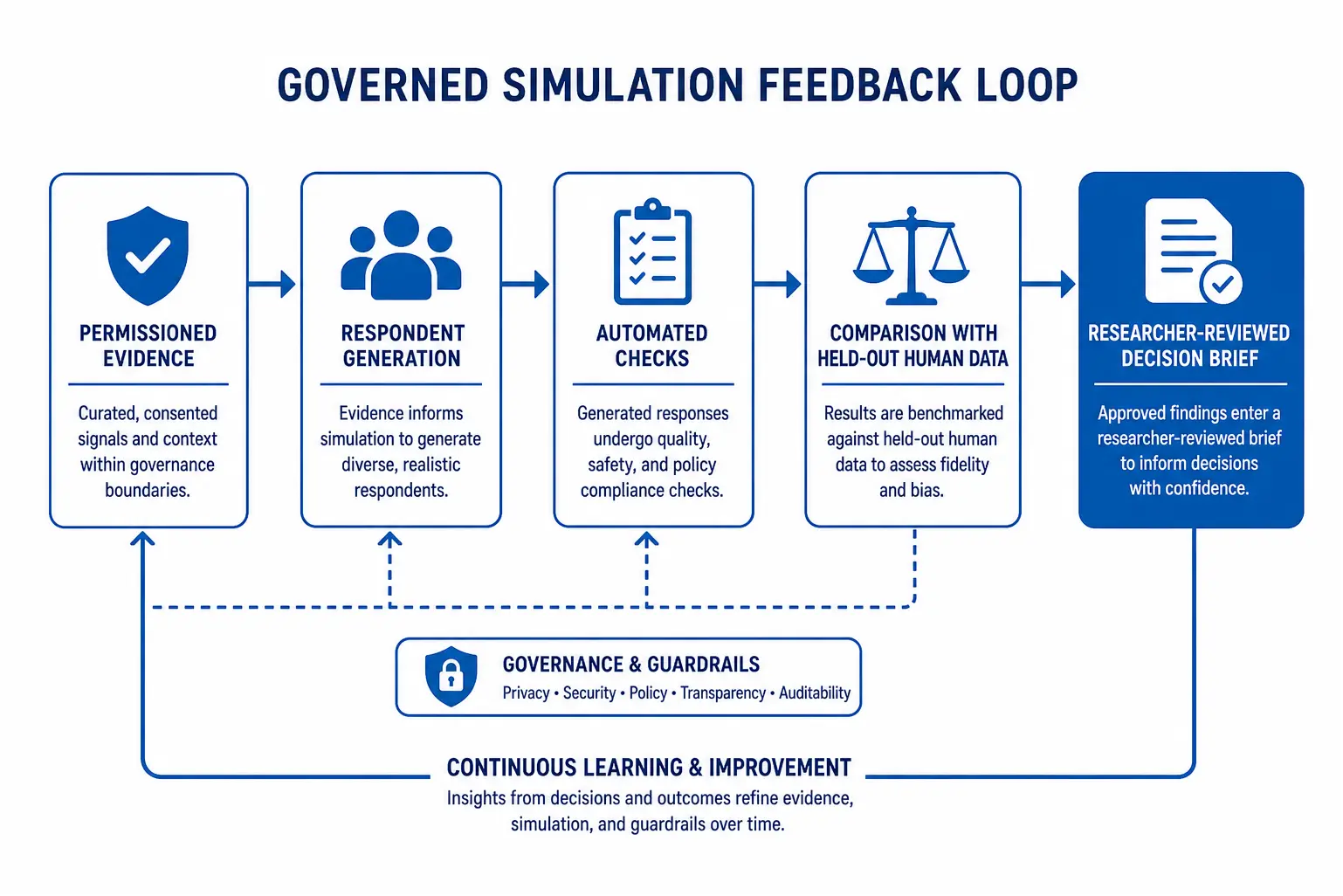
The stronger workflow links permissioned evidence, generation, automated checks, independent human benchmarking, and researcher approval. Version logs make changes traceable when prompts, models, or market conditions shift.
For regional expansion, review language and cultural interpretation separately from statistical fit. A fluent translation does not demonstrate local validity.
Tools and Resources for Synthetic Data Research
- Synthetic Data Vault: Open-source tools for generating and evaluating structured synthetic datasets. Suitable for technical teams testing tabular research workflows.
- Synthcity: An open-source library supporting generation and evaluation experiments. Use it to compare methods rather than assume one generator suits every dataset.
- Qualtrics: A commercial platform for collecting human research benchmarks. Keep observed responses distinct from simulations.
- NIST Privacy Framework: A free governance resource for organizing privacy risks, responsibilities, and controls around research workflows.
Expand Research Coverage Without Replacing Consumer Evidence
Synthetic data earns its place through better research decisions, not larger response counts. Start with concept screening, evidence-gap exploration, or questionnaire pretesting, then validate the output against independent human responses.
Keep privacy controls, regional checks, and clear labeling inside the workflow. Before expanding a pilot, confirm that it improves the next decision after accounting for review time and correction costs.
Explore H-in-Q.com’s AI and automation services to discuss a measurable research pilot. The next phase of market research will reward teams that combine faster simulation with stronger evidence.
Questions fréquemment posées
Qu’est-ce que les données synthétiques dans la recherche de marché ?
Synthetic data in market research is artificially generated information designed to reproduce selected patterns in real research data. It supports testing and analysis without directly reusing every original record. Its usefulness depends on the source evidence, generation method, privacy safeguards, and independent checks against real consumer responses.
Can AI-generated respondents replace traditional surveys?
AI-generated respondents do not replace traditional surveys when decisions require evidence of actual consumer attitudes or behavior. They support early exploration, questionnaire testing, and scenario analysis. Use human respondents to validate consequential findings, investigate unfamiliar needs, and measure outcomes that simulated answers cannot independently establish.
How do you check whether synthetic respondents are accurate?
Check synthetic respondents against human responses excluded from model development. Compare answer distributions, concept rankings, subgroup errors, and consistency across repeated runs. Define acceptance thresholds before testing. Accuracy is specific to the task and population, so success in one study does not establish reliability across unrelated markets.
Is synthetic market research data anonymous?
Synthetic market research data is not automatically anonymous or exempt from privacy requirements. Generators can reproduce sensitive details, particularly when trained on small datasets or unusual records. Assess disclosure risk, restrict access to source information, document lawful processing, and test outputs before sharing them outside the research team.
How can regional teams use AI-generated respondents?
Regional teams can use AI-generated respondents to explore locally relevant messages and prepare targeted human studies. Ground simulations in local language, category behavior, and current regional evidence. Validate results with residents rather than translating a national persona and assuming it represents local purchasing patterns or cultural expectations.
What should a first synthetic research pilot include?
A first synthetic research pilot should include one narrow decision, permissioned source data, a held-out human benchmark, and predefined acceptance thresholds. Start with a reversible task, such as screening message variants. Record costs, researcher review time, subgroup errors, and whether the findings actually improve the next human study.

 English
 Français
 Español