


AI market research FAQ : Market research is moving fast, and the questions marketers ask are moving just as fast. With 95% of researchers now using AI tools regularly or experimentally according to Qualtrics’ 2026 Market Research Trends report, the conversation has shifted from “should we use AI?” to “how do we use it well, what does it cost, and where does it fall short?”
This FAQ compiles the 20 most important questions US marketers, brand managers, and research leaders are asking about AI market research in 2026, organized into five categories and answered with the directness and specificity that the topic deserves.
Category 1: The Basics
Q1: What is AI market research?
AI market research is the use of artificial intelligence; primarily machine learning, natural language processing (NLP), and predictive analytics – to automatically collect, analyze, and interpret consumer and market data at scale. Instead of manually coding survey responses and generating reports over weeks, AI processes thousands of data points simultaneously and surfaces actionable insights in hours.
It monitors social media conversations, analyzes customer reviews, processes support transcripts, tracks competitor activity, and conducts adaptive consumer surveys ; all with varying degrees of automation depending on the platform and research question.
Q2: How does AI market research work?
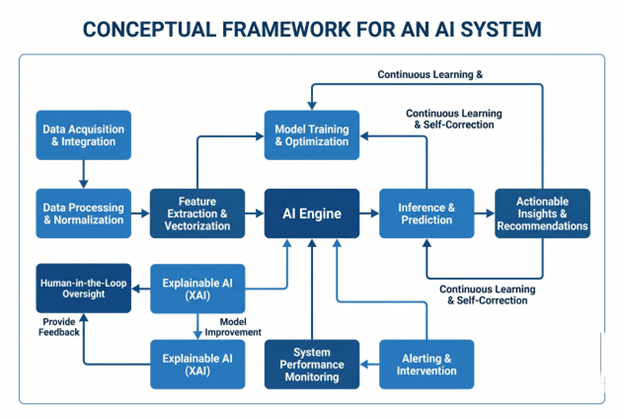
AI market research works through a six-step process: data ingestion (pulling from social media, reviews, surveys, behavioral signals), NLP reading (interpreting unstructured text), sentiment and emotion detection (classifying how people feel), pattern detection (finding clusters and correlations), predictive modeling (forecasting future behavior), and insight delivery (generating structured reports and alerts).
The specific tools involved depend on the research type. Social listening platforms handle brand monitoring. Automated survey platforms handle quantitative consumer studies. Competitive intelligence tools track competitor activity. Conversational AI platforms conduct adaptive interviews at scale.
Q3: What is the difference between AI and traditional market research?
Traditional market research generates primary data through surveys, focus groups, and interviews , then analyzes it manually over 4–12 weeks. It produces statistically validated findings but arrives slowly and costs $15,000–$100,000+ per study.
AI market research processes existing consumer signals continuously ; social media, reviews, behavioral data at a fraction of the cost and in hours rather than weeks. It does not replace traditional research for high-stakes strategic decisions requiring primary data validation, but it replaces the majority of recurring monitoring and tracking research that traditional methods handle too slowly and expensively to be useful in real time.
Q4: What are the main types of AI market research?
Four main types cover most use cases. Social listening monitors online brand mentions, sentiment, and category conversations in real time. AI-powered surveys automate the design, distribution, quality control, and analysis of consumer questionnaires. Competitive intelligence tracks competitor pricing, product launches, messaging, and market positioning automatically. Conversational AI research conducts adaptive interviews with consumers, following unexpected responses with relevant follow-up questions, producing qualitative depth at quantitative scale.
Most research programs combine multiple types: social listening for continuous monitoring, AI surveys for periodic validation, and competitive intelligence for strategic context.
Q5: Can AI replace traditional market research entirely?
No. AI excels at scale, speed, continuous monitoring, and pattern detection across large datasets. It cannot replace the human depth of focus group moderation, the statistical validity of structured primary research, or the motivational insight of in-depth qualitative interviews. The most effective research programs use AI to replace the volume of routine monitoring and tracking work, and reserve traditional methods for the strategic decisions where primary data and human depth are genuinely required.
Category 2: Tools and Platforms
Q6: What are the best AI market research tools in 2026?
The best tools depend on your specific research need. For social listening and brand monitoring: Brandwatch (enterprise scale) or Brand24 (mid-market). For automated consumer surveys: Quantilope or Attest. For competitive intelligence: Crayon. For audience profiling: GWI Spark. For secondary research on a free budget: Perplexity AI. For multilingual brand signal tracking across MENA and global markets: BuzzPulse-in-Q. For conversational consumer research: Converse-in-Q.
No single tool covers every research need. The most effective stacks combine one monitoring tool, one survey tool, and one competitive intelligence tool based on the research workflows that generate the most business value.
👉See the full comparison of the 7 best AI market research tools
Q7: What AI market research tools are free or low-cost?
Several capable free tools exist for small businesses and teams starting out. Perplexity AI (free tier) delivers strong secondary research, competitive landscape analysis, and trend identification with cited sources. Google Trends is free and reliable for demand validation and seasonal pattern analysis. AnswerThePublic (free tier) maps the questions consumers ask about your category. Reddit and Google Reviews provide free qualitative consumer sentiment if mined manually.
For paid tools with the lowest cost of entry, Brand24 starts at around $199/month for social monitoring. Perplexity Pro is $20/month. A capable small business research stack costs $0–$200/month using these tools in combination.
Q8: What is a synthetic persona in market research?
A synthetic persona is an AI-generated virtual consumer built from real behavioral and demographic data that simulates how actual customer segments respond to products, pricing, and messaging. Unlike static persona documents, synthetic personas are interactive; researchers query them in real time, test concepts against them, and receive responses calibrated to represent specific audience segments.
Leading platforms achieve up to 90% alignment with real human survey data on structured tasks like pricing, ranking, and concept testing. They are most reliable for structured research tasks and less accurate for capturing emotional nuance and cultural subtext. Simile, a Stanford spinout, raised $100 million in early 2026 specifically to build enterprise-grade AI digital twins for this purpose.
Q9: How do AI market research tools handle multiple languages?
AI market research platforms vary significantly in multilingual capability. Most leading social listening tools support sentiment analysis in 50–90+ languages for major world languages with reasonable accuracy. Arabic presents a specific challenge: the significant differences between Modern Standard Arabic and regional dialects (Moroccan Darija, Gulf Arabic, Levantine Arabic) require platform calibration on regional data before achieving reliable sentiment accuracy.
Platforms built for multilingual markets (like H-in-Q.com’s BuzzPulse-in-Q) provide native coverage across English, French, Spanish, and Arabic simultaneously, with specific calibration for MENA dialect variants. For global brands operating across language markets, verifying dialect-specific accuracy should be part of any platform evaluation.
Q10: How do I choose the right AI market research tool for my business?
Start with your highest-priority research job, not the tool with the most features. Ask: What is the most expensive or time-consuming research workflow in my organization? What insights am I currently missing because my research is too slow? What would I do with better competitive intelligence or earlier brand signals?
Match tool to job: social listening for always-on brand monitoring, survey platforms for consumer validation, competitive intelligence for market positioning. Request a demo using your real research questions, not the vendor’s pre-packaged demonstration dataset. Validate data quality controls before scaling. Start with one tool, prove ROI, then expand.
Category 3: Implementation
Q11: How do I get started with AI market research?
Start with the free stack before investing in paid tools. Set up Perplexity AI for competitive research, Google Trends for demand monitoring, and AnswerThePublic for customer question mapping. These three free tools take 30 minutes to set up and deliver immediate research value.
Once you have validated the value of AI research in your workflow, identify your single highest-priority paid tool based on your biggest research gap: social monitoring (Brand24), competitive intelligence (Crayon), or consumer surveys (Attest). Add one paid tool, validate ROI over 60–90 days, then expand the stack.
👉 [Internal Link: “The complete beginner’s guide to AI market research for small businesses” → /blog/ai-market-research-small-business]
Q12: How long does it take to implement AI market research?
Implementation time varies by tool type. Social listening platforms like Brandwatch or Brand24 can be configured and producing initial data within 24–72 hours; setup involves defining keywords, brand names, and competitors to monitor. AI survey platforms like Attest require 1–2 days to design a study and typically deliver results within 3–5 days. Competitive intelligence tools like Crayon require 1–2 weeks for full competitor setup and calibration.
For specialized language contexts (particularly Arabic dialects) allow 4–8 weeks of calibration before relying on sentiment outputs for strategic decisions. The calibration period is an investment, not a delay: it is what separates reliable Arabic-language insight from misleading outputs built on standard MSA models.
Q13: How do I measure the ROI of AI market research?
Measure ROI across three dimensions: cost savings, time savings, and decision quality improvements. Cost savings: compare annual AI platform subscriptions to the traditional research budget they replace. Time savings: track how many hours per week the research team reclaims from manual data collection and analysis. Decision quality: track business outcomes from decisions made using AI research signals; campaign performance, product launch success rates, crisis response speed.
The most compelling ROI cases in the industry combine all three. A typical mid-market implementation shows 50–60% direct cost reduction, 75% reduction in analysis time, and measurable improvements in campaign performance from faster and more frequent insight cycles.
Q14: What data do AI market research tools need to work effectively?
Requirements vary by tool type. Social listening tools pull from public data sources, no internal data required. Competitive intelligence tools monitor publicly available competitor information, again, no internal data required. AI survey platforms require you to define your target audience and research questions. Predictive analytics tools work best with your own historical data: past purchase records, CRM data, customer behavior patterns.
For maximum value, connect AI research platforms to your CRM and marketing analytics stack. Insights detected by social listening that connect to pipeline data, or consumer survey findings that link to conversion data, generate significantly higher actionable value than standalone research outputs that sit disconnected from business data.
Q15: What are the most common implementation mistakes?
Five implementation mistakes account for most AI market research failures. Skipping calibration for specialized language or category contexts produces misleading outputs with high confidence scores. Replacing all traditional research at once removes the validation layer before AI outputs have been proven reliable for your specific context. Treating AI output as final truth without human review introduces errors into strategic decisions. Choosing tools by feature count rather than by research job match leads to paying for capability that is never used. Failing to connect research to decisions, running AI research that generates reports no one acts on, produces zero ROI regardless of platform quality.
Category 4: Accuracy and Ethics
Q16: How accurate is AI market research?
Accuracy depends heavily on tool type, language context, and research task. Standard sentiment analysis on clear English text achieves 85–90% accuracy on most major platforms. Accuracy decreases for irony, cultural subtext, niche industry vocabulary, and non-standard language including dialects. Synthetic consumer platforms achieve up to 90% alignment with real human survey data on structured tasks; pricing, ranking, concept testing, but perform less accurately on emotional nuance and group dynamics.
The practical standard for AI research accuracy is: reliable for directional insight and pattern detection; requires human validation before driving consequential business decisions; and improves significantly with calibration on domain-specific language.
Q17: What are the risks of AI market research?
Four risks merit attention. Data quality risk: AI trained on fraudulent survey responses, biased social samples, or demographically unrepresentative data produces misleading insights with high confidence. Hallucination risk: generative AI tools can produce plausible-sounding but factually incorrect research outputs, particularly on niche market sizing and specific consumer behavior statistics. Dialect and cultural risk: sentiment analysis models calibrated on standard language perform poorly on dialects, regional vernacular, and cultural context without adaptation. Overconfidence risk: dashboards and confidence scores can create a false sense of certainty in outputs that require human judgment to interpret correctly.
Mitigating these risks requires data quality controls, human review checkpoints, calibration investment for specialized contexts, and treating AI outputs as research inputs rather than research conclusions.
Q18: Who owns the data when using AI market research platforms?
Data ownership terms vary by vendor. Most enterprise platforms; Brandwatch, Quantilope, Attest; assign ownership of raw data and generated insights to the client, with explicit contractual protections. Key questions to verify in any vendor agreement: Does the vendor train their AI models on your data? Who owns the insights generated from your research? How is your data stored, and in which jurisdictions? What happens to your data if you end the contract?
ESOMAR has published “20 Questions to Help Buyers of AI-Based Services for Market Research” as a standard framework for evaluating vendor data practices. Reviewing vendor contracts against this framework before signing is best practice for any enterprise research program.
Q19: Is AI market research ethical?
AI market research raises several ethical questions that responsible practitioners address explicitly. Synthetic consumer research; using AI-generated personas rather than real respondents, raises questions about representation accuracy, particularly for underrepresented demographic groups where training data is limited. Social listening raises questions about consumer consent: the people whose conversations are being monitored did not agree to be research subjects. Regulatory frameworks are evolving: California’s CPPA automated decision-making rules came into effect January 2026, and the EU AI Act’s high-risk provisions activate August 2026.
The ethical standard for AI market research: use publicly available data for social listening, disclose AI methods to clients and stakeholders, validate synthetic research outputs against real human data before high-stakes use, and stay current with applicable data protection regulations in your operating markets.
Category 5: The Future
Q20: Where is AI market research headed in the next two years?
Four trajectories are already underway and will accelerate through 2027. Synthetic research will become mainstream: analysts project synthetic data will account for over 50% of market research inputs by 2027. Agentic research will replace manual monitoring: AI agents will autonomously track research questions, surface relevant signals, and trigger alerts without human prompting; moving from dashboards to proactive intelligence. AI-native consumer behavior will require new measurement methods: as more consumer decisions happen inside AI systems rather than on searchable web surfaces, new measurement disciplines focused on AI recommendation tracking and conversational commerce analytics will become standard. Multilingual AI research parity will close the global research gap: the cost and quality advantage that English-language research has historically held over Arabic, French, and other language markets is closing as NLP models improve; opening emerging market consumer intelligence at scale for the first time.
The organizations that build their AI research infrastructure now are not just moving faster than competitors, they are building compounding institutional intelligence that becomes more valuable with every research cycle and harder to replicate with every passing month.
Quick Reference: AI Market Research at a Glance
| Question | Quick Answer |
| What does AI market research cost? | $0–$200/month (small business) to $5,000+/month (enterprise) |
| How fast does it produce insights? | 24–72 hours for most research questions |
| How accurate is it? | 85–90% on standard tasks; varies by language/complexity |
| Does it replace traditional research? | No – augments it; replaces monitoring and tracking workflows |
| Best free tool to start with? | Perplexity AI for secondary research; Google Trends for demand |
| How much can it save? | 50–60% vs. traditional agency research costs |
| Is it suitable for Arabic markets? | Yes, with dialect calibration (4–8 weeks) |
| Who is it for? | Marketers, brand managers, research teams, small businesses |
Still Have Questions?
The 20 answers above cover the questions US marketers ask most often. For deeper exploration of specific topics, the articles below go further:
👉 How AI Market Research Works: The 6-Step Process →
👉 AI vs Traditional Market Research: Full Comparison →
👉 The 7 Best AI Market Research Tools in 2026 →
👉 AI Market Research for Small Businesses →
👉 10 Ways AI Is Changing Consumer Research →
👉 AI Market Research Case Study: 61% Cost Reduction →
Ready to implement AI market research for your organization? H-in-Q.com builds custom AI research infrastructure for US businesses and global brands. book your free strategy call →