

You have never done AI market research before. You have heard the term; you understand it involves artificial intelligence and consumer data, but you have no idea where to open a browser tab and start. This guide is written for exactly that person.
By the time you finish reading, you will have a clear picture of the four tools to open first, the exact prompts to type into each one, and a 48-hour schedule that takes you from complete beginner to having real, actionable insight about your market, without spending a dollar or learning anything technical. According to Qualtrics’ 2026 Market Research Trends report, 95% of researchers now use AI tools regularly or experimentally. The fastest path to joining them is a specific, operational starting point; not a conceptual overview.
What AI Market Research Actually Means for a Beginner
Before touching any tool, a one-paragraph definition that cuts through the jargon.
AI market research is the use of artificial intelligence tools to understand your customers, your competitors, and your market faster and at lower cost than traditional methods like surveys and focus groups. For a beginner, it practically means typing questions into AI-powered platforms and getting structured, cited answers about your competitive landscape, customer behavior, and market trends in minutes rather than weeks.
You do not need to understand machine learning. You do not need to know what NLP stands for. You need to know which tool to open and what to type. That is what this guide provides.
The Beginner’s Four-Tool Starter Kit (All Free)
These four tools form your complete starter kit. All are free to use at the level a beginner needs. None require account setup beyond basic email registration.
Tool 1: Perplexity AI – Your Research Engine
What it does: Perplexity combines AI language capabilities with real-time web search, delivering structured, cited answers to research questions. Unlike standard AI chatbots, it searches the web when you ask questions, so market data and competitive information reflect current conditions, not training data from months ago.
Why beginners should start here: It is the closest thing to having a research analyst available on demand. You ask a question in plain language. It searches relevant sources, synthesizes the findings, and shows you exactly which sources it used so you can verify anything important.
Free tier: Unlimited basic searches with citations. More than sufficient for all beginner research needs.
Open it at: perplexity.ai
Tool 2: Google Trends – Your Demand Validator
What it does: Google Trends shows relative search interest in any topic over time, broken down by geography, related queries, and comparison terms. It tells you whether interest in your product category is growing, flat, or declining and where in the US that interest is strongest.
Why beginners need it: Before investing time or money based on a market assumption, spend 90 seconds on Google Trends to verify that people are actually searching for what you think they are. A declining search trend is not a disqualifier, but it is information you need before making decisions.
Free tier: Completely free, no account required.
Open it at: trends.google.com
Tool 3: AnswerThePublic – Your Customer Question Map
What it does: AnswerThePublic pulls real autocomplete data from search engines and organizes it into a visual map of the questions people actually ask about any topic. Type in your product category and see hundreds of real customer questions organized by intent.
Why beginners need it: The questions people type into Google before they find you are your most valuable marketing intelligence. AnswerThePublic shows you exactly what your potential customers do not understand, what problems they are trying to solve, and what language they use to describe their needs. This feeds directly into messaging, content strategy, and product positioning.
Free tier: Limited searches per day, sufficient for initial research on 3–5 core topics.
Open it at: answerthepublic.com
Tool 4: Reddit Search – Your Unfiltered Consumer Voice
What it does: Reddit is where consumers express their unfiltered opinions about products, brands, and categories without the social pressure of review platforms or the awareness that a brand might be watching. Searching Reddit for your category, your competitors’ names, or your customers’ pain points reveals the authentic consumer language that surveys and focus groups rarely capture.
Why beginners need it: It is free, requires no tool setup, and produces qualitative consumer insight that traditional research would charge thousands of dollars to replicate. Thirty minutes reading relevant Reddit threads about your competitors will tell you more about real customer frustrations than most survey reports.
Free tier: Completely free, no account required.
Access at: reddit.com, then search your category or competitor name
Your 48-Hour Beginner Quick-Start Schedule
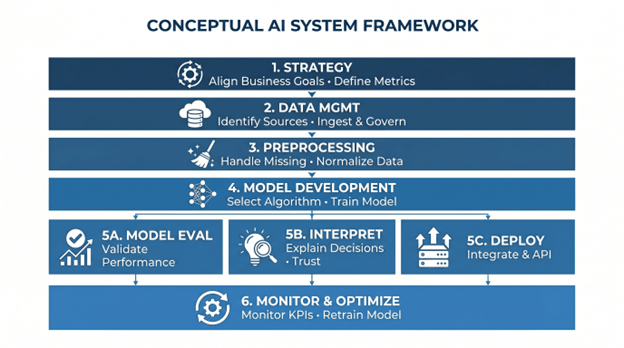
This schedule is designed to take you from zero to a functional initial market picture in two business days, spending no more than 2–3 hours per day.
Day 1 (2–3 hours): Competitive Landscape and Market Context
Hour 1: Competitive overview with Perplexity AI
Open Perplexity AI and type these four prompts in sequence, reading and noting the key findings from each:
Prompt 1: Competitive landscape: “I’m researching the [your category] market in the US. Who are the top 3–5 competitors, how do they position themselves, and what are their approximate price points?”
Prompt 2: Market size and growth: “What is the estimated US market size for [your category] in 2026 and what is the expected growth rate over the next 3 years? Cite your sources.”
Prompt 3: Customer complaints: “What are the most common customer complaints about [your top competitor]? Summarize the main recurring issues from online reviews and forums.”
Prompt 4: Industry trends: “What are the 3–5 most significant trends reshaping the [your industry] industry in 2026? Include specific examples.”
After each response, note the 2–3 most actionable findings and click through to verify at least one cited source per response. This verification habit is what separates reliable AI research from unchecked AI output.
Hour 2: Demand validation with Google Trends
Open Google Trends and run these checks:
- Search for your primary product or category keyword. Select “United States,” “Past 5 years.” Is the trend line growing, flat, or declining?
- Add your top 2–3 competitors as comparison terms. Which has the strongest and fastest-growing search interest?
- Check “Related queries” for rising searches; these often reveal emerging sub-categories or adjacent needs your competitors have not addressed.
Screenshot or note the findings. A growing trend with rising related queries is a strong validation signal. A declining trend requires explanation before building a strategy around the category.
Hour 3: Customer question mapping with AnswerThePublic
Open AnswerThePublic and search your primary product category. Set the country to United States.
Review the wheel or list of questions and identify:
- The 5 questions that appear most frequently (high search volume signal)
- The 3 questions that your current product or messaging directly answers
- The 3 questions that your competitors are not answering well (from your Perplexity research)
This gap; questions consumers are asking that no competitor is answering clearly, is your first content and positioning opportunity.
End of Day 1 output: A one-page competitive landscape summary with market size estimate, trend direction, top competitor positioning, main customer complaints, and a list of unanswered customer questions.
Day 2 (2 hours): Consumer Voice and Pattern Validation
Hour 1: Reddit research for unfiltered consumer insight
Search Reddit for three specific queries and spend 15 minutes per query reading the top posts and comments:
- [your category] recommendations: What are consumers recommending to each other, and why?
- [your competitor name] review or [your competitor name] problems: What do real users say when they are not filling out a structured review form?
- [your category] alternatives: What are consumers looking for that current options do not provide?
Note the specific language consumers use. The exact words they use to describe problems, desires, and comparisons are more valuable than any marketing framework; because they are the words your marketing should speak back to them.
Hour 2: Synthesis and first insight document
Combine your Day 1 and Day 2 findings into a single structured document. Format it as:
- Market overview: Size, growth direction, main category dynamics
- Top 3 competitors: Positioning, price point, main customer complaints
- Consumer language: 10–15 exact phrases consumers use to describe their needs and frustrations
- Unanswered questions: 3–5 questions consumers ask that no competitor answers clearly
- Opportunity signal: Based on all of the above, where is the clearest gap between what consumers want and what the market currently offers?
This document is your first AI market research output. It took 4–5 hours total, cost nothing, and would have taken a junior analyst 2–3 weeks to produce manually.
5 Mistakes Every AI Market Research Beginner Makes
Learning these mistakes before you make them saves significant time and prevents your first AI research from producing misleading outputs.
Mistake 1: Treating AI output as ground truth without verification. AI tools (including Perplexity) can produce plausible-sounding statistics and market size figures that are fabricated or significantly outdated. Verify every specific number by clicking through to the cited source before including it in any document that will influence a business decision. The rule: if you cannot find the original source, do not treat the statistic as reliable.
Mistake 2: Writing vague prompts and accepting vague answers. “Tell me about the fitness market” produces a useless response. “What are the top 5 direct-to-consumer fitness equipment brands in the US, how do they position themselves differently, and what is the typical price range for their core products?” produces a useful one. Specificity in your prompt directly determines the quality of your output. Add context (your product type, your target customer, your geographic focus), specify the format you want the answer in, and ask for citations.
Mistake 3: Running a single research session and calling it done. AI market research is most valuable when it is continuous, not a one-time activity. The competitive landscape you research today will change next month. Schedule a weekly 30-minute research session: a Perplexity check on competitor activity, a Google Trends review on key terms, and a quick Reddit scan for emerging consumer language. The compounding value of regular AI research far exceeds the value of a single intensive session.
Mistake 4: Using AI for research questions that require primary data. AI tools analyze existing public data. They cannot tell you whether your specific target customers will pay $49 or $79 for your specific product, because that information does not exist in public data. Questions that require primary data; validated pricing, product concept testing, new segment exploration, still require traditional research methods or dedicated AI survey platforms. Know the limit of what free AI tools can answer before depending on them for consequential decisions.
Mistake 5: Ignoring the human validation step. The fastest way to embed bad information into your strategy is to skip the step where an experienced person reads the AI output and says, “that doesn’t match what I know about this category.” AI research is most reliable when it surfaces patterns for an expert to evaluate, not when it replaces expert judgment entirely. Even as a beginner, you have domain knowledge about your market that should be used to quality-check AI outputs before you act on them.
How AI Market Research Works Under the Hood (The Non-Technical Version)
You do not need to understand the technology to use AI market research effectively, but a basic understanding helps you know why the tools behave the way they do and where their limits come from.
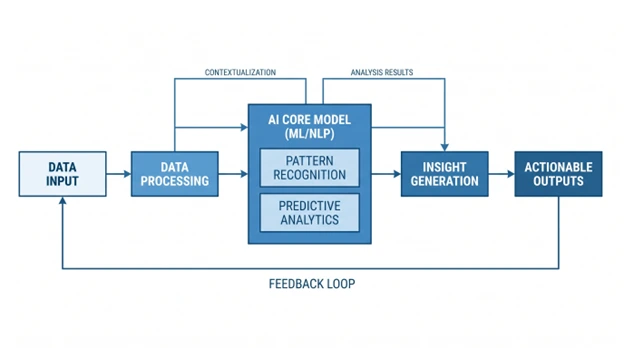
Natural language processing (NLP) is what allows AI tools to read and understand text; customer reviews, social media posts, survey responses, the same way a human analyst would, but thousands of times faster. When you ask Perplexity about competitor complaints, NLP is what reads and categorizes the language in those reviews.
Machine learning is what allows AI platforms to identify patterns across large datasets without being explicitly programmed to look for specific patterns. When a social listening tool detects a sentiment shift around your brand before it appears in your quarterly survey, machine learning is finding the correlation in behavioral data.
Predictive analytics uses historical patterns to forecast future behavior. When AI tools tell you a trend is “emerging,” they are applying pattern recognition to historical search and behavioral data to extrapolate forward.
For a beginner, the practical implication is AI tools are very good at processing large amounts of existing information and finding patterns. They are less reliable at generating new information that does not exist in their data sources. Ask them to synthesize and analyze. Do not ask them to predict specific numbers or create data that does not exist.
👉 For a deeper technical explanation: How AI Market Research Works: The 6-Step Process →
What to Do After Your First 48 Hours
Your initial research is complete. Here is the progression that builds on it.
Week 2: Add competitive monitoring. Sign up for Brand24 (free trial available) and set up monitoring for your brand name, your top competitor’s name, and your primary category keyword. This takes 30 minutes and gives you real-time alerts when these terms appear online; the beginning of always-on competitive intelligence.
Week 3: Deepen customer research. Use AnswerThePublic to map the questions around your top three product features or use cases. Cross-reference the questions with your Reddit research findings. The overlap between what consumers ask in search and what they express in unfiltered forum conversations is your highest-confidence insight about real customer needs.
Month 2: Add a survey layer. Sign up for a free or low-cost survey platform (SurveyMonkey free tier, or Attest free trial) and run your first consumer validation question to a defined audience. Use the questions you surfaced from AnswerThePublic to inform what you ask. AI secondary research tells you what the market looks like from the outside; a survey tells you what your specific target customer thinks when you ask them directly.
Month 3: Consider your first paid tool. Based on the research you have done and the gaps you have identified, select one paid tool that solves your single highest-priority research problem. If brand monitoring is your biggest need, Brand24 at ~$199/month. If competitive intelligence is the priority, Semrush at ~$117/month. If consumer surveys are the gap, Attest at custom pricing. One tool, one job, proven ROI before expanding.
👉 The complete small business AI research stack guide: AI Market Research for Small Businesses →
Your Beginner’s Toolkit Reference Card
| Tool | Job | Cost | Time to First Output |
| Perplexity AI | Competitive research + market context | Free | 10 minutes |
| Google Trends | Demand validation + trend direction | Free | 5 minutes |
| AnswerThePublic | Customer question mapping | Free (limited) | 15 minutes |
| Reddit Search | Unfiltered consumer voice | Free | 30 minutes |
| Brand24 | Social monitoring (next step) | ~$199/month | 1 hour setup |
| Semrush | Competitive search intelligence | ~$117/month | 2 hours setup |
| Attest | Consumer surveys | Custom | 1 day first results |
How AI Is Making Market Research Accessible to Everyone
The structural shift that makes this guide possible is real. The research capabilities described here; competitive landscape analysis, demand validation, consumer question mapping, sentiment monitoring, were genuinely inaccessible to most small businesses and individual marketers three years ago. They required agency budgets, specialist skills, and timelines measured in weeks.
AI has eliminated every one of those barriers simultaneously. The free tools available in 2026 deliver research capability that was enterprise-only in 2022. The prompts in this guide produce outputs that junior research analysts would have spent days collecting and organizing manually.
The only remaining barrier is starting. The 48-hour schedule in this guide removes it.
As your research capability grows, H-in-Q.com’s BuzzPulse-in-Q and Converse-in-Q platforms extend what you can do beyond the free tools; adding real-time multilingual brand monitoring and AI-moderated consumer conversations for businesses ready to invest in deeper intelligence infrastructure.
Frequently Asked Questions: AI Market Research for Beginners
Frequently Asked Questions: AI Market Research for Beginners
How do I start AI market research as a complete beginner?
Open Perplexity AI, type your first competitive research question; "Who are the top 3 competitors in [your category] and how do they position themselves?", and read the cited response. That is your first AI market research session. From there, follow the 48-hour schedule in this guide: add Google Trends for demand validation, AnswerThePublic for customer question mapping, and Reddit for unfiltered consumer voice. The entire starter kit is free and takes under 5 hours total to produce a useful initial market picture.
What is the best free AI tool for market research beginners?
Perplexity AI is the best free starting tool because it combines AI capabilities with real-time web search and cited sources. Unlike standard AI chatbots that draw only on training data, Perplexity searches the web when you ask questions; making competitive and market data current rather than months stale. The free tier provides unlimited basic searches with source citations, making it reliable enough for initial research when paired with source verification.
How accurate is AI market research for beginners?
AI research is reliable for directional market intelligence; understanding competitive positioning, identifying consumer question patterns, validating trend directions, and discovering customer language. It is less reliable for specific statistics: market size figures, growth rates, and numerical claims should always be verified against the cited source before use. The practical rule: use AI outputs to guide your research direction and identify what to investigate further, not as the final word on factual claims.
Do I need technical skills to do AI market research?
No. Every tool in the beginner starter kit requires only the ability to type questions in plain English and read structured responses. No coding, no data analysis software, no statistics background. The most important skill for beginner AI market research is writing clear, specific prompts, and that improves naturally with practice over your first few sessions.
How long does it take to learn AI market research?
The basic workflow described in this guide; competitive research, demand validation, customer question mapping, consumer voice research, takes under 48 hours to learn and execute for the first time. Becoming proficient at writing high-quality prompts and interpreting outputs reliably takes 2–4 weeks of regular use. Building a complete ongoing research routine with monitoring and periodic surveys takes 2–3 months from the first session.
When should I upgrade from free tools to paid platforms?
Upgrade when a specific research gap is costing your business money or time that a paid tool would eliminate. The most common triggers: you need real-time brand monitoring that manual Reddit searches cannot keep up with (add Brand24 or similar); you need deeper competitive search intelligence than free Google Trends provides (add Semrush); you need validated consumer survey data from a defined audience rather than inferred patterns from public data (add Attest or Quantilope). Pay for one tool at a time and prove the ROI before adding the next.
Conclusion
You came to this guide as a complete beginner. You are leaving with a free four-tool starter kit, a 48-hour quick-start schedule, four proven research prompts, and a clear picture of the five mistakes to avoid.
The only thing left is to open a browser tab and type your first prompt into Perplexity AI. The research community you are joining has grown from early adopters to 95% of professionals in two years; because the tools genuinely work, and because the barrier to entry is genuinely as low as this guide describes.
Your first competitive research question is waiting. Type it.
Ready to go beyond the free starter tools when you are ready to grow? H-in-Q.com builds AI market research infrastructure for organizations at every stage, from first-time users to enterprise research programs. Explore our approach →