
Two Models, Real Costs, and What US Marketers Need to Know
The average traditional focus group costs between $7,000 and $30,000 per session and delivers results six to eight weeks after you needed them. For most US marketing teams operating on compressed timelines and tighter budgets, that math stopped making sense years ago. What has changed in 2026 is that there is now a better option. AI focus groups deliver the same qualitative depth at a fraction of the cost and in a fraction of the time, and the gap is widening every quarter.
This guide explains exactly how AI focus groups work; the two distinct models, the step-by-step process behind each, what the research says about accuracy, and how to decide which approach is right for your next project. H-in-Q’s AI market research team has compiled this from hands-on implementation experience across US and MENA markets. By the end, you will know how to get started, what to expect, and how to avoid the mistakes most teams make in their first AI research project.
What Is an AI Focus Group? The Definition That Actually Matters
An AI focus group is a market research method that uses artificial intelligence; either to moderate discussions with real participants or to simulate audience reactions through AI-generated personas. It delivers the qualitative depth of traditional focus groups at a fraction of the cost and time, making consumer insight accessible to businesses of any size.
That definition matters because most content on this topic conflates two very different approaches. Understanding the distinction is the first decision every research team needs to make. The global market research industry is valued at $140 billion, and AI is now the primary driver of its transformation, with 83% of market research professionals planning to invest in AI for their research activities according to Qualtrics’ 2025 industry survey. The shift is not experimental; it is operational.
AI has split focus group research into two fundamentally different disciplines, and choosing the wrong one for your objective will produce unreliable data regardless of how well you execute.
The Two Models of AI Focus Groups: Which One Do You Actually Need?
Before running a single session, every US marketing team needs to understand that “AI focus group” describes two completely different methodologies. Mixing them up or choosing the wrong one for your research objective; is the most common mistake in AI-powered qualitative research.
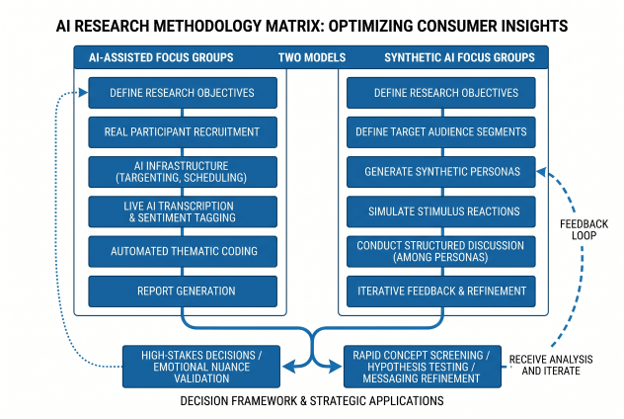
Model 1: AI-Assisted Focus Groups (Real Participants + AI Infrastructure)
This approach keeps real human participants at the center. AI handles everything around them: recruitment targeting, scheduling, real-time transcription, sentiment tagging, theme extraction, and report generation. What used to require a three-person research team and six weeks of work now runs with one researcher and a two-week timeline.
The core components of an AI-assisted focus group include automated recruitment using algorithm-driven targeting to source participants matching precise demographic and psychographic criteria, live AI transcription with 90%+ accuracy across accents and dialects, real-time sentiment analysis that flags emotional responses as they happen, and automated thematic coding that identifies patterns across hundreds of responses in minutes rather than days.
This model is the right choice when you need emotionally nuanced feedback, are testing sensitive topics where lived human experience matters, or are making high-stakes product or positioning decisions that will drive significant investment. The authenticity of real participants is irreplaceable for these use cases.
Model 2: Synthetic AI Focus Groups (AI-Generated Personas, No Real Participants)
This is a newer and more radical approach. Instead of recruiting real people, the system generates synthetic personas representing your target audience segments. These AI-powered virtual participants evaluate your concepts, messaging, and creative; providing both quantitative predictions and qualitative reasoning based on behavioral and demographic data patterns.
Synthetic AI focus groups are the most cost-effective hypothesis-testing tool in the modern research toolkit. They will not replace deep qualitative research, but they will tell you which hypotheses are worth testing with real humans and which ones to kill before you spend a dollar on recruitment.
The accuracy case is solid: studies comparing AI-generated focus group responses to real participant sessions show 85–92% correlation in sentiment and theme detection (Zocket Research, 2026). That correlation is strong enough for directional research, concept screening, and messaging refinement. It is not strong enough for final validation of high-stakes decisions.
How AI Focus Groups Work: Step-by-Step Process for Each Model
AI-Assisted Focus Groups: 6 Steps from Brief to Insight
Step 1: Define your research objective. Write a specific, answerable question before touching any tool. “How do female Gen Z consumers in the US respond to our new product positioning?” is a research objective. “Understand our brand” is not. The quality of your AI focus group output is directly proportional to the precision of your objective.
Step 2: Configure AI recruitment targeting. AI recruitment tools allow you to specify demographic attributes (age, location, income, job title), psychographic profiles (values, media consumption, purchase behavior), and behavioral qualifiers (category users, competitor customers, brand aware vs. unaware). AI matches participants from panels of millions in hours rather than days.
Step 3: Design the discussion guide. Structure your guide around 6–10 open-ended questions with clear probing prompts. AI moderation tools can adapt questions in real time based on participant responses, but the strategic logic of the discussion guide still requires human judgment. Front-load your most critical questions, attention and quality drop after 45 minutes in any format.
Step 4: Run the session with AI moderation support Modern AI focus group platforms like HiVox-in-Q facilitate community-based discussions where AI manages the flow of conversation, ensures all participants contribute, and flags high-value responses in real time. The moderator’s role shifts from facilitating logistics to interpreting strategic signals.
Step 5: AI analysis and thematic coding Post-session, AI tools automatically transcribe, sentiment-tag, and code the discussion. Researchers using AI-assisted analysis discover critical insights up to 5x faster than traditional manual coding methods (Looppanel, 2024). The system surfaces recurring themes, outlier perspectives, and emotional intensity signals across the full dataset.
Step 6: Synthesize and act AI-generated reports provide sentiment breakdowns, theme hierarchies, key quotes, and recommended actions. The human researcher’s job at this stage is to validate the synthesis against business context; AI identifies patterns; humans determine what those patterns mean for the decision at hand.
Synthetic AI Focus Groups: 5 Steps from Prompt to Findings
Step 1: Define your target audience segment. Describe your audience in specific terms: demographics, psychographics, behavioral patterns, and purchase context. The richer this description, the more accurate the synthetic personas will be. Generic descriptions produce generic personas that reflect average opinion rather than your specific target audience.
Step 2: Generate synthetic personas The AI system builds detailed persona profiles; complete with pain points, buying triggers, objections, media habits, and behavioral archetypes; grounded in your audience description and trained on large-scale behavioral data. Best practice is to generate 5–8 distinct personas representing your key audience segments, including at least one skeptic or edge case.
Step 3: Present your stimulus. Expose the personas to your research material: an ad concept, product name, landing page copy, pricing options, or messaging alternatives. This mirrors the stimulus presentation phase of a traditional focus group. You can test multiple variants simultaneously across all personas; something physically impossible in traditional research.
Step 4: Collect reactions and discussion. The AI conducts a structured discussion among the personas, with each responding independently based on its profile before group dynamics are introduced. This eliminates the groupthink, social desirability bias, and dominant-voice effects that consistently distort traditional focus group data.
Step 5: Receive analysis and iterate. The system generates a transcript, sentiment breakdown, key themes, and recommendations. The entire process from persona generation to final report takes 30 minutes to a few hours depending on complexity. Critically, you can iterate refine your stimulus based on findings and run the next version immediately, with zero additional recruitment cost.
AI Focus Groups vs. Traditional Research: The Honest Comparison
| Factor | Traditional Focus Group | AI-Assisted | Synthetic AI |
| Cost per session | $7,000–$30,000 | $2,000–$8,000 | $100–$500 |
| Timeline | 4–8 weeks | 1–2 weeks | Hours |
| Sample size | 6–12 participants | 20–100+ | Unlimited |
| Geographic reach | Limited | Global | Global |
| Groupthink risk | High | Medium | Eliminated |
| Emotional nuance | Highest | High | Moderate |
| Best for | High-stakes validation | Scalable qual research | Rapid hypothesis testing |
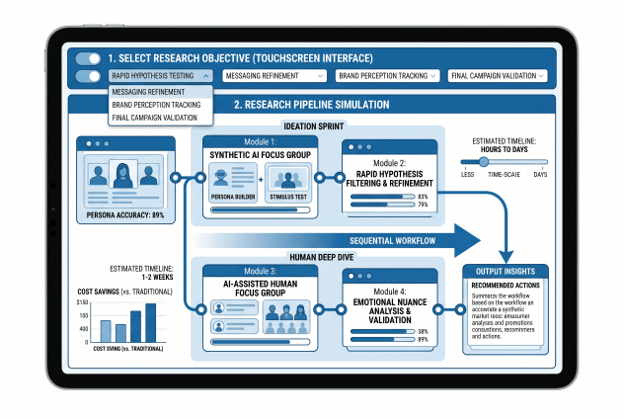
The most important row is the last one. These are not competing methods; they are sequential tools in a research strategy. Use synthetic AI focus groups to generate and screen hypotheses. Use AI-assisted focus groups with real participants to validate the strongest candidates. Reserve traditional in-person focus groups for the highest-stakes, most emotionally complex decisions.
How AI Is Transforming Focus Group Research for US Businesses in 2026
The traditional focus group was designed for a world where insights were scarce and expensive. In 2026, the problem has inverted: insights are abundant, and the competitive advantage belongs to the organizations that can generate, test, and act on them faster than their competitors.
AI is enabling three structural shifts in how US businesses approach qualitative research. First, research is moving from episodic to continuous; rather than one focus group per quarter, leading marketing teams now run AI-powered sessions weekly, testing messaging, creative, and positioning in near real-time. Second, research access is democratizing; AI focus groups have reduced the entry cost of professional qualitative research by 80–90%, putting enterprise-grade insights within reach of mid-market and growth-stage businesses. Third, bias is being systematically reduced; AI moderation eliminates the moderator influence, groupthink, and social desirability bias that have always distorted traditional focus group data.
Hivox-in-Q’s community-based AI focus group platform represents this shift in practice: real participants engage in AI-facilitated discussions that combine the human authenticity of traditional research with the analytical precision and scalability of AI infrastructure, delivering insights that neither approach could produce alone.
Tools for AI Focus Groups in 2026
- Hivox-in-Q: Community-based AI focus group platform combining real-participant discussions with AI moderation and real-time analysis. Built for brands that need authentic qualitative insights at scale, with multilingual support. 👉 AI focus group platforms
- Looppanel: AI-powered qualitative research platform specializing in transcription, automated tagging, and theme extraction for focus groups and user interviews.
- Dytto: Specializes in synthetic AI focus group generation with persona-building tools and concept testing workflows.
- Perspective AI: AI-moderated focus group platform with automated research plan generation and market strategy synthesis.
- Remesh: Online focus group platform supporting 50–250 participants with AI-powered sentiment analysis and real-time polling. 👉 AI market research tools
FAQ: How AI Focus Groups Work? Questions US Marketers Are Asking
How AI Focus Groups Work? Questions US Marketers Are Asking
What is an AI focus group?
An AI focus group is a market research method that uses artificial intelligence to either moderate discussions with real participants or simulate audience reactions through AI-generated personas. It delivers qualitative consumer insights faster and at significantly lower cost than traditional focus groups, with sessions completing in hours rather than weeks.
How do AI focus groups work step by step?
AI focus groups follow a six-step process: define your research objective, configure audience targeting or generate synthetic personas, design the discussion guide, run the AI-moderated session, analyze results through automated thematic coding, and synthesize findings into actionable recommendations. The full process takes 1–3 days for AI-assisted sessions and a few hours for synthetic models.
Are AI focus groups as accurate as traditional focus groups?
For directional research, concept testing, and messaging evaluation, studies show 85–92% correlation between AI-generated responses and real participant focus groups. AI focus groups are most reliable for screening hypotheses and refining options. For final validation of high-stakes decisions with strong emotional components, combining AI research with real-participant validation produces the most reliable results.
How much do AI focus groups cost in 2026?
Traditional focus groups cost $7,000–$30,000 per session. AI-assisted focus groups with real participants run $2,000–$8,000. Synthetic AI focus groups using persona simulation cost $100–$500 per study; an 80–90% reduction versus traditional methods. The cost reduction makes continuous research economically viable for the first time for most US businesses.
Can AI replace human moderators in focus groups?
AI can handle moderation logistics; managing discussion flow, ensuring equal participation, probing vague responses, and flagging high-value moments in real time. For community-based and large-scale qualitative research, AI moderation consistently outperforms human moderators on consistency and bias control. Human judgment remains essential for strategic interpretation and high-stakes emotional research.
What is the difference between AI focus groups and traditional focus groups?
Traditional focus groups involve 6–12 recruited participants in a facilitated in-person or video session, costing $7,000–$30,000 and taking 4–8 weeks. AI focus groups use artificial intelligence for moderation, analysis, or participant simulation; reducing costs by 80–90%, compressing timelines from weeks to hours, scaling to hundreds of participants, and eliminating the groupthink and moderator bias that consistently affect traditional res
Conclusion
AI focus groups have crossed the threshold from experimental to essential. The $140 billion market research industry is reorganizing around AI-assisted and synthetic research models because they deliver qualitative insight faster, cheaper, and with less systematic bias than any method that came before. For US marketing teams, the practical implication is straightforward: the barrier to continuous, high-quality consumer research has collapsed, and the competitive advantage now belongs to teams that build AI research into their regular workflow rather than treating it as a one-off project.
The decision is not whether to adopt AI focus groups; it is which model to start with. If you need rapid concept screening or messaging validation, start with synthetic AI personas. If you need authentic qualitative depth at scale, AI-assisted platforms with real participants deliver. Most sophisticated research programs use both in sequence. H-in-Q’s Hivox-in-Q platform is built for exactly that workflow; combining community-based real-participant discussions with AI infrastructure that makes enterprise-grade qualitative research accessible to any US business ready to move faster than their competitors. Start your first AI focus group today →
The brands that build this capability now will not be playing catch-up in 2027.