


Introduction
91% of companies say market research data directly increased their sales, yet most early-stage founders skip it entirely, assuming real research requires a budget they don’t have. It doesn’t. Government databases, customer interviews, free survey tools, and social listening cover almost everything a paid research agency would provide, at the cost of your own time instead of a five-figure invoice. Skip this step and you’re building on assumptions instead of evidence, which is exactly how products launch to a market that was never actually there. This guide gives you 8 free market research methods that actually work, in the order you should use them, with specific targets for how much data is enough. At H-in-Q, our own free tool suite exists precisely because we watched founders skip market research not from laziness, but because nobody laid out a clear, no-budget path to doing it properly. In this guide, you’ll get exactly that path.
What Free Market Research Actually Means
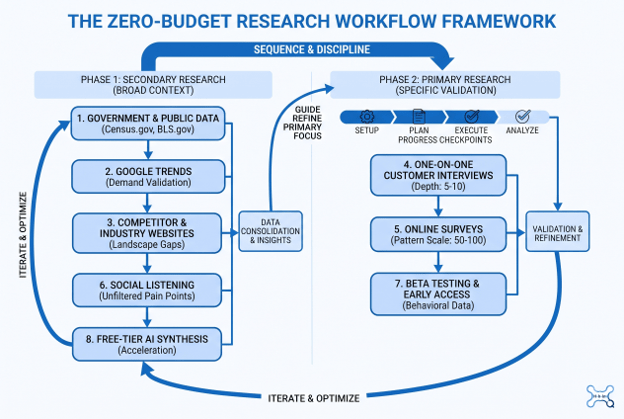
Free market research doesn’t mean lower-quality research; it means trading a research budget for your own time and discipline. It splits into two categories: secondary research (data that already exists; government statistics, industry reports, competitor websites) and primary research (data you collect yourself; interviews, surveys, focus groups). The strongest free research combines both: secondary research builds broad market context quickly, and primary research validates the specific assumptions your business actually depends on.
The businesses that get free market research wrong aren’t the ones with no budget; they’re the ones who skip straight to opinion instead of gathering either type of evidence. This guide walks through 8 methods in a deliberate sequence: start broad and cheap (secondary sources), then narrow to your specific audience (primary research), so you spend your limited time on the questions secondary research couldn’t already answer.
Why Free Market Research Still Delivers Results in 2026
The revenue case for market research is well established: 91% of companies report that research data directly increased their sales, and the mechanism is straightforward, decisions grounded in real customer evidence outperform decisions grounded in founder assumptions. What’s changed by 2026 isn’t whether research works, it’s how accessible the tools to do it have become.
The risk of skipping research isn’t abstract. Founders are often emotionally attached to their own ideas, which creates blind spots that customer feedback is uniquely positioned to correct. A startup that builds for six months based on internal conviction, rather than five interviews and a properly sized survey, is making an expensive bet on assumption. Free research removes the cost excuse entirely; what’s left is discipline.
8 Free Market Research Methods That Actually Work
- Government and public data (secondary research) Census.gov, BLS.gov, Data.gov, and SBA.gov provide free demographic, economic, and industry data broken down by region and sector. Use this first to understand market size, income distribution, and employment trends before spending time on direct customer outreach; it’s the fastest way to build baseline context at zero cost.
- Google Trends (demand validation) Shows search interest in your product category over time and by region, with no account required. Best for spotting seasonality, validating that demand for your category is stable or growing, and comparing interest across geographic markets before committing to one.
- Competitor and industry websites (secondary research) Reading competitor pricing pages, product pages, and customer-facing messaging reveals how an entire category positions itself, and where the gaps are. Pair this with H-in-Q’s free Competitive Analysis Template to keep findings structured instead of scattered across browser tabs.
- One-on-one customer interviews (primary research) 20-30 minute conversations with 5-10 potential customers uncover depth no survey can match. Avoid interviewing friends and family, who are less likely to give honest, critical feedback, recruit from your actual target audience, even if that means cold outreach.
- Online surveys (primary research) Google Forms and Typeform’s free tiers reach larger audiences quickly. Aim for at least 50-100 responses to identify reliable patterns and use H-in-Q’s free Sample Size Calculator to confirm your specific population needs match that baseline.
- Social listening on Reddit, Quora, and niche forums (secondary research) These platforms capture unfiltered consumer language and pain points that never show up in a formal survey, because people describe problems in their own words rather than answering a structured question. Search your product category and adjacent problems to find genuine, unprompted complaints and requests.
- Beta testing and early access (primary research) Letting early customers try your product before full launch, in exchange for structured feedback, validates real usage rather than stated intent. This is the closest free research gets to actual behavioral data instead of self-reported opinion.
- Free-tier AI synthesis (secondary research acceleration) Perplexity, ChatGPT, and Claude can summarize industry reports, draft interview questions, and generate a first-pass competitor overview in minutes. AI tools do not have access to real-time data and cannot conduct primary research themselves. Treat this as a research accelerator for secondary work, not a replacement for talking to real customers.
Free Market Research Best Practices: What Works, What Wastes Time
| Practice | Why It Works |
| Start with secondary research before primary | Answers 50-70% of broad context questions before you spend time on direct outreach |
| Hit the 5-10 interview / 50-100 survey response thresholds | Below these, patterns are unreliable and easy to mistake for signal |
| Avoid interviewing only friends and family | They’re less likely to give honest, critical feedback that surfaces real problems |
| Draft clear, unbiased questions before collecting any data | Leading questions produce data that confirms what you already believed |
| Use social listening for language, not just sentiment | Customers describe problems in their own words, useful for messaging, not just validation |
| Treat AI synthesis as an accelerator, not a data source | AI cannot access real-time data or replace actual customer conversations |
The most common and costly mistake: skipping straight to product development based on founder conviction, without either secondary or primary evidence. Free research removes every cost-based excuse for this; the only remaining barrier is discipline.
How AI Is Transforming Free Market Research in 2026
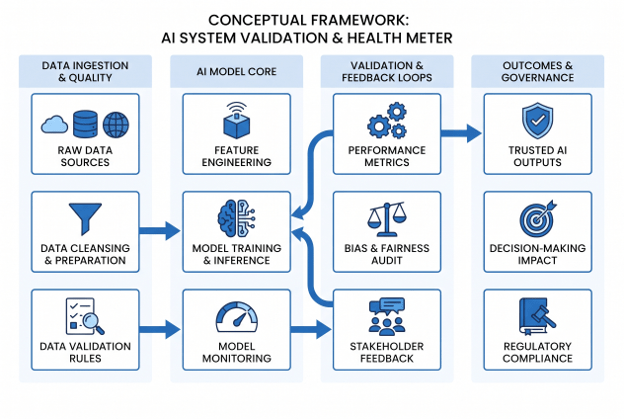
AI has meaningfully compressed the time cost of free market research, which was always the real barrier once money was removed from the equation. Free-tier AI tools can now summarize long industry reports, draft first-pass survey questions, and generate an initial competitor overview in minutes, tasks that used to take hours of manual reading and synthesis, done entirely within a free account.
The limitation hasn’t changed: AI models cannot access real-time data, query proprietary databases, or conduct primary research like customer interviews. The businesses getting the most value from AI-assisted free research use it exactly where it’s strong, synthesizing what already exists, while still doing the human work of talking to 5-10 real customers directly. At H-in-Q, our free tool suite is built around this same division: AI handles synthesis and structure, while the calculators and templates keep the human research rigorous enough to actually trust.
Tools & Resources for Free Market Research
- H-in-Q Sample Size Calculator: confirm your survey has enough responses to be reliable.
- H-in-Q Cross Tab Builder: start from a proven question structure instead of a blank page.
- H-in-Q Matrix Builder: structure competitor research instead of scattered notes.
- Government data (Census.gov, BLS.gov, SBA.gov): free demographic and economic context.
- Perplexity, ChatGPT, Claude (free tier): secondary research synthesis and drafting.
👉Sample Size Calculator Guide
👉 Free vs paid market research tools
FAQ
Can you do market research without spending money?
Yes, combining free government data, Google Trends, Google Forms, social listening, and free-tier AI tools covers most of what a paid research agency provides. The cost shifts from a budget line to your own time and discipline.
How many people should I interview for market research?
Aim for 5-10 one-on-one interviews of 20-30 minutes each. Avoid relying only on friends and family, since they're less likely to give honest critical feedback that reveals real problems.
What's the difference between primary and secondary market research?
Primary research is data you collect directly; interviews, surveys, focus groups. Secondary research uses data that already exists; government statistics, industry reports, competitor websites. Start with secondary research to build context before investing time in primary outreach.
Is Google Trends considered market research?
Yes, as a secondary research tool for demand validation. It shows search interest over time and by region, useful for spotting seasonality and confirming category demand, though it doesn't replace direct customer data.
How do I validate a business idea for free?
Combine secondary research (government data, competitor analysis, Google Trends) with 5-10 customer interviews and a properly sized survey (50-100 responses) to test your core assumptions before investing in development.
What free government data can I use for market research?
Census.gov, BLS.gov, Data.gov, and SBA.gov provide free demographic, economic, and industry data by region and sector; useful for market sizing, income context, and employment trends relevant to your target customer.
Conclusion
The tools to do rigorous market research have never cost less. What separates businesses that actually use them from those that don’t is sequence and discipline, not budget. Start broad with secondary sources like government data and Google Trends, narrow into direct customer interviews and a properly sized survey, and use free AI tools to accelerate synthesis without replacing real conversations. With 91% of companies reporting that market research data increased their sales, the eight free methods above are a genuinely credible substitute for a paid research budget, not a lesser version of it. Ready to start? H-in-Q’s free Sample Size Calculator and Crosstab builder get you from zero to a properly structured primary research study today.